Painter of the Bible
Giovanni di Paolo (Giovanni di Paolo di Grazia)
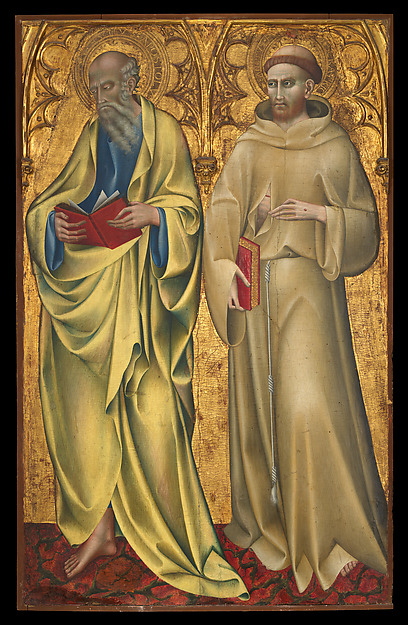
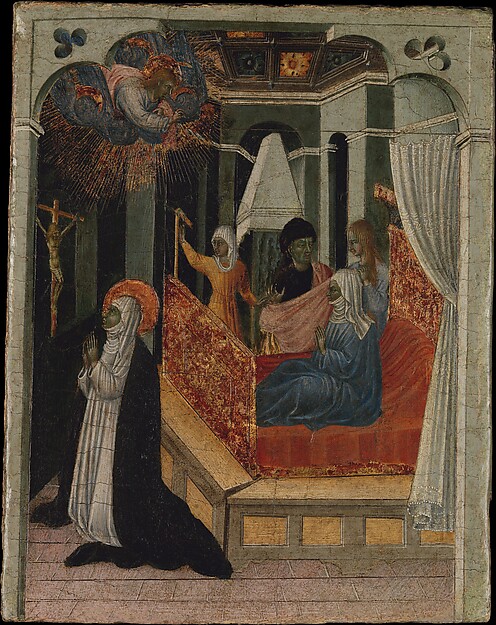
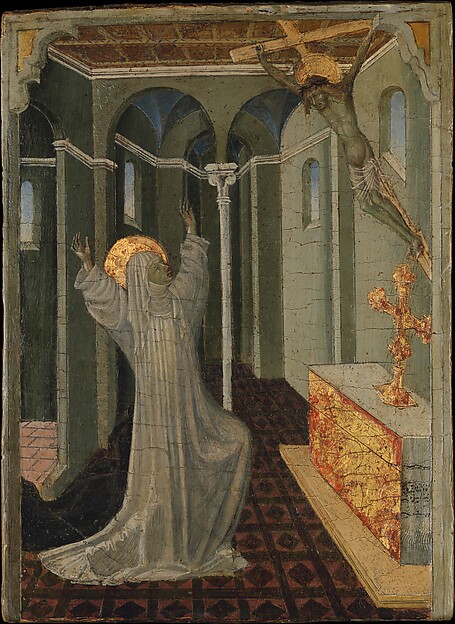
Giovanni di Paolo di Grazia was the leading Sienese painter of the fifteenth century and the most idiosyncratic interpreter of the Sienese tradition that Duccio had founded a hundred years earlier.

Their faith
Why Giovanni di Paolo (Giovanni di Paolo di Grazia) painted Christ
Giovanni di Paolo, born in Siena around 1398, was deeply rooted in the Christian faith that permeated his life and work. As the leading Sienese painter of the fifteenth century, he dedicated himself to creating sacred art that reflected his devotion to God. His career, spanning over sixty years, was marked by his commitment to the Sienese tradition established by Duccio, a legacy that Giovanni embraced and transformed through his unique artistic vision. He produced numerous altarpieces, devotional images, and illuminated manuscripts for churches and monastic houses, demonstrating a profound reverence for scripture and the spiritual life. His works, characterized by vibrant colors and elongated figures, reveal a painter who sought to express the divine through the beauty of his art, echoing the mysticism of his contemporary, Catherine of Siena.
Giovanni di Paolo's faith profoundly influenced his artistic output, as seen in masterpieces like "The Last Judgment" and "The Paradise." In these works, he captures the essence of heavenly joy and the gravity of divine judgment, inviting viewers to contemplate their spiritual journey. His visionary landscapes and emotional depth reflect a mystical approach to sacred themes, drawing the viewer into a deeper understanding of faith and the divine. Giovanni's art transcends time, continuing to inspire and uplift those who encounter it, as his devotion to Christ and the beauty of creation resonate through the ages. His legacy is a testament to the power of art as a means of worship and a pathway to experiencing the divine love of God.
Life & work
Giovanni di Paolo di Grazia was the leading Sienese painter of the fifteenth century and the most idiosyncratic interpreter of the Sienese tradition that Duccio had founded a hundred years earlier. Born in Siena around 1398, registered in the Sienese painters' guild from 1417, and active in the city for the rest of his sixty-year career, he painted altarpieces, predella panels, devotional images, and illuminated manuscripts on commission from Sienese churches, monastic houses, and private patrons. He died in Siena in 1482.
His Christian religious work is unmistakable: small-scale, jewel-colored, with elongated figures moving through landscapes that bend, twist, and flame with an almost visionary intensity. The Last Judgment (Pinacoteca Nazionale, Siena, c. 1465), the Paradise (Metropolitan Museum, c. 1445) — a panel of the blessed in heaven embracing in pastel-colored robes — the Creation and Expulsion (Metropolitan Museum, c. 1445), the great Pizzicaiolo Altarpiece (now dispersed), and the long sequence of small predella panels and personal devotional images he produced throughout his life are scattered across Siena, the Vatican, the Louvre, the National Gallery in London, the Metropolitan Museum, and the Walters Art Museum in Baltimore.
He illuminated, late in life, the manuscript of Dante's Paradiso for the great fifteenth-century Sienese codex now in the British Library — a sequence of small framed panels around the text whose visionary landscapes are among the most original surviving illuminations of any Italian Quattrocento manuscript.
His style ran against the prevailing Florentine current. Where Masaccio and his successors were rebuilding pictorial space around linear perspective, weighty bodies, and rational scale, Giovanni went the other way — exaggerating proportion, simplifying space, intensifying color, and cultivating an emotional register closer to the late-medieval Sienese mystics (Catherine of Siena, his older contemporary) than to the Florentine humanists. The nineteenth century rediscovered him through the Pre-Raphaelites, and he is now read as one of the most original visual imaginations of the entire Italian fifteenth century.
Notable works in detail
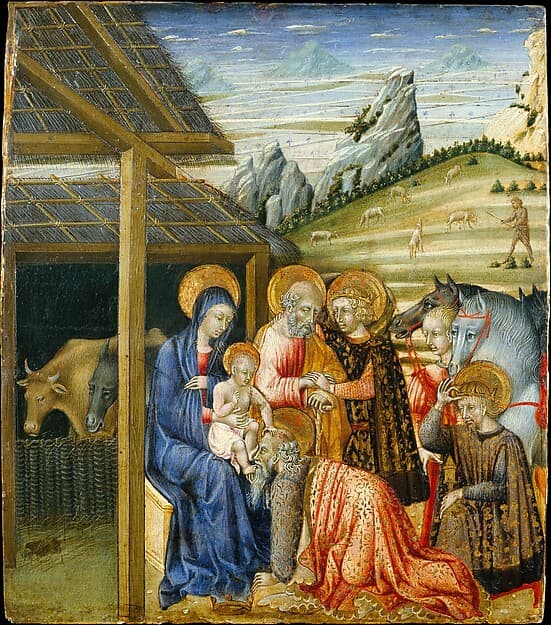
The Adoration of the Magi, painted by Giovanni di Paolo around 1455 in tempera and gold on panel and now in the Metropolitan Museum of Art in New York, depicts the visit of the three kings to the infant Christ as recorded in Matthew 2. Giovanni di Paolo stages the scene with the unmistakable Sienese narrative density of his mature manner: the seated Virgin and the Christ Child on the right, the eldest king kneeling in profile in the foreground offering his gift, the second and third kings waiting their turn behind, a procession of attendants and horses winding through a craggy elongated Tuscan landscape that bends and twists with the visionary intensity that defined his entire style. The chromatic palette of jewel-bright crimson, ultramarine, and tooled gold is the unmistakable Sienese Quattrocento signature; the painting is one of the principal Giovanni di Paolo Adorations in any American collection.
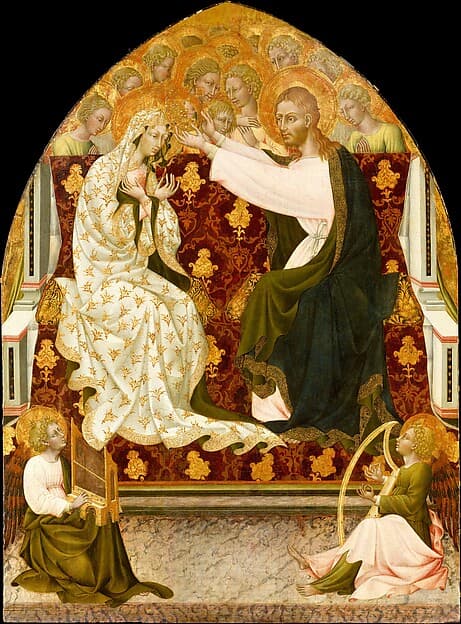
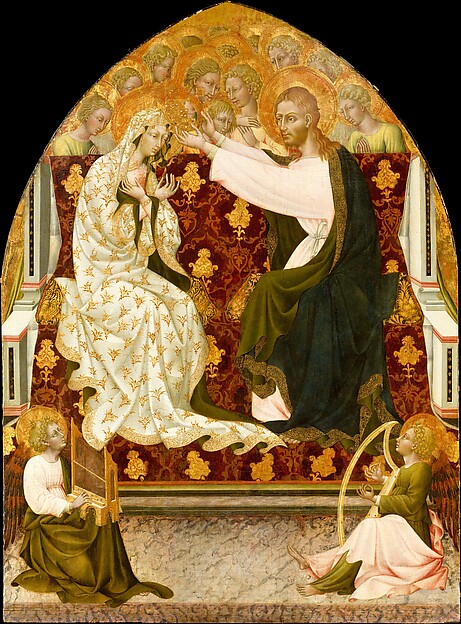
Coronation of the Virgin, painted by Giovanni di Paolo around 1452 in tempera and gold on panel and now in the Metropolitan Museum of Art in New York, depicts the moment from the apocryphal Marian narrative in which Christ crowns his mother Queen of Heaven in the celestial court. Giovanni di Paolo composes the scene with the unmistakable Sienese vertical compositional intensity: Christ and the Virgin seated together at the upper center in a small architectural niche, surrounded by a tightly packed multi-tiered host of singing angels and ranked male and female saints in jewel-bright robes against a tooled-gold background. The chromatic palette and the visionary intensity of the composition — figures stretching, bending, and floating with an almost weightless grace — are the unmistakable Giovanni di Paolo signature and a defining example of his idiosyncratic Sienese Quattrocento style.
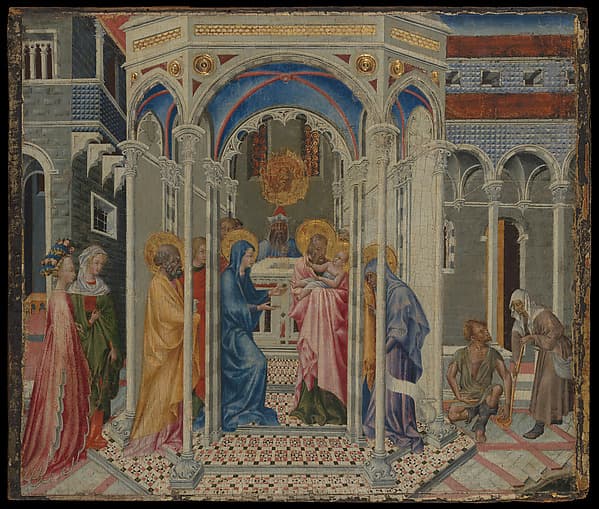
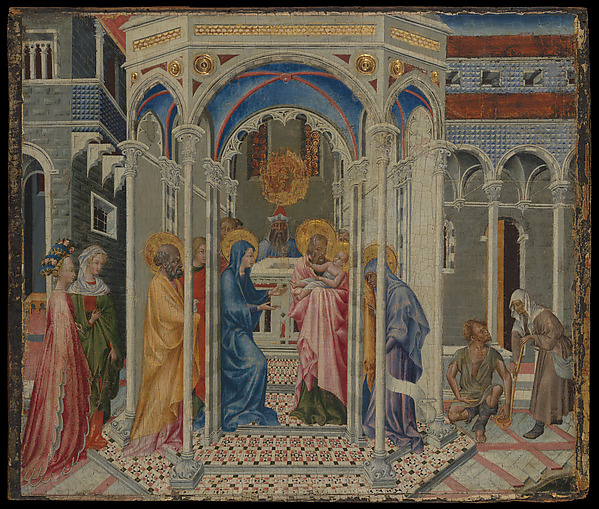
The Presentation of Christ in the Temple
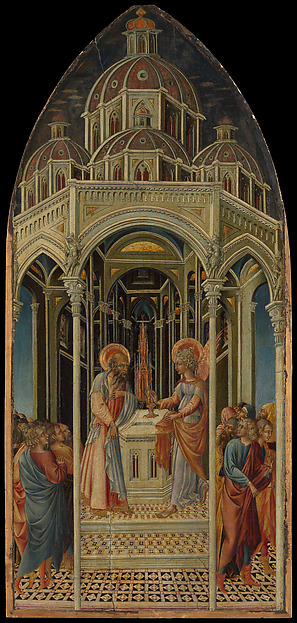
The Presentation of Christ in the Temple, painted by Giovanni di Paolo around 1430 in tempera and gold on panel and now in the Metropolitan Museum of Art in New York, depicts the moment from Luke 2 in which the infant Christ is brought to the Temple in Jerusalem on the fortieth day after his birth for the ritual of Mosaic purification. Giovanni di Paolo stages the scene in a small architectural setting with the Virgin handing the Christ Child to the aged Simeon, who stands at a small altar with the prophet Anna in the background; Joseph waits with the offering of the two doves at the lower right. The chromatic palette of warm pastel rose, mint-green, and tooled gold is characteristic of the early Giovanni di Paolo manner before the elongated visionary style of his mature work fully developed.
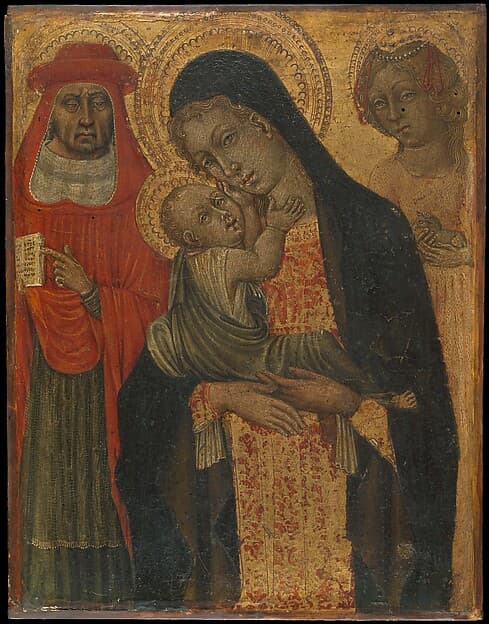
Madonna and Child with Saints Jerome and Agnes
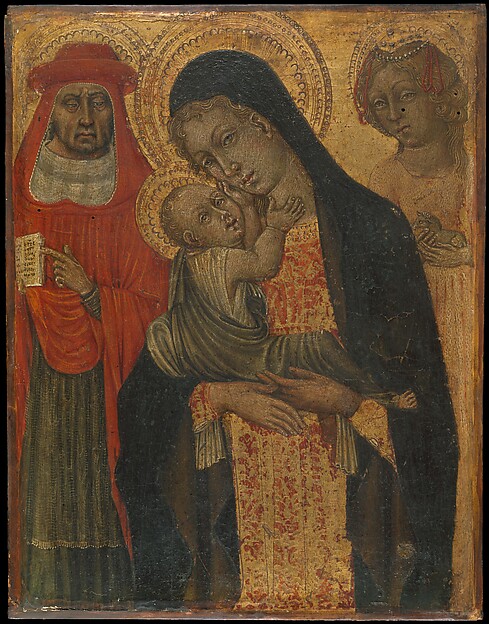
Madonna and Child with Saints Jerome and Agnes, painted by Giovanni di Paolo around 1462 in tempera and gold on panel and now in the Metropolitan Museum of Art in New York, is a small late sacra conversazione — the Italian Renaissance compositional type in which the Madonna sits enthroned with the Christ Child surrounded by attendant saints in a unified pictorial space. The Virgin sits in the center under a small architectural canopy with the Christ Child standing on her lap; Saint Jerome on the left holds a small model of his church, identifying him as one of the Latin Church Fathers who translated the Bible into Latin; Saint Agnes on the right holds a small lamb (the iconographic attribute that gives her name its Latin root). The chromatic palette and the visionary elongated proportions of the figures are the unmistakable late Giovanni di Paolo signature.
Bible scenes Giovanni di Paolo (Giovanni di Paolo di Grazia) painted
Romans
Luke
Matthew
Revelation