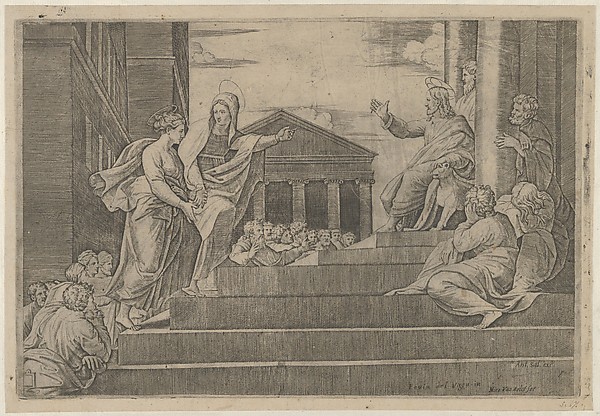
Painter of the Bible
Marcantonio Raimondi
Marcantonio Raimondi was the most important Italian engraver of the High Renaissance and the artist who, by translating Raphael's compositions into circulating prints, made the visual idiom of the Roman papal court the c…

Their faith
Why Marcantonio Raimondi painted Christ
Marcantonio Raimondi was a pivotal figure in the High Renaissance, known for his engravings that brought the beauty of sacred themes to a wider audience. While specific details about his personal faith are scarce, his close association with Raphael, a devout Christian artist, suggests a deep reverence for the spiritual themes they both explored. Raimondi's work primarily emerged during his time in Rome, where he engaged with the religious art of the papal court. His engravings were not merely artistic endeavors; they were acts of devotion, translating sacred narratives into a visual language that could inspire faith across Europe. This dedication to his craft and the spiritual content of his work reflects a profound commitment to the Christian message, as he sought to make the teachings of Christ accessible to all through art.
Raimondi's engravings, such as "The Massacre of the Innocents" and "Lo Spasimo (Christ Falling on the Way to Calvary)," reveal his ability to convey deep emotion and theological significance. These works, derived from Raphael's designs, illustrate key moments in the life of Christ, inviting viewers to reflect on the gravity of sacrifice and redemption. The emotional intensity and clarity of his engravings not only showcase his technical skill but also serve as a testament to his spiritual vision. Through these prints, Raimondi contributed to a legacy that continues to inspire viewers today, reminding us of the transformative power of art in expressing faith and the beauty of Christ's message.
Life & work
Marcantonio Raimondi was the most important Italian engraver of the High Renaissance and the artist who, by translating Raphael's compositions into circulating prints, made the visual idiom of the Roman papal court the common currency of European art for the next two centuries. Born around 1475 in Argini, near Bologna, trained in the workshop of the Bolognese goldsmith and engraver Francesco Francia, and active in Rome from about 1510 in close partnership with Raphael until that painter's death in 1520, he ran the workshop that engraved Raphael's drawings and unrealized compositions. He continued working in Rome through the Sack of 1527, after which he disappears from the documentary record; he probably died in Bologna around 1534.
His religious work falls almost entirely in his Roman period and consists of engravings made directly from Raphael's drawings, often from drawings the painter made specifically for engraving rather than from finished frescoes or panels. The Massacre of the Innocents (1511, after a Raphael drawing) is one of the most copied compositions of its century. The Lo Spasimo (Christ Falling on the Way to Calvary), the Judgment of Paris (whose central river-gods reappear, transformed, in Manet's Déjeuner sur l'herbe four hundred years later), the Adam and Eve, the Saint Cecilia after Raphael's Bologna altarpiece, and the entire engraved program of the Sistine Chapel ceiling and the Vatican Stanze — these prints carried Raphael's vocabulary and Michelangelo's anatomy across Europe in editions that any artist could afford.
A side-project — sixteen erotic engravings (the so-called I Modi) made in 1524 after drawings by Giulio Romano, Raphael's chief assistant — landed Marcantonio briefly in a Roman prison; his release was secured by Cardinal Giulio de' Medici, the future Pope Clement VII.
The Sack of Rome in 1527 wrecked his workshop, his collected drawings, and his commercial network. He returned to Bologna and disappears. By the time he stopped working, however, the conventions of European reproductive engraving — print after design, distribution by editions, copyright as we now know it (his disputes with Albrecht Dürer about copying Dürer's woodcuts are the foundational case in print copyright history) — were established. He shaped what came next more thoroughly than any contemporary painter except Raphael himself.
Notable works in detail
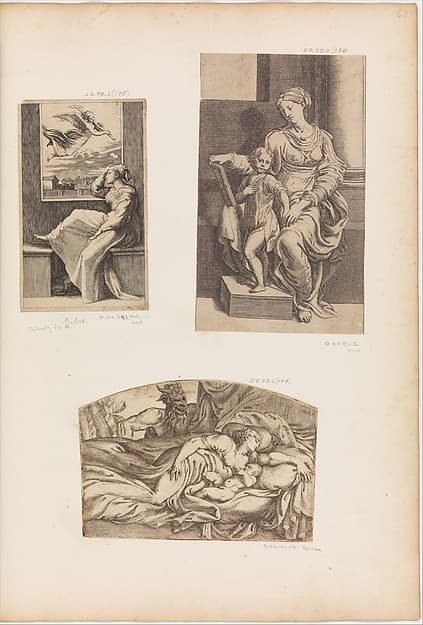
The Virgin and the Young Christ
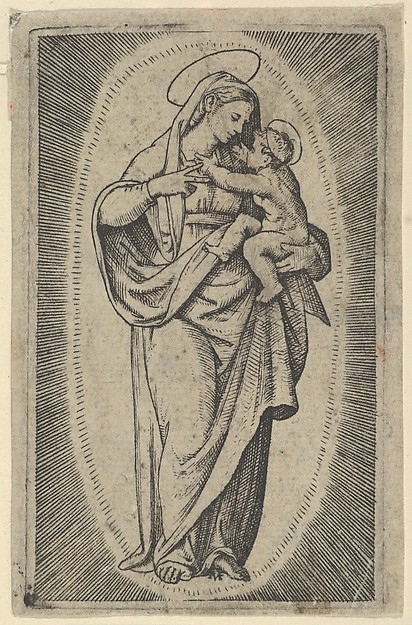
The Virgin and the Young Christ, engraved by Marcantonio Raimondi around 1475 (early in his career, before his move to Rome and the great partnership with Raphael) in his Bolognese workshop, depicts the standard small-format Madonna and Child compositional type that Raimondi's Bolognese teacher Francesco Francia had refined to a high pitch of devotional sweetness. The Virgin sits in three-quarter view holding the Christ Child upright on her lap; the chromatic-tonal range is achieved entirely through the tightly cross-hatched engraved line characteristic of late-Quattrocento Italian engraving. The print is among the early Raimondi treatments of a Marian subject and demonstrates the Bolognese workshop discipline he carried forward into the Roman years that would eventually make him the principal engraver of Raphael's compositions.
met-342711
The Expulsion from Paradise, from the Piccoli Santi (Small Saints) series engraved by Marcantonio Raimondi around 1495 in his early Bolognese workshop years, illustrates the climactic moment of Genesis 3 in which the angel with the flaming sword drives Adam and Eve from the Garden of Eden after the Fall. Raimondi composes the scene as a small vertical print with Adam and Eve in profile fleeing toward the lower right, the angel with the sword extended above them in the upper register, the gates of Eden visible behind. The print is among the early Raimondi treatments of a Genesis subject and demonstrates the small-format devotional engraving manner of the late Quattrocento Bolognese workshop tradition before his transformative encounter with Raphael in Rome around 1510.
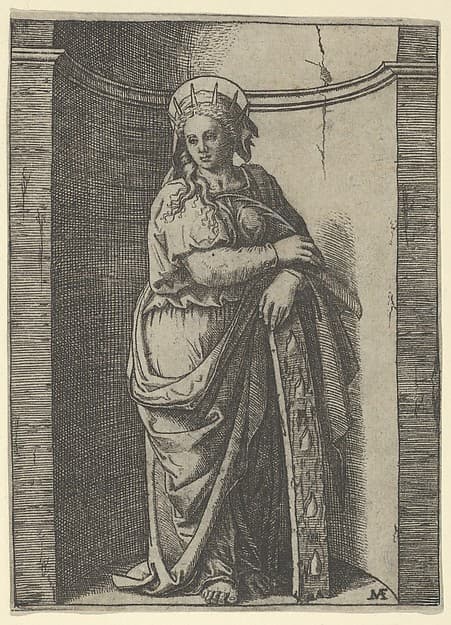
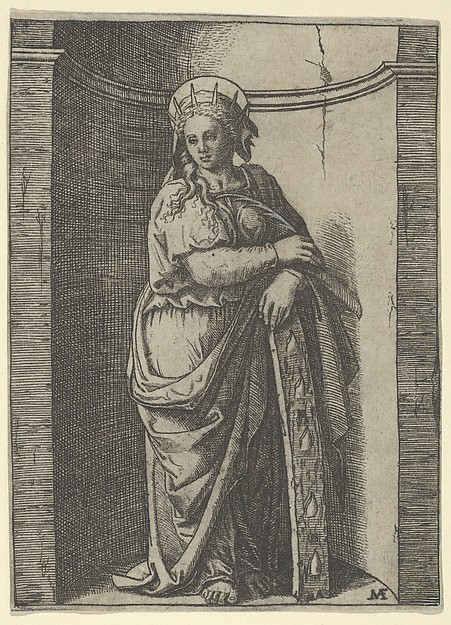
Saint Catherine standing in a niche, resting on a wheel, her instrument of torture
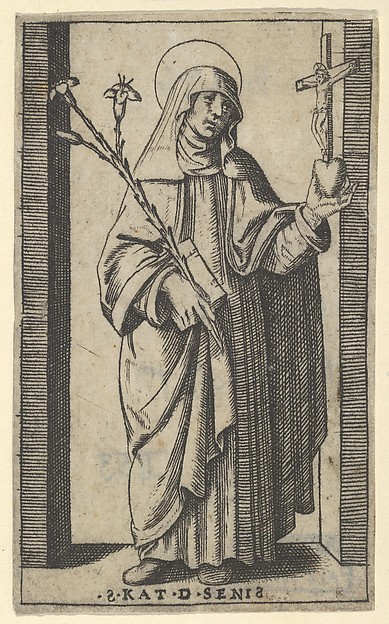
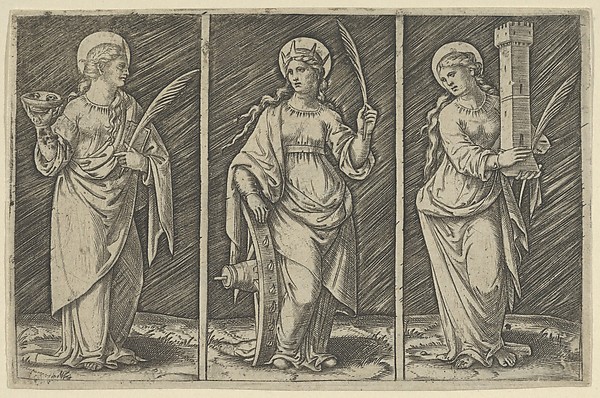
Saint Catherine Standing in a Niche, Resting on a Wheel, from the Piccoli Santi (Small Saints) series engraved by Marcantonio Raimondi around 1495 in his early Bolognese workshop years, depicts the legendary fourth-century Christian martyr in her conventional iconographic posture — standing in a small architectural niche with her hand resting on the wheel of her martyrdom (the wheel from which she escaped through divine intervention before her eventual beheading). The Piccoli Santi series was a small set of devotional engravings of individual saints standing in architectural niches; the format derived from the late-medieval Northern engraving tradition and was a standard Italian Quattrocento engraving genre. The print is among the early Raimondi treatments of a saint subject and an example of his Bolognese workshop discipline before Rome and Raphael.
Bible scenes Marcantonio Raimondi painted
Luke
Matthew
Romans
Revelation
Acts
John