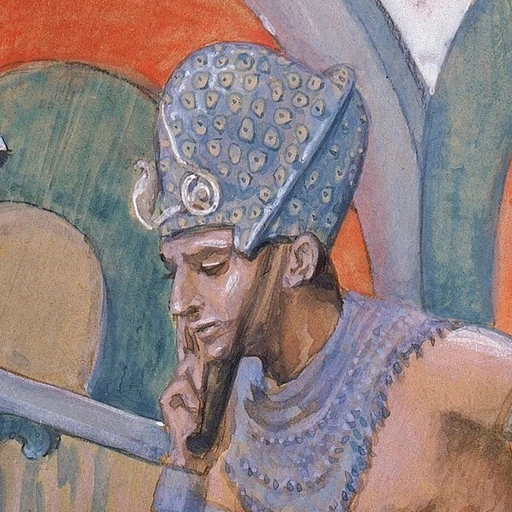
Who was Pharaoh (the Exodus) in the Bible?
Pharaoh was the king of Egypt who enslaved the Israelites and refused to let them go, hardening himself against God.
King of Egypt Who Opposed Israel
c. 1500-1300 BC
Pharaoh was the king of Egypt who enslaved the Israelites and refused to let them go, hardening himself against God.
Follow the reading trailBEYOND THE NAME
Pharaoh was the ruler of Egypt who, fearing the growing number of Israelites, forced them into bitter slavery and ordered their baby boys killed. When Moses and Aaron came demanding that he release the people to worship God, he refused again and again, and a series of plagues fell on Egypt. His repeated hardening led at last to the death of Egypt’s firstborn and the drowning of his army in the sea as Israel went free.
Themes in the authored commentary
These are other entries using this name. Compare their source passages before treating them as the same or different historical people.
FOLLOW THE PASSAGES
These are chapter studies associated with this record. Their order follows the books and chapters, rather than a reconstructed timeline of the person’s life.
orders the Hebrew midwives to kill newborn sons and later commands all Egypt to drown Israelite boys
Genesis ended with Joseph settling his father and brothers in Egypt as honoured guests, the family of Jacob safe and flourishing in the land of Goshen. Exodus opens by naming the sons who came down - Now these are the names of the children of Israel, which came into Egypt (v. 1) - and then turns the page on a whole era: And Joseph died, and all his brethren, and all that generation (v. 6). What does not die is the promise God made to Abraham.
Chapter overview from the authored study guide.the resistant king before whom Moses and Aaron are commanded to speak again
Exodus 6 begins with God answering Moses’ complaint. The first visit to Pharaoh brought heavier work for Israel. God tells Moses what He will do to Pharaoh and reminds him who made the covenant with Israel’s ancestors.
Chapter overview from the authored study guide.confesses sin when the hail falls but hardens his heart again after it stops
The next three plagues reach Egypt’s livestock, its people, and its fields. The magicians can no longer stand before Moses when they are covered in boils. Then hail and fire break trees and kill people and animals left in the open.
Chapter overview from the authored study guide.receives the final warning about the death of the firstborn but will not relent
The plagues have come and gone, and Pharaoh still holds the people in Egypt. The Lord tells Moses what will happen next. Yet will I bring one plague more upon Pharaoh, and upon Egypt; afterwards he will let you go hence (v. 1). The warning comes just before Israel receives the Passover instructions.
Chapter overview from the authored study guide.pursues Israel into the parted sea with his army and is drowned when the waters return
Israel has left Egypt with its wealth and with the LORD leading them in cloud and fire. Pharaoh has changed his mind and sent his chariots after them. The Israelites can see the army coming, and the sea is in front of them.
Chapter overview from the authored study guide.the Egyptian king whom God raised up to display his power, hardened as a vessel of wrath
Romans 9 opens with Paul’s tears. After eight chapters of theological triumph - justification by faith, freedom in Christ, life through the Spirit - Paul suddenly turns and says he would gladly be accursed if it meant Israel’s salvation. The great promises God made to Abraham, Isaac, and Jacob seem to have been rejected. How can Paul hold both truths: God’s righteousness and Israel’s rejection? God’s faithfulness and His apparent abandonment of His people?
Chapter overview from the authored study guide.THE PEOPLE AROUND THE PERSON
Relationships follow the source graph. Some are interpretive or uncertain, and individual verse citations are not yet available for every connection.
STUDY & INTERPRETATION
The Pharaoh of Exodus embodies human power set against the purposes of God, a king who claims mastery over a people God has claimed as His own. The long contest of the plagues is a clash between Pharaoh’s will and the LORD’s, and Pharaoh’s hardening, both his own stubbornness and God’s judgment upon it, drives the story toward the great deliverance at the sea. His downfall reveals that no earthly throne can finally stand against God’s redeeming hand. The Exodus he resisted becomes the central pattern of rescue in all of Scripture, the night of the lamb’s blood and the passage through the waters echoing forward to the salvation God would accomplish for the world.
From the Learn of Christ person commentary. Read alongside the linked Scripture passages.KEEP SCRIPTURE CLOSE
11 authored chapter guides feature this person. This is guide coverage, not an exhaustive count of biblical mentions.
ASK A BETTER QUESTION
Identity, story, early-life sources, family, and where to read.
Pharaoh was the king of Egypt who enslaved the Israelites and refused to let them go, hardening himself against God.
Pharaoh was the ruler of Egypt who, fearing the growing number of Israelites, forced them into bitter slavery and ordered their baby boys killed. When Moses and Aaron came demanding that he release the people to worship God, he refused again and again, and a series of plagues fell on Egypt. His repeated hardening led at last to the death of Egypt’s firstborn and the drowning of his army in the sea as Israel went free.
Our authored studies connect Pharaoh (the Exodus) with Exodus, Romans. The linked chapters provide reading context, not proof that an unnamed or inferred identity is explicitly named there. A verified, identity-specific verse index is not yet available for this record, so these chapter tags should not be treated as an exhaustive list of mentions.
A separate childhood account for Pharaoh (the Exodus) is not provided in our current authored profile sources. Begin with Exodus 1 and the passages linked here for the evidence that is available. The first indexed reference to a name is not a birth record. This profile does not establish a birth date, schooling, or childhood events beyond what its sources state.
The current source graph does not list immediate family for Pharaoh (the Exodus). That is a limit of this data, not evidence that Pharaoh (the Exodus) had no relatives. Read the cited passages for the details they actually give.
The Pharaoh of Exodus embodies human power set against the purposes of God, a king who claims mastery over a people God has claimed as His own. The long contest of the plagues is a clash between Pharaoh’s will and the LORD’s, and Pharaoh’s hardening, both his own stubbornness and God’s judgment upon it, drives the story toward the great deliverance at the sea.
Answers draw on our existing authored biography and linked chapter studies. Where supplied, verse assignments come from the individualized STEP Bible index. Childhood answers distinguish documented events from gaps in the available sources.
YOUR OWN OBSERVATIONS
Notes, saved people, and study marks stay in this browser. They do not sync to your account.
KEEP EXPLORING
People featured in the same study guides. Sharing a chapter does not establish a family relationship.