Who was Moses in the Bible?
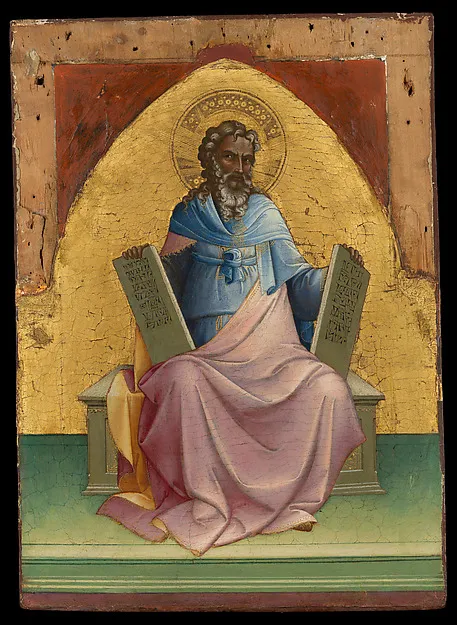
Led Israel out of slavery in Egypt and received the law on Sinai.
Lawgiver and deliverer
c. 1400 BC
Led Israel out of slavery in Egypt and received the law on Sinai.
Follow the reading trailBEYOND THE NAME
Hebrew baby raised as Egyptian royalty, exiled for forty years to Midian, then sent back by the burning-bush God to confront Pharaoh and lead Israel out. Met with God face to face on Sinai and received the law for the nation.
Themes in the authored commentary
FOLLOW THE PASSAGES
Selected passages and introductions help you read this person’s story in context.
infant placed in a basket on the Nile, then grows up to kill an Egyptian and flee to Midian
Moses’s early life moves from danger beside the Nile to Pharaoh’s household and then to refuge in Midian. His sister, his mother, Pharaoh’s daughter, and his future wife all take part in the events that shape his story.
receives the divine call at the burning bush and is commissioned to lead Israel out of Egypt
At the burning bush, God calls Moses to return to Egypt and lead the Israelites out. Moses asks questions about his own adequacy and about God’s name. The chapter establishes the mission that will bring him before Pharaoh.
leads Israel to the sea, reassures the frightened people, stretches his hand to part the waters, and closes them over Pharaoh's army
The Israelites face the sea while Pharaoh’s forces pursue them. Moses speaks to the people, and the passage describes the opening of a way through the water. This deliverance becomes a defining event in Israel’s memory.
ascends Mount Nebo, surveys the promised land, and dies there; mourned thirty days by Israel
Moses sees the land before his death, and the narrative looks back on his distinctive relationship with God. Joshua succeeds him as leader. The chapter marks the transition from the wilderness journey to Israel’s entrance into the land.
THE PEOPLE AROUND THE PERSON
Recorded parents
Recorded spouses
Recorded children
Relationships follow the source graph. Some are interpretive or uncertain, and individual verse citations are not yet available for every connection.
STUDY & INTERPRETATION
The mediator of the old covenant and the prophet to whom every later prophet is compared. Hebrews casts Christ as the new and greater Moses, leading not Israel out of Egypt but the people of God out of sin into eternal rest. His face shone after meeting God; ours are unveiled in Christ.
From the Learn of Christ person commentary. Read alongside the linked Scripture passages.KEEP SCRIPTURE CLOSE
174 authored chapter guides feature this person. This is guide coverage, not an exhaustive count of biblical mentions.
ASK A BETTER QUESTION
Identity, story, early-life sources, family, and where to read.
Led Israel out of slavery in Egypt and received the law on Sinai.
Hebrew baby raised as Egyptian royalty, exiled for forty years to Midian, then sent back by the burning-bush God to confront Pharaoh and lead Israel out. Met with God face to face on Sinai and received the law for the nation.
The individualized passage index associates this Moses record with Exodus, Leviticus, Numbers, Deuteronomy, Joshua, Judges, 1 Samuel, 1 Kings, 2 Kings, 1 Chronicles, 2 Chronicles, Ezra, Nehemiah, Psalms, Isaiah, Jeremiah, Daniel, Micah, Malachi, Matthew, Mark, Luke, John, Acts, Romans, 1 Corinthians, 2 Corinthians, 2 Timothy, Hebrews, Jude, Revelation. There are 785 distinct indexed verse references in the 66-book Bible. Browse the book-by-book list below; it separates this identity from other people who share the name. Source assignments and textual identifications can require interpretation.
Exodus 2 describes Moses’s birth, his mother’s effort to protect him, the basket among the reeds, and his adoption by Pharaoh’s daughter. His sister helps arrange for his mother to nurse him. The chapter then moves forward to Moses as a grown man.
Moses’s source record lists Amram (father), Jochebed (mother), Zipporah (spouse), Gershom (child), Eliezer (child). These are source-graph relationships; legal family, uncertain identifications, and ancestral language require the cautions below. Individual verse evidence is not yet retained for every family edge.
The mediator of the old covenant and the prophet to whom every later prophet is compared. Hebrews casts Christ as the new and greater Moses, leading not Israel out of Egypt but the people of God out of sin into eternal rest.
Answers draw on our existing authored biography and linked chapter studies. Where supplied, verse assignments come from the individualized STEP Bible index. Childhood answers distinguish documented events from gaps in the available sources.
FIND THE PERSON IN THE TEXT
785 distinct verse references in the source’s 66-book index. These are indexed name assignments, rather than every indirect allusion to this person. A name may also refer to descendants, a tribe, or a nation; read each passage to distinguish that usage from the individual.
“And the child grew, and she brought him unto Pharaoh’s daughter, and he became her son. And she called his name Moses: and she said, Because I drew him out of the water.”
Exodus 2:10 · King James Version
“And the LORD called unto Moses, and spake unto him out of the tabernacle of the congregation, saying,”
Leviticus 1:1 · King James Version
“And Moses sent them to the war, a thousand of every tribe, them and Phinehas the son of Eleazar the priest, to the war, with the holy instruments, and the trumpets to blow in his hand.”
Numbers 31:6 · King James Version
“And they sing the song of Moses the servant of God, and the song of the Lamb, saying, Great and marvellous are thy works, Lord God Almighty; just and true are thy ways, thou King of saints.”
Revelation 15:3 · King James Version
References are adapted from STEP Bible / Tyndale House TIPNR (CC BY 4.0). Deduplicated, matched to this identity, and checked against the bundled KJV’s verse bounds. Interpretive assignments and translation/versification differences may remain. This index is separate from evidence for individual family relationships.
YOUR OWN OBSERVATIONS
Notes, saved people, and study marks stay in this browser. They do not sync to your account.
KEEP EXPLORING
People featured in the same study guides. Sharing a chapter does not establish a family relationship.