Wisdom of Solomon 10
People in this chapter
The chapters before this one praised Wisdom in soaring terms. Now the book does something quieter and far more daring. It tells the whole story of God's people over again, from the first man to the Exodus, and at every turn it puts the same word in the subject's place: she. She preserved the first man. She brought Noah safely through the flood. She delivered, she went down into the pit, she stood against dreadful kings.
The history of Israel is retold as the history of one rescuing presence, and the reader is invited to recognise her at work where it might once have seemed there was only chance or struggle.
Tap any highlighted phrase to jump to the commentary that unpacks it.
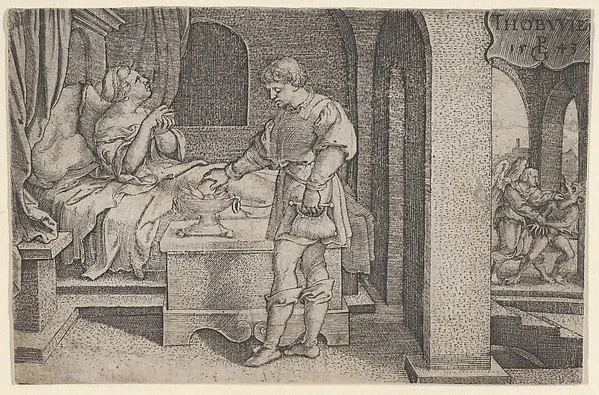
Wisdom of Solomon 10:1-3She Preserved the First Man, and the Unjust Walked Away
1She preserved him, that was first formed by God the father of the world, when he was created alone, 2And she brought him out of his sin, and gave him power to govern all things.
The history opens at the very beginning, with the first man God formed, here called "the father of the world." Wisdom "preserved" him, watched over him, kept him. The chapter does not pause to relitigate the whole story of the garden; it presses on to the rescue. Even the first man, even "created alone," was not left to himself. From the dawn of the human story, Wisdom is the one who guards what God has made and refuses to abandon it to ruin.
The line is gentle and full of hope: Wisdom "brought him out of his sin, and gave him power to govern all things." The fall is named honestly - there was a sin - and yet the accent falls on recovery. The first man did not stay where he fell. Wisdom drew him out and restored to him the calling given at creation, to rule and tend the world God made. Here at the very start of the chapter is its theme in miniature: wherever a person has gone down, Wisdom goes after them, lifts them, and sets them back toward the life they were made for.
3But when the unjust went away from her in his anger, he perished by the fury wherewith he murdered his brother.
Against the preserved first man stands the first to refuse her. Cain is not named, but the deed is unmistakable: he "went away from her in his anger" and "perished" in the fury that drove him to kill his brother. The chapter draws a sharp line. The one who welcomes Wisdom is preserved; the one who walks away from her in rage destroys himself. The anger that Cain would not surrender became the thing that consumed him. To leave Wisdom is not a neutral choice. It is to step out from under the only protection there is.
Wisdom of Solomon 10:4-9Saved Through the Flood, Delivered from the Fire
4For whose cause, when water destroyed the earth, wisdom healed it again, directing the course of the just by contemptible wood.
When the flood came and "water destroyed the earth," Wisdom "healed it again" by steering the just man - Noah - safely through on "contemptible wood." The phrase is striking. The ark was nothing impressive, just timber, a thing easily despised. Yet God chose that humble wood to carry the hope of the world across the waters of judgment. Wisdom often works this way, taking what looks weak and unremarkable and making it the means of salvation. The world's great deliverances have rarely arrived in forms the world finds impressive.
5Moreover when the nations had conspired together to consent to wickedness, she knew the just, and preserved him without blame to God, and kept him strong against the compassion for his son.
Now the scene shifts to Abraham. Amid nations "conspired together to consent to wickedness," Wisdom "knew the just," singled him out, and kept him blameless before God. The closing phrase touches the hardest moment of his life: she "kept him strong against the compassion for his son," steadying him in the trial when he was asked to give up Isaac. Wisdom does not only rescue from outward danger. She gives inward strength for the moments when obedience costs the most, when love itself is tested and the heart needs holding firm.
6She delivered the just man who fled from the wicked that were perishing, when the fire came down upon Pentapolis: 7Whose land for a testimony of their wickedness is desolate, and smoketh to this day, and the trees bear fruits that ripen not, and a standing pillar of salt is a monument of an incredulous soul.
When fire fell on the cities of the plain - the "Pentapolis," the five cities - Wisdom "delivered the just man who fled," rescuing Lot from a world about to perish. The contrast is total. The wicked are consumed; the one who flees toward safety at God's word is brought out alive. Through every age the same mercy holds true: when judgment comes, God knows how to deliver the one who turns to Him, even out of the middle of a city in flames.
The chapter pauses over the ruined land that "smoketh to this day," its trees bearing fruit that never ripens, and the "standing pillar of salt" left as "a monument of an incredulous soul." Lot's wife, who looked back, becomes a lasting warning. Disbelief that clings to what is being destroyed turns a person to stone in the very act of escaping. The desolate, smoking ground is itself a sermon: the wreckage of wickedness remains visible long after, a testimony that what God judges, He judges in earnest.
The string of rescues is gathered into a single summary line: "wisdom hath delivered from sorrow them that attend upon her." To "attend upon" Wisdom is to wait on her, to keep close, to serve her. Those who do are delivered, again and again, from the sorrows that swallow others. The verse does not promise a life without trouble; Noah still faced the flood and Abraham still faced the knife. It promises that those who hold to Wisdom are carried through the trouble rather than lost in it.
Wisdom of Solomon 10:10-14She Went Down With Him Into the Pit
10She conducted the just, when he fled from his brother’s wrath, through the right ways, and shewed him the kingdom of God, and gave him the knowledge of the holy things, made him honourable in his labours, and accomplished his labours.
Here is Jacob, fleeing his brother's wrath and far from home. Wisdom "conducted" him "through the right ways" and "shewed him the kingdom of God." This points back to the night Jacob lay alone with a stone for a pillow and saw the ladder set up between earth and heaven, with the angels of God ascending and descending. In his loneliest moment, in flight and fear, the runaway was given a vision of heaven opened. Wisdom led him not around the wilderness but through it, and in the middle of it she let him see the kingdom of God.
11In the deceit of them that overreached him, she stood by him, and made him honourable. 12She kept him safe from his enemies, and she defended him from seducers, and gave him a strong conflict, that he might overcome, and know that wisdom is mightier than all.
Through years of being cheated and outmanoeuvred, Wisdom "stood by him" and turned his losses into honour. She even "gave him a strong conflict, that he might overcome" - an echo of the night Jacob wrestled until daybreak and would not let go until he was blessed. The purpose of the struggle is named plainly: "that he might know that wisdom is mightier than all." Wisdom does not always remove the wrestling. Sometimes she grants it, because the one who has wrestled and prevailed comes away knowing, in a way nothing else could teach, that her strength is greater than every power arrayed against him.
13She forsook not the just when he was sold, but delivered him from sinners: she went down with him into the pit. 14And in bands she left him not, till she brought him the sceptre of the kingdom, and power against those that oppressed him: and shewed them to be liars that had accused him, and gave him everlasting glory.
Now the chapter reaches its most tender line. Joseph was sold by his own brothers, and Wisdom "forsook not the just when he was sold." She "went down with him into the pit." She did not wait at the rim and pull him out from a safe distance; she descended with him into the cistern, into slavery, into the prison cell. This is the heart of how God saves. He does not rescue from far off.
He goes down into the place of the captive and stays with him in the bands, in the dark, until the time of lifting comes.
Wisdom stayed in the chains with Joseph "till she brought him the sceptre of the kingdom." The one accused was vindicated; his accusers were shown to be liars; the slave was lifted to rule over Egypt and given "everlasting glory." The descent into the pit was not the end of the story but the road to the throne. The pattern is unmistakable and it will be repeated in the greatest story of all: the way down, through betrayal and chains and the lowest place, becomes the way up to glory and dominion.
Wisdom does not abandon her own in the depths; she carries them through the depths to a crown.
Wisdom of Solomon 10:15-21Through the Red Sea, and the Mouth of the Dumb Was Opened
15She delivered the just people, and blameless seed from the nations that oppressed them. 16She entered into the soul of the servant of God, and stood against dreadful kings in wonders and signs.
The chapter widens from individuals to a whole nation. Now it is "the just people" whom Wisdom delivers, the "blameless seed" rescued from the nation that oppressed them. The story of the Exodus begins. What Wisdom did for the first man, for Noah, for the patriarchs one by one, she now does for an entire people in bondage. The God who saves individuals is the same God who saves a multitude; the rescue that began in a garden reaches a nation crying out under slavery, and Wisdom answers.
Here at last is Moses, named only as "the servant of God." Wisdom "entered into" his soul and through him "stood against dreadful kings in wonders and signs." The deliverer of Israel was first himself indwelt by Wisdom; the signs before Pharaoh flowed from a man in whom she had made her home. This is how God works His great deliverances. He fills a willing servant and stands against the powers of the age through him. The plagues and wonders were the overflow of Wisdom dwelling in a faithful heart.
17And she rendered to the just the wages of their labours, and conducted them in a wonderful way: and she was to them for a covert by day, and for the light of stars by night: 18And she brought them through the Red Sea, and carried them over through a great water. 19But their enemies she drowned in the sea, and from the depth of hell she brought them out. Therefore the just took the spoils of the wicked.
As Israel went out, Wisdom "was to them for a covert by day, and for the light of stars by night" - shade over them in the burning day, light before them in the dark. This is the pillar of cloud and fire, the visible sign that God Himself was traveling with His people, shielding and leading at once. The same presence that guided individuals through their private trials now spreads itself like a canopy over a whole nation on the march.
Wisdom is shelter and guidance together: cover when the way is too bright and harsh, light when it is too dark to see.
At the sea the deliverance is complete. Wisdom "brought them through" the waters and "carried them over," while the enemy who pursued them was drowned. The reader is meant to hear the great refrain of the Exodus, that the Lord saved Israel and the people "saw the Egyptians dead upon the sea shore." The phrase "from the depth of hell she brought them out" pictures a people drawn up out of the very jaws of destruction, as good as in the grave and yet led out alive.
Salvation here is rescue at the last possible moment, a hand reaching down into the deep to lift up those who had no way of their own.
20And they sung to thy holy name, O Lord, and they praised with one accord thy victorious hand. 21For wisdom opened the mouth of the dumb, and made the tongues of infants eloquent.
The chapter ends in song. The rescued people "sung to thy holy name" and "praised with one accord" the victorious hand of God - the song of Moses and Miriam at the sea. And the final line gives the reason their praise could rise at all: "wisdom opened the mouth of the dumb, and made the tongues of infants eloquent." Those who could not speak were given words; the helpless were given a voice. This is Wisdom's last gift in the chapter and a fitting close to a hymn of deliverance.
The God who brings His people out of the deep also gives them the tongue to praise Him, turning the once-silent into singers.
Where this echoes in Scripture
She Preserved the First Man, and the Unjust Walked Away
- Genesis 3:15And I will put enmity between thee and the woman, and between thy seed and her seed; it shall bruise thy head, and thou shalt bruise his heel.The first sin is met at once with a promise of rescue, just as this chapter moves from the fall to the recovery.
- Genesis 4:6-7And the LORD said unto Cain, Why art thou wroth?... sin lieth at the door. And unto thee shall be his desire, and thou shalt rule over him.Cain was warned to master his anger; he "went away" from that counsel and perished by it.
- 1 John 3:12Not as Cain, who was of that wicked one, and slew his brother. And wherefore slew he him? Because his own works were evil.The New Testament reads Cain the same way: a man undone by what he would not surrender.
Saved Through the Flood, Delivered from the Fire
- Genesis 7:23And every living substance was destroyed... and Noah only remained alive, and they that were with him in the ark.Noah carried through the flood on the ark - the "contemptible wood" that healed the world.
- Genesis 19:26But his wife looked back from behind him, and she became a pillar of salt.The monument of the "incredulous soul" that this chapter holds up as a warning.
- Luke 17:32-33Remember Lot's wife. Whosoever shall seek to save his life shall lose it.Jesus makes the same point: the backward look toward what is perishing is itself the danger.
She Went Down With Him Into the Pit
- Genesis 28:12And he dreamed, and behold a ladder set up on the earth, and the top of it reached to heaven: and behold the angels of God ascending and descending on it.The fleeing Jacob is "shewed the kingdom of God" - heaven opened over the runaway.
- Genesis 39:21But the LORD was with Joseph, and shewed him mercy... even in the prison.Wisdom "went down with him into the pit" - God's presence in the cell, not only on the throne.
- Philippians 2:8-9He humbled himself, and became obedient unto death... wherefore God also hath highly exalted him.The way down to the lowest place becomes the way up to the highest name.
Through the Red Sea, and the Mouth of the Dumb Was Opened
- Exodus 13:21And the LORD went before them by day in a pillar of a cloud... and by night in a pillar of fire, to give them light.The "covert by day" and "light of stars by night" - God's presence shielding and leading His people.
- Exodus 15:1-2I will sing unto the LORD, for he hath triumphed gloriously... The LORD is my strength and song, and he is become my salvation.The song at the sea, where the rescued people "praised with one accord" the victorious hand of God.
- Matthew 21:16Out of the mouth of babes and sucklings thou hast perfected praise.Jesus echoes the chapter's close: God puts eloquent praise in the mouths of the small and silent.