Psalms 103
People in this chapter
Psalm 103 is headed simply A Psalm of David, and it begins in an unusual place: not with God, but with the psalmist's own soul. Bless the LORD, O my soul: and all that is within me, bless his holy name (v. 1). He is not praying yet; he is preaching to himself, summoning his own heart to do what hearts so often will not do on their own - turn toward God and bless Him.
And the engine of the whole psalm is named in the very next line: forget not all his benefits (v. 2). Worship here is not worked up out of nothing; it is remembered. David rouses his praise by calling to mind, one by one, the things God has actually done.1
Tap any highlighted phrase to jump to the commentary that unpacks it.
Psalm 103:1-5 · A Psalm of DavidBless the LORD, O My Soul
1Bless the LORD, O my soul: and all that is within me, bless his holy name. 2Bless the LORD, O my soul, and forget not all his benefits: 3Who forgiveth all thine iniquities; who healeth all thy diseases; 4Who redeemeth thy life from destruction; who crowneth thee with lovingkindness and tender mercies; 5Who satisfieth thy mouth with good things; so that thy youth is renewed like the eagle’s.
The psalm opens with a command, but not one addressed to God - David is speaking to himself: Bless the LORD, O my soul: and all that is within me, bless his holy name (v. 1). It is a striking way to begin. He does not wait until he feels like worshipping; he summons the worship, calling his own soul to attention and ordering it to bless. And he asks for everything: not a corner of the heart, not a polite gesture, but all that is within me. The whole inner self - mind, memory, affection, will - is to be gathered up and turned toward God's holy name.
There is deep wisdom in this. The soul is not always ready to praise of its own accord; left to itself it drifts toward worry, grievance, or dullness. So David takes himself in hand. He does not pretend to a feeling he does not have; he commands the act, trusting that as the soul does what it is told - remembering, naming, blessing - the feeling will follow. This is worship as a deliberate turning, the will leading the heart rather than waiting on it.
The engine of the whole psalm is in the second line: Bless the LORD, O my soul, and forget not all his benefits (v. 2). David's praise is not worked up out of thin air; it is remembered. He stirs his soul to bless by refusing to forget - and forgetting is exactly the soul's temptation. We are quick to register what is wrong and slow to recall what has been given; yesterday's rescue fades while today's trouble fills the whole sky.
Against that drift David sets a discipline of memory, and then he does the remembering out loud, one benefit at a time: God forgiveth all thine iniquities, healeth all thy diseases, redeemeth thy life from destruction, crowneth thee with lovingkindness and tender mercies, satisfieth thy mouth with good things (vv. 3-5).
Notice the sweep of that list - it moves from the deepest need to the daily one, from the forgiveness of sins to the satisfying of a hungry mouth, and it caps the whole with renewal: thy youth is renewed like the eagle's. The God David blesses is not distant or stingy. He is the One whose benefits reach every layer of a life, from the guilt that haunts the conscience to the bread that meets the body.
Psalm 103:6-10Merciful and Gracious, Slow to Anger
6The LORD executeth righteousness and judgment for all that are oppressed. 7He made known his ways unto Moses, his acts unto the children of Israel. 8The LORD is merciful and gracious, slow to anger, and plenteous in mercy. 9He will not always chide: neither will he keep his anger for ever. 10He hath not dealt with us after our sins; nor rewarded us according to our iniquities.
Before David names God's character, he grounds it in history. The LORD executeth righteousness and judgment for all that are oppressed. He made known his ways unto Moses, his acts unto the children of Israel (vv. 6-7). This matters. The mercy the psalm is about to celebrate is not a private intuition or a hopeful guess; it is something God made known, revealed in public acts that a whole people witnessed. The God who acts for the oppressed is the God who brought Israel out of Egypt and showed Moses His ways on the mountain.
There is a beautiful pairing in verse 7 worth noticing: Israel saw God's acts - the plagues, the sea, the bread from heaven - but Moses was shown God's ways, the deeper logic of His character behind the deeds. The crowd sees what God does; the one who draws near learns who God is. David is among those who have pressed past the acts to the ways, and what he found there is what the next verse will declare. The mercy he blesses rests on revelation, not on wishful thinking.
Then comes one of the most freeing sentences in all of Scripture: He hath not dealt with us after our sins; nor rewarded us according to our iniquities (v. 10). Read it slowly, because everything hangs on the two little negatives. God has not dealt with us as our sins deserve; He has not paid us back according to what we have actually done.
There is a justice that would do exactly that - weigh the deed, measure the wrong, render the matching wage - and David is confessing that this is precisely what God has withheld. Note that he is not pretending the sins are not there; the verse names them plainly, our sins… our iniquities. The wonder is not that there is nothing to answer for, but that God has chosen not to answer it against us.
This is the gospel showing through the Old Testament: a real debt, and a God who does not collect it in kind. Verse 9 has already softened the ground - he will not always chide: neither will he keep his anger for ever - and now verse 10 states the mercy outright. The God who could justly repay every iniquity has instead held back, and that gap, between what we have earned and what we receive, is the very space in which a sinner can stand and live.
Psalm 103:11-18As Far as the East Is from the West
11For as the heaven is high above the earth, so great is his mercy toward them that fear him. 12As far as the east is from the west, so far hath he removed our transgressions from us. 13Like as a father pitieth his children, so the LORD pitieth them that fear him. 14For he knoweth our frame; he remembereth that we are dust. 15As for man, his days are as grass: as a flower of the field, so he flourisheth. 16For the wind passeth over it, and it is gone; and the place thereof shall know it no more. 17But the mercy of the LORD is from everlasting to everlasting upon them that fear him, and his righteousness unto children’s children; 18To such as keep his covenant, and to those that remember his commandments to do them.
David now reaches for the biggest measures he can find, because ordinary words are too small for what he is trying to say. For as the heaven is high above the earth, so great is his mercy toward them that fear him (v. 11). He looks up at the unreachable height of the sky and uses it as a ruler for mercy. How great is God's chesed? As great as the distance from the ground beneath your feet to the farthest star you can see - an immeasurable height, a span no one can cross.
And then, in verse 12, he changes the axis from vertical to horizontal and finds an even more perfect image. He has measured the size of mercy by the height of heaven; now he measures the removal of sin by the width of the horizon.
The two verses work as a pair: mercy is as high as heaven, and sin is flung as far as east is from west. The first tells you how much love there is; the second tells you how completely the thing that separated you from that love has been taken away. Both reach for the limits of the created world and then confess that even those limits fall short.
Having measured mercy against the heavens, David now measures human life against the grass, and the contrast is the point. As for man, his days are as grass: as a flower of the field, so he flourisheth. For the wind passeth over it, and it is gone; and the place thereof shall know it no more (vv. 15-16). It is an honest, unsentimental look at how brief we are. The flower does not even know it has bloomed before the hot wind comes and it is gone, leaving no trace - the place thereof shall know it no more.
A lesser poet might have left us there, in the melancholy of our own frailty. But David sets the fragile grass against something that does not wither: But the mercy of the LORD is from everlasting to everlasting upon them that fear him, and his righteousness unto children's children (v. 17).
There is the great but. We pass; His chesed does not. Our days blow away like a flower in a field; His mercy runs from everlasting to everlasting - backward beyond our birth, forward beyond our death, on into the lives of children's children. The brevity of the grass is not the last word; the permanence of mercy is. And that mercy rests, verse 18 adds, on such as keep his covenant - not a vague benevolence floating over everyone indifferently, but a faithful love that meets a faithful, remembering people and holds them across the generations.
Psalm 103:19-22Bless the LORD, All His Works
19The LORD hath prepared his throne in the heavens; and his kingdom ruleth over all. 20Bless the LORD, ye his angels, that excel in strength, that do his commandments, hearkening unto the voice of his word. 21Bless ye the LORD, all ye his hosts; ye ministers of his, that do his pleasure. 22Bless the LORD, all his works in all places of his dominion: bless the LORD, O my soul.
Before the final summons to worship, David lifts his eyes to the throne: The LORD hath prepared his throne in the heavens; and his kingdom ruleth over all (v. 19). It is a deliberate widening of the lens. The psalm has been intimate - my soul, my iniquities, the Father who pities his children - and now it pulls back to show the whole cosmos under one rule. The God who forgives your particular sins and remembers your particular dust is no local deity, no tribal helper; His throne is prepared… in the heavens, and His kingdom ruleth over all.
This is not a change of subject; it is the necessary completion of it. The mercy David has been celebrating is the mercy of the One who governs everything that is. That is what makes the tenderness so staggering: the One who stoops to pity the dust is the One whose dominion has no edge. A mercy from a small god would be a small comfort; this mercy comes from the throne over all. And it is precisely because His kingdom rules over all that the next verses can call on all of it - every rank of creature in every place - to join the blessing.
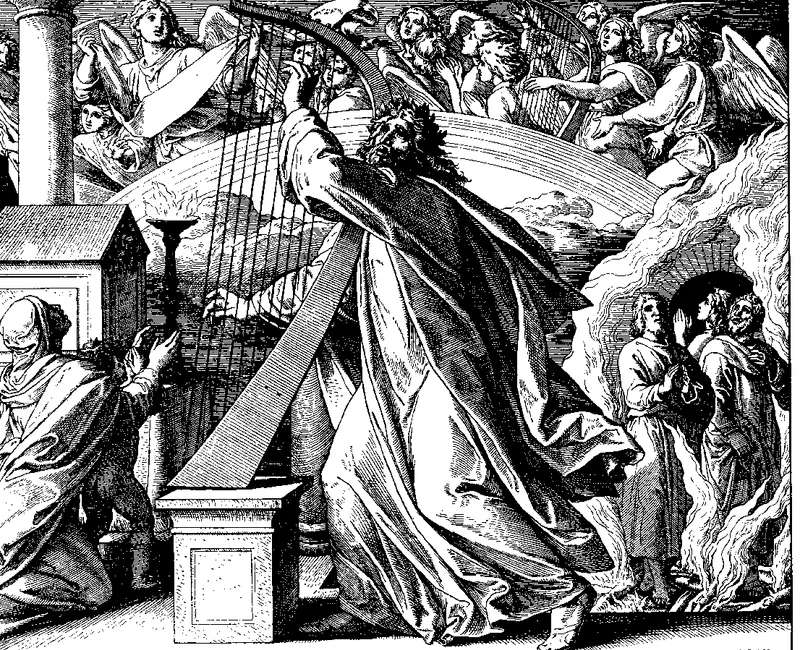
The psalm ends by widening the choir until it can grow no wider, and then narrowing it back to a single voice. David calls first on the highest creatures - ye his angels, that excel in strength, that do his commandments (v. 20) - then on the hosts of heaven, the ministers who do God's pleasure (v. 21), then on absolutely everything: Bless the LORD, all his works in all places of his dominion (v. 22). Every creature in every corner of the universe is summoned into the song.
And then, having called the angels and the hosts and all the works of God to bless the LORD, David ends exactly where he began: bless the LORD, O my soul. The last words of the psalm are its first words.
The whole vast chorus - angels, armies, all creation - comes back home to rest on the one small soul that started the song. David does not lose himself in the cosmic scale; he takes his place in it. The angels excel in strength, and his own praise is one frail, grass-like voice among them - but it belongs in the chorus all the same. The same soul he commanded to bless God in verse 1 is the soul he commands again in verse 22, only now it has been all the way through the mercy, the forgiveness, the pity, the everlasting love, and the throne over all - and it has all the more reason to obey.
Research trail
Sources & further study
These references support the historical, linguistic, manuscript, and contextual notes in this chapter. Scripture remains the primary text; external sources are provided so readers can inspect the research directly.
- Psalm 103 - Translators' NotesThe NET Bible's detailed footnotes on Psalm 103 - the force of the verb behind “forgiveth” in verse 3, the meaning of being “crowned” with lovingkindness in verse 4, and the idiom of mercy reaching “from everlasting to everlasting” in verse 17.
- Psalm 103 · Hebrew + classical Jewish commentaryThe Hebrew text of Psalm 103 with Rashi, Ibn Ezra, and other classical commentators side by side - useful for chesed (the “mercy / lovingkindness” that runs through vv. 4, 8, 11, 17) and for the maternal force of racham behind “tender mercies” (v. 4) and “pitieth” (v. 13).
- Psalm 103 ↔ Exodus 34 · Mark 2 · Matthew 8 · Luke 15Traces the threads tying Psalm 103 to the rest of Scripture - the Sinai self-revelation it leans on (Exod. 34:6 in v. 8), the joined forgiving-and-healing answered in the paralytic's rescue (Mark 2:5-11; Matt. 8:17), and the grass-like brevity of man (vv. 15-16) echoed in Isaiah 40 and 1 Peter 1.
Where this echoes in Scripture
Bless the LORD, O My Soul
- Mark 2:5-11Son, thy sins be forgiven thee... Arise, and take up thy bed, and go thy way into thine house.The forgiving and the healing of verse 3, spoken over one man in one moment.
- Matthew 8:17Himself took our infirmities, and bare our sicknesses.Matthew ties Jesus' healings to the joined forgiving-and-healing God of verse 3.
- Psalm 116:12What shall I render unto the LORD for all his benefits toward me?The same refusal to forget God's benefits that drives verse 2.
- Lamentations 3:22-23his compassions fail not. They are new every morning: great is thy faithfulness.The daily, renewing mercy David blesses for in verses 3-5.
Merciful and Gracious, Slow to Anger
- Exodus 34:6The LORD God, merciful and gracious, longsuffering, and abundant in goodness and truth.The Sinai self-revelation David rehearses almost word for word in verse 8.
- John 1:14the Word was made flesh, and dwelt among us... full of grace and truth.The grace and truth of verse 8 made flesh - the glory of God seen in a human face.
- Micah 7:18-19he retaineth not his anger for ever... thou wilt cast all their sins into the depths of the sea.The same God who does not keep His anger and does not deal with us after our sins (vv. 9-10).
- Ephesians 1:7In whom we have redemption through his blood, the forgiveness of sins, according to the riches of his grace.The mercy of verse 8 named as the riches of grace in which our sins are forgiven.
As Far as the East Is from the West
- Hebrews 10:17And their sins and iniquities will I remember no more.The transgressions removed in verse 12, named in the new covenant as the sins God remembers no more.
- Luke 15:20when he was yet a great way off, his father saw him, and had compassion, and ran.The fatherly pity of verse 13 with a face - compassion that runs to meet the returning child.
- Isaiah 40:6-8All flesh is grass... The grass withereth, the flower fadeth: but the word of our God shall stand for ever.The grass-like brevity of man (vv. 15-16) set against what does not fade.
- 1 Peter 1:24-25For all flesh is as grass... but the word of the Lord endureth for ever.The same contrast as verses 15-17 - withering flesh, enduring mercy and word.
- Luke 1:50And his mercy is on them that fear him from generation to generation.The everlasting mercy of verse 17, sung again as reaching from generation to generation.
Bless the LORD, All His Works
- Psalm 47:8God reigneth over the heathen: God sitteth upon the throne of his holiness.The throne prepared in the heavens and the kingdom ruling over all (v. 19).
- Revelation 5:11-13I heard the voice of many angels round about the throne... every creature... heard I saying, Blessing, and honour.The angels, hosts, and all creation of verses 20-22 gathered before the throne in one blessing.
- Psalm 148:2Praise ye him, all his angels: praise ye him, all his hosts.The same summons to angels and hosts that David sounds in verses 20-21.
- Daniel 7:14his dominion is an everlasting dominion, which shall not pass away, and his kingdom that which shall not be destroyed.The kingdom that ruleth over all (v. 19), seen as a dominion without end.