Psalms 104
Psalm 104 begins exactly where Psalm 103 began - Bless the LORD, O my soul - but it turns the soul's gaze outward, off the self and onto the whole created world. It is the great creation hymn of the Psalter, and it reads less like a doctrine of origins than like a guided walk: the psalmist takes us by the hand and points, again and again, at what God has made. Look, he says - the light He wears like a garment, the heavens He stretched like a tent-curtain, the clouds He rides, the springs He sends down the valleys, the grass for the cattle and the bread for man.
The poem moves the way the eye moves on a clear day, from the vault of heaven down to a single bird singing in a branch, and at every level it finds the same thing: the unhurried, generous work of one Maker's hands.1
Tap any highlighted phrase to jump to the commentary that unpacks it.
Psalm 104:1-4Clothed with Honour and Majesty
1Bless the LORD, O my soul. O LORD my God, thou art very great; thou art clothed with honour and majesty. 2Who coverest thyself with light as with a garment: who stretchest out the heavens like a curtain: 3Who layeth the beams of his chambers in the waters: who maketh the clouds his chariot: who walketh upon the wings of the wind: 4Who maketh his angels spirits; his ministers a flaming fire:
The psalm opens with the soul talking to itself - Bless the LORD, O my soul - and then, almost at once, runs out of plain words and reaches for poetry. How do you describe the greatness of the One who made everything? The psalmist tries clothing: thou art clothed with honour and majesty… Who coverest thyself with light as with a garment. Light, the very first thing God called into being, is here pictured as the robe He wears.
The image is deliberately overwhelming. If light is His garment, the heavens are no more to Him than a tent-curtain He stretches out; the clouds are His chariot; the wind is something He walks upon. These are not measurements; they are worship straining at its own limits. The psalmist is not telling us God's dimensions but God's scale - that the whole sweep of sky and storm, which dwarfs us, is to its Maker like a cloak thrown over the shoulders.
And notice the posture this produces: not fear that shrinks back, but praise that leans in. The bigger God is shown to be, the more the soul is summoned to bless Him. Greatness, in this psalm, is never cold; it is the first reason given for delight.
Psalm 104:5-9Who Laid the Foundations of the Earth
5Who laid the foundations of the earth, that it should not be removed for ever. 6Thou coveredst it with the deep as with a garment: the waters stood above the mountains. 7At thy rebuke they fled; at the voice of thy thunder they hasted away. 8They go up by the mountains; they go down by the valleys unto the place which thou hast founded for them. 9Thou hast set a bound that they may not pass over; that they turn not again to cover the earth.
From the heavens the psalmist now turns to the ground beneath his feet: Who laid the foundations of the earth, that it should not be removed for ever (v. 5). The picture is of a building set on foundations - the earth not floating by accident but established, stable, meant to last. There is deep comfort in that single phrase, that it should not be removed. The world we stand on is not precarious in God's hands; He has founded it.
But the psalmist is honest that the earth has known a more chaotic state. He remembers a time when the waters stood above the mountains (v. 6) - the deep covering everything like a garment, the dry land nowhere in sight. The God of this psalm is the One who brought order out of that watery formlessness, exactly as the opening of Genesis describes the Spirit moving over the face of the waters and the dry land appearing at God's word.
Creation here is not chaos left to itself; it is chaos mastered, the deep put in its place by the One who founded the earth to stand.
What happens to the waters is told almost like a drama of obedience. At thy rebuke they fled; at the voice of thy thunder they hasted away (v. 7) - the deep, which had covered the mountains, retreats at a word from God like a servant dismissed. The waters run off to their appointed places, up by the mountains… down by the valleys unto the place which thou hast founded for them (v. 8).
And then comes the decisive line: Thou hast set a bound that they may not pass over; that they turn not again to cover the earth (v. 9). God draws a boundary the sea cannot cross. The same waters that once covered everything are now held back by nothing more than the command of the One who set the limit.
This is one of the quiet, steadying truths of the whole psalm: the forces that could overwhelm us are kept in their place by God. The sea has a leash, and the hand that holds it is the Maker's. What looks to us like the brute power of nature is, underneath, a creation kept - bounded, ordered, and held within the word of God.
Psalm 104:10-18The Springs Into the Valleys
10He sendeth the springs into the valleys, which run among the hills. 11They give drink to every beast of the field: the wild asses quench their thirst. 12By them shall the fowls of the heaven have their habitation, which sing among the branches. 13He watereth the hills from his chambers: the earth is satisfied with the fruit of thy works. 14He causeth the grass to grow for the cattle, and herb for the service of man: that he may bring forth food out of the earth; 15And wine that maketh glad the heart of man, and oil to make his face to shine, and bread which strengtheneth man’s heart. 16The trees of the LORD are full of sap; the cedars of Lebanon, which he hath planted; 17Where the birds make their nests: as for the stork, the fir trees are her house. 18The high hills are a refuge for the wild goats; and the rocks for the conies.
Having set the cosmic stage - light, heavens, the bounded sea - the psalmist now zooms all the way in, to water running through a valley. He sendeth the springs into the valleys, which run among the hills (v. 10). The waters that God held back at His command in verse 9 are the same waters He now sends out as a gift, channelled into springs that give drink to every beast of the field (v. 11).
It is a beautiful turn: the deep that had to be bounded is also the source of life, doled out in measure exactly where it is needed.
And watch how wide the circle of God's care runs. He waters not just the fields men farm but the wild places - the wild asses that no one owns quench their thirst at His springs; the birds find their homes and sing among the branches (v. 12). The provision reaches creatures of no use to us at all.
This is one of the quietly radical notes of the psalm: God's generosity is not measured by human usefulness. He waters the hills, satisfies the earth, and tends the thirst of animals no farmer counts - because the whole creation, not just its profitable corner, is the work of His hands and the object of His care.
In verse 15 the psalmist notices something tender about God's provision: it does not stop at the bare minimum. God could have given only what keeps a body alive, but He gives more. And wine that maketh glad the heart of man, and oil to make his face to shine, and bread which strengtheneth man's heart. Bread for strength, yes - that is necessity. But wine to gladden the heart and oil to make the face shine are not strictly necessary; they are gifts of gladness and dignity, the difference between surviving and flourishing.
The God of this psalm is not a grudging provider doling out rations. He is generous past the point of need, building delight into the daily supply. The bread that strengthens the heart is a quiet anticipation of a deeper provision still - the One who would call Himself the bread of life come down from heaven - but even at its plainest, the verse is a window into God's character. He gives what is needed, and then He gives more, because gladness and shining faces are themselves part of what He intends for the creatures He feeds.
Psalm 104:19-23He Appointed the Moon for Seasons
19He appointed the moon for seasons: the sun knoweth his going down. 20Thou makest darkness, and it is night: wherein all the beasts of the forest do creep forth. 21The young lions roar after their prey, and seek their meat from God. 22The sun ariseth, they gather themselves together, and lay them down in their dens. 23Man goeth forth unto his work and to his labour until the evening.
The psalm now lifts its eyes to the great timekeepers of the sky: He appointed the moon for seasons: the sun knoweth his going down (v. 19). The moon and sun are not worshipped here, as they were across the ancient world; they are appointed - given a job by God, set to mark the rhythm of the year and the turning of day to night.
There is a lovely touch in the phrase the sun knoweth his going down. The sun does not blaze on forever, scorching everything; it knows its hour to set, keeps its appointed bound, just as the sea kept its bound in verse 9.
The whole creation is shot through with this kind of ordered obedience - limits kept, rhythms honoured, each thing doing what it was appointed to do. The very regularity we take for granted, the reliable swing of light and dark and season, is in this psalm not a brute fact of physics but a faithfulness - the steady keeping of an appointment made by God. Sunset is not the sun running out; it is the sun obeying.
The psalmist watches the rhythm of day and night divide the world between its creatures, and there is no rivalry in it. By night, the beasts of the forest do creep forth - the young lions go out and seek their meat from God (v. 21), hunting in the dark hours given to them. Then the sun ariseth, they gather themselves together, and lay them down in their dens (v. 22), and the day belongs to someone else: Man goeth forth unto his work and to his labour until the evening (v. 23).
Day for the worker, night for the predator - each has its appointed time and place, and the world is large enough and ordered enough for both.
Two things are quietly dignified here. The first is the lions' hunger: even the predator's prey is described as meat sought from God, so that the wild kill is folded into divine provision rather than set against it. The second is human work. The labour of an ordinary day - going out in the morning, coming home at evening - is named right alongside the lions and the stars as part of the creation's good rhythm. Daily work is not a curse breaking the harmony of the psalm; it is woven into it.
Psalm 104:24-30In Wisdom Hast Thou Made Them All
24O LORD, how manifold are thy works! in wisdom hast thou made them all: the earth is full of thy riches. 25So is this great and wide sea, wherein are things creeping innumerable, both small and great beasts. 26There go the ships: there is that leviathan, whom thou hast made to play therein. 27These wait all upon thee; that thou mayest give them their meat in due season. 28That thou givest them they gather: thou openest thine hand, they are filled with good. 29Thou hidest thy face, they are troubled: thou takest away their breath, they die, and return to their dust. 30Thou sendest forth thy spirit, they are created: and thou renewest the face of the earth.
At verse 24 the long tour gives way to a single cry: O LORD, how manifold are thy works! in wisdom hast thou made them all: the earth is full of thy riches. The word manifold means many-folded, layer upon layer - the sheer, overflowing variety of what God has made. And the psalmist refuses to credit it to chance: it is in wisdom that all of it was made.
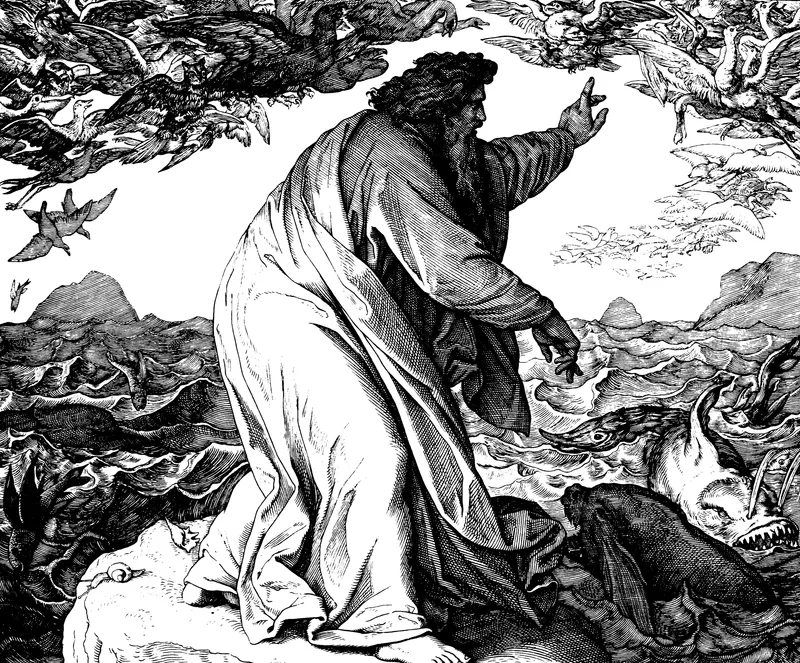
Then his eye turns to the sea, the very place that had to be bounded back in verse 9, and finds it teeming - things creeping innumerable, both small and great beasts (v. 25). There even sails leviathan, the great sea-creature the ancient world feared as the embodiment of the deep's terror. But look what the psalm does with it: there is that leviathan, whom thou hast made to play therein (v. 26).
The dreaded monster is reduced to a creature at play in God's ocean - made by Him, harmless before Him, frolicking like a great beast in a field that belongs to its owner. Nothing in the sea, not even its most fearsome inhabitant, stands outside the wisdom that made it or the hand that holds it. The chaos-beast is God's plaything.1
Psalm 104:31-35I Will Sing Unto the LORD
31The glory of the LORD shall endure for ever: the LORD shall rejoice in his works. 32He looketh on the earth, and it trembleth: he toucheth the hills, and they smoke. 33I will sing unto the LORD as long as I live: I will sing praise to my God while I have my being. 34My meditation of him shall be sweet: I will be glad in the LORD. 35Let the sinners be consumed out of the earth, and let the wicked be no more. Bless thou the LORD, O my soul. Praise ye the LORD.
As the tour ends, the psalmist lifts his eyes from the works to the Worker, and from the present moment to forever: The glory of the LORD shall endure for ever: the LORD shall rejoice in his works (v. 31). Two things are said here that change how everything before them is read. First, that God's glory endures - the creation may pass through seasons of trouble and the creatures may return to their dust, but the glory of the One who made them does not fade.
And second, the surprising note that God rejoices in His works. The delight has not been only the psalmist's; it began with God Himself, who looked at what He had made and called it good, and who still takes joy in it. The psalmist's wonder, then, is not a sentiment he has worked up on his own - it is an echo of God's own gladness in creation.
And the same God whose works delight Him is the God before whom the earth trembles and the hills smoke at His touch (v. 32). The tenderness and the majesty are not in tension. The hand that opens to feed the wild asses is the hand whose touch sets mountains smoking. To bless this God is to reckon with both at once.
Now the psalmist tells us what the whole long tour has been for: I will sing unto the LORD as long as I live: I will sing praise to my God while I have my being (v. 33). All the looking - at light and sea and springs and stars - was never meant to end in mere information. It was meant to end in song. The creation is not a museum to be catalogued but a Maker to be praised, and the psalmist commits himself to that praise for the whole length of his life: as long as I live… while I have my being.
There is a lovely honesty in tying the song to his own breath. He has just confessed, in verse 30, that his very breath is God's gift, sent forth and able to be withdrawn - and now he resolves to spend that borrowed breath on praise for as long as he has it. My meditation of him shall be sweet: I will be glad in the LORD (v. 34). The thought of God is not a duty he grits his teeth through; it is sweet to him, a gladness.
This is where the reading of creation finally lands: not in analysis, but in a settled, lifelong, glad intention to bless the One who made it all.
The final verse holds together two notes that sit strangely side by side: Let the sinners be consumed out of the earth, and let the wicked be no more. Bless thou the LORD, O my soul. Praise ye the LORD (v. 35). After thirty-four verses of pure praise, why the sudden mention of the wicked? Because the psalmist has been gazing at a world of breathtaking order, generosity, and beauty - a creation that does exactly what its Maker appointed, the sun keeping its hour, the sea its bound, the creatures their seasons - and the one thing that does not fit, the one discord in the whole symphony, is wickedness: the will that refuses to bless the God all else obeys.
The prayer is not personal spite; it is a longing that the one jarring note be resolved, that the creation be at last wholly what God made it to be.
And then the psalm loops home. Its very last words are its very first words - Bless the LORD, O my soul - now joined by an invitation to everyone listening: Praise ye the LORD. The single Hebrew word behind that last line is Hallelujah. The tour of the made world ends exactly where it began, in blessing, and widens at the last moment from one soul's praise into a summons for all.
Research trail
Sources & further study
These references support the historical, linguistic, manuscript, and contextual notes in this chapter. Scripture remains the primary text; external sources are provided so readers can inspect the research directly.
- Psalm 104 - Translators' NotesThe NET Bible's detailed footnotes on Psalm 104 - the imagery of God enthroned above the waters, the meaning of leviathan “made to play” in the sea (v. 26), and the force of verse 30, where God's sending forth of His ruach both creates and renews the face of the ground.
- Psalm 104 · Hebrew + classical Jewish commentaryThe Hebrew text of Psalm 104 with Rashi, Ibn Ezra, Radak, and other classical commentators side by side - useful for ruach (the single word behind “spirits” in v. 4, “breath” in v. 29, and “spirit” in v. 30) and for chokmah, the “wisdom” in which all things are made (v. 24).
- Psalm 104 ↔ Genesis 1 · John 1 · Colossians 1 · Hebrews 1Traces the threads tying Psalm 104 to the rest of Scripture - its close parallels to the creation account of Genesis 1, the line about angels as “spirits” quoted in Hebrews 1:7, and the New Testament confession that all things were made and are upheld by the One through whom God created the worlds (John 1:3; Col. 1:16-17; Heb. 1:2).
Where this echoes in Scripture
Clothed with Honour and Majesty
- John 1:1-3All things were made by him; and without him was not any thing made that was made.The making that Psalm 104 praises, traced to the Word through whom all things came to be.
- Hebrews 1:7Who maketh his angels spirits, and his ministers a flame of fire.Verse 4 quoted directly - to set the Son above the angels who serve Him.
- Genesis 1:3And God said, Let there be light: and there was light.The light God first called forth becomes, in verse 2, the garment He wears.
- Isaiah 40:22that stretcheth out the heavens as a curtain, and spreadeth them out as a tent to dwell in.The same image as verse 2 - the heavens as a curtain stretched by God's hand.
Who Laid the Foundations of the Earth
- Genesis 1:9Let the waters under the heaven be gathered together unto one place, and let the dry land appear.The same gathering of the waters and emergence of dry land that verses 6-9 recall.
- Job 38:8-11Hitherto shalt thou come, but no further: and here shall thy proud waves be stayed.God's boundary on the sea (v. 9), spoken by God Himself out of the whirlwind.
- Jeremiah 5:22which have placed the sand for the bound of the sea by a perpetual decree, that it cannot pass it.The fixed limit of verse 9 named as God's perpetual decree over the waters.
- Proverbs 8:29When he gave to the sea his decree, that the waters should not pass his commandment.Wisdom present when God set the very boundary Psalm 104:9 celebrates.
The Springs Into the Valleys
- Matthew 6:25-26Behold the fowls of the air... yet your heavenly Father feedeth them. Are ye not much better than they?The feeding of verse 14 made the ground of Jesus' cure for anxiety.
- Psalm 145:15-16Thou openest thine hand, and satisfiest the desire of every living thing.The same open hand and universal feeding that runs through verses 10-18.
- Acts 14:17gave us rain from heaven, and fruitful seasons, filling our hearts with food and gladness.The bread, wine, and gladness of verse 15 named by Paul as God's witness to all nations.
- John 6:35I am the bread of life: he that cometh to me shall never hunger.The bread that strengthens the heart (v. 15) opening toward a deeper bread come down from heaven.
He Appointed the Moon for Seasons
- Genesis 1:14-16Let there be lights in the firmament of the heaven... and let them be for signs, and for seasons.The sun and moon appointed as timekeepers, exactly as verse 19 describes.
- Psalm 19:1-2The heavens declare the glory of God... Day unto day uttereth speech, and night unto night sheweth knowledge.The ordered turning of day and night (vv. 19-23) read as a wordless witness to God.
- Jeremiah 31:35which giveth the sun for a light by day, and the ordinances of the moon and of the stars for a light by night.The appointed sun and moon of verse 19 named as fixed ordinances from God.
- Job 38:39-40Wilt thou hunt the prey for the lion? ... when they couch in their dens.The lions seeking their meat from God (v. 21) - provision God claims as His own work.
In Wisdom Hast Thou Made Them All
- Colossians 1:16-17by him were all things created... and by him all things consist.The waiting, dependent creation of verses 27-30, confessed as held together by the Son.
- Hebrews 1:3upholding all things by the word of his power.The open hand that sustains every creature (v. 28), named as the upholding word of the Son.
- Genesis 1:2And the Spirit of God moved upon the face of the waters.The same Spirit (ruach) that renews creation's face in verse 30, present at its beginning.
- Job 34:14-15If he gather unto himself his spirit and his breath; all flesh shall perish together.The truth of verses 29-30 - that all life hangs on the breath God gives and can withdraw.
I Will Sing Unto the LORD
- Genesis 1:31And God saw every thing that he had made, and, behold, it was very good.The Maker's own delight in His works (v. 31) - God rejoicing in the creation He called good.
- Revelation 4:11thou hast created all things, and for thy pleasure they are and were created.The God who rejoices in His works (v. 31), worshipped before the throne as the Creator of all.
- Psalm 146:1-2While I live will I praise the LORD: I will sing praises unto my God while I have any being.The lifelong resolve of verse 33, sung again almost word for word.
- Psalm 19:14Let the words of my mouth, and the meditation of my heart, be acceptable in thy sight.The sweet meditation of verse 34 - the inner life turned, like the psalm, toward God.