Acts 26
People in this chapter
A king sits in the judgment seat, and a prisoner in chains is told he may speak. Paul stretches out his hand. What follows is the third telling of the Damascus road in Acts1 - the noonday light brighter than the sun, the voice that knew his name, the warning that it is hard to kick against the goads. Paul has lived thirty years inside that grip.
Tap any highlighted phrase to jump to the commentary that unpacks it.
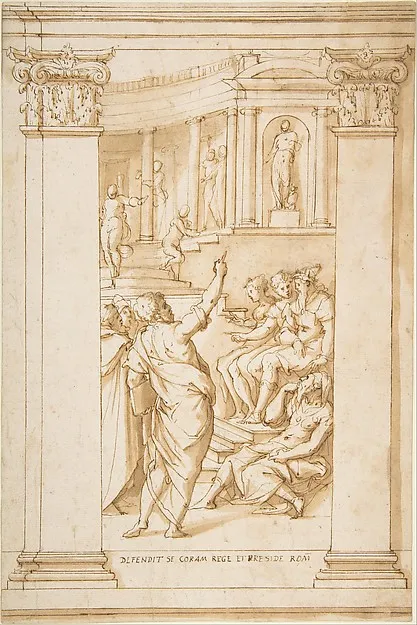
Acts 26:1-3The Hand Stretched Forth
1Then Agrippa said unto Paul, Thou art permitted to speak for thyself. Then Paul stretched forth the hand, and answered for himself: 2I think myself happy, king Agrippa, because I shall answer for myself this day before thee touching all the things whereof I am accused of the Jews: 3Especially because I know thee to be expert in all customs and questions which are among the Jews: wherefore I beseech thee to hear me patiently.
No centurion interrupts. No council shouts him down. The hand stretched forth is an ancient gesture of authority - the pose of an orator, not a defendant. Yet the chains are still there, just behind him, and Luke wants you to see both at once. Paul is a prisoner of Rome and a free man of Christ in the same body. The shackles set the scene; they do not set the tone.
A man whose next sentences may decide whether he lives opens with gratitude. The word conveys a settled sense of being blessed, fortunate, even honoured to stand here. Watch where that comes from: rooted somewhere neither Rome nor Jerusalem can reach. When the worst the court can do has lost its grip on a man, you are looking at someone who has already been found.
Acts 26:4-8After the Strictest Sect
4My manner of life from my youth, which was at the first among mine own nation at Jerusalem, know all the Jews; 5Which knew me from the beginning, if they would testify, that after the most straitest sect of our religion I lived a Pharisee. 6And now I stand and am judged for the hope of the promise made of God unto our fathers: 7Unto which promise our twelve tribes, instantly serving God day and night, hope to come. For which hope’s sake, king Agrippa, I am accused of the Jews. 8Why should it be thought a thing incredible with you, that God should raise the dead?
Paul reminds the court: you all know this about me. He is not claiming to be someone other than who he was. He was a Pharisee2 - a man of the law, zealous, meticulous, devoted. He did not become this by accident. His entire youth was shaped toward it. His credentials are real. The Jerusalem community witnessed it. And yet, he will tell them, all of that devotion was devotion to something false.
This is why his conversion matters: he did not give up righteousness; he discovered that the righteousness he sought was pointing him in the wrong direction.
The promise Paul speaks of is the resurrection. The prophets spoke of it. Israel's covenant hope for centuries has been that God would raise the dead. Paul is saying: I am on trial for believing what your own prophets taught you. This is Paul's rhetorical genius. He shows that faith in Jesus is faith in what the Law and the Prophets already promised.
Acts 26:9-11The Persecutor
9I verily thought with myself, that I ought to do many things contrary to the name of Jesus of Nazareth. 10Which thing I also did in Jerusalem: and many of the saints did I shut up in prison, having received authority from the chief priests; and when they were put to death, I gave my voice against them. 11And I punished them oft in every synagogue, and compelled them to blaspheme; and being exceedingly mad against them, I persecuted them even unto strange cities.
He was no bystander at the killings. To give his voice against them was to cast a vote for their death, and he cast it with full authority - letters from the high priest in hand, the religious establishment at his back. This is a man owning state-sanctioned violence in open court, before the very community he once tried to erase: I hunted you, and I was good at it.
Worse than killing, in a way, was forcing believers to curse the name they loved. That memory never left him. Years later he names it plainly - a blasphemer, a persecutor, injurious. But then he says the harder thing: he obtained mercy “that in me first Jesus Christ might shew forth all longsuffering, for a pattern to them which should hereafter believe” (1 Tim. 1:16). His worst is held up as the exhibit - proof that if mercy reached him, it can reach you.
Acts 26:12-13The Light Above the Sun
12Whereupon as I went to Damascus with authority and commission from the chief priests, 13At midday, O king, I saw in the way a light from heaven, above the brightness of the sun, shining round about me and them which journeyed with me.
The light outstrips the sun. It is noon, the brightest part of the day, and still this light overwhelms it. The men with Paul see it too - this is an event in the world, not a private vision. A crack opens in the fabric of the ordinary world, and the glory of the risen Christ comes through. Paul is struck blind by it. All of his sight - all of his understanding, his confidence, his momentum - goes dark in that instant.
Acts 26:14-15Why Persecutest Thou Me
14And when we were all fallen to the earth, I heard a voice speaking unto me, and saying in the Hebrew tongue, Saul, Saul, why persecutest thou me? it is hard for thee to kick against the pricks. 15And I said, Who art thou, Lord? And he said, I am Jesus whom thou persecutest.
The image is of an ox kicking against the pricks - the goads, the sharp instruments used to drive a yoke animal. To kick against the pricks is to resist the one who is trying to direct you, and in resisting, to harm yourself. The harder you kick, the deeper the goads cut. Paul has been kicking against God all his life - trying to extinguish what he thought was heresy, not knowing he was kicking against the hands that made him. The resistance only wounded him. And now those hands have caught him.
The risen Jesus tells Paul: You are persecuting me. Not “You are persecuting my church.” But “You are persecuting me.” The union between Christ and His body is so complete that what touches them touches Him. Paul has been hunting the members, and in doing so, has been wounding the head. This revelation - that he has been hurting Christ himself - may be the deepest wound of all to a man of Paul's conscience.
Acts 26:16-18Made a Minister and a Witness
16But rise, and stand upon thy feet: for I have appeared unto thee for this purpose, to make thee a minister and a witness both of these things which thou hast seen, and of those things in the which I will appear unto thee; 17Delivering thee from the people, and from the Gentiles, unto whom now I send thee, 18To open their eyes, and to turn them from darkness to light, and from the power of Satan unto God, that they may receive forgiveness of sins, and inheritance among them which are sanctified by faith that is in me.
Jesus says He has appeared to Paul for this purpose - a deliberate act with a mission attached. The appearance itself is the commissioning. To see the risen Christ is to be sent. There is no neutral encounter with the resurrection. It always reorients the whole of a life toward witness. This encounter on the Damascus road - the third account of it in Acts1 - carries the weight of Paul's entire apostolic authority.
Paul is appointed to do two things: to testify to what he has seen, and to testify to what Christ will show him. His apostleship rests on an ongoing relationship with the risen Jesus - appearance after appearance, revelation after revelation. Paul will spend decades in that grip, being shown things, being told things, being prepared for every circumstance he will face.
Paul is sent to the Gentiles with a cosmic purpose: to turn them from darkness to light, and from the power of Satan unto God. This is a confrontation with spiritual powers, reaching deeper than any diplomacy or negotiation. The work is to open eyes that have been kept shut, to move people from one kingdom to another. The language echoes Isaiah 42:7 and 49:6 - the Servant Songs. Paul's commission is the commission of the Servant of the Lord. What was written for the Messiah, Paul is being sent to carry out.
Acts 26:19-23I Was Not Disobedient
19Whereupon, O king Agrippa, I was not disobedient unto the heavenly vision: 20But shewed first unto them of Damascus, and at Jerusalem, and throughout all the coasts of Judaea, and then to the Gentiles, that they should repent and turn to God, and do works meet for repentance. 21For these causes the Jews caught me in the temple, and went about to kill me. 22Having therefore obtained help of God, I continue unto this day, witnessing both to small and great, saying none other things than those which the prophets and Moses did say should come: 23That Christ should suffer, and that he should be the first that should rise from the dead, and should shew light unto the people, and to the Gentiles.
Three decades land in one understated line - he was not disobedient to what he saw. Hear the litotes: not a boast about obedience, just the quiet absence of refusal, through imprisonment, shipwreck, beating, and abandonment. The vision never faded and never lost its authority. It pointed a direction, and Paul simply kept walking it, year after unglamorous year.
Paul has been a witness to both small and great. Kings and beggars. Philosophers and slaves. His witness was not stratified by social status. A centurion was as important as a governor. A household servant's faith mattered as much as a Pharisee's. This is the democratization of the Gospel that the Gentile mission enacted. The good news is not reserved for the powerful or the privileged. It comes to all.
Acts 26:24-25Words of Truth and Soberness
24And as he thus spake for himself, Festus said with a loud voice, Paul, thou art beside thyself; much learning doth make thee mad. 25But he said, I am not mad, most noble Festus; but speak forth the words of truth and soberness.
Festus, the governor, has interrupted with mockery. You are mad. Your learning has driven you insane. Paul's response does not attack Festus. It simply restates his own position: I am speaking words of truth and soberness. Not ecstasy. Not fanaticism. Truth and clarity. The most sane thing anyone has ever said in that courtroom is being called madness because it announces a reality Festus cannot absorb.
Acts 26:26-29Almost Thou Persuadest Me
26For the king knoweth of these things, before whom also I speak freely: for I am persuaded that none of these things are hidden from him; for this thing was not done in a corner. 27King Agrippa, believest thou the prophets? I know that thou believest. 28Then Agrippa said unto Paul, Almost thou persuadest me to be a Christian. 29And Paul said, I would to God, that not only thou, but also all that hear me this day, were both almost, and altogether such as I am, except these bonds.
Paul turns from the governor to the king. Agrippa, believest thou the prophets? The king who knows Scripture. The king educated in Israel's heritage. Paul is asking not “Do you believe me?” but “Do you believe the prophets?” And he answers his own question with audacity: I know that thou believest. Paul is placing a responsibility before Agrippa: your own faith in the prophets commits you to faith in Christ. They point to Him. You cannot have one without the other.
Agrippa's answer is one of the most tragic words in Scripture: Almost thou persuadest me to be a Christian. He has heard the defence. He has heard the case made that faith in the prophets is faith in Christ. He is intellectually convinced. He is emotionally moved. He is almost persuaded. And yet - he does not yield. He does not stand and declare allegiance to Jesus. He does not take the step from almost to altogether.
He remains on the threshold. The door remains open. And after this, it will not. History moves on. Agrippa will not appear in Scripture again. The moment of choice has passed.
Paul's response is pastoral and profound. He does not shame Agrippa for his hesitation. Instead, he prays a prayer so generous it breaks the heart: “I would to God, that not only thou, but also all that hear me this day, were both almost, and altogether such as I am, except these bonds.” He is saying: I wish you had my conviction and my freedom, my joy and my liberty in Christ, everything I have found, minus only the chains. This is the prayer of a man who has nothing left to lose, praying for the wholeness of those who have everything to gain.
Acts 26:30-32This Man Might Have Been Set at Liberty
30And when he had thus spoken, the king rose up, and the governor, and Bernice, and they that sat with them: 31And when they were gone aside, they talked between themselves, saying, This man doeth nothing worthy of death or of bonds. 32Then said Agrippa unto Festus, This man might have been set at liberty, if he had not appealed unto Caesar.
Bernice3 was Agrippa's sister, and she is present at the trial. Her presence is significant: she is a woman of authority and influence in her own right, a widow who has returned to her brother's court. That she hears Paul's defence alongside the king suggests the defence was a public hearing, open to the room. Scripture does not record whether she believed. But she stood in the presence of the risen Christ's witness, as did her brother.
The court adjourns. The king4 and the governor confer in private. And their conclusion is stark: This man does nothing worthy of death or of bonds. Paul has committed no crime against Rome. Agrippa is explicit: Paul could be released right now. The only thing stopping him is his own appeal to Caesar. He asked for Rome's hearing, and Rome will hear him. He has bound himself by his own petition. His chains are, in a sense, self-imposed.
Research trail
Sources & further study
These references support the historical, linguistic, manuscript, and contextual notes in this chapter. Scripture remains the primary text; external sources are provided so readers can inspect the research directly.
- Paul's Three Damascus-Road AccountsComparative resource exploring the three parallel accounts of Paul's conversion (Acts 9, 22, 26) and their literary relationships.
- PhariseesOpen-access SBL entry on the Pharisaic sect, Paul's former devotion to its strictest observance, and their theology.
- BerniceOpen-access SBL entry on Bernice, Agrippa II's sister, who heard Paul's defence at Caesarea.
- Herod Agrippa IIOpen-access SBL entry on the Jewish king before whom Paul made his final defence, with historical context.
Where this echoes in Scripture
Made a Minister and a Witness
- Matthew 28:18-19All power is given unto me in heaven and in earth. Go ye therefore, and teach all nations.The risen Christ commissions the apostles the same way He commissions Paul: the encounter is the sending.
- Isaiah 42:6-7I the LORD have called thee... to open the blind eyes, to bring out the prisoners from the prison.The Servant's task - opening blind eyes - is the very charge laid on Paul in verse 18.
- Isaiah 49:6I will also give thee for a light to the Gentiles, that thou mayest be my salvation unto the end of the earth.What was written for the Messiah, Paul is sent to carry out among the nations.
- Acts 9:3-6Suddenly there shined round about him a light from heaven... Saul, Saul, why persecutest thou me?Luke's first account of the same road; here Paul tells it himself, in his own voice, before a king.
- Galatians 1:15-16It pleased God... to reveal his Son in me, that I might preach him among the heathen.Paul's own summary of the commission - revelation and sending arriving together.
Almost Thou Persuadest Me
- John 2:23-24Many believed in his name, when they saw the miracles which he did. But Jesus did not commit himself unto them.A crowd that came close on the strength of signs - belief that stops short of surrender, like Agrippa's.
- Luke 9:62No man, having put his hand to the plough, and looking back, is fit for the kingdom of God.The peril of the half-turn: Agrippa looked back from the very threshold.
- Mark 10:21-22Then Jesus beholding him loved him... And he was sad at that saying, and went away grieved.Another man who heard, was moved, and walked away with the door still open behind him.
- Hebrews 4:7To day if ye will hear his voice, harden not your hearts.Scripture's steady answer to almost: the time to cross over is now, not later.
- 2 Corinthians 6:2Behold, now is the accepted time; behold, now is the day of salvation.Paul elsewhere presses the same urgency he presses on Agrippa - almost has an expiry.