Who was Eleazar in the Bible?
Eleazar was a son of Aaron who became Israel’s high priest after him.
Son of Aaron and High Priest
c. 1400 BC
Eleazar was a son of Aaron who became Israel’s high priest after him.
Follow the reading trailBEYOND THE NAME
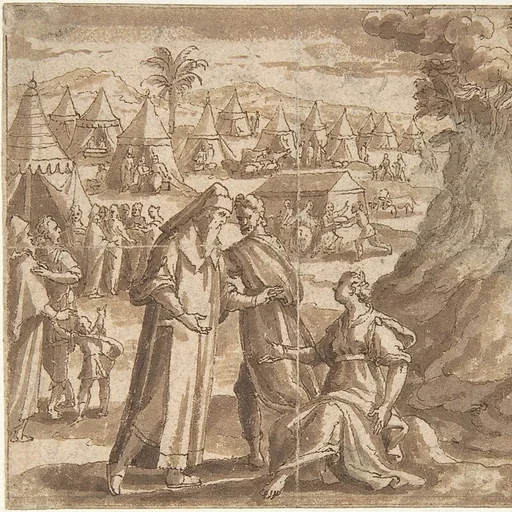
Eleazar was the third son of Aaron and succeeded his father as high priest, leading Israel in worship through the wilderness years and into the land. He stood beside Moses and Joshua at key moments, helping to allot the inheritance among the tribes. In 1 Chronicles 24 his descendants make up the larger of the two priestly branches organized for temple service.
Themes in the authored commentary
These are other entries using this name. Compare their source passages before treating them as the same or different historical people.
FOLLOW THE PASSAGES
These are chapter studies associated with this record. Their order follows the books and chapters, rather than a reconstructed timeline of the person’s life.
named alongside his brothers as one of Aaron's sons appointed to serve as priests
The Lord gives Moses instructions for the clothing Aaron will wear as high priest. The ephod holds the names of Israel’s twelve tribes on its shoulder stones, six names on each stone. Aaron carries the names on his shoulders when he comes before the Lord. The breastplate holds twelve more stones, one for each tribe, placed directly over the heart. The Urim and Thummim go in the breastplate too. Israel used them to seek God’s guidance. The hem of Aaron’s blue robe has cloth pomegranates and gold bells. The bells sound as he moves.
Chapter overview from the authored study guide.son of Aaron appointed as chief over the Levites and keeper of the sanctuary
Numbers opened with a census of the men of war, tribe by tribe, and a careful arrangement of the camp around the tabernacle. Now the LORD turns to the one tribe left out of that fighting count - Levi - and gives it a different vocation altogether. The chapter begins with Aaron and his sons, and with a memory that casts a long shadow: Nadab and Abihu died before the LORD, when they offered strange fire before the LORD (v. 4).
Chapter overview from the authored study guide.father of Phinehas, whose priestly line receives a covenant of peace
Israel is camped at Shittim, near the Jordan, after the LORD has blessed the people through Balaam. The people began to commit whoredom with the daughters of Moab (v. 1), and the immorality opened a door to something worse: they were called… unto the sacrifices of their gods, and Israel joined himself unto Baal-peor (vv. 2-3). The people eat at the sacrifices and bow down to the gods of Moab. The LORD is angry at what Israel has done.
Chapter overview from the authored study guide.took over the priestly office after Aaron's death at Moserah
Moses recalls the new tablets at Sinai, the ark that held them, and the duties given to the Levites. Then he asks, "What doth the Lord thy God require of thee?" His answer is to fear the Lord, walk in His ways, love and serve Him, and keep His commandments.
Chapter overview from the authored study guide.presides with Joshua at Shiloh over the casting of lots for tribal land
Joshua 18 records Israel setting up the tabernacle after the main campaigns. the whole congregation of the children of Israel assembled together at Shiloh, and set up the tabernacle of the congregation there. And the land was subdued before them (v. 1). For the first time the tent of meeting has a settled home in the heart of the land - Shiloh will house the tabernacle for generations to come - and the nation has a centre to gather around. Seven tribes still have to receive their land.
Chapter overview from the authored study guide.ancestor whose line provides the majority of the priestly divisions organized in this chapter
An aged king sits down to do paperwork. Near the end of his life, David sorts the sons of Aaron into shifts so the worship will never lapse. He does not pick the order himself. He casts lots, and in the faith of Israel the lot was never chance - it was where the choice was handed back to God. The great houses and the small were thrown in together. None was seeded ahead of another.
Chapter overview from the authored study guide.THE PEOPLE AROUND THE PERSON
Recorded parents
Recorded spouses
Recorded children
Relationships follow the source graph. Some are interpretive or uncertain, and individual verse citations are not yet available for every connection.
STUDY & INTERPRETATION
Eleazar carries the high-priestly office at the founding of Israel’s worship, wearing the garments his father wore and standing where Aaron stood between the people and God. His line proves the more numerous and is given more divisions in the temple courses of 1 Chronicles 24, a steady stream of priests serving across the centuries. Through him the office of intercession is handed down, generation after generation drawing near on the people’s behalf. The whole succession of high priests, faithful yet mortal, prepares the reader for the One who would offer a single sacrifice and remain forever a priest who never passes the office on, bringing God and humanity together in Himself.
From the Learn of Christ person commentary. Read alongside the linked Scripture passages.KEEP SCRIPTURE CLOSE
27 authored chapter guides feature this person. This is guide coverage, not an exhaustive count of biblical mentions.
ASK A BETTER QUESTION
Identity, story, early-life sources, family, and where to read.
Eleazar was a son of Aaron who became Israel’s high priest after him.
Eleazar was the third son of Aaron and succeeded his father as high priest, leading Israel in worship through the wilderness years and into the land. He stood beside Moses and Joshua at key moments, helping to allot the inheritance among the tribes. In 1 Chronicles 24 his descendants make up the larger of the two priestly branches organized for temple service.
The individualized passage index associates this Eleazar record with Exodus, Leviticus, Numbers, Deuteronomy, Joshua, Judges, 1 Chronicles, Ezra. There are 61 distinct indexed verse references in the 66-book Bible. Browse the book-by-book list below; it separates this identity from other people who share the name. Source assignments and textual identifications can require interpretation.
A separate childhood account for Eleazar is not provided in our current authored profile sources. Begin with Exodus 6:23 and the passages linked here for the evidence that is available. The first indexed reference to a name is not a birth record. This profile does not establish a birth date, schooling, or childhood events beyond what its sources state.
Eleazar’s source record lists Aaron (father), Elisheba (mother), Putiel’s daughter (spouse), Phinehas (child). These are source-graph relationships; legal family, uncertain identifications, and ancestral language require the cautions below. Individual verse evidence is not yet retained for every family edge.
Eleazar carries the high-priestly office at the founding of Israel’s worship, wearing the garments his father wore and standing where Aaron stood between the people and God. His line proves the more numerous and is given more divisions in the temple courses of 1 Chronicles 24, a steady stream of priests serving across the centuries.
Answers draw on our existing authored biography and linked chapter studies. Where supplied, verse assignments come from the individualized STEP Bible index. Childhood answers distinguish documented events from gaps in the available sources.
FIND THE PERSON IN THE TEXT
61 distinct verse references in the source’s 66-book index. These are indexed name assignments, rather than every indirect allusion to this person. A name may also refer to descendants, a tribe, or a nation; read each passage to distinguish that usage from the individual.
“And Aaron took him Elisheba, daughter of Amminadab, sister of Naashon, to wife; and she bare him Nadab, and Abihu, Eleazar, and Ithamar.”
Exodus 6:23 · King James Version
“And Moses and Eleazar the priest spake with them in the plains of Moab by Jordan near Jericho, saying,”
Numbers 26:3 · King James Version
“And the children of Israel took their journey from Beeroth of the children of Jaakan to Mosera: there Aaron died, and there he was buried; and Eleazar his son ministered in the priest’s office in his stead.”
Deuteronomy 10:6 · King James Version
“The son of Abishua, the son of Phinehas, the son of Eleazar, the son of Aaron the chief priest:”
Ezra 7:5 · King James Version
References are adapted from STEP Bible / Tyndale House TIPNR (CC BY 4.0). Deduplicated, matched to this identity, and checked against the bundled KJV’s verse bounds. Interpretive assignments and translation/versification differences may remain. This index is separate from evidence for individual family relationships.
YOUR OWN OBSERVATIONS
Notes, saved people, and study marks stay in this browser. They do not sync to your account.
KEEP EXPLORING
People featured in the same study guides. Sharing a chapter does not establish a family relationship.