Joshua 12
People in this chapter
After eleven chapters of crossing, marching, and fighting, Joshua 12 stops to take stock. It is a roll-call of the kings Israel overcame - and it deliberately reaches back before Joshua to begin. The first six verses honor the victories won under Moses on the east side of the Jordan: the two formidable kings, Sihon king of the Amorites and Og king of Bashan, whose lands became the inheritance of Reuben, Gad, and half the tribe of Manasseh.
Then the chapter turns to Joshua's own campaign on the west side and lists, one by one, the thirty-one kings of Canaan he and Israel smote. It is less a story than a register - but a register is exactly the right form here, because the point is the count.1
Tap any highlighted phrase to jump to the commentary that unpacks it.
Joshua 12:1-6The Kings of the East · Sihon and Og
1Now these are the kings of the land, which the children of Israel smote, and possessed their land on the other side Jordan toward the rising of the sun, from the river Arnon unto mount Hermon, and all the plain on the east: 2Sihon king of the Amorites, who dwelt in Heshbon, and ruled from Aroer, which is upon the bank of the river Arnon, and from the middle of the river, and from half Gilead, even unto the river Jabbok, which is the border of the children of Ammon; 3And from the plain to the sea of Chinneroth on the east, and unto the sea of the plain, even the salt sea on the east, the way to Bethjeshimoth; and from the south, under Ashdothpisgah: 4And the coast of Og king of Bashan, which was of the remnant of the giants, that dwelt at Ashtaroth and at Edrei, 5And reigned in mount Hermon, and in Salcah, and in all Bashan, unto the border of the Geshurites and the Maachathites, and half Gilead, the border of Sihon king of Heshbon. 6Them did Moses the servant of the LORD and the children of Israel smite: and Moses the servant of the LORD gave it for a possession unto the Reubenites, and the Gadites, and the half tribe of Manasseh.
The chapter opens with a header line that frames everything to come: Now these are the kings of the land, which the children of Israel smote, and possessed their land (v. 1). Two verbs carry the whole register - smote and possessed. The kings were struck down, and their land was taken as an inheritance. And the very first thing the list does is reach backward. Before naming a single one of Joshua's own victories, it records the two great kings overcome on the far side of the Jordan in the days of Moses: from the river Arnon in the south to mount Hermon in the north, the whole eastern tableland.
This is deliberate. The roll-call of conquest does not begin with the man whose name the book bears; it begins a generation earlier, honoring victories that were already won and a leader already gone. The land east of Jordan was not Joshua's doing, and the writer will not let it be forgotten or absorbed into Joshua's account. The work of God through Moses stands on its own page, complete.2
The first king named is Sihon king of the Amorites, who dwelt in Heshbon (v. 2), and the verses trace his realm with careful surveyor's detail - from Aroer on the bank of the Arnon, through the middle of the gorge, across half Gilead, up to the Jabbok on the Ammonite border, and over to the sea of Chinneroth and the salt sea (vv. 2-3). The precision is the point. This is not legend told in round numbers; it is a land deed, written in the names of real rivers and real towns that a person could walk to.
Sihon himself was no minor chieftain. When Israel had asked only to pass peacefully through his territory, he refused and marched out to war - and was broken, and his country became Israel's first foothold in the promised inheritance. By naming his borders so exactly, the chapter quietly insists that the promise of God touches actual ground. It was not a feeling or a hope; it was acreage, mapped and measured, that changed hands because God gave it.
The second eastern king is the more daunting: Og king of Bashan, which was of the remnant of the giants, that dwelt at Ashtaroth and at Edrei (v. 4). His kingdom sprawled across Bashan, the high volcanic plateau northeast of the sea of Galilee, and reached to mount Hermon and Salcah (v. 5) - rich, defensible, formidable terrain. But the detail the text pauses on is his lineage: he was of the remnant of the giants. Elsewhere we learn that his iron bedstead measured nine cubits, the last survivor of a towering line that had haunted the imagination of Israel ever since the spies came back from Canaan trembling at the sons of Anak.
If any enemy on this list seemed exempt from the ordinary rules - too big, too old, too rooted to fall - it was Og. And he is on the list. The remnant of the giants is precisely a remnant: the great ones are gone, and the last of them has gone the way of the rest. The chapter makes its quiet argument by simply including his name among the others. Even the giant is just one more king who did not stand.
The eastern section closes by binding the conquering and the inheriting together: Them did Moses the servant of the LORD and the children of Israel smite: and Moses the servant of the LORD gave it for a possession unto the Reubenites, and the Gadites, and the half tribe of Manasseh (v. 6). Notice the title the verse repeats, twice over: Moses the servant of the LORD. Moses is honoured here as a servant - the one through whose hand the LORD did this work, carrying none of the glory in his own name.
The victory is real and the land is real, and yet the glory runs past Moses to the God he served. Notice too that the smiting and the giving belong together in one breath. It was not enough to defeat the kings; the land had to be handed over, distributed, settled as a lasting possession for the tribes who would live on it. That pairing - enemies overcome, inheritance given - is the rhythm of the whole book, and it is about to repeat on the western side under Joshua.
What God begins in defeating the powers He finishes in seating His people in their home.
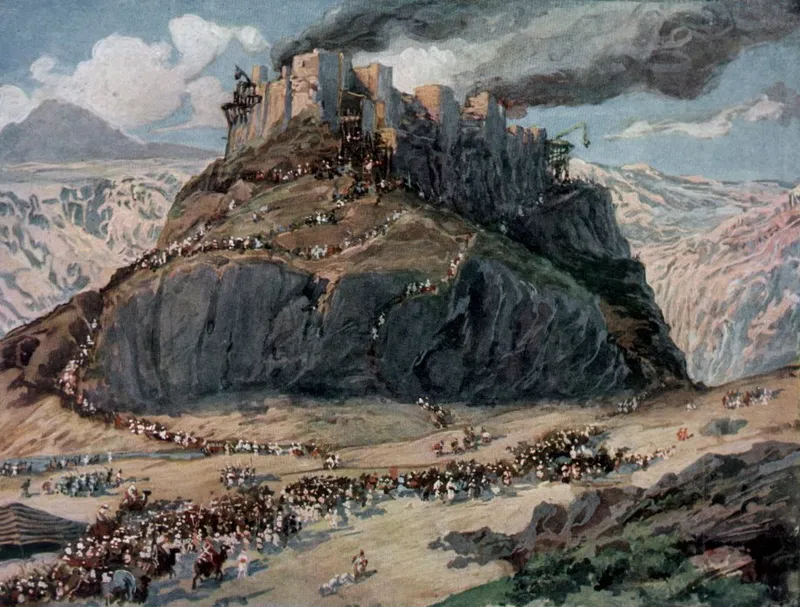
Joshua 12:7-16The Kings of the West · The Roll Begins
7And these are the kings of the country which Joshua and the children of Israel smote on this side Jordan on the west, from Baalgad in the valley of Lebanon even unto the mount Halak, that goeth up to Seir; which Joshua gave unto the tribes of Israel for a possession according to their divisions; 8In the mountains, and in the valleys, and in the plains, and in the springs, and in the wilderness, and in the south country; the Hittites, the Amorites, and the Canaanites, the Perizzites, the Hivites, and the Jebusites: 9The king of Jericho, one; the king of Ai, which is beside Bethel, one; 10The king of Jerusalem, one; the king of Hebron, one; 11The king of Jarmuth, one; the king of Lachish, one; 12The king of Eglon, one; the king of Gezer, one; 13The king of Debir, one; the king of Geder, one; 14The king of Hormah, one; the king of Arad, one; 15The king of Libnah, one; the king of Adullam, one; 16The king of Makkedah, one; the king of Bethel, one;
With verse 7 the chapter crosses the river and turns to Joshua's own campaign: these are the kings of the country which Joshua and the children of Israel smote on this side Jordan on the west. The header mirrors verse 1 almost word for word - same verb, smote; same outcome, land given… for a possession. What Moses did in the east, Joshua now does in the west, and the matching language insists it is one continuous work of the same God through successive servants.
The boundaries are drawn from Baal-gad in the valley of Lebanon in the far north down to the mount Halak, that goeth up to Seir in the south - the whole length of the land. Then verse 8 sweeps across its terrain and its peoples: the mountains and valleys and plains and springs and wilderness and south country; the Hittites, Amorites, Canaanites, Perizzites, Hivites, and Jebusites. Six landscapes, six nations. The writer wants the reader to feel the comprehensiveness before the names even begin.
This was the land in all its varied country and all its varied peoples, brought under the hand of the One who had promised it - every region, none held out.
And then the roll itself begins, in the flattest, most unadorned grammar imaginable: The king of Jericho, one; the king of Ai, which is beside Bethel, one (v. 9). It is no accident that Jericho stands first. Jericho was the threshold - the first city to fall when Israel crossed the Jordan, the one whose walls came down without a battering ram, the proof at the very outset that this conquest would be the LORD's doing and not Israel's engineering.
And Ai follows second, which carries its own memory: Ai was the place of Israel's one humiliating defeat, when sin in the camp turned a small city into a rout, until the matter was set right and the city taken. To list Jericho and Ai first is to begin the register where the story began - with the impossible victory and the costly lesson both. Every later name on the list stands downstream of these two: the God who opened the land at Jericho, and the God who taught at Ai that victory is never automatic but always His to give.
The roll-call does not start arbitrarily. It starts at the door.
Then the names come, two to a verse, each stamped with the same small word: one. The king of Jerusalem, one; the king of Hebron, one… the king of Jarmuth, one; the king of Lachish, one (vv. 10-11). The modern eye wants to skim. Resist it, and read them slowly - because every one is a world. Behind each name stood a fortified city with its own walls and gates, its own standing army, its own king on his own throne, its own temple and gods.
Archaeology has turned up many of these very places - Lachish, Hebron, Jerusalem, Eglon - their ruins and gate-complexes and burn-layers still in the ground. These were not symbols; they were power, the concentrated military and political might of a civilization. And to each one the chapter answers with a single syllable: one. Counted. Finished. Added to the tally. There is something almost merciful in the flatness of it. The text does not gloat over fallen cities or linger over slaughter.
It simply numbers them, the way a shepherd numbers sheep through a gate - one, and one, and one - and moves on. Each one is a stronghold that thought itself permanent, reduced to a single word in a list because the word of God proved more permanent than any of them.
Joshua 12:17-24All the Kings Thirty and One
17The king of Tappuah, one; the king of Hepher, one; 18The king of Aphek, one; the king of Lasharon, one; 19The king of Madon, one; the king of Hazor, one; 20The king of Shimronmeron, one; the king of Achshaph, one; 21The king of Taanach, one; the king of Megiddo, one; 22The king of Kedesh, one; the king of Jokneam of Carmel, one; 23The king of Dor in the coast of Dor, one; the king of the nations of Gilgal, one; 24The king of Tirzah, one: all the kings thirty and one.
The list runs on to its close - Tappuah… Hepher… Aphek… Madon… Hazor… Megiddo… Kedesh - gathering up cities scattered across the whole map of Canaan, north to south, coast to highland (vv. 17-23). Some of these names would echo for centuries: Hazor was the head of the northern kingdoms, a great fortified city that Joshua burned; Megiddo guarded the most important pass in the land and would see battle after battle down the ages; Taanach and Dor and the rest each held their stretch of ground.
The writer is not arranging them for drama. He is simply being thorough, and the thoroughness is the message. This is a complete accounting - the entire network of Canaanite power, region by region, brought into one list, with nothing famous highlighted and nothing awkward omitted. When God said He would give the land, He did not mean some of it, the easy parts, the lowlands where chariots could not reach. He meant the land. The roll-call's very completeness is a kind of faithfulness made visible: nothing left off the page, because nothing was left undone.
And then the sum: The king of Tirzah, one: all the kings thirty and one (v. 24). After thirty-one repetitions of that small word, the chapter gathers them into a single total - and the total lands like the closing of a book. Thirty and one. It is the most undramatic sentence imaginable, and it carries the whole weight of the chapter. Add the number up and you are looking at the entire military, political, and religious power structure of Canaan: every throne, every army, every walled capital, every shrine to every god - all of it, counted and finished.
The thirty-one strongholds that each believed themselves permanent are now one phrase at the bottom of a ledger. The reader is asked to stand in awe of the completeness. The text has been candid elsewhere about what those societies practiced. Nothing was left standing that could resist the purpose of God. What He swore, He performed - not partway, not mostly, but entirely, down to the thirty-first name. The flat little phrase is, in truth, one of the loudest statements of faithfulness in the book: God finishes what He begins.
Research trail
Sources & further study
These references support the historical, linguistic, manuscript, and contextual notes in this chapter. Scripture remains the primary text; external sources are provided so readers can inspect the research directly.
- Joshua 12 - Translators' NotesThe NET Bible's detailed footnotes on Joshua 12 - the eastern boundaries from the Arnon to mount Hermon (vv. 1-3), the identity of Sihon and Og and the “remnant of the giants” (vv. 2-5), the geography of the western campaign (vv. 7-8), and the structure of the thirty-one-king list that follows.
- Joshua 12 · Hebrew + classical Jewish commentaryThe Hebrew text of Joshua 12 with Rashi and other classical commentators alongside - useful for the verb nakah (v. 1, “smote,” the LORD-given defeat of the kings), for yarash (v. 1, “possessed,” the taking of the land as inheritance), and for the geography of Sihon's and Og's territories named in verses 2-5.
- Joshua 12 ↔ Joshua 21 · Hebrews 4 · 1 Corinthians 15 · Psalm 110Traces the threads tying Joshua 12 to the rest of Scripture - the roll of conquered kings (vv. 9-24) read beside the summary that there failed not ought of any good thing which the LORD had spoken (Josh. 21:45), the rest won by conquest read beside the rest that remaineth (Heb. 4:8-9), and the subduing of every king read beside the reign in which Christ must… put all enemies under his feet (1 Cor. 15:25; Ps. 110:1).
Where this echoes in Scripture
The Kings of the East · Sihon and Og
- Numbers 21:33-35they smote him, and his sons, and all his people... and they possessed his land.The defeat of Og (v. 4) as it first happened under Moses - the giant king struck down and his land taken.
- Deuteronomy 3:11For only Og king of Bashan remained of the remnant of giants; behold, his bedstead was a bedstead of iron... nine cubits.The lineage named in verse 4 - Og the last of the giants, his great bed a measure of the foe that fell.
- Joshua 21:45There failed not ought of any good thing which the LORD had spoken unto the house of Israel; all came to pass.The summary of which this whole list is the proof - every word God spoke, performed down to the last name.
- Hebrews 4:8-9For if Jesus had given them rest, then would he not afterward have spoken of another day... There remaineth therefore a rest to the people of God.The rest Joshua won (v. 6) read as a foreshadow - real, yet pointing past itself to a greater rest in the One who bears his name.
- Psalm 135:10-12Who smote great nations, and slew mighty kings; Sihon king of the Amorites, and Og king of Bashan... and gave their land for an heritage.Israel's own praise rehearsing verses 2-6 - the kings smitten and the land given remembered as the LORD's doing.
The Kings of the West · The Roll Begins
- Joshua 6:20the wall fell down flat... and they took the city.The fall of Jericho, the first name on the western roll (v. 9) - the threshold victory that proved the conquest was the LORD's.
- 1 Corinthians 15:25-26For he must reign, till he hath put all enemies under his feet. The last enemy that shall be destroyed is death.The pattern of the roll-call (vv. 9-16) carried to its end - every enemy named and subdued under the reign of Christ.
- Psalm 110:1The LORD said unto my Lord, Sit thou at my right hand, until I make thine enemies thy footstool.The promise behind the conquest - every hostile power, like every king here, finally made a footstool.
- Colossians 2:15And having spoiled principalities and powers, he made a shew of them openly, triumphing over them in it.The decisive defeat of every power, foreshadowed by the long list of kings smitten in verses 9-16.
- Deuteronomy 7:1hath cast out many nations before thee, the Hittites, and the Girgashites, and the Amorites, and the Canaanites...The nations of verse 8 named in the promise beforehand - the peoples God said He would give into Israel's hand.
All the Kings Thirty and One
- Joshua 11:10Hazor beforetime was the head of all those kingdoms.The standing of Hazor (v. 19) - the greatest of the northern cities, named here among the thirty-one that fell.
- Joshua 21:45There failed not ought of any good thing which the LORD had spoken unto the house of Israel; all came to pass.The verse the total of verse 24 proves - the completeness of the count matching the completeness of the promise kept.
- 1 Peter 1:4To an inheritance incorruptible, and undefiled, and that fadeth not away, reserved in heaven for you.The inheritance possessed by conquest (v. 1) lifted to its fullness - a possession that cannot be lost.
- Nehemiah 9:24So the children went in and possessed the land... and thou gavest them into their hands, with their kings, and the people of the land.Israel's later prayer rehearsing this very chapter - the kings given into their hands, the land possessed.
- Romans 8:37Nay, in all these things we are more than conquerors through him that loved us.The conquest of verse 24 carried into the believer's life - every power overcome through the One who leads His people in.