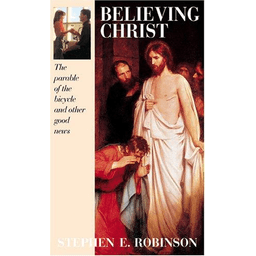
- Starting price
- ~$13 paperback
- Free tier
- No
- Platforms
- Print · Kindle · Audiobook
- Developer
- Deseret Book
- Launched
- 1992
- Updated
- May 31, 2026
The verdict
Believing Christ is the book Latter-day Saints hand to a friend who is exhausted by trying to be perfect. Stephen E. Robinson takes a single distinction - believing IN Christ versus actually believing Christ - and builds a short, warm, pastoral case that the Atonement was meant to apply to them, personally, now. It speaks from inside the Latter-day Saint tradition to readers in it, and within that audience it has been quietly transformative for more than thirty years.
Try Believing Christ ↗Opens deseretbook.com
Believing Christ has quietly become one of the most pressed-into-your-hands books in Latter-day Saint life. A returned missionary burning out on her own checklist gets a copy. A father who feels he will never measure up gets a copy. A bishop keeps a small stack in his office. The book occupies a specific and unusual piece of real estate: it is a work of accessible theology that found its way into ordinary devotional reading, and it did so by addressing a feeling that a great many faithful readers recognized the moment they saw it named on the page.
The book was written by Stephen E. Robinson, a Latter-day Saint scholar who was teaching at Brigham Young University when it appeared in 1992. It is short - somewhere around 120 pages - and it does not read like a scholarly monograph. It doesn't bury you in footnotes. It doesn't assume a seminary vocabulary. It doesn't argue at you. Robinson writes the way a thoughtful teacher talks to one person across a table: plainly, with stories from his own family, circling a single idea until it comes into focus and stays there.
That single idea is the engine of the whole book. Many faithful Latter-day Saints, Robinson observes, believe IN Christ without much difficulty - they affirm that He exists, that He is the Son of God, that He is the Savior. What they struggle to do is believe Christ: to actually trust that what He promised is true for them, that His grace and His Atonement reach all the way down to their own failures and exhaustion. Robinson's claim is that the gap between those two kinds of belief is where a lot of sincere people get stuck, and that closing it is the difference between a religion of grinding self-improvement and a relationship with a Savior. The book's job, from the first chapter, is to close that gap.
✓ The good
- One clarifying idea, delivered cleanly - the believe-IN-Christ versus believe-Christ distinction is the kind of frame readers remember and repeat for years
- The parable of the bicycle is genuinely effective - a homely, concrete image that does real explanatory work and is the part nearly everyone quotes
- Short and humane - around 120 pages of plain, warm prose you can read in an evening and hand to someone who is struggling
- Pastoral rather than academic - Robinson writes from his own family, which makes the book feel like counsel from a friend instead of a lecture
- Speaks directly to perfectionism - for readers worn down by the feeling that they will never be good enough, the book names that exhaustion and addresses it head-on
- Grounded throughout in scripture and the Latter-day Saint understanding of the Atonement - it stays anchored to the texts and teachings its readers already hold
- Has aged well within its audience - more than thirty years on, it is still actively recommended and re-read, which is rare for a popular devotional title
✗ Watch out
- Written specifically for a Latter-day Saint readership - it assumes that context, vocabulary, and canon throughout, so readers outside the tradition will read it as one tradition's pastoral theology of grace
- Short and devotional rather than scholarly - by design a pastoral book, not a comprehensive or technical study of the Atonement, so readers wanting depth will need to go further
- Single-idea by construction - the believe-IN versus believe-Christ frame carries the whole book, and a reader who grasps it early may find the later chapters reinforcing rather than expanding it
- The conversational, family-anecdote style that many readers love can feel slight or repetitive to readers who prefer rigor and citation
- Not free - unlike older public-domain Latter-day Saint classics, it is an in-copyright title you have to buy, though used copies are cheap and plentiful
Best for
- Latter-day Saints worn out by perfectionism and self-reckoning
- Readers who want one short, warm book on grace and the Atonement
- Anyone handing a struggling friend something accessible and encouraging
- Returned missionaries, new converts, or members in a discouraged season
Avoid if
- You want a comprehensive or technical theology of the Atonement
- You are looking for a tradition-neutral treatment rather than a Latter-day Saint one
- You prefer heavily footnoted, citation-driven scholarship
- You bounce off devotional, anecdote-led prose and want sustained argument
What Believing Christ is
Believing Christ is Stephen E. Robinson's short, accessible book on grace and the Atonement of Jesus Christ, first published by Deseret Book in 1992. It is written from within the Latter-day Saint tradition and for a Latter-day Saint readership, and at roughly 120 pages it is built to be read in a sitting or two. Its organizing argument is a distinction Robinson draws early and returns to throughout: that there is a difference between believing IN Christ - affirming that He is real and is the Savior - and believing Christ, meaning actually trusting that His promises and His Atonement apply personally to the reader.
Around that distinction the book gathers a series of plainly told illustrations, the most famous of which is the parable of the bicycle, drawn from an exchange with one of Robinson's own children. The tone is pastoral and personal rather than systematic; Robinson teaches through story and through scripture his readers already hold rather than through technical theology. The book speaks within and to the Latter-day Saint tradition, addressing readers who are familiar with its vocabulary and canon, and it has remained one of the most widely recommended titles in that setting since it appeared.
Why Latter-day Saint readers keep reaching for it
A great deal of popular religious writing aims to inform - to explain a doctrine, defend a claim, walk through a passage. Believing Christ is doing something narrower and, for its readers, more useful: it is trying to dislodge a single stuck feeling. Robinson is writing for the sincere, active member who is doing everything asked and still privately believes they are failing - that grace is real in theory but somehow not for them. He names that experience precisely, and a reader who has lived inside it tends to feel, often for the first time, that someone has described their actual interior life on the page.
What makes the book travel is that it does this without scolding and without softening. Robinson does not tell the exhausted reader to try harder, and he does not tell them the standard does not matter. He reframes the relationship: the Atonement, in his telling, is not a reward you earn by finally becoming good enough but a partnership you enter now, as you are. That reframing - delivered in plain language, anchored in scripture and the tradition's own teaching on the Atonement, and carried by a story about a bicycle - is why the book has stayed in circulation for more than three decades when most devotional titles fade in five.
The believe-IN-Christ versus believe-Christ distinction
The book's central move is a deceptively simple piece of wordplay that turns out to carry real weight. Robinson distinguishes between believing IN Christ and believing Christ. To believe IN Christ is to affirm propositions about Him - that He exists, that He is the Son of God, that He is the Redeemer. Robinson takes for granted that his readers already do this; it is, for the faithful Latter-day Saint audience he is writing to, the easy part. To believe Christ, by contrast, is to take Him at His word: to actually trust that the things He promised - forgiveness, sufficiency, a place with Him - are true for you, personally, in your present condition rather than some future improved one.
Robinson's diagnosis is that a lot of devout, hardworking people live in the gap between those two. They affirm the doctrine and still carry a quiet conviction that the grace it describes is meant for other, better people. Naming that gap is most of what the book accomplishes, and it is why readers describe the distinction as something that reorganized how they read scripture and how they understood the Atonement they had affirmed for years. The frame is the book's engine; almost everything else is illustration of it.
The parable of the bicycle
The most famous passage in the book, and the one named in its subtitle, is the parable of the bicycle. Robinson tells it from his own family: a young child wants a bicycle and dutifully saves her pennies, only to discover that even all the money she has comes nowhere close to the price. A parent, seeing both the longing and the genuine effort, offers a deal - give me everything you have, and a hug, and I will cover the rest. The child's pennies do not buy the bicycle. They are nowhere near enough. But they are accepted as her whole part, and the gift is given.
The parable does real work because it holds two things together that struggling readers tend to experience as opposites: the requirement to give everything you have, and the recognition that everything you have will never be the purchase price. In Robinson's telling the small offering is not the cost of the gift but the condition of receiving it - a complete effort, gladly accepted, while the actual price is paid by someone else. It is a homely, concrete image, and it has become the single most quoted thing in the book precisely because it makes the abstraction of grace something a reader can picture instantly.
A pastoral book about perfectionism, not a treatise
It is worth being clear about what kind of book this is, because that shapes who should read it. Believing Christ is short, warm, and pastoral. Robinson writes from his own life - his marriage, his children, his own moments of discouragement - and the prose has the cadence of counsel rather than scholarship. He is not building a comprehensive doctrine of the Atonement, defending it against objections, or surveying how it has been understood across centuries. He is sitting with a specific reader and a specific ache, and nearly every chapter is aimed at that reader.
That ache is perfectionism: the grinding, often invisible exhaustion of feeling that you must be flawless and that you are perpetually falling short. The book speaks to that experience with unusual directness, which is why it lands so hard for the people it is written for and why it is so often given as a gift. The flip side is that a reader looking for rigor, citation, and breadth will find the book intentionally narrow. It is doing one thing, on purpose, for one audience - and judged on those terms it does it remarkably well.
Pricing
Paperback
~$13
The standard Deseret Book paperback and the copy most readers own. Used copies turn up everywhere for a few dollars.
Kindle / eBook
~$10-13
Searchable and highlight-syncing, available from Deseret Book and major retailers. Roughly the price of paperback.
Audiobook
~$10-16
A narrated edition exists for listeners who prefer to commute or walk with it. As of writing, pricing varies by retailer.
Used / secondhand
~$1-5
After thirty-plus years in print the secondhand supply is enormous - the way many readers acquire their first copy.
Believing Christ is not free, which sets it apart from the older Latter-day Saint classics that have passed into the public domain. It is an in-copyright Deseret Book title, so you buy it - but it has been in print for more than thirty years, so the practical floor on price is very low. Used paperbacks turn up at thrift stores and library sales for a dollar or two, which is how a great many readers acquire their first copy.
A new paperback runs around $13 from Deseret Book and major retailers - call it the everyday default and the edition most quotations are keyed to. The Kindle or eBook edition lands in roughly the same range, with the usual benefits of searchable text and highlights that sync across devices, which is genuinely useful for a book this quotable and this often shared.
An audiobook edition exists for readers who prefer to listen; as of writing its price varies by retailer, generally in the neighborhood of the print. Most readers do not need anything beyond the paperback. At this length and price the book is an easy, low-stakes recommendation - cheap enough to buy several copies and give them away, which is exactly what its readers tend to do.
Where Believing Christ falls behind
Audience scope. The book is written specifically for Latter-day Saints, in the vocabulary and canon of that tradition, and it never pretends otherwise. That is a feature for its intended reader and a limit for everyone else: a reader outside the tradition will encounter it as one tradition's pastoral theology of grace rather than a general account, and some of its references will land differently than for the audience Robinson is addressing.
Depth. By design this is a short devotional book, not a comprehensive or technical study. Robinson is not surveying the doctrine of the Atonement in detail, weighing competing accounts, or engaging objections at length. That is the right call for the book he set out to write, but it means Believing Christ is a starting point and an encouragement rather than a thorough treatment, and a reader who wants rigor will need to read further.
Single idea. The believe-IN-Christ versus believe-Christ distinction is the whole architecture, and the parable of the bicycle is its centerpiece. A reader who grasps both in the first chapter may feel the later chapters reinforcing the point more than extending it. The repetition is part of how the book works - it is trying to make one truth stick - but readers who prize forward momentum sometimes notice the book circling.
Style. The conversational, anecdote-led voice that makes the book feel like counsel from a friend is not for everyone. Readers who prefer sustained argument, citation, and a more formal register can find the family stories slight. It is a matter of taste rather than a defect, but it is worth knowing going in.
Believing Christ vs. The God Who Weeps vs. Jesus the Christ
These three are accessible windows into Latter-day Saint belief, and they do genuinely different jobs. Believing Christ (Robinson, 1992) is the short, pastoral book on grace and the Atonement - one clarifying idea, a memorable parable, and a warm voice aimed squarely at the discouraged reader. The God Who Weeps (Terryl and Fiona Givens, 2012) is the contemporary, literary meditation - reflective and essayistic, drawing on poetry and philosophy to articulate why Latter-day Saint belief is worth holding, more atmosphere than argument. Jesus the Christ (James E. Talmage, 1915) is the comprehensive classic - a roughly 700-page, chapter-by-chapter life of Christ from within the tradition, thorough and deliberate where the other two are brief.
Different strengths. Robinson is the most immediately consoling - the book you hand to someone who is exhausted and needs encouragement this week. The Givenses are the most literary and reflective - better for a reader drawn to beauty and big questions than to a single practical frame. Talmage is the most exhaustive - the one you reach for when you want depth and scope rather than a short read. If your need is encouragement about grace, start with Robinson. If it is a reflective case for belief, add the Givenses. If it is a full study of the life of Christ, that is Talmage's book.
All three are read within the Latter-day Saint tradition and written from inside it. Believing Christ is the most narrowly focused, the shortest, and the one most often given away. Each teaches from that tradition's canon and doctrine throughout, so a reader outside it will encounter all three as expressions of one tradition's understanding rather than tradition-neutral works.
The bottom line
Believing Christ is the book Latter-day Saints reach for when grace has started to feel like one more thing to fail at. Robinson takes a single distinction - believing IN Christ versus believing Christ - and a single homely parable, and uses them to tell an exhausted reader that the Atonement was always meant for them, now, as they are. It is short, warm, anchored in scripture and the tradition's own teaching, and unusually direct about perfectionism. It is pastoral rather than scholarly and speaks from inside its tradition to readers in it - but for that reader, it has been quietly changing how people understand grace for more than thirty years. If someone you love is worn out by trying to be perfect, this is the book to hand them.
Alternatives to Believing Christ
 The God Who WeepsTerryl and Fiona Givens's contemporary, literary meditation on Latter-day Saint belief - reflective and essayistic rather than a single practical frame.
 Jesus the ChristJames E. Talmage's comprehensive 1915 life of Christ from within the tradition - exhaustive and chapter-by-chapter where Robinson is short and pastoral.
 The Book of MormonThe keystone scripture of the Latter-day Saint canon - the primary text Robinson writes alongside and the natural place to read further on the Atonement.
 Gospel LibraryThe official free Latter-day Saint study app - scripture, footnotes, audio, and a deep library for following any thread the book opens up.
Frequently asked questions
Who wrote Believing Christ, and when?
Stephen E. Robinson, a Latter-day Saint scholar who was teaching at Brigham Young University, wrote it, and it was first published by Deseret Book in 1992. It grew out of his teaching and speaking on grace and the Atonement and was written for a general Latter-day Saint readership rather than an academic one.
What is the parable of the bicycle?
The book's most famous illustration, named in the subtitle and drawn from Robinson's own family. A child saves her pennies for a bicycle but cannot come close to the price; a parent offers to cover the rest in exchange for everything she has saved and a hug. The pennies do not buy the bicycle, but they are accepted as her whole part while the real price is paid by someone else - his homely picture of grace and the Atonement.
What does "believing Christ" mean as opposed to "believing in Christ"?
It is the distinction the whole book turns on. Believing IN Christ, in Robinson's framing, is affirming that He is real and is the Savior. Believing Christ goes further: actually trusting that what He promised is true for you personally, right now. His argument is that many faithful readers do the first easily and get stuck on the second.
Is this a Latter-day Saint book?
Yes. It is written from within the Latter-day Saint tradition and for a Latter-day Saint readership, drawing on that tradition's scripture, vocabulary, and teaching on the Atonement throughout. A reader outside the tradition can certainly read it, but will encounter it as one tradition's pastoral theology of grace rather than a tradition-neutral treatment.
How long is the book, and is it hard to read?
It is short - around 120 pages - and it is not hard to read. Robinson writes in plain, warm, conversational prose, teaching through personal stories and scripture rather than technical theology. Most readers finish it in an evening or two, which is part of why it is so often given away as a gift.
Is Believing Christ free?
No. Unlike older Latter-day Saint classics in the public domain, it is an in-copyright Deseret Book title, generally around $13 new for the paperback, with eBook and audiobook editions in a similar range. After thirty-plus years in print, though, used copies are plentiful - often a dollar or two secondhand.
Who is this book best for?
Readers - especially Latter-day Saints - worn down by perfectionism and the feeling that they will never be good enough, who want one short, encouraging book on grace and the Atonement. It is a frequent gift for returned missionaries, new converts, and anyone in a discouraged season. It is not the book to choose if you want a comprehensive or heavily footnoted theology.
Sources & further reading
More Latter-day Saint Books
 The Doctrine and CovenantsThe volume of modern revelations at the center of Latter-day Saint scripture - 138 sections, two Official Declarations, and the founding document of a still-growing church.
 The Pearl of Great PriceThe shortest of the four Latter-day Saint standard works - five short texts that hold the First Vision account, the Articles of Faith, and some of the tradition’s most-quoted scripture.
 The Standard Works (Quad)The four-in-one scripture set most Latter-day Saints carry - King James Bible, Book of Mormon, Doctrine and Covenants, and Pearl of Great Price, bound with one of the most thorough study apparatuses in print.Jesus the ChristJames E. Talmage's 1915 study of the life and mission of Jesus Christ - for over a century the standard Latter-day Saint treatment of the Messiah, and now free in the public domain.
 Come, Follow MeThe official home-centered, church-supported study curriculum of the Church of Jesus Christ of Latter-day Saints - the weekly reading schedule the whole Church follows together, free in Gospel Library and in print.The Book of Mormon Study GuideA single-volume, verse-by-verse companion that walks a Latter-day Saint reader through the entire Book of Mormon - background, commentary gathered from Church leaders and scholars, maps, and helps, all keyed to the text you read alongside it.