- Starting price
- Free
- Free tier
- Yes
- Platforms
- Gospel Library app · Print · Kindle · Audiobook · Web
- Developer
- The Church of Jesus Christ of Latter-day Saints
- Launched
- 1835
- Updated
- May 31, 2026
The verdict
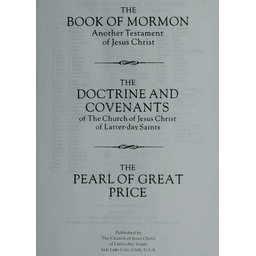
The Doctrine and Covenants is one of the four standard works of The Church of Jesus Christ of Latter-day Saints - a collection of modern revelations, most given through Joseph Smith, that Latter-day Saints receive as scripture on the same footing as the Bible and the Book of Mormon. It is the most administrative and the most contemporary of the standard works, and the one that most directly shapes how the Church is governed and how its members understand their own history.
Try The Doctrine and Covenants ↗Opens churchofjesuschrist.org
The Doctrine and Covenants occupies a place no other book of scripture does. The Bible is ancient. The Book of Mormon is presented as an ancient record translated in the 19th century. The Doctrine and Covenants is almost entirely 19th-century in its own voice - a sequence of revelations, most of them received through Joseph Smith between 1828 and 1844, with a handful of later additions, that Latter-day Saints receive as the word of God for the founding and ordering of the Restoration. It is scripture written, in effect, in real time, addressed to named people facing concrete decisions.
It does not read like the Bible. It does not read like the Book of Mormon. It does not read like a narrative at all. Most sections open with a short editorial header giving the date, place, and circumstance, and then move directly into revelation - instructions on organizing the Church, answers to specific questions Joseph Smith brought to the Lord, doctrinal expositions on subjects from the afterlife to the nature of priesthood, and the occasional sharply personal word to an individual. The effect is less like reading a story and more like reading the founding correspondence of a movement, if that correspondence were received as divine.
First published in 1835 (expanding the 1833 Book of Commandments), the volume has grown over time and remains, by the tradition's own understanding, open to addition - a scripture that can still receive new sections. The current edition contains 138 numbered sections plus two Official Declarations, the documents that announced the end of the practice of plural marriage (1890) and the extension of priesthood ordination to all worthy male members (1978). For Latter-day Saints it is indispensable; for any reader trying to understand the Restoration tradition from the inside, it is the single most revealing text there is.
✓ The good
- One of the four standard works - Latter-day Saints receive it as scripture alongside the Bible, the Book of Mormon, and the Pearl of Great Price, and it is the doctrinal backbone of much of the Church's teaching
- Uniquely contemporary - most of its content is modern revelation in its own voice, addressed to identifiable people and situations, which makes it unusually concrete and grounded
- The clearest single source for distinctive Restoration doctrine - sections like 76, 88, 121, and 130 lay out teaching on the degrees of glory, priesthood, and the premortal and postmortal life in language found nowhere else in scripture
- Completely free to read - the full text, study helps, and audio are in Gospel Library and on churchofjesuschrist.org at no cost, with at-cost print editions
- Richly cross-referenced in the official edition - footnotes link sections to the Bible, the Book of Mormon, and the Topical Guide, so a reader can trace a theme across all the standard works
- Section headings and historical context are unusually well documented - the date, place, and circumstance of nearly every revelation are known and extensively sourced
- Short sections make it approachable in daily portions - many run a page or two, and the Come, Follow Me curriculum walks the whole book on a manageable schedule
✗ Watch out
- Presupposes familiarity with early Church history - many sections respond to events, people, and places a newcomer will not recognize without a study companion or the section headings
- Not a narrative read - organized roughly chronologically by revelation rather than as a story, it lacks the plot momentum of the Bible's histories or the Book of Mormon
- The 19th-century revelatory diction (thee, thou, the language of decree) takes some adjustment for readers used to modern-English scripture
- Rewards a study apparatus - the headings, dates, and historical introductions do a lot of the work, and the bare text without them leaves much context on the table
- Topical rather than systematic - doctrine is spread across sections by the order revelations came, so a full picture of any one subject means cross-referencing several places
Best for
- Latter-day Saints studying their own scripture at depth or following Come, Follow Me
- Readers wanting to understand Restoration doctrine and Church governance from the primary text
- Students of 19th-century American religious history reading the sources directly
- Anyone who has heard a section quoted and wants to read it in full context
Avoid if
- You want a continuous narrative rather than a collection of discrete revelations
- You want a text that stands alone without historical context or study helps
- You are looking for the shared Christian canon of the Catholic, Orthodox, or Protestant Bible
- You prefer modern-English phrasing and find revelatory diction hard going
What The Doctrine and Covenants is
The Doctrine and Covenants is one of the four books of scripture - the standard works - of The Church of Jesus Christ of Latter-day Saints, alongside the King James Bible, the Book of Mormon, and the Pearl of Great Price. It is a collection of revelations, most received through Joseph Smith in the 1820s, 1830s, and early 1840s, together with a small number of later additions and two Official Declarations. The current edition contains 138 numbered sections plus the two declarations. Where the other standard works are ancient or presented as ancient, the Doctrine and Covenants is the modern-revelation volume, and Latter-day Saints understand it as remaining open to further additions.
It was first published in 1835, expanding and replacing the 1833 Book of Commandments, and has grown through subsequent editions as additional revelations were canonized. The book is distinctive to the Restoration tradition and is not part of the Catholic, Orthodox, or Protestant Bible. Its sections range widely in subject and length - some are a few verses of personal counsel, others are extended doctrinal discourses on the afterlife, priesthood, or the organization of the Church. Most are dated and tied to a specific historical occasion, which gives the volume its characteristic grounded, documentary feel.
Why Latter-day Saints turn to it for doctrine and governance
The single biggest practical difference between the Doctrine and Covenants and the other standard works is immediacy. The revelations are dated, addressed, and occasioned - section 25 is directed to Emma Smith, section 121 was received while Joseph Smith was imprisoned in Liberty Jail, section 89 (the Word of Wisdom) responds to a specific question about health and conduct. Because the circumstances are known, readers can see exactly what question a revelation was answering, which makes the doctrine feel anchored rather than abstract.
It is also the volume that most directly shapes how the Church runs. Much of its content is organizational - how the priesthood is structured, how councils operate, how leaders are called, how the Church gathers and cares for its members. For Latter-day Saints, that makes the Doctrine and Covenants both a doctrinal text and a kind of constitutional one, the place where the offices and patterns of the modern Church are established. Many of the teachings members consider most distinctive - on the premortal life, the degrees of glory, eternal families, and the destiny of the human soul - are stated most fully here.
Modern revelation in its own voice - scripture addressed to real people and moments
The defining feature of the Doctrine and Covenants is that most of it is presented as revelation received in the 19th century and recorded as it came, rather than a translated ancient record or a compiled history. Each section typically carries a header giving the date, the place, and the circumstance - a question asked, a crisis faced, a decision pending - and then renders the revelation itself, often in the first person as the voice of the Lord. Section 76 records a shared vision of the afterlife. Section 88 is called "the olive leaf" and ranges across light, law, and the resurrection. Section 121, written from a jail cell, turns suffering into one of the volume's most quoted passages on leadership and the use of authority.
This sounds like a small thing. In practice it shapes the whole reading experience. Because the revelations are tied to identifiable moments, the doctrine arrives already embedded in a situation - you are not handed an abstract proposition but watching a specific question answered. For Latter-day Saints that immediacy is part of the volume's power: the same God who spoke to ancient prophets is presented as speaking to a named people in a documented time and place. For any reader, it makes the text unusually concrete, and it is why the section headings and historical context matter so much to getting the most out of it.
Distinctive doctrine and Church governance, gathered in one place
If you want to understand what is distinctive about Latter-day Saint belief and practice, the Doctrine and Covenants is the densest single source. The teaching on the three degrees of glory - celestial, terrestrial, and telestial - is laid out in section 76. The structure and offices of the priesthood are established across several sections. The Word of Wisdom, the health code familiar even to outside observers, is section 89. Sections 130 and 131 record short, pointed statements on the nature of God, eternal marriage, and the conditions of exaltation. The organization of councils, the law of consecration, the work of redeeming the dead, and the gathering of the Church all have their primary scriptural footing here.
The other half of the book is governance. The Doctrine and Covenants is where the modern Church's administrative pattern is set down - how revelation flows through called leaders, how quorums are formed, how decisions are made by common consent, how the Church is to handle its members, its property, and its mission. For Latter-day Saints this dual character is the point: the book is at once a doctrinal compendium and the founding charter of an institution, and the two are not separable. Reading it is the most direct way to see how the tradition understands both what it believes and how it is meant to operate.
The Official Declarations and the open canon
Appended after the 138 sections are two Official Declarations, documents the Church canonized as part of the volume. Official Declaration 1 (1890), the Manifesto issued by President Wilford Woodruff, announced the end of the practice of plural marriage. Official Declaration 2 (1978) announced the revelation extending priesthood ordination and temple ordinances to all worthy male members of the Church without regard to race. Both are presented in the text with their dates and context, and both mark turning points in the tradition's history that the volume records as part of its own ongoing story.
Their presence points to something structural about the book: among the standard works, the Doctrine and Covenants is understood to remain open. Latter-day Saints hold that revelation continues and that the canon can still grow - the most recent sections and declarations were added in the 19th and 20th centuries, and the tradition does not regard the volume as closed. That openness is part of what distinguishes the Doctrine and Covenants from a finished ancient text. It is scripture that the tradition believes is, in principle, still being written.
Pricing
Gospel Library (digital)
Free
The full text, footnotes, Topical Guide links, study notes, and free audio in the official Gospel Library app and on churchofjesuschrist.org. The way most members read it day to day.
Standalone print
At cost (~$5-$15)
A bound Doctrine and Covenants on its own, sold at or near cost through Church distribution and Deseret Book. Inexpensive and common in classrooms.
Triple Combination
~$10-$40
The Doctrine and Covenants bound with the Book of Mormon and the Pearl of Great Price in one volume - the standard study set for the modern revelations alongside the other Restoration scriptures.
Quad (Quadruple Combination)
~$30-$90+
All four standard works in one volume - the King James Bible plus the Triple Combination. Leather and personalized editions run higher; the everyday hardcover is modest.
Audiobook
Free (Gospel Library) / paid retail editions vary
Official narrated audio is free in Gospel Library; standalone audiobook editions are also sold through major retailers at typical audiobook prices.
For practical purposes, the Doctrine and Covenants is free. The complete text - with footnotes, cross-references to the rest of the standard works, the Topical Guide, study notes, and free narrated audio - is in the official Gospel Library app and on churchofjesuschrist.org at no cost and with no account barrier for reading. For the overwhelming majority of readers, digital is the everyday way in, and it is the most fully featured.
In print, the volume is sold at or near cost through Church distribution channels and at typical retail through Deseret Book and other sellers. A standalone Doctrine and Covenants runs only a few dollars and is common in classrooms and seminary. The Triple Combination - the Doctrine and Covenants bound with the Book of Mormon and the Pearl of Great Price - is the usual study set for the modern revelations, and the Quad adds the King James Bible for all four standard works in one volume.
Edition prices climb only when you choose materials and personalization: leather bindings, indexed thumb tabs, larger print, and name imprinting move a Quad from a modest hardcover into gift territory. Audiobook editions are sold at standard audiobook prices through major retailers, but the official narration is already free in Gospel Library, so most readers never need to buy audio separately.
Most readers do not need a premium binding. The free digital text is the balanced default - it is searchable, cross-linked to the other standard works, and updated in place - and a low-cost print copy covers anyone who prefers paper for study and marking.
Where The Doctrine and Covenants falls behind
Historical context required. Many sections respond to specific 19th-century events, people, and places, and a reader without that background will miss what a revelation is answering. The official section headings supply a lot of it, but the bare text alone leaves much on the table - a study companion or the Come, Follow Me schedule fills the gap.
Not a narrative. The book is arranged roughly in the order revelations were received, not as a continuous story, so it does not carry a reader along the way the Bible's histories or the Book of Mormon do. It rewards study in portions more than straight-through reading, and newcomers expecting a plot can find the structure disorienting at first.
Topical, not systematic. Doctrine is distributed across sections by chronology rather than gathered by subject, so building a complete picture of any one teaching - priesthood, the afterlife, eternal marriage - means cross-referencing several sections. The footnotes and Topical Guide help, but the assembly is on the reader.
Period diction. The revelations are recorded in 19th-century revelatory English - the language of thee and thou and divine decree - which takes adjustment for readers accustomed to modern-English scripture. It is far from impenetrable, but it is a register, and a few passages read slowly until the ear settles.
Doctrine and Covenants vs. the Book of Mormon vs. the Pearl of Great Price
These three, with the King James Bible, make up the standard works of The Church of Jesus Christ of Latter-day Saints, and each does a different job within the canon. Different strengths. The Book of Mormon is the narrative and devotional core - presented as an ancient record of peoples in the Americas and their dealings with God, it reads as scripture in the familiar sense, with stories, sermons, and a sustained witness of Jesus Christ, and it is the volume most often handed to someone encountering the tradition for the first time.
The Doctrine and Covenants is the modern-revelation and governance volume - contemporary in voice, organized by occasion rather than story, and the densest single source for distinctive Restoration doctrine and for how the Church is structured and run. Where the Book of Mormon is meant to be read, the Doctrine and Covenants is often consulted, section by section, for what it establishes. The Pearl of Great Price is the shortest of the four - a compact collection of the Book of Moses, the Book of Abraham, Joseph Smith-Matthew, Joseph Smith-History, and the Articles of Faith, supplying foundational texts on the Creation, the premortal life, and the tradition's own founding account.
Most Latter-day Saints study all four together, often in a single bound Quad and on a shared yearly schedule. They are complements within one canon, not competitors - the Doctrine and Covenants is simply the part that speaks in the present tense.
The bottom line
The Doctrine and Covenants is the most contemporary and the most administrative of the Latter-day Saint standard works, and the clearest window into how the Restoration tradition understands both its doctrine and itself. Latter-day Saints receive it as scripture and return to it constantly; any reader trying to understand the tradition from the inside will find more of it explained here than anywhere else. It rewards a little historical context and a study schedule, but the text is free, richly cross-referenced, and unusually grounded in real moments. For the questions it answers, there is no substitute.
Alternatives to The Doctrine and Covenants
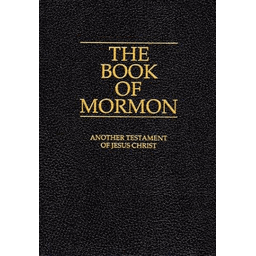 The Book of MormonThe narrative and devotional center of the Latter-day Saint canon - the volume most often read straight through and shared first.
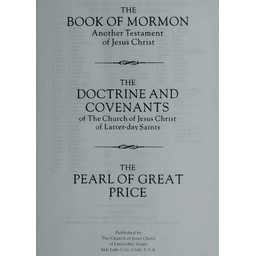 The Pearl of Great PriceThe compact fourth standard work - Moses, Abraham, Joseph Smith-History, and the Articles of Faith in one short, much-cited volume.
 Gospel LibraryThe official free app for reading all four standard works with footnotes, audio, study notes, and the full Church library.
 The Joseph Smith PapersThe free documentary archive behind the revelations - original manuscripts, transcripts, and scholarly apparatus for the sources of the Doctrine and Covenants.
Frequently asked questions
What is the Doctrine and Covenants?
It is one of the four standard works - books of scripture - of The Church of Jesus Christ of Latter-day Saints, alongside the King James Bible, the Book of Mormon, and the Pearl of Great Price. It is a collection of modern revelations, most received through Joseph Smith between the 1820s and 1840s with some later additions, currently containing 138 sections plus two Official Declarations.
How is it different from the Book of Mormon?
The Book of Mormon is presented as an ancient record translated in the 19th century and reads as a narrative scripture with stories and sermons. The Doctrine and Covenants is almost entirely 19th-century in its own voice - a sequence of revelations tied to specific dates and circumstances, focused on doctrine and on how the Church is organized and governed. They are companion volumes within the same canon.
Is the Doctrine and Covenants part of the Bible?
No. It is distinctive to the Restoration tradition and is not part of the Catholic, Orthodox, or Protestant Bible. Latter-day Saints receive it as scripture alongside the Bible, and the official edition is heavily cross-referenced to the Bible, but it is a separate volume of the Latter-day Saint standard works.
What are the Official Declarations at the end?
They are two documents the Church canonized as part of the volume. Official Declaration 1 (1890) announced the end of the practice of plural marriage. Official Declaration 2 (1978) announced the revelation extending priesthood ordination and temple ordinances to all worthy male members of the Church. Both appear in the text with their dates and historical context.
Can the Doctrine and Covenants still grow?
By the tradition's own understanding, yes. Among the standard works it is the one regarded as open - Latter-day Saints hold that revelation continues and that sections and declarations can still be added, as the most recent additions in the 19th and 20th centuries were. The volume is not considered a closed canon.
How should a newcomer start reading it?
Begin with the section headings, which give the date, place, and circumstance of each revelation, and read in small portions rather than straight through. The Church's Come, Follow Me curriculum walks the whole book on a yearly schedule with context and questions, and the free Gospel Library app supplies footnotes, cross-references, and audio that make the historical background much easier to follow.
Is it free, and where can I read it?
Yes. The full text, study helps, and narrated audio are free in the official Gospel Library app and on churchofjesuschrist.org, with no account needed to read. Print editions are sold at or near cost - as a standalone volume, bound in the Triple Combination with the Book of Mormon and Pearl of Great Price, or in the Quad with all four standard works.
Sources & further reading
More Latter-day Saint Books
The Pearl of Great PriceThe shortest of the four Latter-day Saint standard works - five short texts that hold the First Vision account, the Articles of Faith, and some of the tradition’s most-quoted scripture. The Standard Works (Quad)The four-in-one scripture set most Latter-day Saints carry - King James Bible, Book of Mormon, Doctrine and Covenants, and Pearl of Great Price, bound with one of the most thorough study apparatuses in print.
 Jesus the ChristJames E. Talmage's 1915 study of the life and mission of Jesus Christ - for over a century the standard Latter-day Saint treatment of the Messiah, and now free in the public domain.
 Believing ChristThe short Latter-day Saint book on grace that quietly reframed how a generation of readers understood the Atonement - built around one homely parable about a girl, a bicycle, and a father.
 Come, Follow MeThe official home-centered, church-supported study curriculum of the Church of Jesus Christ of Latter-day Saints - the weekly reading schedule the whole Church follows together, free in Gospel Library and in print.The Book of Mormon Study GuideA single-volume, verse-by-verse companion that walks a Latter-day Saint reader through the entire Book of Mormon - background, commentary gathered from Church leaders and scholars, maps, and helps, all keyed to the text you read alongside it.