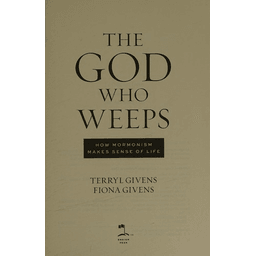
- Starting price
- ~$15 hardcover
- Free tier
- No
- Platforms
- Print · Kindle · Audiobook
- Developer
- Ensign Peak (Deseret Book)
- Launched
- 2012
- Updated
- May 31, 2026
The verdict
The God Who Weeps is the book Latter-day Saints hand to a thoughtful friend who asks what they actually believe - and the one many members keep on the nightstand for themselves. Terryl and Fiona Givens write a literary, hope-saturated articulation of the tradition's core intuitions rather than a verse-by-verse manual. Read it for what it is: one tradition's self-portrait, written about as well as that portrait has ever been written.
Try The God Who Weeps ↗Opens deseretbook.com
The God Who Weeps has quietly become the book Latter-day Saints reach for when someone asks, in earnest, what their faith feels like from the inside. It is not the catechism, not the missionary discussion, not the doctrinal manual. It is a short, literary essay - fewer than 150 pages - in which two of the tradition's most widely read writers try to say plainly and beautifully why the world looks the way it does to a believing member of the Church of Jesus Christ of Latter-day Saints. The subtitle says the quiet part out loud: "How Mormonism Makes Sense of Life."
It is not a work of apologetics. It does not argue you into anything. It does not stack proofs or refute critics or march through a syllabus. Terryl Givens - a literature scholar by training - and Fiona Givens write instead the way an essayist writes: an idea, then a poem, then a line from an early church father, then a turn back to the idea now seen from a new angle. The book draws on Dostoevsky and Dickinson, on Origen and Julian of Norwich, on a wide span of Christian writers across the centuries, treating them as fellow travelers reaching toward the same intuitions the authors find articulated in their own tradition.
What you actually get is five short chapters, each built around a single proposition the Givenses lay out in the preface as the framework of their faith: that God is a personal being who feels with and weeps over His children; that human beings existed as souls before this life; that we are here to grow rather than merely to be tested; that the scope of salvation is far wider and more hopeful than a hard binary; and that to live by these convictions is itself a deliberate, reasonable wager. It is a book about consolation as much as doctrine - and that, more than any single argument, is why it travels the way it does.
✓ The good
- The most literary statement of Latter-day Saint belief in print - the Givenses write prose that members and outside readers alike describe as genuinely beautiful, not merely earnest
- A clear, sympathetic window into the tradition's core intuitions - premortal existence, a feeling God, human growth, and an expansive scope of salvation, each given its own chapter and its own emotional weight
- Short and finishable - under 150 pages, readable in an evening or two, which is exactly why it gets handed to busy friends and seekers
- Deeply ecumenical in its reading list - Origen, Julian of Norwich, Dostoevsky, Dickinson and many others appear as fellow seekers, so the book never feels insular
- Consolation as much as catechism - the central image of a God who weeps with His children lands with readers carrying real grief, regardless of background
- An accessible on-ramp to Terryl Givens's larger body of scholarship - readers who want the footnotes and the history can follow him into denser work afterward
- Holds up to rereading - because it is built on images and questions rather than a checklist, members report returning to it the way one returns to a favorite essay
✗ Watch out
- Reflective and literary rather than systematic - it sketches a sensibility, not a complete or ordered theology, so readers wanting a doctrine-by-doctrine map will need other books
- Light on chapter-and-verse scripture work - the argument moves through poetry, philosophy, and church history more than through sustained exegesis of biblical or Latter-day Saint texts
- Presents the tradition from inside its own convictions - a non-LDS reader should approach it as one tradition articulating its outlook, not as a neutral survey of Christian theology
- Very short - at under 150 pages it is an opening statement, and readers who want depth on any single theme will find it gestured at rather than fully developed
- Assumes a contemplative reader - its essayistic, allusive style rewards slow reading and can feel diffuse to anyone wanting brisk, bullet-pointed answers
Best for
- Latter-day Saints wanting a reflective, literary statement of their own faith
- Thoughtful seekers curious how the world looks from inside the tradition
- Readers carrying grief who want consolation alongside doctrine
- Anyone who loves essay-driven, allusive spiritual writing
Avoid if
- You want a systematic, doctrine-by-doctrine theology rather than an essay
- You want sustained verse-by-verse scripture exposition
- You want a neutral comparative survey across Christian traditions
- You prefer brisk, bullet-pointed answers over contemplative prose
What The God Who Weeps is
The God Who Weeps is a 2012 book by Terryl Givens and Fiona Givens, published by Ensign Peak, an imprint associated with Deseret Book. Subtitled "How Mormonism Makes Sense of Life," it is a short - under 150 pages - literary articulation of the core convictions of the Church of Jesus Christ of Latter-day Saints, written for thoughtful readers rather than specialists. Its five chapters each take up a single proposition: a God who is personal and feels with His children; a premortal existence of the human soul; mortal life as a setting for growth; an expansive and hopeful scope of salvation; and the reasonableness of choosing to live by these convictions.
It is best understood as the tradition speaking in its own voice. Terryl Givens is a scholar of literature and of Latter-day Saint thought, and the book reads like an essayist's work - drawing freely on poets, philosophers, and Christian writers across history to frame ideas the authors locate at the heart of their faith. It is not a manual, a defense against critics, or a comparative study. It is one carefully written statement of what the world looks like to a believing Latter-day Saint, offered to members and curious outsiders alike.
Why readers reach for the Givenses
Most introductions to a faith are organized like a syllabus: define the terms, list the doctrines, cite the proof texts, close with an invitation. The God Who Weeps is organized like an essay. The Givenses begin not with a doctrine but with a feeling - the intuition that a good universe would be presided over by a God who is moved by suffering rather than removed from it - and then they build outward, letting a line of Dostoevsky or a verse of Dickinson do the work a bullet point would do in a manual. That choice is the whole appeal. It meets the reader as a person with longings rather than a student with a checklist.
The result is a book that members feel comfortable lending to almost anyone. A seeker does not have to wade through insider vocabulary. A friend from another tradition encounters the ideas dressed in the shared language of Western literature and historic Christian writers, which keeps the book from feeling like a closed circle. And a lifelong Latter-day Saint finds the convictions they were raised on rendered with a literary care they may not have heard them given before. It is the rare introduction that works equally well as a first encounter and as a re-encounter - the kind of book people press on others precisely because it said the thing they had felt but could not phrase.
A God who weeps: the central image
The book takes its title and its emotional center from a striking scene the authors draw out of Latter-day Saint scripture, in which God is shown weeping over the suffering of His children. The Givenses build their opening chapter around this picture of a God who is not impassive or distant but personally moved - a being who feels with creation rather than presiding over it from beyond all feeling. They set this intuition in conversation with figures across Christian history who reached toward something similar, treating the weeping God less as a proprietary doctrine than as the answer a tender universe would require.
This is the move that gives the book its reach. Readers carrying real grief - a loss, a diagnosis, a prodigal child - tend to find the image of a weeping God more consoling than any argument, and they report it staying with them long after the particular chapter. Within the tradition, it functions as a keynote: everything else in the book, from premortal existence to the breadth of salvation, follows from the premise that the God at the center of the story loves and suffers alongside the people in it. It is reported here as the tradition's own self-understanding, and it is the passage most readers quote back.
Premortal existence and human growth
Two of the book's five chapters take up convictions that sit near the heart of Latter-day Saint belief: that the human soul existed before mortal birth, and that this life is best understood as a setting for genuine growth rather than merely a pass-or-fail examination. The Givenses develop these less as propositions to be proved than as a lens that, once adopted, reorganizes how a life looks - why the soul feels older than its years, why suffering can be formative rather than only punitive, why the point of mortality might be becoming rather than simply behaving. They marshal poets and early Christian thinkers who entertained kindred ideas, again presenting the tradition's view as part of a long human conversation.
For a Latter-day Saint reader, these chapters articulate something often felt but rarely written down with this care. For a reader outside the tradition, they are the clearest short statement available of how these particular convictions hang together and what they do for the people who hold them. The book does not argue that other readers should adopt them; it shows what the world looks like to those who do. That framing - the tradition explaining itself in its own terms - is exactly what makes the chapters useful to both audiences, and it is consistent with the kind of resource this site exists to map.
An expansive scope of salvation, and the wager to believe
The book's later chapters open onto its most hopeful theme: a scope of salvation the Givenses present as far wider and gentler than a stark eternal binary, in keeping with the tradition's distinctive understanding of God's reach beyond this life. They then close with a chapter on choice - arguing that, given genuine uncertainty, deliberately living as though these convictions are true is itself a reasonable and even courageous wager rather than a failure of nerve. The tone throughout is invitational, not coercive; the authors are describing the bet they have made and why, not pronouncing on anyone who bets differently.
This pairing - an expansive hope, then a clear-eyed choice - is what leaves readers with the book's characteristic afterglow. It is consolation with a spine: hopeful about how the story ends, honest that belief is still a decision made without certainty. Members cite these chapters when they want to explain why their faith feels both tender and demanding at once. Outside readers get an unusually candid look at how a thoughtful believer in this tradition holds hope and uncertainty together. Reported neutrally, it is the tradition's own account of why it finds the wager worth making.
Pricing
Hardcover
~$15
The standard Ensign Peak edition (figures vary by retailer). The copy most readers own and lend out.
eBook / Kindle
~$13
Searchable and highlight-syncing; typically a couple of dollars under the hardcover. Around $13 as of writing.
Audiobook
~$17
A read-aloud edition exists; prices and inclusion in subscription services vary. The allusive prose carries well in audio.
Used / library
under $5
A 2012 title with a wide print run - used copies and library holds are easy to find for those who want to read it first.
The God Who Weeps is not free. Because it is a 2012 title with a wide print run, used hardcovers turn up cheaply - often under five dollars - and library copies are easy to come by, which is how a lot of readers sample it before buying their own. A new hardcover runs around fifteen dollars (figures vary by retailer and over time); call it the everyday default and the copy most people end up lending out.
The eBook typically runs a couple of dollars below the hardcover - around thirteen dollars as of writing - and brings the usual conveniences: full-text search and highlights that sync across devices, both genuinely handy for a book this quotable. An audiobook edition exists as well, in the neighborhood of seventeen dollars or bundled with a subscription service depending on where you look, and the Givenses' allusive, cadenced prose holds up nicely read aloud.
There is no premium or study edition to weigh here - this is a short trade book, not a reference work, so the choice is simply format and budget. If you want to read it before committing, the library or a used copy is the obvious move. If you expect to mark it up and lend it, the hardcover is the balanced default. Most readers do not need the audiobook unless they prefer to listen; the print edition is the one people keep.
Where The God Who Weeps falls behind
Not a systematic theology. The book sketches a sensibility - five convictions, beautifully framed - rather than an ordered, comprehensive account of the tradition's doctrine. That is by design; the Givenses are writing an essay, not a manual. But a reader who wants doctrine mapped point by point, with the connective tissue spelled out, will need to pair it with something built for that job.
Light on scripture exposition. The argument moves through poetry, philosophy, and historic Christian writers far more than through sustained verse-by-verse work in the Bible or Latter-day Saint scripture. Readers who want the case anchored chapter-and-verse, the way a study guide or a verse-by-verse commentary would do it, will find this book reaching for Dostoevsky where they expected a proof text.
Written from inside its own convictions. The God Who Weeps articulates the Latter-day Saint outlook as the tradition understands itself; it is not a neutral, comparative survey of how various Christian traditions read these questions. That is the right call for the book the Givenses set out to write. A non-LDS reader should simply come to it as one tradition's self-portrait rather than as an even-handed map of the whole landscape.
Very short. At under 150 pages, every theme is an opening statement. The weeping God, premortal existence, the scope of salvation - each could carry a book of its own, and elsewhere in the literature each does. Here they are gestured toward with great care but not exhausted, which is why readers who fall for the book so often go looking for something longer next.
The God Who Weeps vs. Believing Christ vs. Jesus the Christ
These three are among the most-recommended books for understanding Latter-day Saint belief from the inside, and they do genuinely different jobs. The God Who Weeps (Terryl and Fiona Givens, 2012) is the literary-essayistic statement - short, allusive, built around a handful of core intuitions and the consolation they offer. Believing Christ (Stephen E. Robinson, 1992) is the warm, practical treatment of grace and the Atonement, written in plain modern prose for everyday members wrestling with whether the good news really applies to them. Jesus the Christ (James E. Talmage, 1915) is the classic, comprehensive life of Christ - long, formal, and exhaustive where the other two are brief.
Different strengths. The Givenses are the most beautiful and the most concerned with the felt shape of belief - the book to hand a thoughtful seeker or a grieving friend. Robinson is the most pastorally useful for a member struggling personally with grace, and the most quoted in that specific conversation. Talmage is the most thorough and the most cited as a doctrinal and devotional reference, the volume people keep on the shelf for depth. If you want one short, inviting entry point, it is The God Who Weeps. If your question is grace and the Atonement specifically, add Robinson. If you want the full, careful treatment of the life and ministry of Jesus, reach for Talmage.
All three are widely read within the Church of Jesus Christ of Latter-day Saints, and all three are written from inside that tradition. The God Who Weeps is the most literary and the most likely to be appreciated by readers outside the tradition who simply love good spiritual essays. Robinson is the most conversational. Talmage is the most scholarly and the most demanding - the long road where the Givenses are the short one.
The bottom line
The God Who Weeps is the book Latter-day Saints reach for when they want their faith said beautifully rather than diagrammed. In under 150 pages, Terryl and Fiona Givens render the tradition's core intuitions - a God who feels with His children, a soul that predates this life, a wide and hopeful scope of salvation - with a literary care that lands on members and curious outsiders alike. Read it for what it is: one tradition's self-portrait, written about as well as that portrait has ever been written. Just pair it with something longer if you want the full doctrinal map.
Alternatives to The God Who Weeps
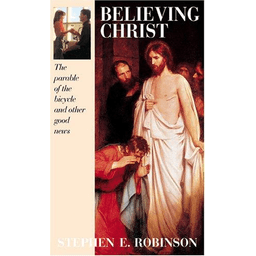 Believing ChristStephen E. Robinson's widely loved book on grace and the Atonement - shorter, warmer, and in plain modern prose.
 Jesus the ChristJames E. Talmage's classic, comprehensive life of Christ - the long, formal counterpart to the Givenses' short essay.
 The Neal A. Maxwell InstituteBYU-based Latter-day Saint scholarship - books, journals, and podcasts for readers who want the footnotes Givens leaves out.
 Gospel LibraryThe official Latter-day Saint study app - free home of the Church's scriptures, talks, and study materials.
Frequently asked questions
Who wrote The God Who Weeps?
Terryl Givens and Fiona Givens, a husband-and-wife pair of Latter-day Saint writers. Terryl Givens is a scholar of literature and of Latter-day Saint thought, and the book reflects that literary background - it reads like an essay rather than a textbook. It was published in 2012 by Ensign Peak, an imprint associated with Deseret Book.
What is The God Who Weeps about?
It is a short, literary articulation of core Latter-day Saint convictions for thoughtful readers, organized around five themes: a God who feels with and weeps over His children, a premortal existence of the soul, mortal life as a setting for growth, an expansive and hopeful scope of salvation, and the reasonableness of choosing to live by these beliefs. The subtitle is "How Mormonism Makes Sense of Life."
Is The God Who Weeps a good introduction for someone outside the tradition?
Many readers find it so, with one caveat: it is written from inside the Latter-day Saint tradition and presents that tradition's outlook in its own terms, rather than as a neutral comparison across Christian traditions. Approached as one faith explaining how the world looks from the inside - which is what it is - it is an unusually clear and beautifully written window for a curious outside reader.
Is it a work of apologetics or proof?
No. It does not stack arguments, refute critics, or try to prove its claims. It is a reflective, essayistic book that draws on poetry, philosophy, and Christian writers across history to frame the convictions the authors hold. Its closing chapter does make a case that choosing to believe is reasonable, but the tone is invitational rather than combative.
How long is the book, and how hard is it to read?
It is short - under 150 pages - and most readers finish it in an evening or two. The prose is accessible but contemplative and allusive, weaving in lines from poets and early Christian writers, so it rewards slow reading more than skimming. People who love essay-driven spiritual writing tend to love it; people who want brisk, bullet-pointed answers may find it diffuse.
Where can I get The God Who Weeps and what does it cost?
It is widely available in print, eBook, and audiobook. As of writing, the hardcover runs around fifteen dollars, the eBook around thirteen, and the audiobook around seventeen (prices vary by retailer and over time). It is sold through Deseret Book and general booksellers, and used copies are common and cheap if you want to read it first.
What should I read after The God Who Weeps?
For the Atonement and grace specifically, many readers turn to Stephen E. Robinson's Believing Christ. For a thorough, classic life of Christ, James E. Talmage's Jesus the Christ. For deeper scholarship with footnotes, the Neal A. Maxwell Institute's books and journals. And the free Gospel Library app is the home of the Church's own scriptures and study materials.
Sources & further reading
More Latter-day Saint Books
 The Doctrine and CovenantsThe volume of modern revelations at the center of Latter-day Saint scripture - 138 sections, two Official Declarations, and the founding document of a still-growing church.
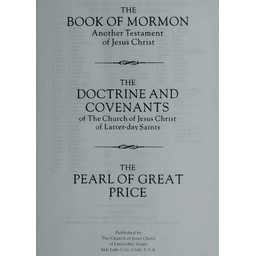 The Pearl of Great PriceThe shortest of the four Latter-day Saint standard works - five short texts that hold the First Vision account, the Articles of Faith, and some of the tradition’s most-quoted scripture.
 The Standard Works (Quad)The four-in-one scripture set most Latter-day Saints carry - King James Bible, Book of Mormon, Doctrine and Covenants, and Pearl of Great Price, bound with one of the most thorough study apparatuses in print.Jesus the ChristJames E. Talmage's 1915 study of the life and mission of Jesus Christ - for over a century the standard Latter-day Saint treatment of the Messiah, and now free in the public domain.Believing ChristThe short Latter-day Saint book on grace that quietly reframed how a generation of readers understood the Atonement - built around one homely parable about a girl, a bicycle, and a father.
 Come, Follow MeThe official home-centered, church-supported study curriculum of the Church of Jesus Christ of Latter-day Saints - the weekly reading schedule the whole Church follows together, free in Gospel Library and in print.