- Starting price
- Free (PDF / daily email)
- Free tier
- Yes
- Platforms
- Print · Kindle · Web (free PDF) · Daily email
- Developer
- Crossway
- Launched
- 1998
- Updated
- May 31, 2026
The verdict
The devotional for readers who want their daily reading tied to an actual whole-Bible plan rather than a verse plucked out of context. Carson’s reflections are meatier than the genre norm, the M’Cheyne plan behind it is demanding, and the full text is free - which makes the only real question whether you want a companion this substantive.
Try For the Love of God ↗Opens crossway.org
For the Love of God has quietly become the devotional of choice for readers who got tired of a verse-a-day and wanted something built on an actual plan to read the whole Bible. D.A. Carson - New Testament scholar, longtime seminary professor, prolific author - wrote it not as a collection of standalone meditations but as a daily companion to a specific reading schedule: the M’Cheyne plan, a nineteenth-century calendar that takes a reader through the entire Bible in a year, and through the New Testament and the Psalms twice.
It doesn’t moralize. It doesn’t hand you an isolated verse and a feeling. It doesn’t pretend the day’s passage exists in a vacuum. Each daily entry takes one of the four chapters the M’Cheyne plan assigns for that day and writes roughly a page of reflection on it - usually tracing a thread that connects it to the wider sweep of Scripture, showing how a detail in Leviticus or a line in a Psalm fits into the one long story the whole Bible is telling.
The two volumes were published by Crossway in 1998 and 1999, and the project has had an unusually long second life on the web. Carson co-founded The Gospel Coalition, which hosts the full text free online and pushes the day’s reading and reflection to a large daily-email list. The result is a devotional that a reader can work through for years entirely for free, or own in print for the cost of a paperback - and one that has steadily built a reputation as the thinking reader’s entry into reading the Bible as a whole.
✓ The good
- Built on a real whole-Bible plan - the M’Cheyne schedule carries the reader through the entire Bible in a year and the New Testament and Psalms twice, so the devotional reinforces actual reading rather than replacing it
- Biblical-theology reflections that connect the dots - Carson’s specialty is showing how a single passage fits the larger storyline of Scripture, which is rare in the daily-devotional category
- Genuinely free in full - Crossway and The Gospel Coalition offer the complete text online as a PDF and via a daily email, with no paywall and no account required
- Substantive without being a commentary - each entry is roughly a page, long enough to teach something real, short enough to read before the day starts
- A scholar’s precision in plain prose - Carson writes for ordinary readers but never talks down, and the reflections hold up to re-reading
- Two volumes give two full years - the plan and the reflections differ across the set, so a reader can spend two years in it before repeating
- Equally useful as a learning tool - many readers use it less as a warm devotional and more as a year-long short course in how to read the Bible cohesively
✗ Watch out
- Presumes you’re actually following the M’Cheyne plan - the reflections are tethered to a heavy daily reading load (around four chapters a day), and a reader who skips the reading loses much of the point
- Meatier and more theological than warm-devotional - readers wanting comfort, narrative, or emotional consolation first will find Carson more interested in teaching than soothing
- Two volumes to track - the project is split across two books, which is more to manage than a single 365-day volume
- The M’Cheyne pace is demanding - finishing the whole Bible plus a second pass through the New Testament and Psalms in a year is a real commitment, and falling behind is easy
- The vantage is broadly Reformed evangelical - Carson’s framing reflects that stream, and readers from other traditions will occasionally translate a phrase
Best for
- Readers who want a daily devotional anchored to a complete whole-Bible reading plan
- Christians who want to learn to read Scripture as one connected story rather than isolated verses
- Anyone willing to commit to a heavier daily reading load in exchange for more substance
- Cost-conscious readers who want a high-quality devotional available entirely for free
Avoid if
- You want a short verse-a-day devotional with no required outside reading
- You’re looking for a warm, narrative, or emotionally consoling tone first
- You won’t keep up with roughly four chapters of Bible reading a day
- You prefer a single-author classic from a different tradition, where the framing matches your own
What For the Love of God is
For the Love of God is a two-volume daily devotional by D.A. Carson, published by Crossway in 1998 and 1999. It is built around the M’Cheyne Bible reading plan - a schedule devised by the Scottish minister Robert Murray M’Cheyne in the nineteenth century that assigns four chapters of reading a day and carries the reader through the whole Bible in a year, plus a second pass through the New Testament and the Psalms. Each day, Carson takes one of the assigned chapters and writes roughly a page of reflection on it.
Carson is a New Testament scholar who taught for decades at Trinity Evangelical Divinity School and has written widely for both academic and lay audiences. The reflections reflect that background: his recurring habit is biblical theology - tracing how a given passage connects to the larger storyline of Scripture, how a theme introduced in one book pays off in another. The aim is not only to comment on the day’s chapter but to teach the reader, over a year, how the Bible holds together as a whole.
Why readers reach for For the Love of God when they want to read the whole Bible
The single biggest practical difference between For the Love of God and most daily devotionals is that it is not really a standalone book - it is a companion to a reading plan. The typical one-page-a-day devotional gives the reader a verse and a reflection and asks nothing else of them. Carson’s does the opposite: it assumes the reader is working through the M’Cheyne schedule, reading several chapters of the Bible each day, and the daily reflection is there to illuminate one of those chapters and stitch it into the larger picture.
This sounds like a small thing. In practice it’s transformative. Readers who stay with it describe a gradual shift in how they read Scripture - the habit of treating verses as isolated fortune-cookie lines loosens, and the instinct to ask how a passage fits the whole story grows. It is less a book to be consumed than a year-long apprenticeship in reading the Bible cohesively, which is why so many readers recommend it specifically to people who want to finally read the whole thing and understand how the pieces connect.
The M’Cheyne reading plan: the engine the whole book runs on
For the Love of God is organized around the M’Cheyne Bible reading plan, a schedule created by Robert Murray M’Cheyne, a Scottish minister of the nineteenth century. The plan assigns four chapters of reading per day across two tracks - one moving through the Old Testament and Gospels, another through the rest of the New Testament and the Psalms - so that over a year the reader covers the entire Bible once and the New Testament and Psalms twice. Carson keeps this plan at the front of each volume and writes his daily reflection on one of the day’s assigned chapters.
This is the structural decision that defines the book, and it cuts both ways. For a reader who follows the plan, the payoff is large: the reflections land on passages the reader has just read, and the cumulative effect is a guided trip through all of Scripture with a scholar pointing out the connections along the way. For a reader who treats the reflections as standalone and skips the reading, much of the value evaporates - Carson is often building on something in the day’s chapters, and the entry can feel like arriving in the middle of a conversation. The plan is not optional decoration. It is the engine.
Carson’s biblical-theology reflections: connecting the day’s chapter to the whole story
What sets Carson’s entries apart from the devotional norm is the recurring move he makes: rather than drawing a single application from the day’s chapter, he tends to trace how that chapter connects to the wider sweep of the Bible. A detail in the Levitical sacrifices points forward to a theme that pays off in Hebrews. A line in a Psalm echoes a promise made in Genesis. A moment in the Gospels reaches back to the prophets. This is biblical theology - reading the parts in light of the whole - and it is Carson’s scholarly specialty rendered in plain, accessible prose.
The result is a devotional that teaches as it goes. Readers regularly describe finishing a year with a noticeably better sense of how the Bible fits together than they had before - not because Carson lectures, but because he models the connecting habit day after day until it starts to rub off. The reflections are meatier than the genre average; a reader looking for a soft landing each morning may find them more demanding than expected, while a reader who wants to actually understand the text usually finds this the most valuable thing the book offers.
The free full text: the PDF, the website, and the daily email
Unusually for a book still in print, the complete text of both volumes of For the Love of God is available free online. Crossway offers it as a downloadable PDF, and The Gospel Coalition - the ministry Carson co-founded - hosts the reflections on the web and delivers the day’s M’Cheyne reading plus Carson’s reflection to a large daily-email list each morning. There is no paywall, no required account, and no app to install; a reader can work through the entire two-year project without spending anything.
This changes the calculus for the book in a way that is worth being explicit about. With most devotionals, the question is which edition to buy. With this one, the question is whether to buy at all - the free email is arguably the best way to build the daily habit, since the reading and the reflection arrive together in the inbox without any effort from the reader. The paperbacks (around $18 a volume) and Kindle editions remain worthwhile for readers who prefer a physical copy, want to read offline, or like to mark up the page, but they are a convenience purchase rather than the only way in.
Pricing
Free PDF / Web
Free
The complete text of both volumes is available free online through Crossway and The Gospel Coalition - full reflections, with no paywall or account required.
Daily Email
Free
The Gospel Coalition sends the day’s M’Cheyne reading and Carson’s reflection to an inbox each morning. The lowest-friction way to read it as a daily habit.
Paperback (per volume)
~$18
Crossway’s trade paperback of Volume 1 or Volume 2. Around $18 each, so roughly $36 for the full two-year set in print.
Kindle
~$10-13
E-book editions of each volume, searchable and syncable across devices. A convenient paid option for readers who prefer to own a copy.
Pricing on For the Love of God is genuinely unusual for a book of this caliber, because the most complete option is also the free one. Crossway and The Gospel Coalition make the full text of both volumes available online - as a PDF and on the web - with no paywall and no account. The Gospel Coalition also runs a free daily email that sends the day’s M’Cheyne reading and Carson’s reflection straight to an inbox each morning.
For readers who want to own a copy, the trade paperbacks run around $18 per volume, so roughly $36 for the full two-year set in print. The Kindle editions are cheaper, in the $10-13 range per volume, and add search and syncing across devices. None of the paid formats unlock anything the free text lacks; they are about preference for paper, offline reading, and marginal notes.
Because the project is split across two volumes, a reader committing to print is buying two books rather than one - worth knowing if budget or shelf space matters. The good news is that nothing forces the decision up front: a reader can start free with the email or the PDF, see whether Carson’s depth and the M’Cheyne pace suit them, and buy print only if they decide they want a lasting copy.
For most readers, the free daily email is the best value, full stop - it removes all friction from the daily habit and costs nothing. The paperbacks are the move for readers who know they prefer reading and annotating on paper and want both volumes on the shelf.
Where For the Love of God falls behind
Presumes the reading. The reflections are written to accompany the M’Cheyne plan’s roughly four chapters a day, and a reader who wants the reflection without doing the reading will get far less out of it. This is by design, not a flaw - but it means For the Love of God is not a low-commitment devotional, and a reader expecting one will be surprised by how much it leans on the reading load behind it.
A demanding pace. Reading the whole Bible in a year, plus a second pass through the New Testament and the Psalms, is a substantial daily commitment. Readers who fall behind on the schedule often find the reflections drift out of sync with where they actually are, and catching up on several days of skipped chapters can feel like a chore rather than a rhythm.
More teaching than comfort. Carson is a scholar, and the entries are meatier and more theological than the warm, consoling tone many readers expect from a morning devotional. A reader looking primarily for emotional encouragement, narrative, or a gentle start to the day will find this one more interested in understanding the text than in soothing the reader.
Two volumes to manage. The project spans two books rather than a single 365-day volume, which is a little more to track in print and a little more to budget for. Readers who like the tidiness of one book covering one calendar year will feel the seam between Volume 1 and Volume 2.
A particular vantage. Carson writes from a broadly Reformed evangelical perspective, and the framing of certain reflections reflects that. The biblical-theology substance travels well across traditions, but readers from Catholic, Orthodox, Latter-day Saint, or Wesleyan backgrounds will occasionally meet a phrase shaped by Carson’s stream and want to translate it into their own.
For the Love of God vs. New Morning Mercies vs. The Songs of Jesus
These three sit near each other on the modern devotional shelf, but they aim at different things. For the Love of God is the whole-Bible companion - tied to the M’Cheyne reading plan, oriented toward teaching the reader how Scripture connects, and meatier than the genre norm. New Morning Mercies, by Paul David Tripp, is the gospel-centered heart devotional - one undated page a day, pastoral and counseling-flavored, returning relentlessly to grace. The Songs of Jesus, by Tim Keller, is the Psalms devotional - a year of short daily reflections walking through the Psalter one piece at a time.
Different strengths. For the Love of God is better at building a panoramic, connected understanding of the whole Bible over a year - but it asks the most of the reader, since it presumes the daily reading. New Morning Mercies is better at re-anchoring the heart in the gospel in five quiet minutes with no outside reading required. The Songs of Jesus is narrower and gentler than Carson, focused entirely on the Psalms, and a good fit for a reader who wants depth in one book rather than a tour of all sixty-six.
If you want a year-long, guided trip through the entire Bible with a scholar showing you how it fits together, Carson is the pick - and it’s free. If you want a short daily gospel reset, choose Tripp. If you want to live in the Psalms for a year, choose Keller. The three are not competing so much as covering different needs, and a reader could reasonably move from one to the next in successive years.
The bottom line
For the Love of God is the standout choice for readers who want their daily devotional welded to an actual whole-Bible reading plan rather than floating free of context. Carson’s biblical-theology reflections are more substantial than almost anything else in the category, the M’Cheyne plan behind it carries the reader through the entire Bible in a year, and the full text is free as a PDF and a daily email. The trade-offs are real but knowable going in: it presumes you’re doing the heavy daily reading, it teaches more than it comforts, and it spans two volumes. For a reader ready to commit, it is one of the most rewarding - and most generously priced - devotionals available.
Alternatives to For the Love of God
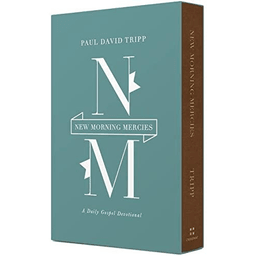 New Morning MerciesPaul David Tripp’s gospel-centered daily devotional. One undated page a day, pastoral and aphoristic, with no outside reading required - a warmer, lower-commitment counterpart to Carson.
 My Utmost for His HighestOswald Chambers’ classic daily devotional. Dense, demanding, and re-read year after year - like Carson in depth, but built around surrender rather than a whole-Bible plan.The Songs of JesusTim Keller’s year-long devotional through the Psalms. Short daily reflections walking the Psalter one piece at a time - narrower and gentler than Carson’s whole-Bible sweep.
 The Gospel CoalitionThe ministry Carson co-founded, which hosts the free For the Love of God text and daily email alongside a large library of articles, podcasts, and resources.
Frequently asked questions
Is For the Love of God really free?
Yes. The complete text of both volumes is available free online through Crossway as a PDF and through The Gospel Coalition on the web, with no paywall and no account required. The Gospel Coalition also sends the day’s reading and reflection as a free daily email. The paperbacks and Kindle editions are for readers who prefer to own a physical or offline copy.
What is the M’Cheyne reading plan?
It’s a Bible reading schedule created by the nineteenth-century Scottish minister Robert Murray M’Cheyne. It assigns about four chapters of reading a day and carries the reader through the entire Bible in a year, plus a second pass through the New Testament and the Psalms. For the Love of God is built around it - Carson writes a daily reflection on one of the day’s assigned chapters.
Do I have to follow the reading plan to use the book?
You can read the reflections on their own, but you’ll get far more out of the book if you follow the M’Cheyne plan alongside them. Carson’s entries are written to illuminate the day’s assigned chapters and connect them to the wider story of Scripture, so skipping the reading means missing much of what each reflection is doing.
Why are there two volumes?
The project covers two years of daily reading and reflection. Crossway published Volume 1 in 1998 and Volume 2 the following year, each with its own track through the M’Cheyne plan and its own set of reflections. A reader can spend two years working through the full set before repeating.
How is this different from a typical verse-a-day devotional?
Most daily devotionals give you a short, standalone reflection on a single verse and ask nothing else of you. For the Love of God is a companion to a whole-Bible reading plan: it assumes you’re reading several chapters a day and uses the daily reflection to teach you how those chapters fit into the larger biblical story. It’s more substantial and more demanding than the verse-a-day norm.
What tradition does D.A. Carson write from?
Carson is a New Testament scholar writing from a broadly Reformed evangelical perspective; he taught for decades at Trinity Evangelical Divinity School and co-founded The Gospel Coalition. The framing of the reflections reflects that stream. The biblical-theology substance travels widely, though readers from other traditions may occasionally translate a phrase into their own vocabulary.
Is For the Love of God a good fit for a first devotional?
It can be, but go in knowing it’s more demanding than most. It works best for a reader ready to commit to roughly four chapters of Bible reading a day and interested in learning how Scripture connects, rather than one looking for a quick, gentle start to the morning. A reader who wants something lighter to begin with might start with a shorter devotional and come to Carson later.
Sources & further reading
More Devotional Books
My Utmost for His HighestThe 90-year-old daily devotional that still outsells most new releases - short, dense, and famously unwilling to let a reader off the hook. Morning and EveningThe 1865 twice-daily devotional from the Prince of Preachers - still in print, still in the morning routine of millions, and still doing something almost no other devotional even tries.The Songs of JesusTim and Kathy Keller’s 365-day walk through every Psalm has quietly become the daily-practice companion to Keller’s Prayer - a short passage, a brief reflection, and a written prayer for each morning of the year.
 Streams in the DesertThe hundred-year-old daily devotional that gets handed to people in the hospital, at the funeral, after the diagnosis - and the one question worth answering before you buy it.New Morning MerciesA 365-day devotional built on one stubborn idea: the gospel is not just the door you walked through, it’s the air you keep breathing - and Paul David Tripp will not let you forget it.Daily Light on the Daily PathThe 1794 family devotional made of nothing but arranged Scripture - morning and evening, every day of the year, with no human commentary at all, and almost no one else has tried to do what it does.