
- Starting price
- Free
- Free tier
- Yes
- Platforms
- iOS · Android · Web
- Developer
- The Gospel Coalition + Crossway
- Launched
- 2012
- Updated
- May 24, 2026
The verdict
A small, modern catechism that quietly does what longer ones cannot - fit into a regular Christian week without being abandoned by February. Free, well-built, and one of the easiest yes-recommendations in this entire library.
Try New City Catechism ↗Opens newcitycatechism.com
New City Catechism has quietly become the favorite catechism of pastors and parents who like the idea of a catechism but have watched their families bounce off the longer Reformation ones. It is short. It is modern in cadence. It is built around 52 questions and answers - one per week, one full year, done. And it is free on iOS, Android, and the web, with a free print edition and a free church curriculum behind it.
It does not try to replace the Heidelberg Catechism. It does not try to replace the Westminster Shorter Catechism. It does not pretend that 52 questions can carry the doctrinal weight of 129 or 107. What it does instead is take the same broadly Reformed shape those catechisms occupy, condense it, modernize the English, and add the one thing classical catechisms never had - a child-length short answer paired with a longer adult answer for every single question.
The project was started by Tim Keller and Sam Shammas at Redeemer Presbyterian Church in New York City, then published in partnership with The Gospel Coalition and Crossway. That lineage tells you most of what you need to know about the theological posture: broadly Reformed-evangelical, anchored in classical Protestant categories, written for an urban and global audience that often did not grow up with any catechism at all.
✓ The good
- Free everywhere - app, web, print, audio, video, church curriculum, all of it, no paywall
- Genuinely short - 52 questions you can actually finish, not 129 you will abandon by question 40
- Dual-track answers - same Q gets a kid-length short answer and an adult-length long answer
- Built for weekly use - one question per week, designed to land in a normal rhythm rather than a sprint
- Each question ships with scripture, a short commentary by a contemporary pastor, and a written prayer
- Church curriculum is real - leader guides, slides, kids material, a full year of small-group lessons, free
- The app is uncluttered - no upsell flow, no premium tier dangling at the bottom of the screen
✗ Watch out
- Only 52 questions - meaningfully thinner than Heidelberg or Westminster on the sacraments, ecclesiology, and last things
- Broadly Reformed in posture - readers from non-Reformed traditions will notice their distinctives are not represented
- No built-in progress tracking across devices unless you sign in, and the sync story has historically been thin
- Audio and video assets exist but are not as polished as a dedicated devotional app like Hallow or Dwell
- Commentary contributors are mostly TGC-network voices - a feature for some readers, a narrow window for others
Best for
- Families who want a year-long shared rhythm with one question per week
- Churches looking for a free, ready-to-teach curriculum that fits a school year
- New believers who want a compact map of the Christian faith without a 400-page systematic
- Adults from a Reformed-evangelical background who want catechesis without the seventeenth-century English
Avoid if
- You want the full breadth and depth of the Heidelberg or Westminster Larger Catechism
- You are looking for a Catholic, Orthodox, or Latter-day Saint catechetical resource
- You need detailed treatment of sacramental theology, polity, or eschatology
- You prefer the linguistic weight and historic resonance of the original Reformation catechisms
What New City Catechism is
New City Catechism is a 52-question catechism - a structured set of questions and answers covering the Christian faith - written for modern readers and delivered through a free app, a free website, a free print edition, and a free year-long curriculum for churches and families. It is modeled on the classical Reformation catechisms (Heidelberg, Westminster Shorter, and the Geneva Catechism of Calvin) but condensed and rewritten in contemporary English.
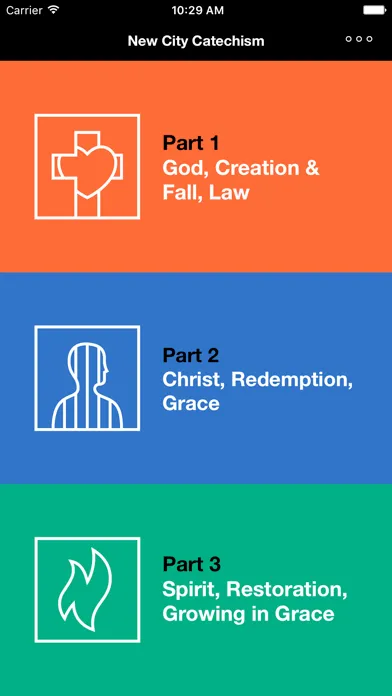
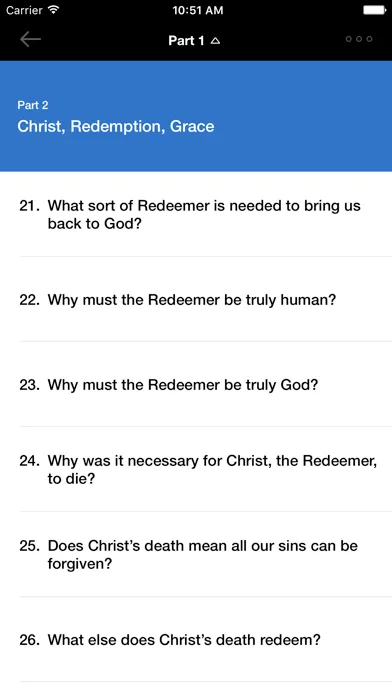
It is published by The Gospel Coalition and Crossway, and was developed at Redeemer Presbyterian Church in New York City under Tim Keller and Sam Shammas. The 52 questions are organized into three parts - God, creation, and fall (questions 1-20), Christ, redemption, and grace (questions 21-35), and the Spirit, the kingdom, and the means of grace (questions 36-52) - which is the same three-part shape Heidelberg uses, just compressed.
Why so many pastors and parents prefer New City Catechism
The single biggest practical difference between New City Catechism and the older Reformation catechisms is finishability. Heidelberg has 129 questions arranged over 52 Lord’s Days. Westminster Shorter has 107. New City has 52 - exactly one per week for one year - and that single design decision changes how families and small groups actually use it. A catechism you finish builds a different kind of memory than a catechism you start.
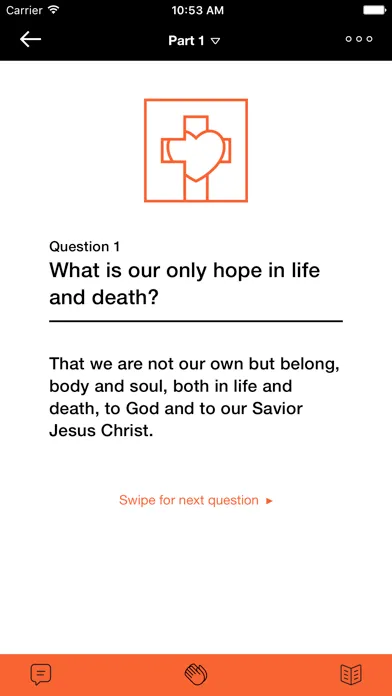
The second difference is the dual-track answer. Every question has a short answer (one or two sentences, child-memorable) and a longer adult answer that fills in the same ground with more substance. Parents and kids land on the same words; adults get the deeper paragraph. Classical catechisms do not do this. In practice it means one family can use one resource without splitting into a kids version and an adults version, which is the rock most family catechism plans break on.
52 weekly Q&A: the one-year, one-question-per-week structure
The catechism is built around a calendar - 52 questions for 52 weeks, three parts of roughly equal length, with each week’s question carrying scripture, commentary, prayer, and an audio reading. The app surfaces the current week by default, but you can jump to any question, replay older weeks, and revisit Christ Connection material at any time. The whole thing fits into a school year almost exactly, which is why so many churches schedule it from September to August.
This sounds like a small thing. In practice it is transformative. Most adults who try to learn a catechism quit not because the content is hard but because the schedule collapses. Fifty-two questions at one per week is a pace a normal person can sustain alongside a job and kids and a Sunday morning routine. It is the model that respects your time. Heidelberg and Westminster reward the person who has already built a daily theology habit; New City Catechism is designed to help build that habit in the first place.
Child + adult dual-track answers: the same question, two depths
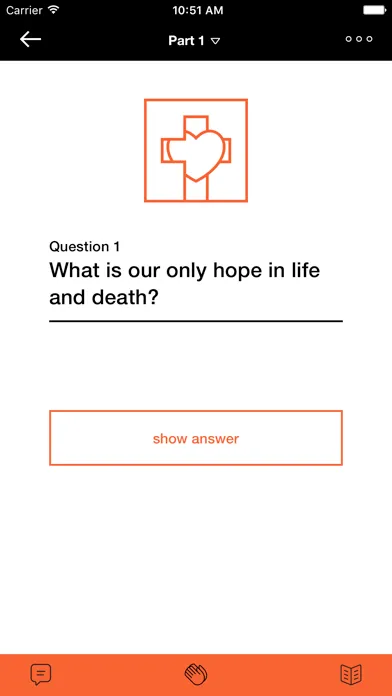
Every question in New City Catechism has two answers - a short answer (typically one or two sentences) that a child can memorize, and a longer answer that expands the same idea with more scriptural framing and theological vocabulary. The app lets you toggle between the two with a single tap. Question 1 is the cleanest example: short answer ends with “that I am not my own but belong, body and soul, both in life and death, to God and to my Savior Jesus Christ.” The adult expansion takes the same sentence and grounds it in fuller language. Parents and children can sit at the same table and recite the same words.
For families this is the feature that does the actual work. A six-year-old and a forty-year-old can engage the same question on the same week without either of them being talked down to or talked over. For church curricula it means the kids class, the youth track, and the adult small group are all on Question 14 together, with material pitched at each age. Classical catechisms simply do not offer this, which is why most family-discipleship plans built on Heidelberg eventually fork into a kids edition and an adults edition. New City Catechism collapses that fork.
Free curriculum for churches and families: the part most people miss
Beyond the app and the print edition, New City Catechism publishes a complete free curriculum for churches and families - a leader guide, presentation slides, a family devotional rhythm, kids lesson plans, and supplementary discussion material covering all 52 weeks. It is built so a small-group leader can pick it up on a Tuesday night and teach a real lesson on Wednesday without a seminary degree or a curriculum budget. The Gospel Coalition hosts the assets; nothing is paywalled.
For pastors and ministry leaders this is the quietly important piece. Free curricula at this depth are rare - most year-long teaching plans cost real money per seat, and the ones that do not cost money tend to look it. New City Catechism’s church curriculum is designed and edited at the same level as the app itself. A church that wants to introduce catechesis without standing up a custom program now has a turnkey way to do it, and the same material their kids are learning on Sunday is the material their parents have on their phones during the week.
Pricing
App (iOS / Android)
Free
Full 52 Q&A, child and adult answers, scripture, commentary, prayer, audio, and video for every week.
Web
Free
newcitycatechism.com mirrors the app - same content, same structure, no account required to browse.
Print edition
Free PDF · paid print
Crossway publishes a small print edition; the PDF is free to download. Hardcover sells for a low single-digit-to-mid price depending on edition.
Church curriculum
Free
Full leader guide, slides, family devotional plan, and kids material for a 52-week parish or small-group rollout.
Pricing is the easiest paragraph in this entire review. New City Catechism is free. The app is free. The website is free. The PDF of the full text is free. The church curriculum is free. The kids materials are free. There is no premium tier, no plus version, no annual subscription waiting at question 25.
Crossway sells a small hardcover print edition of the catechism for a low single-digit-to-mid-teens price depending on which printing you find, and there is a leather edition if you want one for a gift. None of this is required to use the catechism - the print edition is a convenience for people who prefer paper, not a paywall around the content.
For a church the calculation is essentially zero-cost adoption. You can run a full year of catechesis across kids, youth, and adult classes using only the free curriculum assets, with no per-seat license. The only meaningful spend is whatever you choose to print locally for handouts or family take-home cards, and TGC publishes printable versions of those too.
Where New City Catechism falls behind
Only 52 questions. This is the design and also the limit - Heidelberg covers ground on the sacraments, the Lord’s Prayer, and the Ten Commandments at a level of detail New City Catechism simply cannot match in its compressed format. Readers who want full coverage of those areas will eventually graduate to a longer catechism, and the New City team is upfront that this is a feature.
No deep tradition-switching. The framing throughout is broadly Reformed-evangelical. Readers from Lutheran, Anglican, Catholic, Orthodox, or Latter-day Saint traditions will recognize many of the questions and many of the answers, but the surrounding commentary, the choice of contributors, and the way certain doctrines are framed all sit within a Reformed posture. That is not a flaw; it is the resource being honest about what it is. But it does mean it will not function as a one-stop catechism for every tradition.
Thin progress tracking. The app gets you through 52 weeks cleanly but does not have the sophisticated streak, history, and cross-device sync layer of a dedicated habit-style devotional app. If you are coming from YouVersion or Hallow you will notice the gap immediately.
Audio and video are good but not flagship. The video commentaries are short, helpful, and well-shot, but the production layer is a step below a fully dedicated audio-devotional app. For most readers this does not matter - the catechism is the product, not the audio - but if audio-first is your primary mode of engagement, you will probably listen and then go elsewhere for the rest of your week.
New City Catechism vs. Heidelberg Catechism vs. Westminster Shorter Catechism
Different strengths. Heidelberg Catechism (129 questions, 1563) is warmer and more pastoral than most catechisms - its first question (“What is your only comfort in life and in death?”) is the question New City Catechism borrows almost verbatim for its own Question 1. Westminster Shorter (107 questions, 1647) is tighter, more legal in cadence, and built to support the Westminster Confession; it is the catechism Presbyterian churches in the English-speaking world have taught for nearly four centuries. New City Catechism is shorter than either and uses contemporary English throughout.
In practice the choice depends on what you are trying to do. For a family or a church trying to introduce catechesis for the first time, New City Catechism is the easiest on-ramp - it finishes in a year and the dual-track answers are designed for mixed-age use. For a Reformed congregation that wants a confessional document woven into long-term church life, Heidelberg or Westminster carry historical weight and doctrinal depth New City Catechism does not try to match. They are sturdier; New City Catechism is more approachable.
A surprisingly common pattern is to use New City Catechism as a one-year on-ramp, then move into Heidelberg or Westminster the following year for a second pass at greater depth. New City Catechism’s authors openly recommend this. The three catechisms are not competitors so much as a sequence - and you can get all three for free in well-built apps, which makes the whole conversation a different one than it was a generation ago.
The bottom line
New City Catechism is one of the easiest yes-recommendations in this entire library. It is short, well-made, completely free, and designed for the rhythm an actual person actually lives - one question a week for one year. It is not the deepest catechism ever written and it does not try to be. What it does is take a centuries-old Reformation form and make it usable for families and churches who would otherwise never start one. If you are looking for a way into catechesis without buying anything or committing to four hundred questions, this is the place to start.
Alternatives to New City Catechism
 Heidelberg CatechismThe classic 1563 Reformed catechism - 129 questions, warmer and more pastoral than most, the source New City Catechism’s opening question is modeled on.
 ESV Study BibleThe single most-recommended study Bible in evangelical circles - extensive notes, articles, and maps from a broad slate of contributors.
 Knowing GodJ. I. Packer’s modern classic on the doctrine of God - a natural companion read once the catechism opens up questions you want to chase further.
 Mere ChristianityC. S. Lewis’s short, accessible apologetic for the core Christian faith - the other obvious on-ramp book to pair with a 52-week catechism.
Frequently asked questions
Is New City Catechism really free?
Yes - completely. The app on iOS and Android, the web version, the PDF of the full text, the audio and video for every week, and the full church curriculum are all free with no premium tier. Crossway sells optional print editions for people who want a physical book, but nothing is paywalled.
How long does it take to go through New City Catechism?
It is designed for one year - 52 questions, one per week. You can go faster if you want (some readers do one a day for about two months), but the structure, the commentary, and the church curriculum are all built around the weekly cadence.
Who wrote New City Catechism?
It was developed at Redeemer Presbyterian Church in New York City under Tim Keller and Sam Shammas, then published in partnership with The Gospel Coalition and Crossway. The weekly commentaries draw on contemporary pastors and historic figures, and the questions themselves are adapted from Reformation-era sources, especially the Heidelberg, Westminster Shorter, and Geneva catechisms.
What tradition does New City Catechism sit within?
It is broadly Reformed-evangelical, drawing on the classical Protestant Reformation catechisms. Readers from other traditions can use it profitably, but the framing throughout reflects its Reformed roots.
Can children actually use it?
Yes - that is the point of the dual-track answers. Every question has a short answer (one or two sentences) that a child can memorize and a longer adult answer that expands the same ground. Families typically learn the short answer together and read the longer answer aloud for discussion.
How does it compare to the Heidelberg or Westminster Shorter Catechism?
New City Catechism is shorter (52 questions vs. 129 for Heidelberg and 107 for Westminster Shorter) and written in contemporary English. It is the easier on-ramp; Heidelberg and Westminster are deeper and historically weightier. Many people use New City Catechism for a first year, then move into one of the longer catechisms after.
Is there a curriculum for churches?
Yes. The Gospel Coalition publishes a full free curriculum - leader guide, slides, family devotional plan, and kids lesson materials covering all 52 weeks. It is built so a small-group leader or Sunday school teacher can pick it up and teach without additional resources.
Sources & further reading
More Catechism & Theology Apps
Heidelberg CatechismA small, free, single-purpose app that puts the full 1563 Reformed catechism in your pocket with a Lord’s Day schedule and a memorization drill - the kind of tool that does one thing and does it well. Reformed ForumA confessional Presbyterian podcast network and online academy that treats systematic and biblical theology as serious, lifelong study - and assumes you want to do the reading.
 Catechism.appA single iOS app that puts five major Reformed and evangelical catechisms in one searchable, memorization-friendly library - for the price of a coffee.
 B1 ChurchA genuinely free, open-source church platform - app, website, giving and check-in on one database - run by an Oklahoma nonprofit. The catch is not the price - it is that the vendor own docs call the native app deprecated.
 365 Christian Men365 Christian Men delivers short, memorable stories of faith and courage across history, now inside the broader 365 Christian Stories ministry—most useful as a free conversation starter when biography is sourced, contextualized and never confused with Scripture.
 Involv Chat (church.chat)Involv Chat combines ministry-team messaging, rosters, blocked dates and service scheduling in a focused church workspace—useful when leaders protect volunteer consent and resist turning attendance or gifts data into a spiritual score.