1 Samuel 6
Seven months the ark has sat in Philistine territory. Dagon is broken on his own threshold. Plague has chased it city to city. So the lords call their priests and diviners - the nearest thing they have to a Bible - and ask the only question left: what do we do with the box of this God? The diviners answer with one of the strangest pagan sermons in Scripture1. Remember Pharaoh. Send it home with gold.
Tap any highlighted phrase to jump to the commentary that unpacks it.
1 Samuel 6:1-3What Shall We Do to the Ark?
1And the ark of the LORD was in the country of the Philistines seven months. 2And the Philistines called for the priests and the diviners, saying, What shall we do to the ark of the LORD? tell us wherewith we shall send it to his place. 3And they said, If ye send away the ark of the God of Israel, send it not empty; but in any wise return him a trespass offering: then ye shall be healed, and it shall be known to you why his hand is not removed from you.
1 Samuel 6:4-6Emerods of Gold, Mice of Gold
4Then said they, What shall be the trespass offering which we shall return to him? They answered, Five golden emerods, and five golden mice, according to the number of the lords of the Philistines: for one plague was on you all, and on your lords. 5Wherefore ye shall make images of your emerods, and images of your mice that mar the land; and ye shall give glory unto the God of Israel: peradventure he will lighten his hand from off you, and from off your gods, and from off your land. 6Wherefore then do ye harden your hearts, as the Egyptians and Pharaoh hardened their hearts? when he had wrought wonderfully among them, did they not let the people go, and they departed?
Two cities later in Philistia, Israel's exodus story is still being told around firelight. The diviners cite it from memory1. Pharaoh is the warning. Hardened hearts are the danger. The God of Israel is the one variable in the universe a wise pagan does not bargain with. The Philistines, who are about to send the ark home, have read the room better than the priests of Israel did when they carried it into battle two chapters ago.
1 Samuel 6:7-9Building an Honest Test
7Now therefore make a new cart, and take two milch kine, on which there hath come no yoke, and tie the kine to the cart, and bring their calves home from them: 8And take the ark of the LORD, and lay it upon the cart; and put the jewels of gold, which ye return him for a trespass offering, in a coffer by the side thereof; and send it away, that it may go. 9And see, if it goeth up by the way of his own coast to Bethshemesh, then he hath done us this great evil: but if not, then we shall know that it is not his hand that smote us: it was a chance that happened to us.
1 Samuel 6:10-12The Cows That Would Not Turn Aside
10And the men did so; and took two milch kine, and tied them to the cart, and shut up their calves at home: 11And they laid the ark of the LORD upon the cart, and the coffer with the mice of gold and the images of their emerods. 12And the kine took the straight way to the way of Bethshemesh, and went along the highway, lowing as they went, and turned not aside to the right hand or to the left; and the lords of the Philistines went after them unto the border of Bethshemesh.
The Philistines have designed an exquisite test. Untrained cows, never under yoke. Their calves are taken from them and shut up at home so every nerve of every cow is firing in one direction. No driver, no reins. The Philistine lords stand back to watch. The cows walk the straight road to Israel - and they low the whole way. The text does not hide the cost. Obedience and grief share the same path. The animals do what God requires; their hearts are breaking the whole time.
The lords leave themselves a way out: maybe it was only chance that smote them. The chapter will not grant it. The cows walked. The ark went home. There is no neutral “chance” in this universe - the same hand that hardened Egypt softens the necks of two unbroken cows on a dusty road, and steers every yard of it. What the Philistines designed as a coin-flip God turns into a signature.
1 Samuel 6:13-15Joy in the Wheat Field
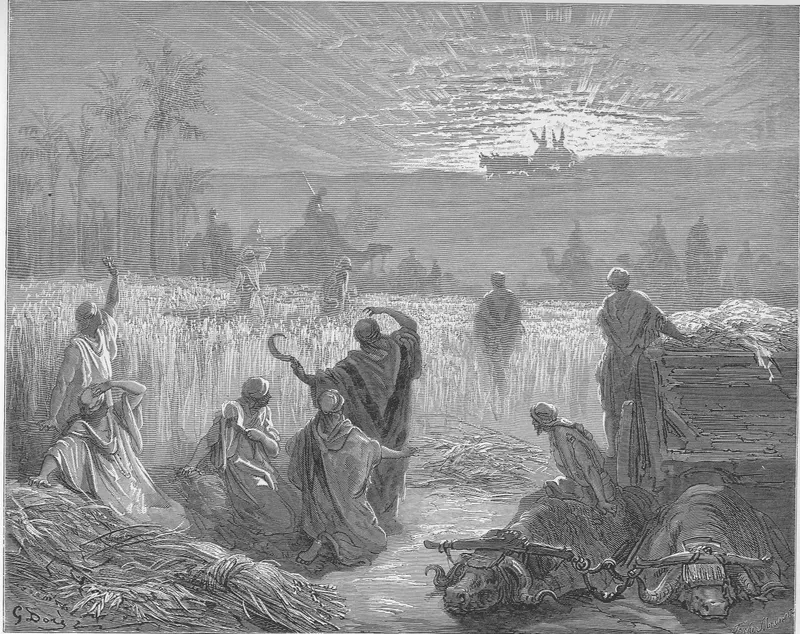
13And they of Bethshemesh were reaping their wheat harvest in the valley: and they lifted up their eyes, and saw the ark, and rejoiced to see it. 14And the cart came into the field of Joshua, a Bethshemite, and stood there, where there was a great stone: and they clave the wood of the cart, and offered the kine a burnt offering unto the LORD. 15And the Levites took down the ark of the LORD, and the coffer that was with it, wherein the jewels of gold were, and put them on the great stone: and the men of Bethshemesh offered burnt offerings and sacrificed sacrifices the same day unto the LORD.
Beth-shemesh means “house of the sun”2. The town sits in the Shephelah, on the border between Philistia and Judah. Wheat harvest is in early summer - full barns, light evenings, the year's most abundant moment. The reapers look up from their work and see the ark of the LORD coming home on a Philistine cart, drawn by cows that had no business pulling it. The text gives us a perfect cinematic shot - the sun, the wheat, the road, the cart, the boys running to tell the village.
A great stone in the field of a man named Joshua becomes a spontaneous altar. The cart that carried the ark is broken up for the fire; the cows that pulled it are offered as the burnt offering. The cart and the animals that bore the holy thing become the holy thing themselves. Everything that touched the ark's homecoming is consecrated to it. The picture is luminous, and it is also the chapter's last glad scene.
1 Samuel 6:16-18Unto This Day
16And when the five lords of the Philistines had seen it, they returned to Ekron the same day. 17And these are the golden emerods which the Philistines returned for a trespass offering unto the LORD; for Ashdod one, for Gaza one, for Askelon one, for Gath one, for Ekron one; 18And the golden mice, according to the number of all the cities of the Philistines belonging to the five lords, both of fenced cities, and of country villages, even unto the great stone of Abel, whereon they set down the ark of the LORD: which stone remaineth unto this day in the field of Joshua, the Bethshemite.
1 Samuel 6:19-21Who Is Able to Stand?
19And he smote the men of Bethshemesh, because they had looked into the ark of the LORD, even he smote of the people fifty thousand and threescore and ten men: and the people lamented, because the LORD had smitten many of the people with a great slaughter. 20And the men of Bethshemesh said, Who is able to stand before this holy LORD God? and to whom shall he go up from us? 21And they sent messengers to the inhabitants of Kirjathjearim, saying, The Philistines have brought again the ark of the LORD; come ye down, and fetch it up to you.
The chapter pivots in a single sentence. Joy turns to lament. The men who looked into the ark were not Philistines - they were Israelites3, the very people Numbers 4:20 had warned would die for doing this very thing. The number in the Masoretic Hebrew text is unusually large (“fifty thousand and threescore and ten”) and many manuscripts and modern translations read just “seventy men.” The exact count is debated; the lesson is not.
The holiness of God is not negotiated by ethnic membership. The covenant people are no more allowed to presume on the holy than the Philistines were.
They ask exactly the right thing - and from inside the moment of judgment, they cannot answer it. So they get rid of the problem. Send the ark to Kirjath-jearim; let someone else stand near it. There it will sit, almost forgotten, for twenty years until David finally brings it up to Jerusalem. From this point on, the whole Old Testament is slowly assembling the answer these grieving men could only put as a question.
Research trail
Sources & further study
These references support the historical, linguistic, manuscript, and contextual notes in this chapter. Scripture remains the primary text; external sources are provided so readers can inspect the research directly.
- 1 Samuel 6 · Hebrew + Jewish commentaryHebrew text with Rashi and Radak on the diviners' counsel, the milch cows, and the Beth-shemesh judgment.
- Tel Beth-Shemesh ExcavationsExcavations at Tel Beth-Shemesh - the border town where the ark came back into Israel from Philistia, sitting on the road between the Shephelah and the Judean hill country.
- The Ark of the CovenantSBL overview of the ark - its construction, its role in the wilderness, and its movements through 1 Samuel and 2 Samuel.
Where this echoes in Scripture
Emerods of Gold, Mice of Gold
- Exodus 12:35-36And they spoiled the Egyptians.The original gold-offering-on-the-way-out the Philistines are echoing.
- Matthew 12:41The men of Nineveh shall rise in judgment with this generation, and shall condemn it.Jesus naming the same dynamic - outsiders responding better to God than insiders.
- Matthew 8:10I have not found so great faith, no, not in Israel.The Roman centurion - reverence found outside the covenant people.
- Mark 7:26-29For this saying go thy way; the devil is gone out of thy daughter.The Syrophoenician mother whose faith Jesus singled out.
- Luke 17:16-18And he was a Samaritan… there are not found that returned to give glory to God, save this stranger.The one healed leper who came back - and he was the outsider.
The Cows That Would Not Turn Aside
Unto This Day
Who Is Able to Stand?
- Numbers 4:20But they shall not go in to see when the holy things are covered, lest they die.The warning the Beth-shemites violated - exactly what Numbers 4 had named.
- Hebrews 10:19-22Having therefore, brethren, boldness to enter into the holiest by the blood of Jesus.The New Testament's direct answer to the Beth-shemites' question.
- Hebrews 12:28-29Let us have grace, whereby we may serve God acceptably with reverence and godly fear: for our God is a consuming fire.The both-and the chapter is reaching for - reverence inside the boldness.