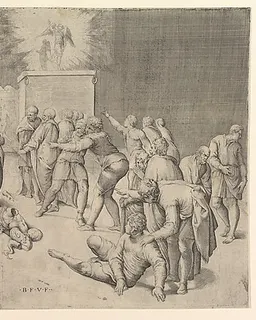
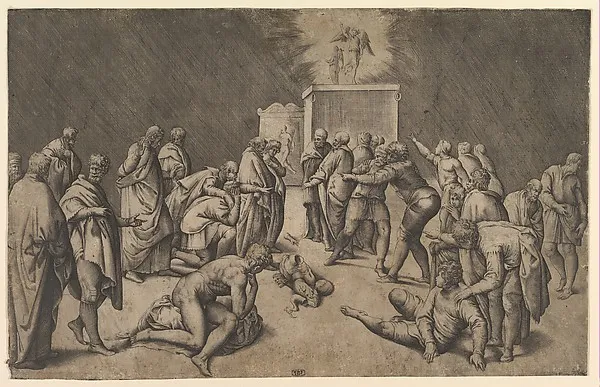
1 Samuel 5
The Philistines won the battle and took the ark of God. They carried it home like plunder and set it in the temple of Dagon, beside the idol of their god (v. 2). The message was plain: our god has beaten yours. Then morning came. Dagon lay face-down on the floor before the ark, flat as a worshipper. They stood him back up. The next morning he was down again, head and hands snapped off on the threshold (v. 4). No hand had touched him.1
Tap any highlighted phrase to jump to the commentary that unpacks it.
1 Samuel 5:1-5Dagon Was Fallen Upon His Face
1And the Philistines took the ark of God, and brought it from Ebenezer unto Ashdod. 2When the Philistines took the ark of God, they brought it into the house of Dagon, and set it by Dagon. 3And when they of Ashdod arose early on the morrow, behold, Dagon was fallen upon his face to the earth before the ark of the LORD. And they took Dagon, and set him in his place again. 4And when they arose early on the morrow morning, behold, Dagon was fallen upon his face to the ground before the ark of the LORD; and the head of Dagon and both the palms of his hands were cut off upon the threshold; only the stump of Dagon was left to him. 5Therefore neither the priests of Dagon, nor any that come into Dagon’s house, tread on the threshold of Dagon in Ashdod unto this day.
The Philistines do with the ark exactly what a victorious army of the ancient world did with the captured emblem of a defeated people's god: they carry it into the temple of their own deity and set it down beside the idol. When the Philistines took the ark of God, they brought it into the house of Dagon, and set it by Dagon (v. 2). The placement is a sermon in itself - their god has won, the God of Israel is now a captive standing in attendance at Dagon's feet.
Then the morning comes, and the sermon is reversed: when they of Ashdod arose early on the morrow, behold, Dagon was fallen upon his face to the earth before the ark of the LORD (v. 3). The posture is unmistakable. To fall on one's face before another is the very gesture of homage and submission. The god who was meant to tower over the ark as conqueror is found prostrate before it, doing obeisance like a worshipper.
The Philistines respond the only way they know how: they took Dagon, and set him in his place again. It is an oddly revealing act - a god who has to be picked up off the floor and propped back upright by the hands of his own people is no god at all. They are holding up the very thing they came to worship.1
The second morning removes any possibility that the first was an accident. When they arose early on the morrow morning, behold, Dagon was fallen upon his face… and the head of Dagon and both the palms of his hands were cut off upon the threshold; only the stump of Dagon was left to him (v. 4). The first fall was a posture; this is a dismemberment. The head - the seat of rule and thought - and the two palms - the instruments of action and power - are severed and left lying on the doorstep, exactly where a worshipper would step.
What remains upright is only a mutilated trunk. The image could hardly be more pointed: a god with no head to plan and no hands to act, broken at the very threshold of his own house. And the long shadow of this scene falls across the generations that follow: therefore neither the priests of Dagon, nor any that come into Dagon's house, tread on the threshold of Dagon in Ashdod unto this day (v. 5).
The Philistines turn the place of their god's humiliation into a superstition, stepping carefully over the threshold for years afterward - an enduring, unintended memorial to the morning their god was found in pieces before the ark of the LORD.
1 Samuel 5:6-7The Hand of the LORD Was Heavy
6But the hand of the LORD was heavy upon them of Ashdod, and he destroyed them, and smote them with emerods, even Ashdod and the coasts thereof. 7And when the men of Ashdod saw that it was so, they said, The ark of the God of Israel shall not abide with us: for his hand is sore upon us, and upon Dagon our god.
The toppling of Dagon was a sign; now comes the weight behind the sign. A hand grown heavy falls on Ashdod, and the judgment does not stay confined to the temple - it spreads through the city and out into the coasts thereof (v. 6). The Philistines had treated the ark as a captured object, a prize to be displayed; they learn that the presence it marks is not inert and not safe. And their own reading of the situation is striking in its clarity: the men of Ashdod… said, The ark of the God of Israel shall not abide with us: for his hand is sore upon us, and upon Dagon our god (v. 7).
They make no mistake about the cause. They do not blame chance, or bad air, or ill fortune. They name the God of Israel directly, and they confess that His hand has fallen on two things at once - on them, and on Dagon our god. It is a remarkable admission from pagan lips: their own deity has been struck and could do nothing, and the same hand that broke their god is now pressing on them.
But notice what their words are not. This is recognition without repentance, fear without surrender. They want the ark gone, not the LORD honored. They have felt His power and want only to be rid of it - the response of those who would rather send God away than bow before Him.
1 Samuel 5:8-12The Cry of the City Went Up to Heaven
8They sent therefore and gathered all the lords of the Philistines unto them, and said, What shall we do with the ark of the God of Israel? And they answered, Let the ark of the God of Israel be carried about unto Gath. And they carried the ark of the God of Israel about thither. 9And it was so, that, after they had carried it about, the hand of the LORD was against the city with a very great destruction: and he smote the men of the city, both small and great, and they had emerods in their secret parts. 10Therefore they sent the ark of God to Ekron. And it came to pass, as the ark of God came to Ekron, that the Ekronites cried out, saying, They have brought about the ark of the God of Israel to us, to slay us and our people. 11So they sent and gathered together all the lords of the Philistines, and said, Send away the ark of the God of Israel, and let it go again to his own place, that it slay us not, and our people: for there was a deadly destruction throughout all the city; the hand of God was very heavy there. 12And the men that died not were smitten with the emerods: and the cry of the city went up to heaven.
Faced with an affliction they cannot stop, the Philistine leaders convene a council: What shall we do with the ark of the God of Israel? (v. 8). Their solution is the instinct of every people who would rather manage a problem than confront its source - move it along. They send the ark to Gath, another of their cities, as if the trouble were tied to a place rather than to a Person. The result is immediate and worse: the hand of the LORD was against the city with a very great destruction: and he smote the men of the city, both small and great (v. 9).
The same heavy hand follows the ark to Gath and falls on high and low alike. This is the quiet lesson threaded through these verses: the judgment of God is not territorial. It is not bound to Ashdod, escaped by a change of address. Wherever the ark goes, the presence goes; and wherever the presence goes among those who hold it as a captured prize, the hand goes too. The Philistines are learning, city by painful city, that you cannot relocate your way out from under God.
By the time the ark reaches the third city, the Philistines have stopped experimenting. They sent the ark of God to Ekron. And… as the ark of God came to Ekron, that the Ekronites cried out, saying, They have brought about the ark of the God of Israel to us, to slay us and our people (v. 10). The Ekronites do not even want it inside their gates; the reputation has arrived ahead of the ark itself.
They convene the same emergency council and reach the only conclusion left: Send away the ark of the God of Israel, and let it go again to his own place, that it slay us not (v. 11). The reason is stated plainly - there was a deadly destruction throughout all the city; the hand of God was very heavy there. Note the intensifying language: at Ashdod the hand was heavy (v. 6); here it is very heavy. The pressure has not eased as the ark traveled; it has mounted.
The Philistines have run the experiment to its end, and the verdict is total. There is no city far enough, no plan clever enough. The only relief is to send the ark of God back to where it belongs - and even that is sought out of sheer desperation to survive, with reverence nowhere in sight.1
The chapter ends on a sound. A whole region of the enemies of Israel is reduced to a single thing: the cry of the city went up to heaven (v. 12) - rising to the very heaven where the God whose ark they seized is enthroned. The phrase carries weight in Scripture. The cry of Sodom went up before the LORD; the cry of enslaved Israel went up out of Egypt and God heard it. A cry going up to heaven is the sound of a people who have come to the end of their own power, confronted by a force they can neither fight nor flee.
And yet - this is a cry of agony, the voices of people longing only to be free of the God pressing on them, without any surrender to Him. It is the cry of those who have learned, beyond all doubt, that the LORD is real and that He cannot be handled - but who have not yet learned to bow. They acknowledge His power without yielding their hearts. The whole episode stands as a sober portrait of what it is to encounter the living God on the wrong terms: to feel His weight, to confess His strength, and still to want Him gone.
Research trail
Sources & further study
These references support the historical, linguistic, manuscript, and contextual notes in this chapter. Scripture remains the primary text; external sources are provided so readers can inspect the research directly.
- 1 Samuel 5 - Translators' NotesThe NET Bible's detailed footnotes on 1 Samuel 5 - the placing of the ark in Dagon's house (vv. 1-2), the severed head and hands left on the threshold (vv. 4-5), the heavy hand of the LORD and the affliction that struck the cities (vv. 6, 9), and the panic at Ekron (vv. 10-12).
- 1 Samuel 5 · Hebrew + classical Jewish commentaryThe Hebrew text of 1 Samuel 5 with Rashi, Radak, and other classical commentators side by side - useful for yad-YHWH (vv. 6, 9, 11, “the hand of the LORD” that falls heavy), for the broken figure of Dagon on the threshold (vv. 4-5), and for the affliction the KJV calls emerods (vv. 6, 9, 12).
- 1 Samuel 5 ↔ Isaiah 46 · 2 Corinthians 6 · Colossians 2Traces the threads tying 1 Samuel 5 to the rest of Scripture - Dagon fallen before the ark (vv. 3-4) read alongside Bel boweth down, Nebo stoopeth (Isa. 46:1-2), the idol that has no place in God's presence (2 Cor. 6:16), and the powers spoiled… openly from within their own stronghold (Col. 2:15).
Where this echoes in Scripture
Dagon Was Fallen Upon His Face
- Isaiah 46:1-2Bel boweth down, Nebo stoopeth... they could not deliver the burden, but themselves are gone into captivity.The same picture as verses 3-4 - the gods of the nations brought low, unable to save themselves.
- Psalm 115:4-7Their idols are silver and gold, the work of men's hands... they have hands, but they handle not.Dagon, found with his hands cut off (v. 4), is exactly the helpless idol this psalm describes.
- Exodus 12:12against all the gods of Egypt I will execute judgment: I am the LORD.The LORD judging the gods of a hostile nation - the same act played out in Dagon's house.
- Judges 16:23-30the lords of the Philistines gathered them together for to offer a great sacrifice unto Dagon their god... and the house fell.Another house of Dagon brought down by the God of Israel - the same god, the same outcome.
- 2 Corinthians 6:16what agreement hath the temple of God with idols? for ye are the temple of the living God.The truth Dagon's empty house declares - the living God shares no shelf with an idol.
- John 12:31Now is the judgment of this world: now shall the prince of this world be cast out.The presence of God leaves no room for a rival power - the same eviction Dagon suffered (v. 4).
- Luke 10:18I beheld Satan as lightning fall from heaven.A power that exalted itself thrown down before the living God, as Dagon was thrown to the floor.
The Hand of the LORD Was Heavy
- Exodus 9:3Behold, the hand of the LORD is upon thy cattle which is in the field... there shall be a very grievous murrain.The hand of the LORD heavy on a hostile nation, just as in verse 6 - the plagues on Egypt echoed at Ashdod.
- 1 Samuel 6:5-6wherefore then do ye harden your hearts, as the Egyptians and Pharaoh hardened their hearts?The Philistines themselves read the affliction of verses 6-7 as the hand of the God who struck Egypt.
- Psalm 32:4For day and night thy hand was heavy upon me: my moisture is turned into the drought of summer.The same heavy hand of verse 6 - felt here by one who, unlike Ashdod, turns toward God.
- Hebrews 10:31It is a fearful thing to fall into the hands of the living God.The lesson Ashdod learned (vv. 6-7) - the presence of the living God is not to be handled lightly.
- Acts 13:11And now, behold, the hand of the Lord is upon thee, and thou shalt be blind.The hand of the Lord falling in judgment on one who opposed His work - the same hand as verse 6.
The Cry of the City Went Up to Heaven
- Colossians 2:15having spoiled principalities and powers, he made a shew of them openly, triumphing over them in it.The deepest pattern of the chapter - the enemy overthrown from within the stronghold that thought it had won.
- Acts 2:24whom God hath raised up... because it was not possible that he should be holden of it.The ark could not be kept in Ashdod (v. 11); the living God could not be held by death.
- Genesis 18:20-21Because the cry of Sodom and Gomorrah is great... I will go down now, and see.A cry of judgment going up before the LORD - the same dread sound as verse 12.
- Exodus 8:8Pharaoh called for Moses and Aaron, and said, Intreat the LORD, that he may take away the frogs from me.A ruler under God's hand begging for relief without yielding his heart - the posture of verses 8-11.
- Philippians 2:9-10God also hath highly exalted him... that at the name of Jesus every knee should bow.Where Dagon was forced down before the ark (v. 4), every power will one day bow before the exalted Christ.