2 Maccabees 5
People in this chapter
Some chapters of Scripture are hard to read because the violence in them is real, and 2 Maccabees 5 is one of them. It opens with a wonder in the sky over Jerusalem: for forty days, horsemen in gilded armor charge across the air with drawn swords and flashing shields, and the people pray that the strange sign will turn to good. What follows is the opposite of good. A deposed high priest named Jason, hearing a false rumor that the king is dead, attacks his own city and butchers his own people.
The real king, Antiochus, returns from Egypt in a fury, storms Jerusalem, and in three days leaves tens of thousands dead. Then he does the unthinkable: he walks into the holiest place on earth and carries off its sacred vessels with profane hands.
Tap any highlighted phrase to jump to the commentary that unpacks it.
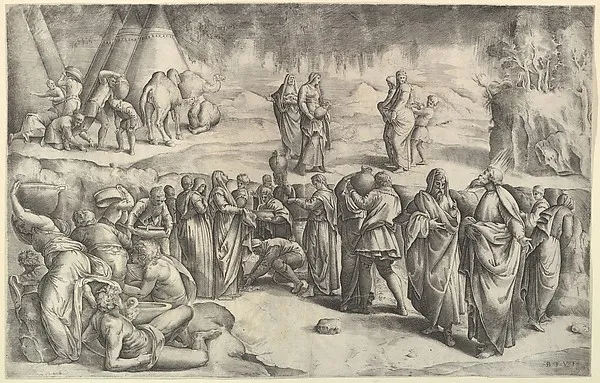
2 Maccabees 5:1-7A Sign in the Heavens and a Brother's Sword
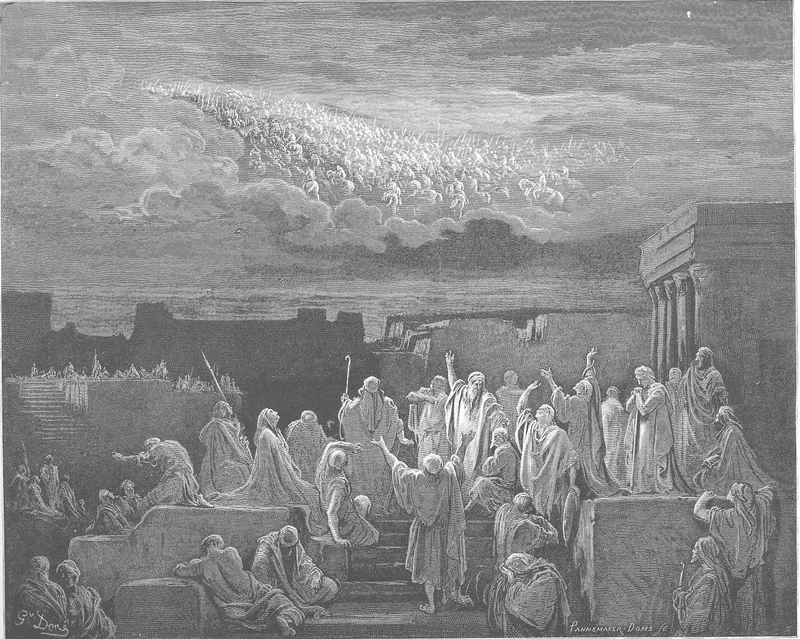
2And it came to pass that through the whole city of Jerusalem for the space of forty days there were seen horsemen running in the air, in gilded raiment, and armed with spears, like bands of soldiers. 4Wherefore all men prayed that these prodigies might turn to good.
The chapter opens with the city under a strange and frightening sky. For forty days, the people of Jerusalem watch armies of horsemen gallop through the air in golden armor, with drawn swords and the crash of shields. The author records it as a portent, a sign that some great upheaval is near. Throughout Scripture, unsettling signs in the heavens go before days of reckoning, and here the omen of war hangs over the city before a single soldier arrives.
The vision does not explain itself. It simply warns that something is coming, and it leaves the people to wonder what.
The people's response to the sign is the first hopeful note in a dark chapter: they pray. Faced with a wonder they cannot interpret, they ask God that the omen might turn to good. It is an instinct worth marking. The faithful bring even their dread to God in prayer. The chapter will show that the road ahead is bitter, yet the prayer is the very posture that will, in time, bring the mercy the chapter promises.
5Now when there was gone forth a false rumour, as though Antiochus had been dead, Jason taking with him no fewer than a thousand men, suddenly assaulted the city: and though the citizens ran together to the wall, the city at length was taken, and Menelaus fled into the castle. 6But Jason slew his countrymen without mercy, not considering that prosperity against one’s own kindred is a very great evil, thinking they had been enemies, and not citizens, whom he conquered.
Jason had once bought the high priesthood and then been pushed aside by a worse man, Menelaus. Now, hearing a false report that Antiochus has died in Egypt, he sees his chance. He gathers a thousand men and falls upon Jerusalem, his own city, the city of the temple he had served. The whole tragedy turns on a rumor that was not even true. Ambition does not wait for facts. It seizes on whatever opening it imagines and rushes through, and here it sets brother against brother inside the walls that should have made them one.
The author pauses to name the horror plainly. Jason slaughters his own countrymen without mercy, treating fellow citizens as if they were foreign enemies. Then comes the line that exposes the rot at the center of it: he did not consider that to triumph against one's own kindred is a very great evil. There is a kind of winning that is itself a defeat. To conquer your own people, to climb over the bodies of those you were meant to protect, is not victory in any sense God recognizes.
Jason gains the city for a moment and loses everything that made the city worth having.
2 Maccabees 5:8-10The Man Who Drove Out Many Dies a Stranger
8At the last having been shut up by Aretas the king of the Arabians, in order for his destruction, flying from city to city, hated by all men, as a forsaker of the laws, and execrable, as an enemy of his country and countrymen, he was thrust out into Egypt: 9And he that had driven many out of their country, perished in a strange land, going to Lacedemon, as if for kindred sake he should have refuge there:
The chapter follows Jason to his end, and it is a portrait of a man unraveling. He is shut up by a foreign king, then flees from city to city, hated by everyone, branded a traitor to his nation and an enemy of his own people. The man who tried to seize a city now cannot find a single place that will keep him. There is a sober pattern here. The one who lives by betrayal eventually finds that betrayal has poisoned every door he might knock on.
Having been faithful to no one, he discovers that no one owes him refuge.
The author lingers on the irony with deliberate weight. The man who had driven many people out of their homeland now perishes himself in a foreign land, far from his own. He flees toward Lacedemon hoping to be taken in as a distant kinsman, and the hope comes to nothing. What he did to others is measured back into his own life. Scripture often shows this quiet justice, where the trap a person sets becomes the trap they fall into, because evil has a way of circling home to the one who sent it out.
10But he that had cast out many unburied, was himself cast forth both unlamented and unburied, neither having foreign burial, nor being partaker of the sepulchre of his fathers.
The final image is the heaviest. Jason had left many of his victims dead without burial, and now he himself dies with no one to mourn him and no grave to receive him, denied even a place among his own fathers in death. In a world that honored the dead above almost everything, to die unlamented and unburied was the deepest dishonor imaginable. The author does not gloat. He records it as a warning written into the order of things: the dishonor a person heaps on others has a way of becoming the measure of their own end.
A life poured out for self leaves nothing behind to grieve over it.
2 Maccabees 5:11-16The Holiest Place Profaned
11Now when these things were done, the king suspected that the Jews would forsake the alliance: whereupon departing out of Egypt with a furious mind, he took the city by force of arms. 13Thus there was a slaughter of young and old, a destruction of women children, and killing of virgins and infants.
Antiochus reads the fighting in Jerusalem as rebellion against him, and he returns from Egypt in a rage to crush it. He takes the city by sheer force. The chapter does not soften what follows. A ruler who has lost his temper and holds absolute power is one of the most dangerous things in the world, and Antiochus turns that fury on a whole city. The disaster that the horsemen in the sky foretold has arrived, and it wears the face of a furious king who answers a rumor of revolt with the death of thousands.
The author records the cost without flinching, and we should not rush past it. Young and old, women and children, even infants are killed; in three days tens of thousands are dead and tens of thousands more sold into slavery. This is the kind of suffering that makes a reader cry out, where is God? The chapter does not pretend the pain away or explain it cheaply. It holds the grief open. And in the verses just ahead, it will do something rare: it will dare to speak about how such a horror can be held within the purposes of a God who has not abandoned His people.
15But this was not enough; he presumed also to enter into the temple, the most holy in all the world, Menelaus, that traitor to the laws, and to his country, being his guide. 16And taking in his wicked hands the holy vessels, which were given by other kings and cities, for the ornament and the glory of the place, he unworthily handled and profaned them.
Killing the people is not enough for Antiochus. He presumes to enter the temple itself, the holiest place on earth, where the sacred and the common were carefully kept apart and only the consecrated could go. And he is led in by Menelaus, a son of Israel who had bought the priesthood and betrayed it. The deepest wound is always the one that comes through the hand of an insider. A pagan king could not have found the way in alone; it took one who knew the holy things and was willing to sell them.
The profaning of the temple begins with a traitor at the door.
Antiochus lays his hands on the holy vessels, the consecrated instruments of worship that kings and cities had given to adorn the house of God, and handles them with contempt. To the king they are only precious metal to be carried off. To God's people they are set apart for His worship, and to seize them so is to profane what is holy. The scene is a study in two ways of seeing. Where the faithful see the glory of God, the proud man sees only plunder.
What is sacred to heaven looks like loot to a heart that knows nothing higher than itself.
2 Maccabees 5:17-20God Chose the Place for the People's Sake
17Thus Antiochus going astray in mind, did not consider that God was angry for a while, because of the sins of the habitants of the city: and therefore contempt had happened to the place:
Here the author steps back and gives us the key to the whole chapter. Antiochus, blinded by pride, imagines that his sword is what conquered Jerusalem. He does not understand that he was permitted to do this only because God was angry for a while on account of the sins of the city. The disgrace fell on the holy place because the people had turned away, and God was angry for a while. The anger is real, but bounded, a season with an end.
The author is teaching us to read catastrophe with a longer eye, to see the discipline of a loving God where a proud man sees only his own strength.
19But God did not choose the people for the place’s sake, but the place for the people’s sake. 20And therefore the place also itself was made partaker of the evils of the people: but afterward shall communicate in the good things thereof, and as it was forsaken in the wrath of almighty God, shall be exalted again with great glory, when the great Lord shall be reconciled.
This single sentence is one of the most important in the book. God did not choose the people for the sake of the temple; He chose the temple for the sake of the people. The building, however holy, exists to serve the relationship between God and His covenant people. People can come to treasure the place more than the God who meets them there, and to value the worship more than the lives the worship is meant to form.
The author quietly puts everything back in order. The sacred space matters because the people matter to God, and the people matter because God loves them.
Because the temple is bound up with the people, it shares their fate. When the people suffer for their sins, the place suffers with them; and when God turns again in mercy, the place will be lifted up with them, exalted once more with great glory. The chapter promises restoration on the far side of judgment, but it hangs that promise on a single condition: it will come when the great Lord is reconciled. Judgment is the season; reconciliation is the goal.
The God who allowed the disgrace is the same God who longs to be reconciled and to restore, and the whole arc bends toward that reconciliation.
2 Maccabees 5:21-27A Sabbath Betrayed, and One Man in the Wilderness
21So when Antiochus had taken away out of the temple a thousand and eight hundred talents, he went back in all haste to Antioch, thinking through pride, that he might now make the land navigable, and the sea passable on foot: such was the haughtiness of his mind.
The author gives us one last look inside Antiochus, and what he finds there is pride swollen past all measure. Having plundered the temple, the king imagines in his arrogance that he could make dry land sailable and the sea walkable, that nothing in heaven or earth lies beyond his reach. This is the inner madness of unchecked power: it forgets there is a God above it and begins to think itself limitless. Scripture watches this pride again and again and marks its end.
The man who believes he can command land and sea has set himself against the only One who actually can, and that contest has only ever ended one way.
25Who when he was come to Jerusalem, pretending peace, rested till the holy day of the sabbath: and then the Jews keeping holiday, he commanded his men to take arms. 26And he slew all that were come forth to see: and running through the city with armed men, he destroyed a very great multitude.
Antiochus sends an officer who works by a colder method than open assault. He comes pretending peace, waits quietly until the Sabbath, and then, while the people are at rest in worship, gives the order to draw swords. He turns the people's devotion into the very trap that destroys them, using the day they would not fight as the day to strike. There is a special cruelty in weaponizing someone's faithfulness against them, in counting on their goodness as a weakness to exploit.
The faithful are vulnerable precisely where they are devoted, and an enemy without conscience knows it.
The slaughter on the Sabbath is the lowest point of the chapter, treachery and bloodshed together on the holy day. And yet this is exactly the moment the author has been preparing us to read rightly. We have been told that God is angry only for a while, that the place suffers with the people and will be restored, that the Lord longs to be reconciled. So even here, at the very bottom, the chapter does not leave us in despair. The night is at its darkest, and the next verse will strike a match.
27But Judas Machabeus, who was the tenth, had withdrawn himself into a desert place, and there lived amongst wild beasts in the mountains with his company: and they continued feeding on herbs, that they might not be partakers of the pollution.
The chapter ends with one man almost no one is watching. While Antiochus rampages through the city, Judas Maccabeus quietly withdraws into the wilderness with a small company and lives among the wild beasts in the mountains. To the eye of power this is nothing, a fugitive hiding in the hills while the conqueror takes everything. But the author closes the chapter here on purpose. The proud king cannot see that the real future of God's people has just slipped out of his grasp into the wilderness, a hidden seed from which deliverance will grow.
God's rescues so often begin small and out of sight, in the one faithful person the powerful never noticed.
Judas and his company eat only wild herbs, content with the plainest food, so that they will not share in the pollution that has overtaken the city. When everything around them is being defiled, they choose to keep themselves clean even at the cost of comfort and safety. This is faithfulness in its quietest and most costly form, the refusal to be carried along by the corruption of the moment simply because resisting is hard.
There are seasons when holding the line means stepping back, going without, accepting the wilderness so as not to be stained by what everyone else has accepted. From that hidden faithfulness, the next chapters of deliverance will be born.
Where this echoes in Scripture
A Sign in the Heavens and a Brother's Sword
- Genesis 4:9-10And the LORD said unto Cain, Where is Abel thy brother?... the voice of thy brother's blood crieth unto me from the ground.The first violence in Scripture is a brother against his brother, the same evil Jason commits.
- Joel 2:30-31And I will shew wonders in the heavens and in the earth... before the great and the terrible day of the LORD come.Signs in the sky go before a day of reckoning, as the horsemen do over Jerusalem.
- 1 John 3:15Whosoever hateth his brother is a murderer: and ye know that no murderer hath eternal life abiding in him.The New Testament names the inner root of what Jason acted out.
The Man Who Drove Out Many Dies a Stranger
- Galatians 6:7Be not deceived; God is not mocked: for whatsoever a man soweth, that shall he also reap.The principle the whole passage dramatizes: a life returns to a person what it sent out.
- Psalm 7:15-16He made a pit, and digged it, and is fallen into the ditch which he made. His mischief shall return upon his own head.The trap turns back on the one who set it, exactly as it does for Jason.
- Matthew 7:2For with what judgment ye judge, ye shall be judged: and with what measure ye mete, it shall be measured to you again.Jesus states the measure-for-measure justice the chapter shows in Jason.
The Holiest Place Profaned
- Daniel 5:2-4Belshazzar... commanded to bring the golden and silver vessels which... were taken out of the temple... and they drank wine, and praised the gods.Another ruler profanes the temple's holy vessels, and judgment follows that very night.
- Psalm 79:1O God, the heathen are come into thine inheritance; thy holy temple have they defiled.The psalmist's lament over a defiled temple gives voice to this chapter's grief.
- Matthew 24:15When ye therefore shall see the abomination of desolation... stand in the holy place...Jesus invokes the memory of the temple's profaning as a sign of trouble to come.
God Chose the Place for the People's Sake
- Psalm 30:5For his anger endureth but a moment; in his favour is life: weeping may endure for a night, but joy cometh in the morning.The very heart of this section: God's anger is for a while; His mercy is the destination.
- John 2:19-21Destroy this temple, and in three days I will raise it up... but he spake of the temple of his body.Christ makes His own body the temple the people are truly for.
- 2 Corinthians 5:19God was in Christ, reconciling the world unto himself, not imputing their trespasses unto them.The reconciliation this chapter waits for is accomplished in Christ.
A Sabbath Betrayed, and One Man in the Wilderness
- Isaiah 14:13-15For thou hast said in thine heart, I will ascend into heaven... yet thou shalt be brought down to hell.The end of the pride that imagines itself above all limits, as Antiochus does.
- 1 Kings 19:18Yet I have left me seven thousand in Israel, all the knees which have not bowed unto Baal.God preserves a faithful remnant when corruption seems total, as with Judas in the hills.
- Hebrews 11:38Of whom the world was not worthy: they wandered in deserts, and in mountains, and in dens and caves of the earth.The faithful who flee to the wilderness to keep themselves undefiled are counted among the heroes of faith.