Ezekiel 40
People in this chapter
The book of Ezekiel has been, for many chapters, a book of tearing down - the glory departing from the temple, the city under siege, the nations judged. Now, in the twenty-fifth year of the exile and the fourteenth after Jerusalem fell, everything turns. In the visions of God the LORD's hand carries the prophet back to the land of Israel and sets him upon a very high mountain, and there before him is the frame of a city (vv. 1-2).
The God who let the house be broken now shows His servant a house being built. From here to the end of the book the vision unfolds, and it begins with a single, arresting figure: a man, whose appearance was like the appearance of brass, with a line of flax in his hand, and a measuring reed (v. 3).1
Tap any highlighted phrase to jump to the commentary that unpacks it.
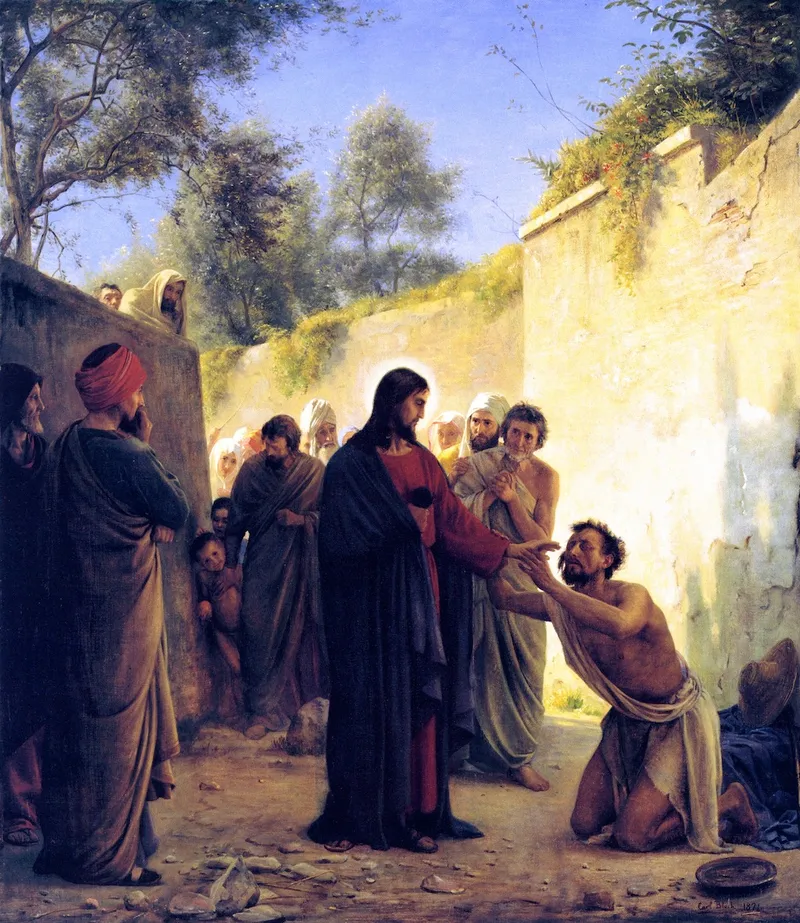
Ezekiel 40:1-4A Man with a Measuring Reed
1In the five and twentieth year of our captivity, in the beginning of the year, in the tenth day of the month, in the fourteenth year after that the city was smitten, in the selfsame day the hand of the LORD was upon me, and brought me thither. 2In the visions of God brought he me into the land of Israel, and set me upon a very high mountain, by which was as the frame of a city on the south. 3And he brought me thither, and, behold, there was a man, whose appearance was like the appearance of brass, with a line of flax in his hand, and a measuring reed; and he stood in the gate. 4And the man said unto me, Son of man, behold with thine eyes, and hear with thine ears, and set thine heart upon all that I shall shew thee; for to the intent that I might shew them unto thee art thou brought hither: declare all that thou seest to the house of Israel.
The vision is dated with the prophet's usual care: In the five and twentieth year of our captivity… in the fourteenth year after that the city was smitten, in the selfsame day the hand of the LORD was upon me, and brought me thither (v. 1). The reckoning is grief turned into a calendar - Ezekiel still counts the years from the day he was carried off, and from the day the city fell. Fourteen years have passed since Jerusalem and its temple were broken.
The exiles have had time to conclude that the dwelling of God among His people is finished, a thing of the past. And on that very day, the LORD's hand comes upon His servant again. In the visions of God He is carried back to the land and set upon a very high mountain, where the frame of a city stands before him (v. 2). The same hand that had shown Ezekiel the glory departing from the old house now lifts him to a high place to be shown a house to come.
After all the tearing down, God begins to show a building.1
At the gate stands a figure unlike Ezekiel himself: a man, whose appearance was like the appearance of brass, with a line of flax in his hand, and a measuring reed (v. 3). The gleam of brass marks him out as more than an ordinary man - a being who carries something of heaven's brightness, sent to guide the prophet through what he is about to see. And he comes equipped with the tools of a builder: a line of flax, a measuring cord for the long distances, and a measuring reed for the near ones.
He has come to lay out a house. The choice of instrument says a great deal. To measure is to declare a thing exact, intended, under control - the very opposite of the chaos exile had made. Where the enemy had pulled down walls and erased every boundary of the holy, this man arrives to set the boundaries afresh, by an unbending standard, down to the cubit. The God who measures is the God who builds with intent.
Then the man speaks, and his charge is the doorway into the whole vision: Son of man, behold with thine eyes, and hear with thine ears, and set thine heart upon all that I shall shew thee; for to the intent that I might shew them unto thee art thou brought hither: declare all that thou seest to the house of Israel (v. 4). Three commands stack up - behold, hear, set thine heart - and they rise in depth.
It is one thing to look; another to listen; another still to set the heart upon what is shown, to take it in and let it lodge where it will shape a person. The measuring that follows is not for idle curiosity; the prophet is brought here for a purpose, and the purpose runs outward: declare all that thou seest to the house of Israel. A people who thought the house of God was gone for good are meant to hear, through Ezekiel, that God is laying out a dwelling among them again.
So the vision asks of its reader exactly what it asked of the prophet: an attentive heart, watching how God makes a way to dwell with His people.
Ezekiel 40:5-7The Wall and the Gate's Threshold
5And behold a wall on the outside of the house round about, and in the man’s hand a measuring reed of six cubits long by the cubit and an hand breadth: so he measured the breadth of the building, one reed; and the height, one reed. 6Then came he unto the gate which looketh toward the east, and went up the stairs thereof, and measured the threshold of the gate, which was one reed broad; and the other threshold of the gate, which was one reed broad. 7And every little chamber was one reed long, and one reed broad; and between the little chambers were five cubits; and the threshold of the gate by the porch of the gate within was one reed.
The measuring begins, fittingly, at the boundary: a wall on the outside of the house round about (v. 5). Before a single room is measured, the line is run around the wall that marks where the common ground ends and the holy ground begins. The reed itself is now defined - six cubits long by the cubit and an hand breadth, the longer royal cubit, a hand's width more than the common one. Every number that follows is reckoned by this generous, exact standard.
The wall is measured one reed thick and one reed high - a clean, deliberate square. There is something quietly important in starting here. A wall both shuts out and lets in; it keeps the holy from being trampled, and it frames the gate through which one may rightly enter. To say the house has a measured wall round about is to say that the presence of God is a real place with a real edge - set apart, and approached on purpose, through the way that is provided.
Ezekiel 40:8-11The Porch and the Entry of the Gate
8He measured also the porch of the gate within, one reed. 9Then measured he the porch of the gate, eight cubits; and the posts thereof, two cubits; and the porch of the gate was inward. 10And the little chambers of the gate eastward were three on this side, and three on that side; they three were of one measure: and the posts had one measure on this side and on that side. 11And he measured the breadth of the entry of the gate, ten cubits; and the length of the gate, thirteen cubits.
From the wall the man comes to the eastern gate and goes up the stairs thereof (v. 6) - the first of many times the vision will have us climb to draw nearer. He measures the threshold, then the row of little chambers set along the passage of the gate, three on each side, all of one measure (vv. 7, 10). These guardrooms line the way in like sentries, each one identical, the whole approach ordered and watched.
He measures the posts, and the porch of the gate within (vv. 8-9) - for the gate is not a thin doorway but a deep structure, a whole journey of its own from the outer face to the inner. Even here, threshold by threshold, the theme is access: to enter is to pass along an appointed way, measured at every step, with the chambers of the gate keeping watch on either hand. The God who receives His people sets the terms of the welcome; the way in is His to lay out, and He lays it out with care.
Ezekiel 40:12-13Chamber to Chamber, Door to Door
12The space also before the little chambers was one cubit on this side, and the space was one cubit on that side: and the little chambers were six cubits on this side, and six cubits on that side. 13He measured then the gate from the roof of one little chamber to the roof of another: the breadth was five and twenty cubits, door against door.
Ezekiel 40:14-16Windows of Light and Palm Trees
14He made also posts of threescore cubits, even unto the post of the court round about the gate. 15And from the face of the gate of the entrance unto the face of the porch of the inner gate were fifty cubits. 16And there were narrow windows to the little chambers, and to their posts within the gate round about, and likewise to the arches: and windows were round about inward: and upon each post were palm trees.
The section ends with two details that lift the eye from the ruler to the beauty of the place. First, narrow windows - windows were round about inward (v. 16). The Hebrew suggests windows wider within than without, splayed so that light, once let in, spreads across the rooms; the house is built to be filled with light. Second, and lovelier still: upon each post were palm trees. The palm was an old emblem of life, of flourishing, of the righteous who shall flourish like the palm tree (Ps. 92:12); it had adorned the doors and walls of the first temple as well.
So the gate is not bare engineering. It is carved with the sign of life, and pierced to gather the light. The vision will not let us mistake the measuring for coldness. The exact God is also the generous one; the place laid out by an unbending standard is a place of light and of growing things. Holiness and beauty are not at odds in the house of God; the same gate is measured to the cubit and crowned with palms.
Ezekiel 40:17-19The Outer Court and Its Thirty Chambers
17Then brought he me into the outward court, and, lo, there were chambers, and a pavement made for the court round about: thirty chambers were upon the pavement. 18And the pavement by the side of the gates over against the length of the gates was the lower pavement. 19Then he measured the breadth from the forefront of the lower gate unto the forefront of the inner court without, an hundred cubits eastward and northward.
Through the eastern gate the man brings Ezekiel into the outward court, and a wider scene opens: a paved court running round about, with thirty chambers set upon the pavement (v. 17). The gate was the way in; the court is the place of gathering. These thirty chambers along the outer court were rooms for the people who came up to worship - for meals, for waiting, for the business of pilgrimage - a place prepared not for priests only but for the congregation drawn near.
The man then measures from gate to gate an hundred cubits (vv. 19, 23, 27), a clean hundred between the outer gates and the inner. The point of all this paving and spacing is welcome with order. The house has room for the people - chambers made ready, courts laid out - and yet the room is measured, the distances fixed, the approach arranged. God prepares a place for His people to come in; and the place He prepares is neither cramped nor chaotic, but spacious and ordered, with somewhere to stand and somewhere to stay.
Ezekiel 40:20-23The North Gate, Measured to Match
20And the gate of the outward court that looked toward the north, he measured the length thereof, and the breadth thereof. 21And the little chambers thereof were three on this side and three on that side; and the posts thereof and the arches thereof were after the measure of the first gate: the length thereof was fifty cubits, and the breadth five and twenty cubits. 22And their windows, and their arches, and their palm trees, were after the measure of the gate that looketh toward the east; and they went up unto it by seven steps; and the arches thereof were before them. 23And the gate of the inner court was over against the gate toward the north, and toward the east; and he measured from gate to gate an hundred cubits.
Now the vision does something striking: it measures three more gates - north, then south, then east into the inner court - and finds them, again and again, the same. The north gate is built after the measure of the first gate (v. 21); the south according to these measures (v. 24); the inner gates too, according to these measures (vv. 28, 32, 35). Fifty cubits long, five and twenty broad, the little chambers three on a side, the palm trees, the windows round about - the same, the same, the same.
To the modern ear the repetition can drag. But the sameness is the message. Whether a worshipper approached from the north or the south or the east, the way in was identical - one standard, one pattern, no privileged door for the favored few and lesser doors for the rest. The God of this house does not vary His terms by who is coming. There is one measured way in, and it is the same for all who would enter.
That every gate matches every other is the architecture preaching that access to God is even-handed, governed by one fixed standard, open on every side by the same appointed way.
Ezekiel 40:24-27The South Gate and the Seven Steps
24After that he brought me toward the south, and behold a gate toward the south: and he measured the posts thereof and the arches thereof according to these measures. 25And there were windows in it and in the arches thereof round about, like those windows: the length was fifty cubits, and the breadth five and twenty cubits. 26And there were seven steps to go up to it, and the arches thereof were before them: and it had palm trees, one on this side, and another on that side, upon the posts thereof. 27And there was a gate in the inner court toward the south: and he measured from gate to gate toward the south an hundred cubits.
Ezekiel 40:28-31Into the Inner Court by the South Gate
28And he brought me to the inner court by the south gate: and he measured the south gate according to these measures; 29And the little chambers thereof, and the posts thereof, and the arches thereof, according to these measures: and there were windows in it and in the arches thereof round about: it was fifty cubits long, and five and twenty cubits broad. 30And the arches round about were five and twenty cubits long, and five cubits broad. 31And the arches thereof were toward the utter court; and palm trees were upon the posts thereof: and the going up to it had eight steps.
Ezekiel 40:32-34The Inner Gate Toward the East
32And he brought me into the inner court toward the east: and he measured the gate according to these measures. 33And the little chambers thereof, and the posts thereof, and the arches thereof, were according to these measures: and there were windows therein and in the arches thereof round about: it was fifty cubits long, and five and twenty cubits broad. 34And the arches thereof were toward the outward court; and palm trees were upon the posts thereof, on this side, and on that side: and the going up to it had eight steps.
Ezekiel 40:35-37The North Gate of the Inner Court
35And he brought me to the north gate, and measured it according to these measures; 36The little chambers thereof, the posts thereof, and the arches thereof, and the windows to it round about: the length was fifty cubits, and the breadth five and twenty cubits. 37And the posts thereof were toward the utter court; and palm trees were upon the posts thereof, on this side, and on that side: and the going up to it had eight steps.
One small detail recurs at gate after gate, and it rewards a reader who has set the heart to notice: the steps. To the outer gates one goes up by seven steps (vv. 22, 26); to the inner gates, eight steps (vv. 31, 34, 37). The numbers themselves matter less than the unmistakable pattern they trace - the deeper in toward the presence of God one moves, the higher one climbs. Each gate is an ascent, and the inner court stands above the outer.
The whole house is built on a gradient that rises toward the holy. To draw near to God in this vision is never to stroll across a flat plain; it is to go up. There is a reverent logic in it that the Psalms knew well - the songs sung on the way to the temple were the songs of ascents, sung by people climbing toward the place where God had set His name. The steps quietly teach that nearness to God is a height to be sought, an ascent that lifts the one who climbs.
And they leave a question on every stair: am I drawing nearer, or hovering at the outer edge?
Ezekiel 40:38-41The Tables Where the Offerings Were Slain
38And the chambers and the entries thereof were by the posts of the gates, where they washed the burnt offering. 39And in the porch of the gate were two tables on this side, and two tables on that side, to slay thereon the burnt offering and the sin offering and the trespass offering. 40And at the side without, as one goeth up to the entry of the north gate, were two tables; and on the other side, which was at the porch of the gate, were two tables. 41Four tables were on this side, and four tables on that side, by the side of the gate; eight tables, whereupon they slew their sacrifices.
Ezekiel 40:42-44Hewn Stone, Hooks, and the Chambers of the Singers
42And the four tables were of hewn stone for the burnt offering, of a cubit and an half long, and a cubit and an half broad, and one cubit high: whereupon also they laid the instruments wherewith they slew the burnt offering and the sacrifice. 43And within were hooks, an hand broad, fastened round about: and upon the tables was the flesh of the offering. 44And without the inner gate were the chambers of the singers in the inner court, which was at the side of the north gate; and their prospect was toward the south: one at the side of the east gate having the prospect toward the north.
Now the measuring reaches the place where the cost of drawing near is paid. By the posts of the gate stand chambers where they washed the burnt offering, and within the porch are tables - two on this side, two on that, eight in all - to slay thereon the burnt offering and the sin offering and the trespass offering (vv. 38-41). These are the stations of approach. The vision has spent three sections asking how a person comes in to God; here it answers, soberly, that the way in passes by the place of sacrifice.
No one ascends to the presence of God without an offering made. The burnt offering ascended wholly to God in devotion; the sin offering and the trespass offering dealt with what was wrong, with guilt and failure that could not simply be waved aside. Even the hooks and the hewn-stone tables and the washing are measured (vv. 42-43), because nothing about atonement is careless. The holiness that lays out the gates by an exact reed also fixes, exactly, the price of admission.
To come near is costly, and the cost is met by blood shed at the gate.
Ezekiel 40:45-47The Priests Who Come Near, and the Foursquare Court
45And he said unto me, This chamber, whose prospect is toward the south, is for the priests, the keepers of the charge of the house. 46And the chamber whose prospect is toward the north is for the priests, the keepers of the charge of the altar: these are the sons of Zadok among the sons of Levi, which come near to the LORD to minister unto him. 47So he measured the court, an hundred cubits long, and an hundred cubits broad, foursquare; and the altar that was before the house.
Beside the tables stand chambers for those whose life is nearness: the priests, the keepers of the charge of the house, and the priests keepers of the charge of the altar - the sons of Zadok among the sons of Levi, which come near to the LORD to minister unto him (vv. 45-46). The phrase come near is the heart of priesthood. While the people gathered in the outer court, the priests were the ones appointed to approach, to stand at the altar and serve in the presence of God on the people's behalf.
The line of Zadok is named because faithfulness in drawing near is not nothing - this house honors those who kept the charge when others failed. There is gravity here. To come near to the LORD is the highest of callings and the most carefully guarded; the vision will not let it be treated lightly. And it opens a longing the whole arrangement cannot fully satisfy: if only the appointed few may come near, and only by way of the altar and the blood, what would it take for the rest - for all the people in the court - to truly draw near as well?
The vision sets the question; it does not yet close it.
Ezekiel 40:48-49The Porch of the House
48And he brought me to the porch of the house, and measured each post of the porch, five cubits on this side, and five cubits on that side: and the breadth of the gate was three cubits on this side, and three cubits on that side. 49The length of the porch was twenty cubits, and the breadth eleven cubits; and he brought me by the steps whereby they went up to it: and there were pillars by the posts, one on this side, and another on that side.
The man measures the inner court and finds it an hundred cubits long, and an hundred cubits broad, foursquare (v. 47). A perfect square sits at the center of the house, and at its heart stands the altar… before the house. The foursquare shape is the vision's seal of completeness and rightness - balanced, whole, equal on every side, the same shape that will mark the city lieth foursquare at the very end of Scripture (Rev. 21:16).
Then, last of all in this chapter, the man brings Ezekiel up to the porch of the house itself, measures its posts and its pillars, and notes once more the steps whereby they went up to it (vv. 48-49). The long journey of the chapter ends here, at the threshold of the house, having climbed from the outer wall through gate after gate, past the altar, up the final stairs to the porch. The chapter does not yet take us inside; that waits for the chapters to come.
It leaves us standing at the door of the house of God, the whole measured way behind us, the dwelling itself just ahead - which is, perhaps, exactly where the vision means to leave a heart that has been set upon all it has been shown.
Research trail
Sources & further study
These references support the historical, linguistic, manuscript, and contextual notes in this chapter. Scripture remains the primary text; external sources are provided so readers can inspect the research directly.
- Ezekiel 40 - Translators' NotesThe NET Bible's detailed footnotes on Ezekiel 40 - the dating of the vision in verse 1, the appearance and instruments of the man in verse 3, the long cubit of verse 5, the layout of the outer east gate and its little chambers (vv. 6-16), and the tables for the burnt offering in verses 38-43.
- Ezekiel 40 · Hebrew + classical Jewish commentaryThe Hebrew text of Ezekiel 40 with Rashi, Radak, and other classical commentators side by side - useful for qaneh ha-middah (v. 3, the “measuring reed” that is the standard for laying out the holy), for sim libcha (v. 4, “set thine heart”), and for the cubit by the cubit and an hand breadth in verse 5.
- Ezekiel 40 ↔ Revelation 11 & 21 · John 2 & 10 · Ephesians 2Traces the threads tying Ezekiel 40 to the rest of Scripture - the man with the measuring reed (v. 3) read alongside the reed given to John to measure the temple of God (Rev. 11:1) and the golden reed that measures the New Jerusalem (Rev. 21:15-16), and the repeatedly measured gates and thresholds read beside the One who is the door (John 10:9) through whom we have access… unto the Father (Eph. 2:18).
Where this echoes in Scripture
A Man with a Measuring Reed
- Ezekiel 1:3the hand of the LORD was there upon him.The same hand of the LORD as verse 1 - the grasp that carries the prophet into the visions of God.
- Revelation 11:1And there was given me a reed like unto a rod... Rise, and measure the temple of God.The measuring reed of verse 3 taken up again - another seer handed a reed to measure the temple of God.
- Zechariah 2:1-2a man with a measuring line in his hand. Then said I, Whither goest thou? ... To measure Jerusalem.The same image as verse 3 - a man sent with a line to measure the city of God for its restoring.
- Deuteronomy 32:46Set your hearts unto all the words which I testify among you this day.The very idiom of verse 4 - to set the heart upon the things of God, past mere hearing.
- John 14:6I am the way, the truth, and the life: no man cometh unto the Father, but by me.The way into God's presence that the whole vision lays out - opened, the Gospel says, in a Person.
Windows of Light and Palm Trees
- John 10:9I am the door: by me if any man enter in, he shall be saved, and shall go in and out, and find pasture.The answer to every measured gate (v. 11) - the appointed Door into the presence and safety of God.
- Psalm 92:12-13The righteous shall flourish like the palm tree... those that be planted in the house of the LORD.The palm trees carved on the gateposts (v. 16) - the sign of flourishing life set in the house of God.
- 1 Kings 6:29he carved all the walls of the house round about with carved figures... and palm trees.The same adornment as verse 16 - palm trees carved through the house, joining Solomon's temple to this vision.
- Psalm 24:3-4Who shall ascend into the hill of the LORD? ... He that hath clean hands, and a pure heart.The question every gate and stair raises (vv. 6, 11) - who may come up and stand in the holy place.
- Ephesians 2:18For through him we both have access by one Spirit unto the Father.The entry these thresholds trace (v. 11) - access to the Father opened through Christ for those near and far.
The North Gate of the Inner Court
- Psalm 84:7They go from strength to strength, every one of them in Zion appeareth before God.The rising steps of verses 22, 26, 31 - the worshippers climbing, going from strength to strength toward God.
- Psalm 84:10I had rather be a doorkeeper in the house of my God, than to dwell in the tents of wickedness.The longing the outer court and its chambers answer (v. 17) - the joy of any place in the house of God.
- Romans 10:12there is no difference between the Jew and the Greek: for the same Lord over all is rich unto all that call upon him.The even-handed gates of verses 24-35 - one way to God, the same for all who come.
- Hebrews 10:19-22boldness to enter into the holiest by the blood of Jesus, by a new and living way... let us draw near.The ascent these steps trace (vv. 31, 34, 37) - a new and living way opened up into the presence of God.
- Psalm 122:1I was glad when they said unto me, Let us go into the house of the LORD.The gladness of the gathering court (v. 17) - the joy of going up to the house of the LORD.
The Porch of the House
- Hebrews 10:11-12this man, after he had offered one sacrifice for sins for ever, sat down on the right hand of God.The tables of repeated offering (vv. 38-41) answered - the one sacrifice that finally opened the way.
- Hebrews 7:25able also to save them to the uttermost that come unto God by him, seeing he ever liveth to make intercession.The priests who come near (v. 46) fulfilled - the High Priest through whom all who come may draw near.
- John 2:19-21Destroy this temple, and in three days I will raise it up... he spake of the temple of his body.The measured house pointing beyond itself (vv. 47-49) - the temple that is finally His body.
- Ephesians 2:20-22an holy temple in the Lord... builded together for an habitation of God through the Spirit.The dwelling this vision lays out (v. 49) - fulfilled in a people built together as God's habitation.
- Revelation 21:16And the city lieth foursquare... the length and the breadth and the height of it are equal.The foursquare court of verse 47 taken up again - the perfect, completed dwelling of God with His people.