Mark 13
People in this chapter
Mark 13 begins on the move. Jesus and His disciples are leaving the temple courts, and one of them, still awed by the place, blurts out, Master, see what manner of stones and what buildings are here! (v. 1). The second temple was one of the wonders of the ancient world, its foundation stones immense, its courts overlaid with gold. Jesus' reply cuts straight across the wonder: Seest thou these great buildings? there shall not be left one stone upon another, that shall not be thrown down (v. 2).
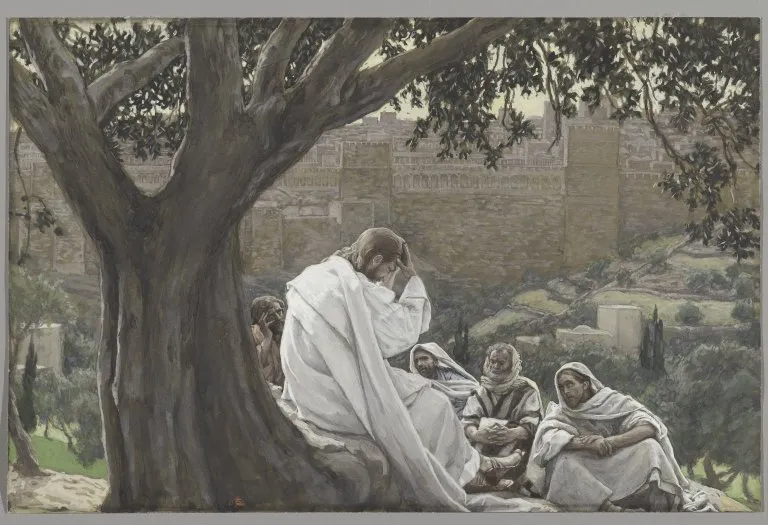
The building that stood at the center of the nation's life and worship would be leveled. Then, seated on the mount of Olives over against the temple, Peter, James, John, and Andrew come to Him privately with the question the whole chapter answers: Tell us, when shall these things be? and what shall be the sign when all these things shall be fulfilled? (v. 4).1
Tap any highlighted phrase to jump to the commentary that unpacks it.
Mark 13:1-4See What Manner of Stones
1And as he went out of the temple, one of his disciples saith unto him, Master, see what manner of stones and what buildings are here! 2And Jesus answering said unto him, Seest thou these great buildings? there shall not be left one stone upon another, that shall not be thrown down. 3And as he sat upon the mount of Olives over against the temple, Peter and James and John and Andrew asked him privately, 4Tell us, when shall these things be? and what shall be the sign when all these things shall be fulfilled?
The scene opens with ordinary wonder. As they leave the temple, one disciple looks back at the architecture and cannot help himself: Master, see what manner of stones and what buildings are here! (v. 1). The awe was warranted. The temple Herod had rebuilt was vast, its foundation stones famously enormous, its facade gleaming - the proudest structure the nation possessed and the center of its worship and identity. To a Galilean fisherman it would have looked permanent, the one thing in Jerusalem that surely could not fall.
Jesus answers the wonder with a quiet, devastating realism: Seest thou these great buildings? there shall not be left one stone upon another, that shall not be thrown down (v. 2). Not damaged, not diminished - dismantled, every block of it. The greatness the disciple admired is precisely what Jesus says is coming down. It is the chapter's first lesson before any sign is named: the most solid-seeming thing in their world was not as enduring as they assumed.1
Jesus crosses the Kidron valley and sits down upon the mount of Olives over against the temple (v. 3) - on the ridge that looks straight back across at the building He has just said will fall. From there four of His closest disciples - Peter, James, John, and Andrew - come to Him privately and ask the question the rest of the chapter answers: Tell us, when shall these things be? and what shall be the sign when all these things shall be fulfilled? (v. 4).
It is a natural question, and a double one: when, and what sign. They want a time and a marker, a way to see it coming and brace for it. Much of what makes this discourse demanding is that Jesus does not answer on their terms. He will say a great deal about how to live and what to watch for, and almost nothing about when. Jesus answers with a charge to stay awake. That gap between the question asked and the answer given is the key to reading the whole chapter rightly.
Mark 13:5-13The Beginnings of Sorrows
5And Jesus answering them began to say, Take heed lest any man deceive you: 6For many shall come in my name, saying, I am Christ; and shall deceive many. 7And when ye shall hear of wars and rumours of wars, be ye not troubled: for such things must needs be; but the end shall not be yet. 8For nation shall rise against nation, and kingdom against kingdom: and there shall be earthquakes in divers places, and there shall be famines and troubles: these are the beginnings of sorrows. 9But take heed to yourselves: for they shall deliver you up to councils; and in the synagogues ye shall be beaten: and ye shall be brought before rulers and kings for my sake, for a testimony against them. 10And the gospel must first be published among all nations. 11But when they shall lead you, and deliver you up, take no thought beforehand what ye shall speak, neither do ye premeditate: but whatsoever shall be given you in that hour, that speak ye: for it is not ye that speak, but the Holy Ghost. 12Now the brother shall betray the brother to death, and the father the son; and children shall rise up against their parents, and shall cause them to be put to death. 13And ye shall be hated of all men for my name’s sake: but he that shall endure unto the end, the same shall be saved.
Jesus' first word in answer to when is not a sign at all but a caution against signs misread: Take heed lest any man deceive you: for many shall come in my name, saying, I am Christ; and shall deceive many (vv. 5-6). Before He names a single event, He names the danger of the events - that people will read them wrongly and be led astray, some even arriving in His own name and claiming His title.
Then He turns to the kind of thing that always tempts a frightened generation to announce that the end has arrived: when ye shall hear of wars and rumours of wars, be ye not troubled: for such things must needs be; but the end shall not be yet (v. 7). It is a striking instruction. Wars, and even mere rumours of wars, are exactly the headlines that make people certain the final hour has struck - and Jesus says the opposite: do not be troubled, and do not conclude from them that the end is here.
Such things must needs be; they are the texture of a broken age, not a countdown clock. The first discipline He asks of His followers is the discipline of not panicking and not jumping to conclusions when the world looks like it is ending.
He widens the lens: nation shall rise against nation, and kingdom against kingdom: and there shall be earthquakes in divers places, and there shall be famines and troubles (v. 8). War, upheaval, the earth itself shaking, hunger - the whole catalog of disaster that human beings have always read as the death-throes of the world. And then the phrase that reframes all of it: these are the beginnings of sorrows. The word translated sorrows is the word for birth pangs, the pains of a woman in labor.
That image does two things at once. It refuses to treat these calamities as the end - they are the beginning, the first contractions, not the final breath. And it insists that the pain is not pointless: labor pains move toward a birth. The age does not merely decay; it travails toward something. So the believer is not to read every catastrophe as the curtain falling, nor as meaningless suffering, but as the groaning of a creation in labor for the new thing God is bringing.
The end is sure; these are its first pangs, not its arrival.
Then Jesus turns from world events to the disciples themselves, and the tone becomes intensely personal: take heed to yourselves: for they shall deliver you up to councils; and in the synagogues ye shall be beaten: and ye shall be brought before rulers and kings for my sake (v. 9). Following Him will cost them; they will stand as defendants before religious and civil powers alike. Yet even this He turns toward the spread of the gospel - they are brought before rulers for a testimony, and, He adds, the gospel must first be published among all nations (v. 10), so that the worldwide reach of the good news takes priority even over the calendar of the end.
And to disciples dreading the moment they are dragged in to testify, He gives a remarkable promise: take no thought beforehand what ye shall speak… for it is not ye that speak, but the Holy Ghost (v. 11). In the hour of trial they will not be left to their own wits; the Spirit Himself will speak through them. The hardest part - betrayal even by brother and father and child (v. 12), and being hated of all men for my name's sake (v. 13) - is met with a Person who will stand with them and speak in them.
Mark 13:14-23The Abomination of Desolation
14But when ye shall see the abomination of desolation, spoken of by Daniel the prophet, standing where it ought not, (let him that readeth understand,) then let them that be in Judaea flee to the mountains: 15And let him that is on the housetop not go down into the house, neither enter therein, to take any thing out of his house: 16And let him that is in the field not turn back again for to take up his garment. 17But woe to them that are with child, and to them that give suck in those days! 18And pray ye that your flight be not in the winter. 19For in those days shall be affliction, such as was not from the beginning of the creation which God created unto this time, neither shall be. 20And except that the Lord had shortened those days, no flesh should be saved: but for the elect’s sake, whom he hath chosen, he hath shortened the days. 21And then if any man shall say to you, Lo, here is Christ; or, lo, he is there; believe him not: 22For false Christs and false prophets shall rise, and shall shew signs and wonders, to seduce, if it were possible, even the elect. 23But take ye heed: behold, I have foretold you all things.
Jesus now points to a particular marker: when ye shall see the abomination of desolation, spoken of by Daniel the prophet, standing where it ought not (v. 14). The phrase reaches back into the book of Daniel, where it names a desecrating horror set up in the holy place, something so defiling that it empties the temple of its purpose. To the parenthesis - let him that readeth understand - Jesus adds an urgency that tells you He is speaking, at least in part, of a real and approaching crisis in Judaea: when this sign appears, then let them that be in Judaea flee to the mountains, and flee at once, not even pausing to grab belongings from the house or a cloak from the field (vv. 14-16).
The instructions are those of a sudden, local emergency - run, do not look back, woe to those slowed by pregnancy or nursing infants, pray it does not fall in winter when flight is hardest (vv. 17-18). Faithful readers have long understood this passage to look first to the catastrophe that fell on Jerusalem within that generation, and many have heard in it as well a pattern of the greater crisis at the end. The chapter does not press a single decoded scheme on us; it gives a warning concrete enough to obey and large enough to keep pondering.2
Of those days Jesus says something almost without parallel: in those days shall be affliction, such as was not from the beginning of the creation which God created unto this time, neither shall be (v. 19). The language is total - suffering unequalled before or since. Yet immediately He sets a limit on it, and the limit is mercy: except that the Lord had shortened those days, no flesh should be saved: but for the elect's sake, whom he hath chosen, he hath shortened the days (v. 20).
Here is the heart of His comfort in the darkest part of the discourse. The affliction is real and severe, but it is not unbounded; God has set its edges. And the reason given for the shortening is tender and specific: for the elect's sake. The days are cut short not for the sake of the powerful or the many, but for the sake of those God has chosen and means to keep. Even at the worst, the timeline is in the Lord's hand, and He bends it toward the rescue of His own.
The believer reading this is meant to come away not with a map of the tribulation but with a settled assurance: however bad the days, they are measured, fenced, and shortened by a God who is watching out for His people.
Jesus returns, with even sharper warning, to the danger he named at the start: deception. If any man shall say to you, Lo, here is Christ; or, lo, he is there; believe him not (v. 21). In a time of terror people grasp at saviors, and false ones will oblige - false Christs and false prophets shall rise, and shall shew signs and wonders, to seduce, if it were possible, even the elect (v. 22). It is a sobering admission: the deception will be sophisticated, backed by apparent signs and wonders, aimed at the very people who belong to God, and so persuasive that only the impossibility of finally fooling the elect keeps them safe.
The mark of these false messiahs is exactly the spectacle Jesus Himself refused - the wonder-working display that draws a crowd and bypasses the cross. Against all of it He gives a plain defense: take ye heed: behold, I have foretold you all things (v. 23). The disciples are not left to discern the danger unaided; they have been told in advance. Forewarning is itself the protection. The reason to know what Jesus said here is not to calculate the end but to be unshockable when the deceivers come - to have already heard, from His own mouth, I told you.
Mark 13:24-37The Son of Man Coming · Watch
24But in those days, after that tribulation, the sun shall be darkened, and the moon shall not give her light, 25And the stars of heaven shall fall, and the powers that are in heaven shall be shaken. 26And then shall they see the Son of man coming in the clouds with great power and glory. 27And then shall he send his angels, and shall gather together his elect from the four winds, from the uttermost part of the earth to the uttermost part of heaven. 28Now learn a parable of the fig tree; When her branch is yet tender, and putteth forth leaves, ye know that summer is near: 29So ye in like manner, when ye shall see these things come to pass, know that it is nigh, even at the doors. 30Verily I say unto you, that this generation shall not pass, till all these things be done. 31Heaven and earth shall pass away: but my words shall not pass away. 32But of that day and that hour knoweth no man, no, not the angels which are in heaven, neither the Son, but the Father. 33Take ye heed, watch and pray: for ye know not when the time is. 34For the Son of man is as a man taking a far journey, who left his house, and gave authority to his servants, and to every man his work, and commanded the porter to watch. 35Watch ye therefore: for ye know not when the master of the house cometh, at even, or at midnight, or at the cockcrowing, or in the morning: 36Lest coming suddenly he find you sleeping. 37And what I say unto you I say unto all, Watch.
Now the discourse lifts to its great certainty. In those days, after that tribulation, the sun shall be darkened, and the moon shall not give her light, and the stars of heaven shall fall, and the powers that are in heaven shall be shaken (vv. 24-25). This is the language the prophets used for the day of the Lord - the whole created order convulsing, the lights of heaven going dark, as God Himself steps onto the stage of history.
It is cosmic, deliberately beyond the scale of any merely local event. And into that darkened sky comes the one sure thing the chapter has been moving toward: then shall they see the Son of man coming in the clouds with great power and glory (v. 26). After every warning about what not to believe, here is what they will actually see - not a rumor, not a claim to be checked, but the visible coming of the Son of man Himself.
He will not arrive in hiddenness this time, to be missed by most and recognized by few. He comes with great power and glory, unmistakable, for all to see. The chapter that began with a building destined to fall now opens onto the King who is destined to appear.1
Jesus presses His point home with two homely pictures. First the fig tree: when her branch is yet tender, and putteth forth leaves, ye know that summer is near (v. 28). The lesson is readiness, not calculation - just as new leaves tell you a season is at hand, so the things He has described tell His people that the end is nigh, even at the doors (v. 29). Then the parable of the absent master: the Son of man is as a man taking a far journey, who left his house, and gave authority to his servants, and to every man his work, and commanded the porter to watch (v. 34).
The picture says a great deal about the time between His comings. The master is away, but not absent in the sense of having forgotten; he has left his servants real authority and to each one a real work to do. The waiting is not idle - it is filled with assigned tasks and entrusted responsibility. And the doorkeeper is given one job above the rest: watch. This is the heart of the parable, and of the whole chapter.
The faithful servant is not the one who has calculated the master's return but the one found doing his work and keeping watch whenever the master comes. The unknown hour is not a problem to be solved; it is the very thing that keeps every hour worth being ready for.
Two sayings sit side by side here, and the chapter sets them deliberately together. First: Verily I say unto you, that this generation shall not pass, till all these things be done (v. 30) - a word whose reach the faithful have understood in more than one way, some hearing it of the generation that would witness Jerusalem's fall, others of the whole interval reaching to the end. The chapter does not force the matter.
Then, immediately, the boundary on all such knowing: of that day and that hour knoweth no man, no, not the angels which are in heaven, neither the Son, but the Father (v. 32). It is a striking sentence, and it is best received exactly as Jesus speaks it. In the days of His mission among us - the same Lord who hungered, who slept in the boat, who learned and grew - He does not announce that day; the disclosure of the hour belongs to the Father.
Jesus is not here unfolding the inner workings of how God knows; He is doing something far more practical. He is taking the timetable off the table altogether. If the angels do not know it, and He Himself in His earthly mission does not declare it, then plainly no human scheme is going to crack it - and the search for the date is closed off at the highest level so that the energy can go where He keeps directing it: to watching.
The unknown hour is not a riddle to be solved but the very reason to stay awake.1
Research trail
Sources & further study
These references support the historical, linguistic, manuscript, and contextual notes in this chapter. Scripture remains the primary text; external sources are provided so readers can inspect the research directly.
- Mark 13 - Translators' NotesThe NET Bible's detailed footnotes on Mark 13 - the disciples' double question in verse 4, the much-discussed scope of this generation in verse 30, and the textual and grammatical issues in the statement that the Son does not know the day (v. 32).
- Mark 13 ↔ Daniel 7 & 9 · Joel 2 · Isaiah 13Traces the threads tying Mark 13 to the rest of Scripture - the Son of man coming with the clouds (vv. 26-27) read alongside Daniel's night vision (Dan. 7:13-14), the abomination of desolation (v. 14) beside Daniel 9 and 11, and the darkened sun and falling stars (vv. 24-25) beside the prophets' language for the day of the Lord.
- Mark 13 · Greek interlinear + lexiconThe Greek text of Mark 13 word by word, each term linked to its lexicon entry - useful for gregoreo (vv. 34-37, the “watch” that means to stay awake), for eklektoi (vv. 20, 22, 27, the “elect” gathered at His coming), and for the verb behind endure in verse 13.
Where this echoes in Scripture
See What Manner of Stones
- Luke 19:41-44they shall lay thee even with the ground... and they shall not leave in thee one stone upon another.Jesus weeping over Jerusalem and foretelling the same fall as verse 2 - the city and temple thrown down.
- John 2:19-21Destroy this temple, and in three days I will raise it up... he spake of the temple of his body.The temple finds its fulfillment in His own person - the One who outlasts the stones of verse 2.
- Micah 3:12Zion shall be plowed as a field, and Jerusalem shall become heaps, and the mountain of the house as the high places of the forest.An earlier prophet's word that the temple mount itself could be laid waste - the shock of verse 2 was not without precedent.
- Matthew 24:1-3when shall these things be? and what shall be the sign of thy coming, and of the end of the world?The parallel account of the disciples' question in verse 4 - the same scene on the same mount.
The Beginnings of Sorrows
- Matthew 24:14this gospel of the kingdom shall be preached in all the world for a witness unto all nations; and then shall the end come.The priority of verse 10 stated plainly - the gospel reaching all nations before the end.
- Acts 4:8Then Peter, filled with the Holy Ghost, said unto them, Ye rulers of the people, and elders of Israel...The promise of verse 11 lived out - a disciple before a council, given his words by the Spirit.
- Romans 8:22we know that the whole creation groaneth and travaileth in pain together until now.The birth-pang image of verse 8 - a creation in labor, groaning toward what God will bring.
- Revelation 2:10be thou faithful unto death, and I will give thee a crown of life.The promise of verse 13 echoed - the one who endures to the end is the one who is saved.
- James 1:12Blessed is the man that endureth temptation: for when he is tried, he shall receive the crown of life.The blessing on endurance that verse 13 holds out - saved through holding fast, not merely beginning.
The Abomination of Desolation
- Daniel 9:27for the overspreading of abominations he shall make it desolate, even until the consummation.The prophet Jesus names in verse 14 - the abomination that brings desolation to the holy place.
- Daniel 12:1there shall be a time of trouble, such as never was since there was a nation even to that same time.The unequalled affliction of verse 19, in the very language of Daniel that Jesus draws upon.
- Luke 21:20-21when ye shall see Jerusalem compassed with armies, then know that the desolation thereof is nigh... let them which are in Judaea flee to the mountains.Luke's parallel to verse 14 - the flight from Judaea tied to the siege of Jerusalem.
- Deuteronomy 13:1-3If there arise among you a prophet... and giveth thee a sign or a wonder... thou shalt not hearken.The ancient test behind verse 22 - even signs and wonders do not certify a voice that leads away from the Lord.
- 2 Thessalonians 2:9whose coming is after the working of Satan with all power and signs and lying wonders.The deceiving signs of verse 22 - counterfeit wonders aimed at leading the faithful astray.
The Son of Man Coming · Watch
- Daniel 7:13-14one like the Son of man came with the clouds of heaven... and there was given him dominion, and glory, and a kingdom.The vision Jesus draws on in verses 26-27 - the Son of man coming with the clouds to an everlasting kingdom.
- Isaiah 40:8The grass withereth, the flower fadeth: but the word of our God shall stand for ever.The permanence of verse 31 - the word of God outlasting all that withers and fades.
- Acts 1:11this same Jesus, which is taken up from you into heaven, shall so come in like manner as ye have seen him go into heaven.The certain return of verse 26 - the visible coming of the same Jesus who ascended.
- Mark 14:37-38Simon, sleepest thou? couldest not thou watch one hour? Watch ye and pray, lest ye enter into temptation.The same command as verses 33-37, in Gethsemane - the watching Jesus asked of these very disciples.
- 1 Thessalonians 5:2-6the day of the Lord so cometh as a thief in the night... let us not sleep, as do others; but let us watch and be sober.The unknown hour and the call to wakefulness of verses 32-37, taken up by the apostle for the whole church.