Psalms 23
People in this chapter
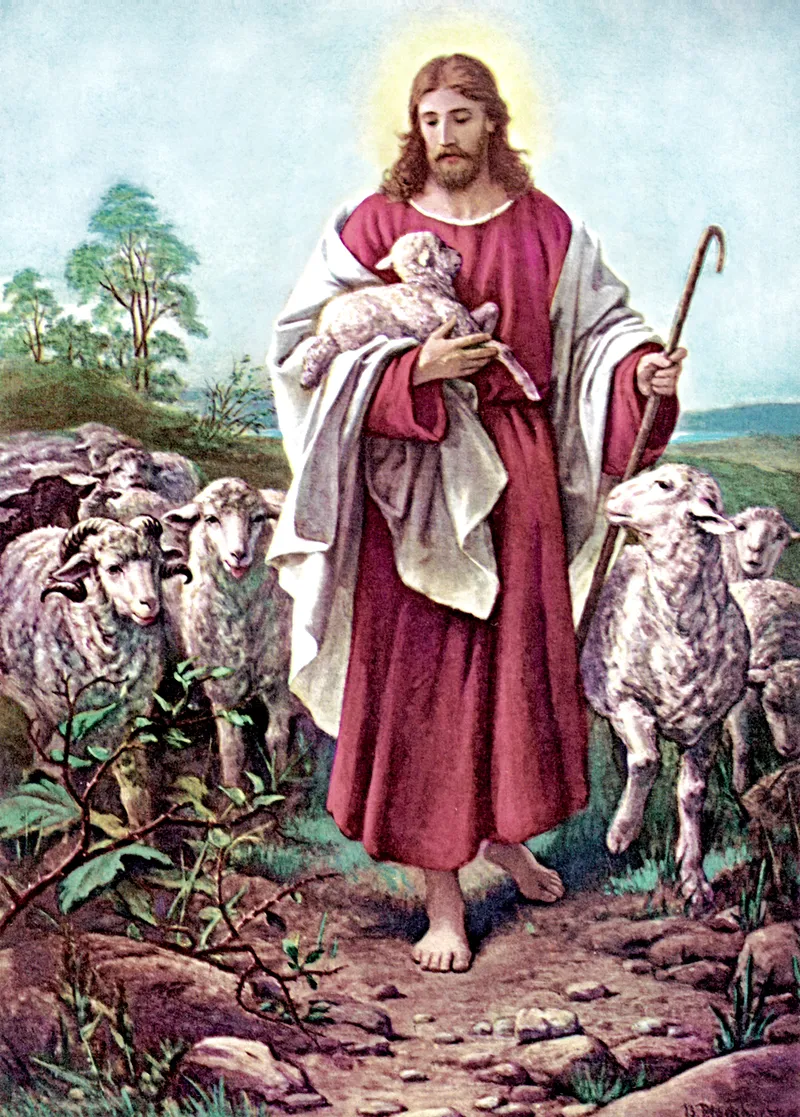
Psalm 23 is, by almost any measure, the most beloved psalm in Scripture - learned by heart in childhood, whispered at deathbeds, read over open graves, carried by believers through every kind of darkness. And the wonder of it is how small it is. Six short verses, no argument, no doctrine spelled out in propositions, just one sustained picture held steadily in view: a shepherd and his sheep. David, who had been a shepherd boy in the fields of Bethlehem before he was ever a king, knew exactly what he was saying.
He had watched over flocks; he had carried lambs; he had fought lions and bears to keep his sheep. So when he writes The LORD is my shepherd, he is not reaching for a pretty figure of speech. He is saying that the God of all the earth tends him with the same close, costly, hands-on care that he himself once gave to defenceless animals on a hillside.1
Tap any highlighted phrase to jump to the commentary that unpacks it.
Psalm 23:1-3 · A Psalm of DavidThe LORD Is My Shepherd
1The LORD is my shepherd; I shall not want. 2He maketh me to lie down in green pastures: he leadeth me beside the still waters. 3He restoreth my soul: he leadeth me in the paths of righteousness for his name’s sake.
Everything in the psalm rests on its first sentence, and the sentence turns on one small possessive word: my. Not “the LORD is a shepherd,” as if describing His job in general; not even “the LORD is the shepherd of Israel,” true as that is - but the LORD is my shepherd. The whole vastness of God is brought down to a relationship as close and particular as the one between a herdsman and a single animal he knows by name.
And out of that relationship flows the psalm's first confession: I shall not want. It is worth weighing how strong those words are. Not “I might not want,” not “I will usually have enough” - but I shall not want. A sheep under a good shepherd lacks nothing it truly needs, because the shepherd has made its needs his responsibility.
The confidence here is not in the sheep's resourcefulness; sheep are famously helpless. It is entirely in the competence and care of the One who leads. To be able to say the LORD is my shepherd is, in the same breath, to be able to say I shall not want - the second clause is simply the first one looked at from the inside.
The first thing the Shepherd does is striking, because it is not to drive but to settle: He maketh me to lie down in green pastures: he leadeth me beside the still waters (v. 2). Two needs are met here, and both are pictures of more than enough. The green pastures are food; the still waters are drink - and not the rushing torrent that a sheep is too timid to approach, but waters of quietness, calmed and safe to come near.
Yet notice the verb in the first line. The Shepherd does not merely lead the flock to the pasture and leave them to graze; He maketh them lie down. A sheep will only lie down when it is free of fear, free of friction with the rest of the flock, free of the gnawing of hunger and the torment of pests - that is, only when everything has been made right around it. So to be made to lie down in green pastures is to be brought to a rest that the sheep could never have arranged for itself.
There is a mercy in this that is easy to miss: part of the Shepherd's work is to stop His people, to make them be still, to give them the rest they would never take on their own because they would drive themselves to exhaustion. He knows when His sheep need not to labour but to lie down.
From rest and restoration the Shepherd moves His flock onward: he leadeth me in the paths of righteousness for his name's sake (v. 3). A good shepherd does not let sheep wander wherever they please; left to themselves they will follow the same ground into ruin, or drift into danger. So he leads them along the right tracks - the safe, true paths that go where they ought to go. The phrase carries a double sense the Hebrew allows: these are both the right paths a shepherd picks across rough country, and the paths of righteousness in which a soul is led to walk uprightly before God.
But the most important words in the verse are the last four: for his name's sake. The leading is not finally about the sheep's preferences; it is about the Shepherd's honour. A shepherd's reputation rides on the condition of his flock - a herdsman known for losing his sheep is no shepherd at all. So God leads His people rightly because His own name is bound up with how they fare.
There is deep comfort in that. It means our being kept does not finally depend on how lovable or deserving we are, but on the faithfulness of the One whose name is staked on bringing us safely through. He leads us in right paths for the sake of His own great name - and that name does not fail.
Psalm 23:4Though I Walk Through the Valley
4Yea, though I walk through the valley of the shadow of death, I will fear no evil: for thou art with me; thy rod and thy staff they comfort me.
At the very centre of the psalm the ground falls away. Up to here the song has been all green pasture and still water; now, without warning, comes the valley of the shadow of death. The Hebrew is a deep, dark word - it names the densest gloom, the deathly shade, the place where light barely reaches. Every reader knows the valley it points to: bereavement, terminal illness, crushing fear, the approach of one's own mortality, the long stretches of darkness that no life is spared.
But notice three things the verse is careful to say. First, the sheep does not camp in the valley - he walks through it. It is a passage, not a destination; the path goes in one side and comes out the other. Second, I will fear no evil - not because there is no evil in the valley, but because something stronger than the evil is present.
And third, mark the precise moment the psalm changes its grammar. All through verses 1-3 David has spoken about the shepherd: he maketh, he leadeth, he restoreth. Now, exactly when the darkness is deepest, the talk turns to direct address: for thou art with me. The closer the danger, the nearer the Shepherd; the deeper the valley, the more personal the words become. Fear is answered not by an explanation but by a Presence.
It is worth lingering on what the psalm does not say. It does not say the Shepherd keeps His sheep out of the valley. It does not promise a life with no dark passages, no grief, no shadow of death. The flock still has to walk the valley - David assumes it as a matter of course: not if I walk through it, but though I walk through it. What the psalm promises is not exemption but company. Thou art with me is the whole of the comfort, and it turns out to be enough.
This is a very different consolation from the one we often want. We would prefer a Shepherd who guarantees fair weather; what we are given is a Shepherd who walks beside us in the storm. And the comfort of His presence is not less than the comfort of rescue - it is more, because rescue can be undone by the next trouble, but a Shepherd who has pledged never to leave cannot be taken away.
The rod and staff - the very tools of His rule over us - are named as our comfort precisely here, in the dark, because what steadies a frightened sheep is not an argument but the knowledge that the one who can defend it is close enough to touch.
Psalm 23:5-6A Table Prepared, a House for Ever
5Thou preparest a table before me in the presence of mine enemies: thou anointest my head with oil; my cup runneth over. 6Surely goodness and mercy shall follow me all the days of my life: and I will dwell in the house of the LORD for ever.
The imagery turns now from open hillside to a spread table, and from Shepherd to Host. Thou preparest a table before me in the presence of mine enemies: thou anointest my head with oil; my cup runneth over (v. 5). Three pictures of lavish, public welcome crowd together. There is a table - not a handful of food snatched on the run, but a meal set out and made ready, the hospitality of a host for an honoured guest.
There is the oil - in that world the host anointed a welcomed guest's head with fragrant oil, a mark of gladness and honour. And there is the cup that runneth over - not measured out drop by careful drop, but poured until it spills, the very picture of generosity that will not stop at “enough.”
What gives the scene its peculiar boldness is the phrase in the presence of mine enemies. God does not provide for His own in secret, in some hidden corner where the hostile cannot see. He spreads the table in plain sight of those who oppose them. The enemies are still there - the psalm does not pretend they have vanished - but they are reduced to spectators, made to watch as the one they would harm is feasted and honoured by God.
There is no anxiety left in this picture, no glancing over the shoulder. The guest sits, and eats, and is anointed, and his cup overflows, while the enemies can only look on.
The last verse gathers the whole psalm into a settled certainty: Surely goodness and mercy shall follow me all the days of my life. The word surely is the sound of a man who has stopped wondering - this is no longer hope but assurance.
And the verb follow is stronger than it looks in English; the Hebrew means to pursue, to chase, to run hard after. It is most often the word for what an enemy does in hot pursuit - and the psalm turns it inside out. The only things now chasing this sheep are goodness and mercy. The two great traits of the Shepherd - His goodness and His chesed, His loyal covenant love - are pictured not as occasionally catching up to us but as following hard on our heels every day of our lives, like two faithful companions who will not be shaken off.
We so often imagine ourselves chased by our failures, our fears, the consequences we dread. The psalm replaces that whole anxious picture with a different one: what is actually pursuing the one who belongs to the Shepherd is relentless goodness, dogged mercy, all the days of life - not some of them, not the good ones only, but all. And that pursuit has a destination, named in the verse's final clause.

Research trail
Sources & further study
These references support the historical, linguistic, manuscript, and contextual notes in this chapter. Scripture remains the primary text; external sources are provided so readers can inspect the research directly.
- Psalm 23 - Translators' NotesThe NET Bible's detailed footnotes on Psalm 23 - the pastoral imagery of verses 1-4, the difficult phrase rendered the valley of the shadow of death, and the shift from shepherd to host at the table of verse 5.
- Psalm 23 · Hebrew + classical Jewish commentaryThe Hebrew text of Psalm 23 with Rashi, Ibn Ezra, and other classical commentators side by side - useful for the verb ra'ah (v. 1, “to shepherd, tend, feed”), for nephesh (v. 3, the “soul” or whole life that is restored), and for the shebet and mish'enet of verse 4, the shepherd's “rod” and “staff.”
- Psalm 23 ↔ John 10 · Hebrews 13 · 1 Peter 2 · Revelation 7Traces the threads tying the Shepherd of Psalm 23 to the New Testament - Jesus as the good shepherd who lays down His life (John 10:11-14), that great shepherd of the sheep (Heb. 13:20), the Shepherd and Bishop of your souls (1 Pet. 2:25), and the Lamb who leads His flock to living fountains of waters (Rev. 7:17).
- Crook (Heka) - ancient Near Eastern shepherd's implementAn ancient shepherd's crook from the Met's Egyptian collection - the same curved staff a herdsman used to draw a straying sheep back to the flock. It lights up the everyday tools behind verse 4's thy rod and thy staff: the heavy rod that drove off predators, the long crooked staff that guided and rescued, and why a defenceless sheep would find the sight of them a comfort rather than a threat.
Where this echoes in Scripture
The LORD Is My Shepherd
- John 10:11I am the good shepherd: the good shepherd giveth his life for the sheep.Jesus takes the shepherd image of verse 1 onto Himself - and carries it all the way to the cross.
- Isaiah 40:11He shall feed his flock like a shepherd: he shall gather the lambs with his arm, and carry them in his bosom.The tending verb of verse 1 (ra'ah) used of God Himself - the gathering, carrying care of the Shepherd.
- Ezekiel 34:11-12I, even I, will both search my sheep, and seek them out... so will I seek out my sheep.God promises to be the Shepherd Israel's leaders failed to be - the leading and restoring of verses 1-3.
- Revelation 7:17the Lamb... shall feed them, and shall lead them unto living fountains of waters.The still waters of verse 2 made eternal - the Lamb who is also the Shepherd, leading His flock home.
Though I Walk Through the Valley
- Matthew 28:20and, lo, I am with you alway, even unto the end of the world. Amen.The Shepherd's “thou art with me” (v. 4) sealed as a promise by the risen Christ to His own.
- John 11:25I am the resurrection, and the life: he that believeth in me, though he were dead, yet shall he live.The One who answers the valley of the shadow of death - having walked it Himself and risen.
- Psalm 46:1God is our refuge and strength, a very present help in trouble.The same comfort as verse 4 - not the absence of trouble, but the presence of God within it.
- 1 Corinthians 15:55O death, where is thy sting? O grave, where is thy victory?Why the sheep can say “I will fear no evil” - the sting of the valley drawn by the risen Shepherd.
A Table Prepared, a House for Ever
- John 14:2-3In my Father's house are many mansions... I go to prepare a place for you.The dwelling of verse 6 made explicit - the Shepherd goes ahead to prepare the home He brings His flock into.
- Psalm 27:4that I may dwell in the house of the LORD all the days of my life, to behold the beauty of the LORD.The same longing as verse 6 - the house of the LORD as the one thing finally desired.
- Luke 15:5-6And when he hath found it, he layeth it on his shoulders, rejoicing... I have found my sheep which was lost.The Shepherd who pursues the one sheep - goodness and mercy following hard after the wanderer (v. 6).
- Revelation 21:3the tabernacle of God is with men, and he will dwell with them, and they shall be his people.The house of the LORD for ever (v. 6) fully kept - God dwelling with His people at the last.