Painter of the Bible
Israhel van Meckenem
Israhel van Meckenem was the most prolific German engraver of the fifteenth century and the artist who, by sheer volume and circulation, made the engraved religious image a household object in late-medieval Northern Europe.

Their faith
Why Israhel van Meckenem painted Christ
Israhel van Meckenem, born in the heart of late-medieval Germany, was a devout Christian whose faith was intricately woven into his artistic practice. As the son of a goldsmith, he was likely immersed in a culture that revered craftsmanship as a divine calling. His training under the Master E. S. and his subsequent work in Bocholt reflect a commitment to creating sacred art that served the spiritual needs of his community. Van Meckenem's engravings were not merely artistic expressions; they were devotional tools that brought the stories of Christ and the Virgin Mary into the homes and hearts of the faithful. His prolific output of around 620 plates, predominantly religious, showcases his dedication to spreading the Christian message through visual means, making him a significant figure in the devotional life of late-medieval Northern Europe.
The depth of Israhel van Meckenem's faith is particularly evident in his works such as the complete Passion of Christ, which consists of twelve intricately engraved plates that narrate the suffering and sacrifice of Jesus. Each plate serves as a meditation on Christ's love and redemption, inviting viewers to reflect on their own faith journeys. His prints, widely circulated and used in prayer books and churches, transformed the way believers engaged with scripture and the sacred narrative. By making religious imagery accessible, van Meckenem not only reinforced the teachings of the Church but also fostered a deeper personal connection to the divine. His legacy endures, as his art continues to inspire and uplift viewers, reminding us of the power of faith expressed through creativity and devotion.
Life & work
Israhel van Meckenem was the most prolific German engraver of the fifteenth century and the artist who, by sheer volume and circulation, made the engraved religious image a household object in late-medieval Northern Europe. Born around 1435 in Meckenem (near Bocholt in the Lower Rhine region), trained almost certainly in his father's goldsmith workshop and probably also in the orbit of the Master E. S. (the great anonymous engraver of the mid-fifteenth century, with whom Israhel apprenticed and from whom he eventually inherited the workshop's plates), he settled in Bocholt by the 1470s and worked there for the rest of his life. He died in Bocholt in 1503.
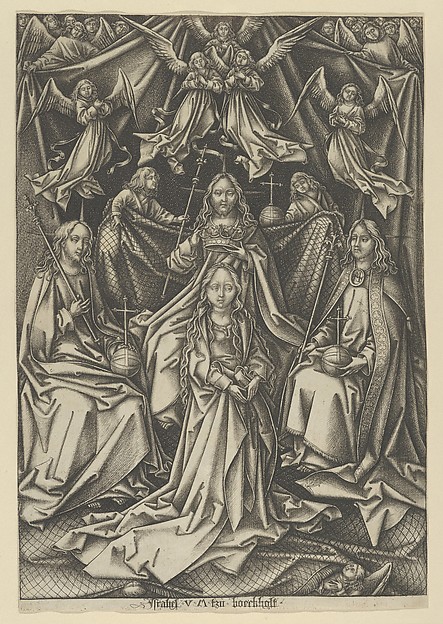
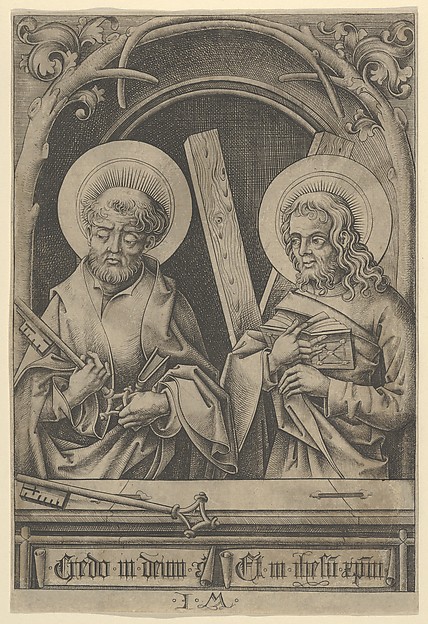
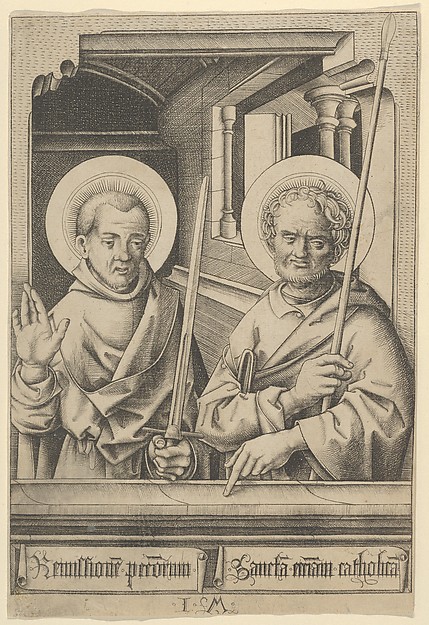
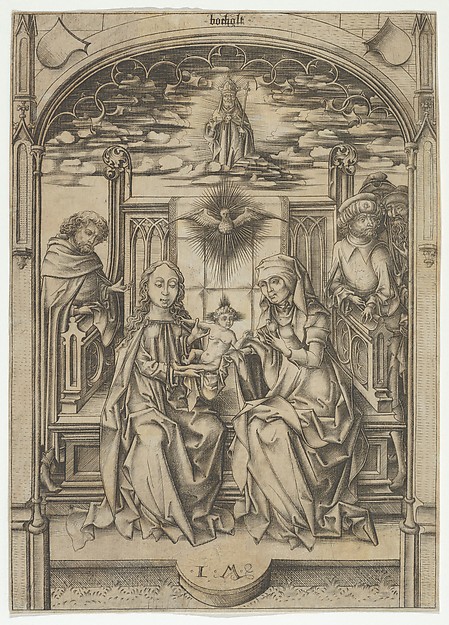
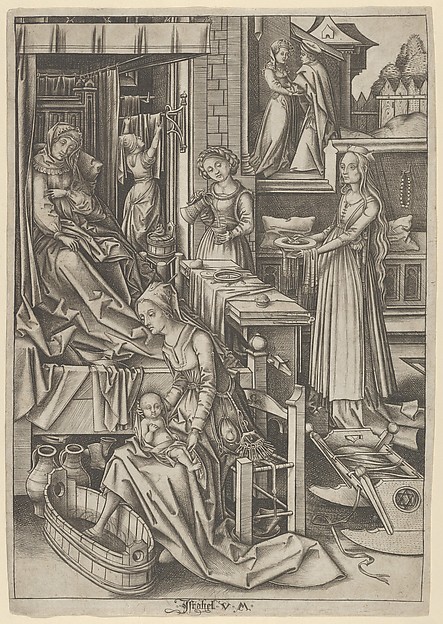
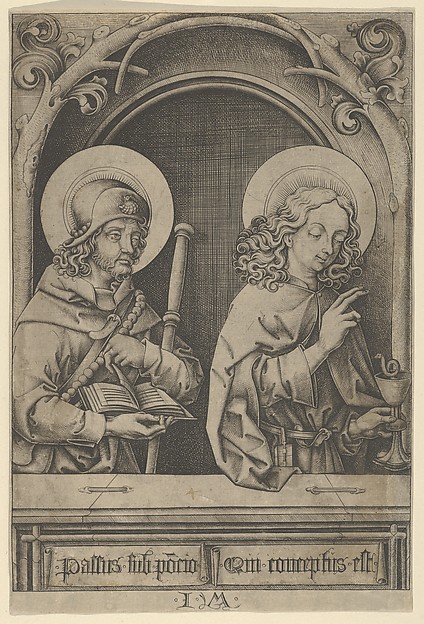
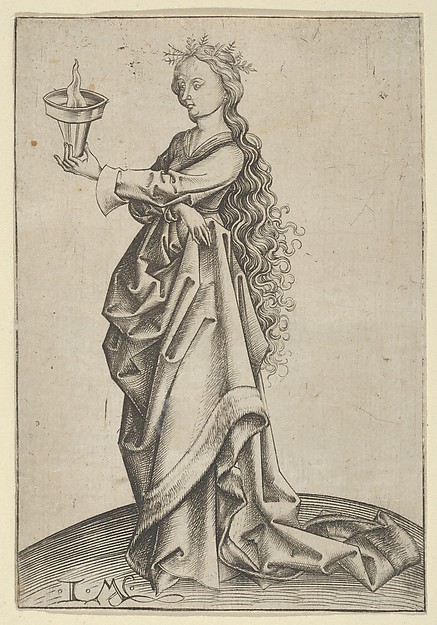
His engraved output runs to about 620 surviving plates — by far the largest individual print catalogue of the fifteenth century. The vast majority are religious: a complete Passion of Christ in twelve plates (which exists in multiple editions, repeatedly reworked), a Life of the Virgin, the Marriage of the Virgin, the Apostles, dozens of single-figure devotional saints, the Mass of Saint Gregory, the Twelve Sibyls, the Wise and Foolish Virgins, and a long sequence of Madonna-and-Child compositions. He also produced about thirty plates of secular subjects — peasants dancing, courtly scenes, the Gymkhana of the Pomegranates — that count among the earliest engravings of contemporary genre subjects in European art.
He was a relentless copyist and republisher. Most of his plates after Schongauer, the Master E. S., the Master of the Banderoles, and various Netherlandish and Italian sources were direct copies — sometimes with the original master's monogram replaced by his own (the famous "i.m." that appears on the plates), sometimes signed alongside the original. The practice was standard fifteenth-century commercial behavior; the modern category of copyright did not exist; and Israhel's copies are themselves often the only surviving record of compositions whose original plates have been lost.
His prints traveled the late-medieval Catholic world in editions of thousands, were pasted into prayer books, distributed at confraternity meetings, copied onto the walls of small parish churches, and used by metalworkers, embroiderers, and stained-glass painters as ready-made compositions. He shaped the visual catechesis of late-fifteenth-century Northern Europe more than almost any other single artist of his generation.
Notable works in detail
met-636600
The Betrayal and Capture of Christ, engraved by Israhel van Meckenem around 1480 in his Bocholt workshop, depicts the moment of the arrest in Gethsemane: Judas embraces Christ in the kiss of betrayal at the center of the composition while the Roman soldiers crowd in with raised lances and torches; Peter on the left side cuts off the ear of the high priest's servant Malchus; the disciples scatter in the background. Meckenem composes the scene with characteristic late-fifteenth-century Northern engraving density — figures piled into the available space with little atmospheric distance — and the careful crosshatched line gives the print the small-format devotional clarity that defined Meckenem's vast output. The print belongs to the great Passion cycle Meckenem produced in multiple editions across his career and is one of the principal Northern engraved Betrayal compositions of the entire fifteenth century.
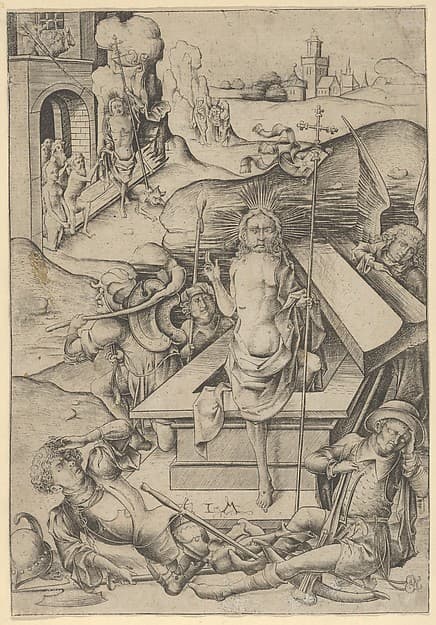
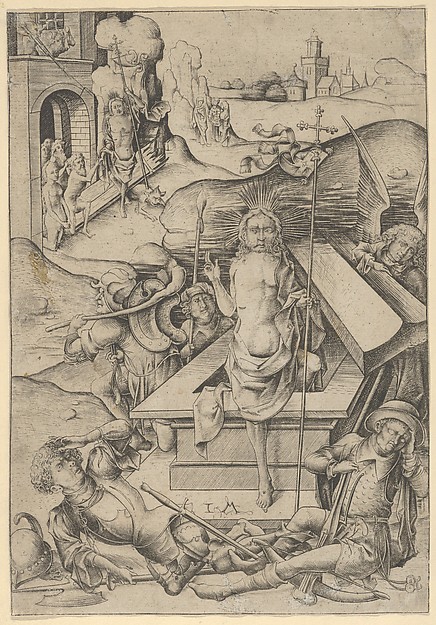
The Resurrection, engraved by Israhel van Meckenem around 1480 in his Bocholt workshop, depicts the moment of the Resurrection: Christ rises from the open stone sarcophagus in the predawn light, his right arm raised in benediction, his banner of Resurrection in his left hand, while the Roman soldiers below are scattered around the tomb in poses of unconscious sleep or panicked awakening. Meckenem composes the scene with characteristic late-fifteenth-century Northern density: the figures crowded into the small space, the architectural elements of the tomb carefully detailed, the carefully crosshatched engraved line giving the print its small-format devotional clarity. The print belongs to the Passion cycle Meckenem produced in multiple editions throughout his career and was reprinted and copied across the late fifteenth and early sixteenth centuries.
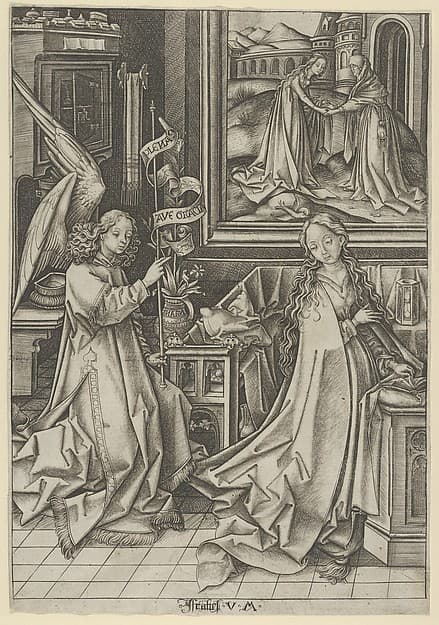
The Annunciation, from "The Life of the Virgin"
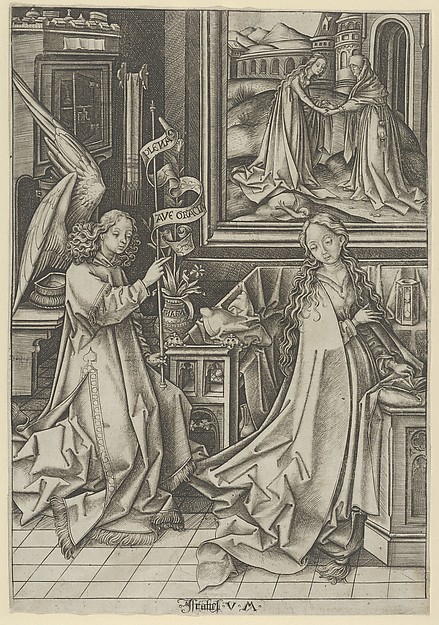
The Annunciation, from The Life of the Virgin series engraved by Israhel van Meckenem around 1490 in his Bocholt workshop, depicts the moment from Luke 1 in which the angel Gabriel appears to the Virgin Mary in her chamber to announce the conception of Christ. Meckenem composes the scene in a small late-medieval interior: the Virgin kneels at her prayer-desk on the right, the angel kneels on the left with the lily of purity in one hand and the banner of greeting in the other, the Holy Spirit descends as a small dove on a beam of golden light. The print belongs to the Life of the Virgin series — one of the standard late-fifteenth-century Northern engraved devotional cycles — and circulated through the Bocholt workshop's distribution network throughout the German-speaking and Low Countries devotional market.
Bible scenes Israhel van Meckenem painted
Luke
Matthew