Painter of the Bible
Lorenzo Monaco (Piero di Giovanni)
Lorenzo Monaco — born Piero di Giovanni in Siena around 1370 and renamed Lorenzo when he took monastic vows in the Camaldolese order around 1391 — was a leading Florentine painter of the early fifteenth century and the p…
._Lorenzo_Monaco.jpg%3Fwidth%3D600&w=2048&q=75)
Their faith
Why Lorenzo Monaco (Piero di Giovanni) painted Christ
Lorenzo Monaco, originally named Piero di Giovanni, embraced a life of devotion when he joined the Camaldolese order around 1391. His commitment to faith was evident in his work as a painter and illuminator at the convent of Santa Maria degli Angeli in Florence, where he dedicated his talents to the glory of God. As a Camaldolese friar, he immersed himself in a life of prayer and contemplation, which deeply influenced his artistic expression. The spiritual discipline of his monastic life, combined with his training under Agnolo Gaddi, allowed him to develop a unique style that reflected both the beauty of the divine and the elegance of the International Gothic period. His illuminated manuscripts and altarpieces served as acts of worship, showcasing his reverence for scripture and the sacred traditions of the Church.
Lorenzo's faith profoundly shaped his artistic vision, as seen in masterpieces like the "Coronation of the Virgin" and the "Adoration of the Magi." The former, created for the high altar of his own convent, captures the moment of divine grace with a vibrant color palette and intricate details that invite contemplation and reverence. Similarly, the "Annunciation" altarpiece reveals his ability to convey deep emotion and spiritual significance through his elongated figures and gilded backgrounds. Each brushstroke and illuminated letter was a testament to his devotion, echoing the prayers and aspirations of the faithful. Lorenzo Monaco's legacy continues to inspire viewers today, as his works remain a bridge between the earthly and the divine, inviting all who encounter them to experience the beauty of faith in Christ.
Life & work
Lorenzo Monaco — born Piero di Giovanni in Siena around 1370 and renamed Lorenzo when he took monastic vows in the Camaldolese order around 1391 — was a leading Florentine painter of the early fifteenth century and the principal Florentine illuminator of his generation. Trained almost certainly in the late Florentine workshop of Agnolo Gaddi (and possibly briefly in his native Siena before moving to Florence), he became a Camaldolese friar at the convent of Santa Maria degli Angeli in Florence, where he ran the convent's painting and manuscript-illumination workshop for the rest of his life. He died in Florence around 1424.
His Christian religious work is concentrated in altarpieces, predella panels, and illuminated manuscripts in his characteristic combination of late-Trecento Florentine narrative density and the new International Gothic figural elegance and chromatic refinement. The Coronation of the Virgin altarpiece (Uffizi, 1414 — painted for the high altar of his own Camaldolese convent of Santa Maria degli Angeli), the Adoration of the Magi altarpiece (Uffizi, c. 1422 — completed by Fra Angelico after Lorenzo Monaco's death), the Annunciation altarpiece in the Bartolini Chapel of Santa Trinita in Florence (c. 1422 — the chapel for which Fra Angelico would later complete the cycle), the Pietà altarpiece in the Pinacoteca Vaticana, and dozens of small predella panels and individual saints across the major museums anchor the painted corpus.
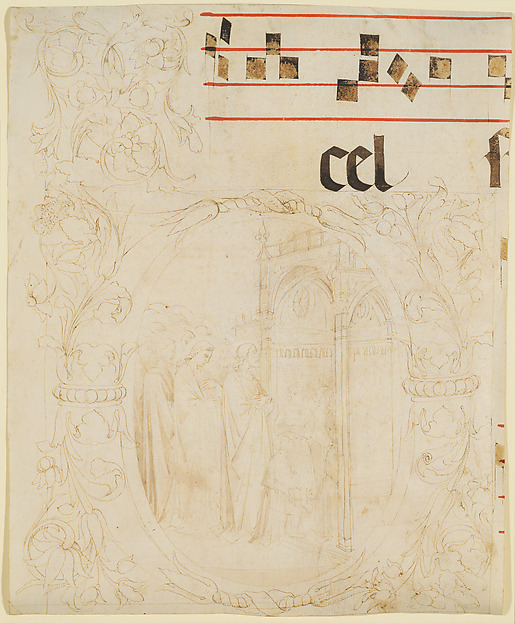
His illuminated manuscripts — choir books and antiphonals produced for the Camaldolese convent and for other Florentine ecclesiastical patrons — are widely held to be among the supreme Florentine Quattrocento illuminations. The vast antiphonal volumes still in the Laurentian Library and the Bargello in Florence, with their large historiated initials and elaborate decorative borders, are the principal record of his manuscript work.
His personal style — slim elongated figures in jewel-bright color, careful decorative pattern, tooled-gold backgrounds, and a delicate emotional restraint — combined the late Florentine Trecento tradition descending from Agnolo Gaddi with the new International Gothic refinement that defined European pictorial fashion in the years around 1400. He was the principal teacher of Fra Angelico, who entered the Camaldolese workshop as a young friar around 1420 and absorbed Lorenzo Monaco's manner directly.
Notable works in detail
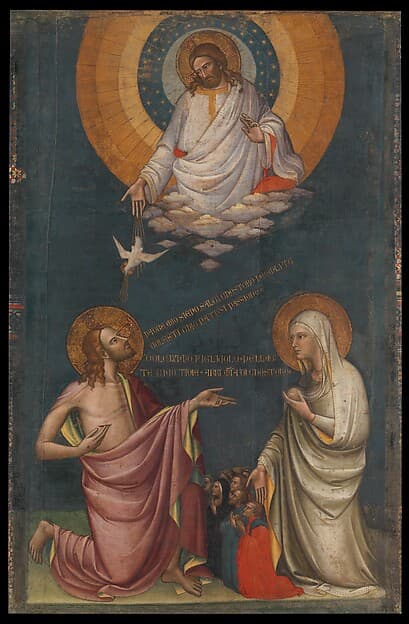
The Intercession of Christ and the Virgin
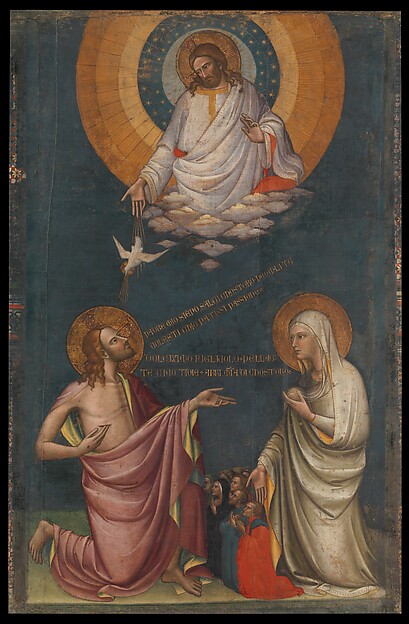
The Intercession of Christ and the Virgin, painted by Lorenzo Monaco around 1402 in tempera and gold on panel and now in the Metropolitan Museum of Art in New York, depicts the iconographic subject from late-medieval Christian devotional tradition in which both Christ and his mother Mary intercede with God the Father for the salvation of humanity — Christ showing the wounds of the Crucifixion and the Virgin showing her breast that suckled the infant Christ, the visible signs of their respective contributions to the work of redemption. Lorenzo Monaco stages the scene as a vertical Trinitarian composition with God the Father at the top, Christ kneeling on his right and the Virgin on his left, both in postures of intercession. The chromatic palette of saturated rose, ultramarine, and tooled gold is the unmistakable early Lorenzo Monaco signature.
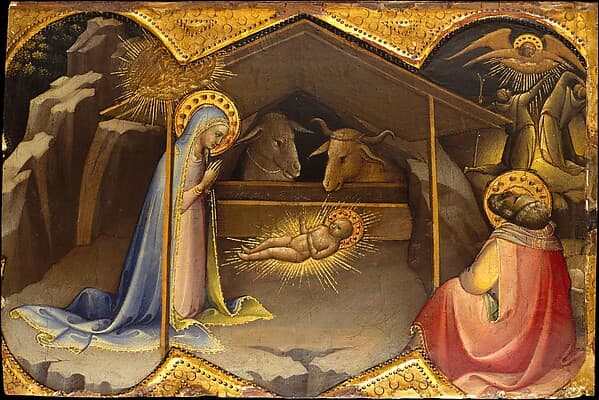
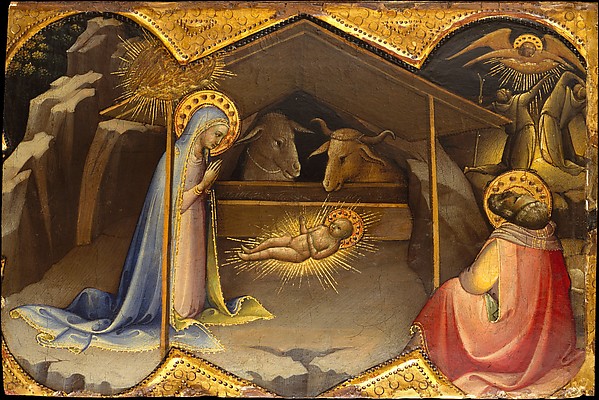
The Nativity, painted by Lorenzo Monaco around 1403 in tempera and gold on panel and now in the Metropolitan Museum of Art in New York, depicts the moment of the birth of Christ in the small dwelling at Bethlehem. Lorenzo Monaco stages the scene as a small intimate vertical composition: the Virgin kneels in profile with her hands folded in adoration before the newborn Christ Child laid on her cloak in the foreground, Joseph waits in the background with a small candle, the ox and the ass occupy the rear of the small thatched stable, and small attending angels descend from the upper register with banners of greeting. The chromatic palette and the elongated figural proportions are characteristic of the mature Lorenzo Monaco Camaldolese workshop manner that defined his entire output.
met-459008
The Crucified Christ between the Virgin and Saint John, painted by Lorenzo Monaco around 1403 in tempera and gold on panel and now in the Metropolitan Museum of Art in New York, depicts the moment of Christ's death on the cross with the conventional Italian Trecento attendant figures of the mourning Virgin and John the Evangelist. The cross stands at the upper center against the tooled-gold background; the Virgin on the left and John on the right are arranged in formal symmetry at the foot of the cross. The chromatic palette of saturated crimson, ultramarine, and tooled gold is the unmistakable mature Lorenzo Monaco signature, and the elongated figural proportions reflect the late-Trecento International Gothic refinement that defined his Florentine Camaldolese workshop.
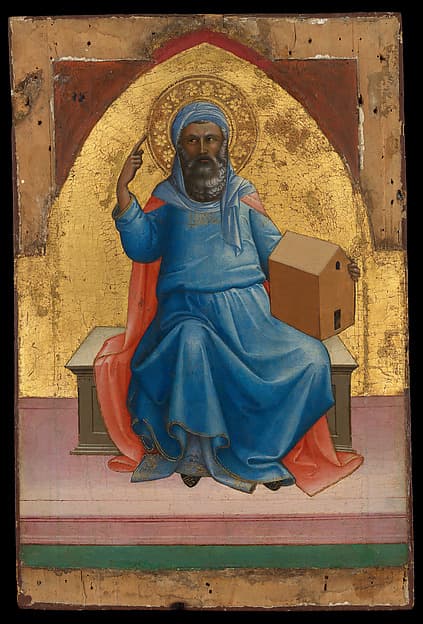
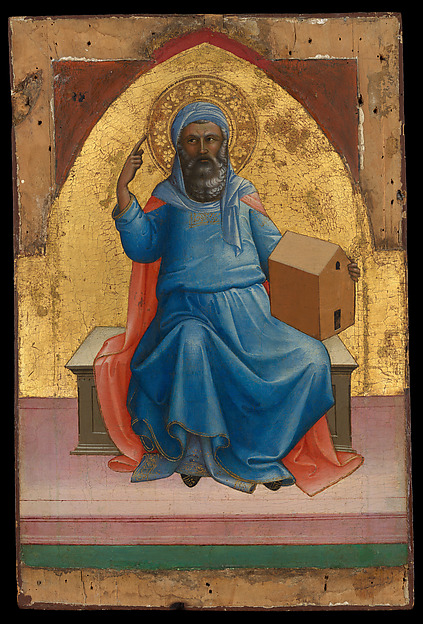
Noah, painted by Lorenzo Monaco around 1408 in tempera and gold on panel and now in the Metropolitan Museum of Art in New York, depicts the Old Testament patriarch in a small standing portrait. Noah stands in three-quarter view holding a small model of the Ark (the iconographic attribute that distinguishes him from any other Old Testament patriarch). The chromatic palette of saturated rose, ultramarine, and tooled gold against the patterned gold-tooled background is characteristic of the mature Lorenzo Monaco Camaldolese workshop manner, and the panel was originally part of a series of Old Testament patriarchs and prophets that the workshop produced for one of the Florentine ecclesiastical commissions of the early fifteenth century.
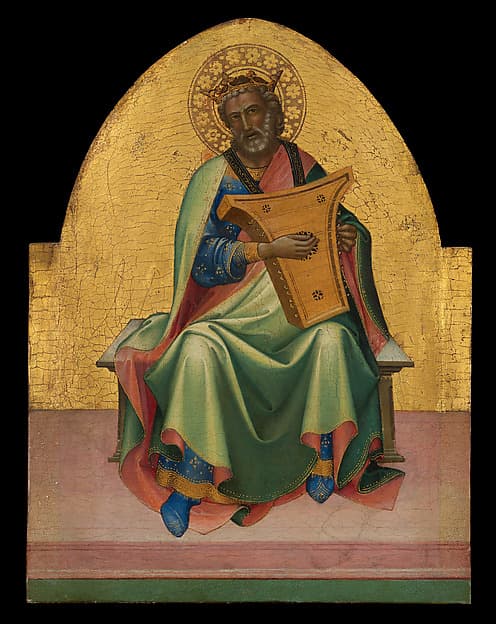
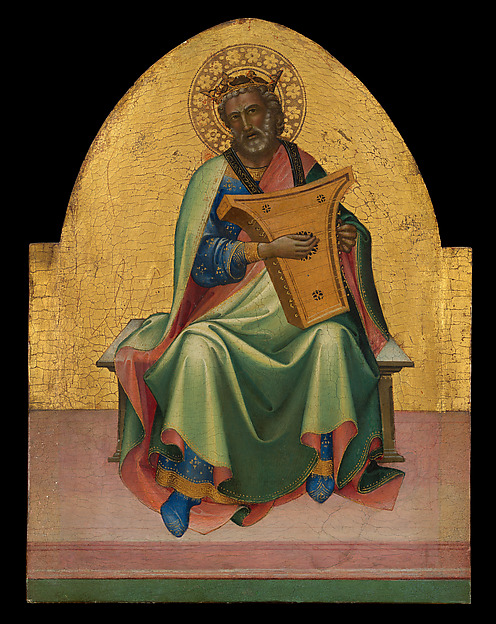
David, painted by Lorenzo Monaco around 1408 in tempera and gold on panel and now in the Metropolitan Museum of Art in New York, depicts the Old Testament shepherd-king in a small standing portrait. David stands in three-quarter view holding a small harp (the iconographic attribute that refers to the psalms traditionally attributed to him); the chromatic palette and the tooled-gold background are characteristic of the mature Lorenzo Monaco signature. The panel belongs to the same series of Old Testament patriarchs and prophets as the Noah, Moses, and Abraham panels of the same date in the Metropolitan and is one of the principal Lorenzo Monaco workshop sequences in any American collection.
Bible scenes Lorenzo Monaco (Piero di Giovanni) painted
Luke
Genesis
1 Samuel
Exodus
John