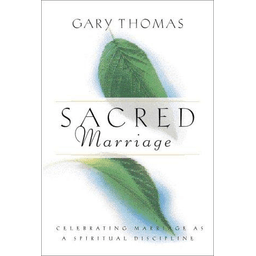
- Starting price
- $15.99 paperback
- Free tier
- No
- Platforms
- Print · Kindle · Audiobook · Audible
- Developer
- Zondervan
- Launched
- 2000 (Updated + Expanded 2015)
- Updated
- May 25, 2026
The verdict
The book that put the word "sanctification" back into mainstream marriage ministry. If you’ve only got one marriage book on the shelf and you want something that won’t age out in a decade, this is the one most counselors quietly recommend.
Try Sacred Marriage ↗Opens zondervan.com
Sacred Marriage has quietly become the favorite of pastors, counselors, and small-group leaders who are tired of recommending books that promise readers a happier spouse and deliver, at best, a slightly less annoyed one. Gary Thomas published it in 2000, Zondervan released an updated-and-expanded edition in 2015, and somewhere along the way it crossed 800,000 copies in print - numbers that put it in the same tier as The 5 Love Languages and The Meaning of Marriage without anything close to their marketing footprint.
It is not a tips book. It doesn’t map your spouse’s personality type. It doesn’t teach you five things to say after a fight. It doesn’t even promise that following the book will make your marriage easier. The thesis sits right on the cover, doubling as the subtitle: "What if God designed marriage to make us holy more than to make us happy?" Thomas spends roughly 300 pages defending that single sentence - and the defense is what makes the book work.
The result is the rare marriage book that ages well. Couples coming out of premarital counseling read it. Couples in their thirties reread it during the first hard stretch. Couples in their fifties find new chapters mattering - the ones on perseverance, on suffering well together, on the long obedience. It’s a book pastors loan out, then buy a fresh copy because the loaned one never comes back.
✓ The good
- Thesis that holds up over decades - "marriage as sanctification" works at every life stage in a way that "love language" frameworks don’t
- Pastoral counselor’s voice - Thomas writes like someone who has sat across the table from real couples, not a theologian working from a desk
- Genuinely cross-tradition - the formative-marriage thesis resonates with Reformed, Catholic, Orthodox, Wesleyan, and Latter-day Saint readers without contortion
- Practical without being prescriptive - chapters end with reflection rather than five-step exercises, which makes it usable in counseling and group settings
- Anchors the Sacred series - Sacred Parenting and Sacred Influence extend the same framework to children and to influencing a difficult spouse
- Updated 2015 edition is meaningfully better - added chapters on respect, sexual intimacy, and lived examples from twenty years of counseling
- Reads aloud well - couples regularly work through it chapter-by-chapter together, which is rare for a 300-page Christian non-fiction book
✗ Watch out
- Slow start - the first two chapters establish the thesis at a pace that can feel philosophical before the practical chapters arrive
- Light on dialogue mechanics - if your marriage problem is "we don’t know how to talk about money," Boundaries or The 5 Love Languages may help faster
- Anecdotes skew toward early-2000s middle-class American Protestant culture - most translate, but readers in other contexts may filter through the examples
- Not a crisis-marriage book - Thomas himself would point couples in active abuse or infidelity situations toward counseling first
- Some readers find the "happiness deflation" framing discouraging on a first read (yet) - it tends to land differently on a second reading, after disappointment
Best for
- Newlyweds finishing premarital counseling and looking for the next book
- Couples in year three to ten hitting the disillusionment stretch
- Pastors and counselors building a marriage-resource bookshelf
- Small groups wanting a 10-12 week study with substance
Avoid if
- You want a fast tactical playbook for one specific conflict pattern
- You’re in active crisis and need a counselor, not a paperback
- You bounce off books with theological vocabulary like "sanctification"
- You want a non-religious relationship book - this is unapologetically Christian
What Sacred Marriage is
Sacred Marriage is a long-form essay disguised as a marriage book. Across roughly twenty chapters Gary Thomas - a pastor, marriage counselor, and writer-in-residence at Second Baptist Houston - argues a single proposition: the deepest purpose of marriage is not romantic happiness but spiritual formation. Marriage, in his framing, is a school for character - a place where two people are reshaped by daily friction, daily forgiveness, and daily choice into the kind of people they couldn’t become alone.
The book is structured around that idea rather than around problems to solve. Chapters cover the discipline of perseverance, the spiritual gift of physical intimacy, the formation that happens through serving a spouse, the role of suffering inside marriage, and the long work of dying to self. The Sacred series - Sacred Parenting (2004) and Sacred Influence (2010) - extends the same lens to raising children and to a wife’s influence over a husband, but Sacred Marriage is the anchor.
Why counselors and pastors keep recommending Sacred Marriage
The single biggest practical difference between Sacred Marriage and the rest of the genre is what it asks of the reader. Most marriage books ask: how do I get my spouse to change so I’m happier? Thomas reverses the question. The book assumes the reader is the one being formed, the spouse is the formative instrument, and God is the one running the curriculum. That reframe is the entire book, and it’s also why pastors keep handing it out - it short-circuits the consumer logic that most couples bring to marriage counseling on day one.
It’s also why the book has aged so well. Frameworks built on "communicate this way" or "speak this love language" date the moment cultural communication norms shift. A book built on the claim that marriage is a sanctification school doesn’t date, because the underlying claim is anthropological - the same in 2000, 2015, and 2026. Thomas is the thoughtful person’s marriage author, and Sacred Marriage is the book he wants you to read first.
The "holy not happy" thesis: the line that became a movement
The subtitle does most of the work the cover does. "What if God designed marriage to make us holy more than to make us happy?" - Thomas is careful to note the "more than," not "instead of." Happiness is not the enemy of the book. Happiness is simply demoted from the primary metric of a marriage to a frequent by-product of a marriage that is succeeding at the deeper task. The first three chapters defend that move at length, drawing on Augustine, Bonhoeffer, the desert fathers, and Thomas’ own pastoral case files (anonymized) to argue that marriages aiming directly at happiness tend to miss it, while marriages aiming at character tend to find both.
In practice this single move resets the entire reading experience. A couple in a hard stretch who reads chapter four - "The Soul’s Embrace" - doesn’t come away with a checklist. They come away wondering whether the difficulty they’re experiencing might be the formation rather than an obstacle to the formation. Counselors report that this reframe alone, applied early, prevents a meaningful percentage of escalations into separation. It’s not a magic spell. It’s a different question - and asking a different question is often the entire fix.
The pastoral counselor’s voice: why the book reads the way it does
Thomas is not a systematic theologian and Sacred Marriage is not a systematic theology of marriage. He is a working pastor and counselor who has sat with thousands of couples, and the prose carries the texture of that work. Chapters open with a real story - a husband who confessed an affair, a wife navigating chronic illness, a young couple already exhausted in year two - and then move into Scripture, into a sentence or two of Augustine or Chrysostom, and back to a quiet question for the reader to sit with. The cadence is closer to a counseling session than to a sermon, which is exactly what the topic needs.
This is also why the practical application works without being prescriptive. Thomas rarely says "do this." He shows what other couples did, names the principle underneath it, and leaves the application to the reader. Chapter-end reflection questions are unusually good - open-ended, two or three per chapter, the kind that small groups actually use rather than skip. For couples doing the book together, the questions become the spine of weekly conversations that go places no scheduled "date night" agenda ever reaches.
The Sacred series ecosystem: Parenting, Influence, and the larger arc
Sacred Marriage was successful enough that Thomas extended the lens. Sacred Parenting (2004) applies the same formative claim to raising children - the argument being that parenting is also designed to shape the parent, not only the child. Sacred Influence (2010) is written for wives navigating a difficult husband, drawing on biblical narratives and counseling case work to map non-manipulative influence. The Sacred Search (2013) brings the lens upstream, to dating and spouse selection. Each book stands alone, but read together they form a coherent vision of relational sanctification across the family life cycle.
For readers who connect with the original, the series is worth knowing about. Most readers don’t need to read all of it - Sacred Marriage and Sacred Parenting are the load-bearing two, and most marriage counselors stop there. Sacred Influence is the more situational one, useful when the framing fits. The throughline is consistent enough that you can read any of them and feel the same author voice, the same counseling cadence, the same patient unwillingness to oversimplify a hard thing.
Pricing
Paperback
~$15.99
The standard edition most readers buy. Updated and expanded 2015 text.
Hardcover
~$22
Gift-format edition, useful for wedding gifts and church libraries.
Kindle
~$11
Full text plus highlighting and Kindle-share notes. Cheapest way in.
Audible / Audiobook
~$15
Unabridged narration - popular with couples who commute together.
Devotional Edition
~$15
A separate companion that pulls the book into daily readings.
Anniversary Edition
~$17
Reissue with additional Thomas commentary on the 20-year impact.
Paperback at around $15.99 is the standard format and the one most readers should buy. The 2015 updated-and-expanded edition is meaningfully better than the 2000 original - fifteen extra years of counseling case work, an added chapter on sexual intimacy, and Thomas’ own reflections on what twenty years of feedback taught him about what he got right and wrong. Make sure you’re getting the updated edition, not a used copy of the first edition.
Kindle at around $11 is the cheapest way in and a good fit for readers who underline heavily. The audiobook at around $15 is unusually well-suited to this material - couples regularly listen together on long drives, pausing to talk. Hardcover at around $22 is the wedding-gift format.
The Devotional Edition (~$15) is a separate book, not just a reformat - Thomas distills the original into a daily-reading structure. Useful if you’ve already read the original and want to revisit it slowly over a year. The Anniversary Edition (~$17) is the original text with new framing material; skip it if you already own the 2015 edition.
Most readers do not need more than one edition. Pick paperback or Kindle, read it once at a normal pace, then reread it a few years later. The second reading is the one most counselors describe as the one that landed.
Where Sacred Marriage falls behind
No conflict-mechanics chapter. Sacred Marriage doesn’t teach you how to have a hard conversation about money or in-laws or sex. The framework changes how you approach the conversation, but the conversation itself is left to other books. If you need the tactical layer, pair it with The Meaning of Marriage or Boundaries.
No personality framework. There is no equivalent of the Five Love Languages quiz, no Enneagram mapping, no attachment-style chapter. Readers who learn best through self-typing tools may find the book abstract - it works in principles rather than profiles, and that’s a deliberate choice.
Light on crisis-marriage and abuse situations. Thomas addresses suffering inside marriage with real care, but Sacred Marriage is not the book to hand someone in an active-abuse situation. The book assumes a baseline of safety and good faith that not every marriage has, and counselors are generally careful about where they place it.
Examples skew middle-class American Protestant. The case studies are mostly drawn from Thomas’ counseling context, which means readers in other cultural settings - international, lower-income, or non-Protestant - sometimes filter through the illustrations to reach the principle. The principles are portable. The illustrations are dated in places.
Sacred Marriage vs. The Meaning of Marriage vs. The 5 Love Languages
These three books are the modern Christian marriage canon, and most pastors recommend at least two of them. Sacred Marriage (Gary Thomas) is the formation book - its central question is "what is marriage for?" and its answer is sanctification. The Meaning of Marriage (Tim and Kathy Keller) is the Reformed-theological treatment - Ephesians 5 read carefully across a few hundred pages, denser, more covenantal in vocabulary, more direct on gender and complementarity. The 5 Love Languages (Gary Chapman) is the tactical book - a single, sticky framework for showing love in ways your spouse actually receives.
Different strengths. Thomas is better at reframing the whole project of marriage. Keller is broader (covenant theology, gender, singleness, public meaning of marriage). Chapman is faster - you can apply chapter three of Chapman to your evening before dinner, which is not true of either other book. Most counselors who recommend more than one usually start a couple on Chapman for early traction, hand them Thomas in year three or four, and hand them Keller when they’re ready for the longer theological treatment.
Sacred Marriage holds up against both. It outsells Keller’s book, and while Chapman is the bigger seller in raw units, Thomas is the one that pastors describe as the book that changed their own marriage - which is a different kind of authority. If you can only buy one, buy this one, and pick up Chapman or Keller later based on which gap you feel.
The bottom line
Sacred Marriage is the book the rest of the genre keeps having to reckon with. Its claim - that marriage is primarily formative, with happiness as a frequent by-product rather than the central target - has been quietly absorbed by a generation of pastors, counselors, and small-group curricula, often without attribution. Read it once in your first decade of marriage, reread it in your second. It won’t fix a fight tonight, and Thomas would say that’s not the book’s job. What it will do is reset the question you’re asking about your marriage, and that reset is what most couples actually need.
Alternatives to Sacred Marriage
 The Meaning of MarriageTim and Kathy Keller’s Reformed-theological reading of Ephesians 5 - denser and more covenantal than Sacred Marriage, with a stronger chapter on singleness.
 The 5 Love LanguagesGary Chapman’s tactical framework for showing love in ways your spouse receives. Faster traction, less depth - the obvious pairing with Sacred Marriage.
 BoundariesCloud and Townsend on saying yes and no with clarity. Reads as the practical complement to Sacred Marriage’s formation lens.
 Love and RespectEmerson Eggerichs’ widely-used Ephesians 5 framework - more prescriptive on gender roles than Thomas, often paired in counseling.
Frequently asked questions
Is Sacred Marriage for newlyweds or for couples already struggling?
Both, but it lands differently at different stages. Newlyweds get the conceptual reset before the disappointment arrives - useful preventatively. Couples three to ten years in tend to describe it as the book that put words to what they were already feeling. It is not, however, a crisis-marriage book. If you’re in an abuse or infidelity situation, see a counselor first.
Do I need the 2015 updated edition, or is the 2000 original fine?
Get the 2015 edition. Thomas added a chapter on sexual intimacy, expanded the chapter on respect, and incorporated fifteen years of additional counseling case work. The original is still good, but the updated edition is meaningfully better - and they cost roughly the same.
Is Sacred Marriage a Catholic, Protestant, Orthodox, or Latter-day Saint book?
Thomas writes from a broadly evangelical Protestant background, but the central thesis - marriage as a school of sanctification - resonates across traditions. Catholic, Orthodox, Wesleyan, Reformed, and Latter-day Saint readers regularly find the framework useful without theological friction. It is one of the rare modern marriage books that travels well across traditions.
What is the rest of the Sacred series?
Sacred Parenting (2004) applies the same formative thesis to raising children. Sacred Influence (2010) is written for wives navigating a difficult husband. The Sacred Search (2013) extends the framework upstream to dating and spouse selection. Each book stands alone; Sacred Marriage and Sacred Parenting are the two most counselors recommend.
Is the audiobook good, or should I read it in print?
The audiobook works unusually well for this material. Couples regularly listen together on long drives and pause to talk through chapters. If you’re going to underline, get the Kindle or paperback. If you’re going to discuss it with your spouse, the audiobook may actually be the better format.
How does Sacred Marriage compare to The 5 Love Languages?
They’re solving different problems. The 5 Love Languages is a tactical book - it teaches you to show love in a way your spouse receives. Sacred Marriage is a formation book - it reframes what marriage is for in the first place. Most counselors recommend Chapman early for fast traction and Thomas a few years in for depth.
Is there a study guide or small-group version?
Yes. Zondervan publishes a Sacred Marriage Participant’s Guide and a companion DVD/video study, designed for 6- to 12-week small-group runs. The chapter-end reflection questions in the main book are strong enough that many groups skip the formal guide and just work straight through the paperback.
More Marriage & Family Books
The 5 Love LanguagesGary Chapman's slim paperback has quietly become the most-recommended marriage book of the last thirty years - and the rare Christian title that crossed fully into the secular mainstream.ParentingPaul David Tripp's 2016 parenting book reframes the whole project around 14 gospel principles - and argues that God is using your kids to change you as much as He's using you to change them.Habits of the HouseholdJustin Whitmel Earley’s field guide to forming Christian families one daily rhythm at a time - and why a Richmond lawyer’s parenting book quietly became the most-recommended title in young-parent small groups.Boundaries in MarriageCloud and Townsend take their five-million-copy Boundaries framework and point it straight at the marriage relationship - arguing that owning your own life is what makes loving your spouse possible.Don’t Make Me Count to ThreeGinger Hubbard's 2003 toddler-discipline book has quietly become the go-to gift for new moms in evangelical circles - short, practical, and aimed at the child's heart rather than just the meltdown in aisle four.The Mission of MotherhoodSally Clarkson's 2003 book reframes motherhood as a high and intentional calling rather than a holding pattern - the vision-casting classic that launched a whole movement of home-discipleship writing.