Judges 21
People in this chapter
Judges 211 is the final chapter of the book, and it reads as a tragedy from first verse to last. To feel its weight you have to remember what has just happened. A monstrous crime at Gibeah (chs. 19-20) had set the nation at war with one of its own tribes, and the war had gone so far that Benjamin was all but annihilated - only six hundred men left alive, hiding in the wilderness at the rock Rimmon.
The chapter opens by reaching back to an oath sworn in the heat of that conflict: Now the men of Israel had sworn in Mizpeh, saying, There shall not any of us give his daughter unto Benjamin to wife. It was the kind of vow people make in fury, never thinking through what it might one day cost. Now the cost has come due. Six hundred surviving men, an entire tribe, and no wives anywhere in Israel they are permitted to marry.
Tap any highlighted phrase to jump to the commentary that unpacks it.
Judges 21:1-7The Oath, the Weeping, and the Missing Tribe
1Now the men of Israel had sworn in Mizpeh, saying, There shall not any of us give his daughter unto Benjamin to wife. 2And the people came to the house of God, and abode there till even before God, and lifted up their voices, and wept sore; 3And said, O LORD God of Israel, why is this come to pass in Israel, that there should be to day one tribe lacking in Israel? 4And it came to pass on the morrow, that the people rose early, and built there an altar, and offered burnt offerings and peace offerings. 5And the children of Israel said, Who is there among all the tribes of Israel that came not up with the congregation unto the LORD? For they had made a great oath concerning him that came not up to the LORD to Mizpeh, saying, He shall surely be put to death. 6And the children of Israel repented them for Benjamin their brother, and said, There is one tribe cut off from Israel this day. 7How shall we do for wives for them that remain, seeing we have sworn by the LORD that we will not give them of our daughters to wives?
The chapter opens on a strange and instructive scene: a nation weeping its heart out over the very thing it had set in motion. The men of Israel had sworn, in the white heat of the war against Benjamin, that none of them would ever give a daughter to that tribe. Now the war is over, Benjamin lies in ruins, and the oath that felt so righteous in the moment has become a noose. So the people came to the house of God, and abode there till even before God, and lifted up their voices, and wept sore. Take the grief seriously; the text does.
This is not crocodile sorrow. They genuinely mourn that a tribe of Israel is about to vanish from the earth, and they pour out that mourning before the LORD until evening. And yet - this is the quiet warning underneath the tears - nowhere in all this weeping do they ask God the one question that matters: what would You have us do? They grieve the consequence; they do not seek the cure from the only One who could give it.
Sorrow over where our choices have landed us is a real and good thing. But it is not the same as turning to God for His way out, and the difference is about to prove catastrophic.
Watch the precise shape of their dilemma in verse 7, because it explains everything that follows: How shall we do for wives for them that remain, seeing we have sworn by the LORD that we will not give them of our daughters to wives? Notice what they treat as fixed and what they treat as negotiable. The oath is fixed - that cannot be touched. So the question becomes a problem of cleverness: how do we obtain wives for Benjamin without technically giving our daughters?
The whole tragedy of the chapter is folded into that framing. They never stop to ask whether the oath itself was rash, whether God might release them from a vow sworn in wrath, whether there is a path of honest repentance and humble appeal to Him. They assume the rules of their own making are immovable, and set their ingenuity to work finding a loophole. And ingenuity unhooked from the wisdom of God is a dangerous engine.
It will, in the next verses, find its loopholes - and the loopholes will cost a town its life and a feast-full of young women their freedom.
Judges 21:8-15Jabesh-gilead Struck; Four Hundred Virgins Taken
8And they said, What one is there of the tribes of Israel that came not up to Mizpeh to the LORD? And, behold, there came none to the camp from Jabeshgilead to the assembly. 9For the people were numbered, and, behold, there were none of the inhabitants of Jabeshgilead there. 10And the congregation sent thither twelve thousand men of the valiantest, and commanded them, saying, Go and smite the inhabitants of Jabeshgilead with the edge of the sword, with the women and the children. 11And this is the thing that ye shall do, Ye shall utterly destroy every male, and every woman that hath lain by man. 12And they found among the inhabitants of Jabeshgilead four hundred young virgins, that had known no man by lying with any male: and they brought them unto the camp to Shiloh, which is in the land of Canaan. 13And the whole congregation sent some to speak to the children of Benjamin that were in the rock Rimmon, and to call peaceably unto them. 14And Benjamin came again at that time; and they gave them wives which they had saved alive of the women of Jabeshgilead: and yet so they sufficed them not. 15And the people repented them for Benjamin, because that the LORD had made a breach in the tribes of Israel.
The loophole-hunt produces its first victim, and it is an entire town. The reasoning runs like this: Israel had sworn a second oath, that any community failing to muster at Mizpeh would be put to death (v. 5). A census of the assembly turns up exactly one absentee - there came none to the camp from Jabesh-gilead. And suddenly the elders see a grim symmetry. Here is a town under a death-oath, with daughters who were never promised away under the first oath.
Destroy Jabesh-gilead for its absence, spare its virgins, and hand them to Benjamin: one stroke satisfies the death-vow, supplies wives, and never technically breaks the no-daughters vow. Beneath the tidy accounting is the cold-blooded slaughter of a town - men, married women, and children - to obtain marriageable girls. The text reports it in flat, unflinching detail precisely so we will not look away from it. This is what it looks like when people who feel deeply religious, who have wept and sacrificed before God, set their own reasoning loose to solve a crisis without Him.
Two oaths sworn in haste are stacked on top of each other, and a whole community is annihilated in the gap between them.
The narrative spares us nothing, and it intends not to. From the wreckage of Jabesh-gilead they take four hundred young virgins, that had known no man, and carry them unto the camp to Shiloh. Read it slowly and let it land as the catastrophe it is: these are real young women, their fathers and mothers and brothers freshly killed by the sword of their own countrymen, now marched off as a supply of wives for the survivors of a different tribe's ruin.
There is no consent here, no courtship, no covenant of marriage as God designed it - only the seizing of human beings to patch a hole the men of Israel had torn open themselves. The Bible records this as an indictment. Every value God had given His people - the sanctity of life, the dignity of a daughter, marriage as a covenant freely entered - is trampled in the name of preserving a tribe. The horror is the whole point.
A people who have made themselves the measure of right and wrong will, with the gravest faces and the best intentions, do things that ought to be unthinkable, and call it the only way.
And then comes the line that turns the stomach all over again, because it reveals that even this atrocity has not solved the problem: and yet so they sufficed them not. Four hundred women, a whole town destroyed to obtain them - and it is not enough. Six hundred men remained at the rock Rimmon; four hundred wives leave two hundred still without. The arithmetic is grotesque, and the narrator lets the grotesqueness speak. This is the unmistakable mark of a sinful solution: it does not even work.
It costs everything - lives, dignity, the conscience of a nation - and still leaves the original wound gaping. So a second scheme will have to be invented to finish what the first could not. Sin has a way of compounding like this; one desperate fix demands the next, and each new wrong is justified by the wrong that came before. The men of Israel have killed a town and stolen its daughters, and they are right back where they started: how shall we do for wives for them that remain?
Judges 21:16-24The Daughters of Shiloh Seized at the Feast
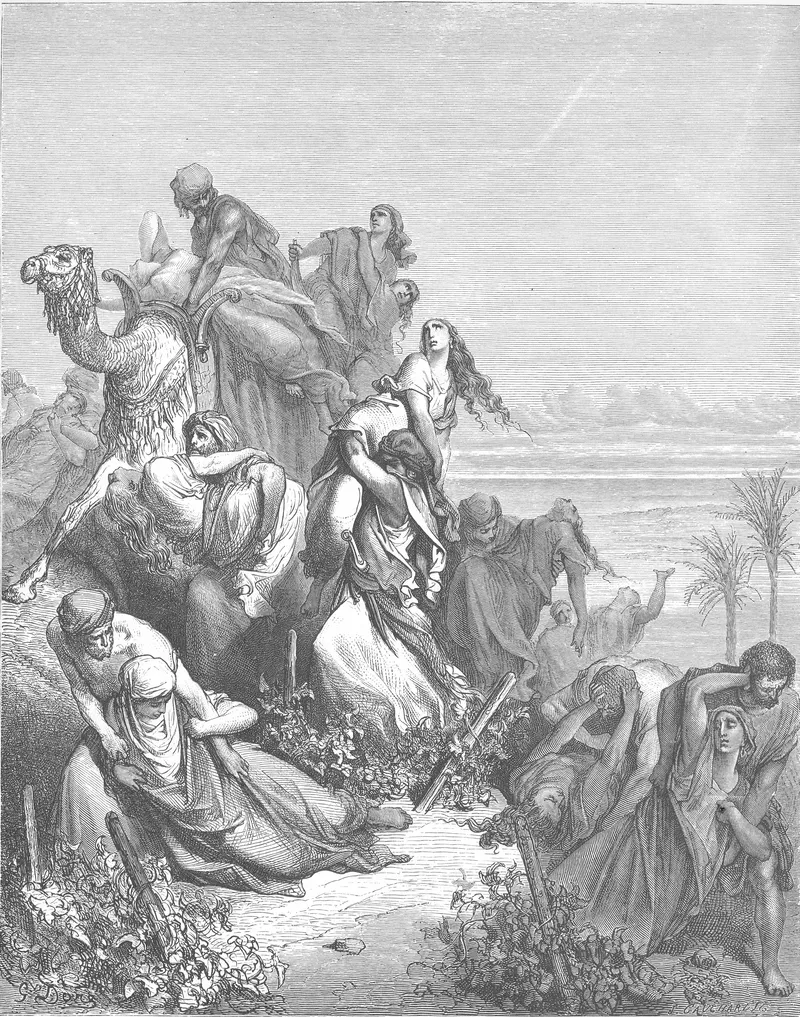
16Then the elders of the congregation said, How shall we do for wives for them that remain, seeing the women are destroyed out of Benjamin? 17And they said, There must be an inheritance for them that be escaped of Benjamin, that a tribe be not destroyed out of Israel. 18Howbeit we may not give them wives of our daughters: for the children of Israel have sworn, saying, Cursed be he that giveth a wife to Benjamin. 19Then they said, Behold, there is a feast of the LORD in Shiloh yearly in a place which is on the north side of Bethel, on the east side of the highway that goeth up from Bethel to Shechem, and on the south of Lebonah. 20Therefore they commanded the children of Benjamin, saying, Go and lie in wait in the vineyards; 21And see, and, behold, if the daughters of Shiloh come out to dance in dances, then come ye out of the vineyards, and catch you every man his wife of the daughters of Shiloh, and go to the land of Benjamin. 22And it shall be, when their fathers or their brethren come unto us to complain, that we will say unto them, Be favourable unto them for our sakes: because we reserved not to each man his wife in the war: for ye did not give unto them at this time, that ye should be guilty. 23And the children of Benjamin did so, and took them wives, according to their number, of them that danced, whom they caught: and they went and returned unto their inheritance, and repaired the cities, and dwelt in them. 24And the children of Israel departed thence at that time, every man to his tribe and to his family, and they went out from thence every man to his inheritance.
The elders restate their bind with even sharper edges. The first oath has now hardened into a curse: Cursed be he that giveth a wife to Benjamin. No father in Israel will hand over a daughter - the oath binds him, and beyond the oath, doing so would call down a curse on his own head. And yet the elders agree that there must be an inheritance for them that be escaped of Benjamin, that a tribe be not destroyed out of Israel. They are caught between a self-imposed curse and a self-imposed crisis - and once again the way they have framed the problem makes a righteous answer impossible.
The oath cannot be touched; the curse cannot be risked; God is not consulted; therefore the only thing left to be clever about is, again, how to obtain the daughters without anyone actually giving them. Mark the spiritual machinery at work here: a people so scrupulous about the letter of their own vow that they will engineer a kidnapping to preserve it, yet so blind to the heart of God's law that they cannot see the kidnapping is itself a far greater evil than releasing themselves from a rash word would have been.
They strain at the gnat of their oath and swallow the camel of abduction.
And here the chapter reaches a particular darkness, because the scheme is built on top of worship itself. There is a feast of the LORD in Shiloh yearly - a holy festival, a time when families came to the sanctuary to rejoice before God, and when the young women of Shiloh would come out to dance in the joy of the celebration. The elders take that sacred, happy gathering and turn it into the staging-ground for an ambush.
The precision of their directions is chilling - the exact location, north of Bethel, on the east side of the highway… and on the south of Lebonah; the exact moment, when the daughters of Shiloh come out to dance. This is no crime of sudden passion. It is planned, mapped, and timed, exploiting the one occasion in the year when the daughters would be out in the open, unguarded, and at their most carefree. That the men of Israel could weave a kidnapping into a feast of the LORD, and feel they had threaded the needle of righteousness in doing so, shows just how far the moral compass of the nation has spun.
They have learned to use even the worship of God as cover for doing what is right in their own eyes.1
The plan even comes with its public-relations strategy already prepared. When the fathers and brothers of Shiloh come to complain - and the elders fully expect that they will - the leaders have rehearsed exactly what they will say: Be favourable unto them for our sakes… for ye did not give unto them at this time, that ye should be guilty. In other words: you didn't technically give your daughters away, so no curse falls on you; the men simply took them; you are off the hook. It is a masterpiece of rationalisation, and that is precisely what makes it so damning.
The whole arrangement is engineered to let everyone keep a clean conscience while a deep wrong is being done. The fathers can tell themselves they kept their oath; the Benjamites can tell themselves the elders authorised it; the elders can tell themselves they saved a tribe. Everyone has a story that absolves them, and the only people with no voice in any of it are the daughters of Shiloh, seized from a dance and carried off.
This is how communal sin so often hides: in a careful sharing-out of plausible excuses, so that the wrong belongs to everyone and therefore, conveniently, to no one.
Judges 21:25No King in Israel: Every Man Right in His Own Eyes
25In those days there was no king in Israel: every man did that which was right in his own eyes.
The book ends not with a story but with a verdict, and it is the verdict that explains every horror in the preceding chapters: every man did that which was right in his own eyes. This is a diagnosis of disease, the Bible's own word for what went wrong. The refrain has sounded four times across the book's closing section (17:6; 18:1; 19:1; 21:25), and each time it sits over a fresh descent into chaos - idolatry, then a tribe's lawless migration, then an atrocity at Gibeah, and now the slaughter of Jabesh-gilead and the seizing of the daughters of Shiloh.
The pattern is unmistakable. When there is no authority above the individual conscience, when each person becomes the final court of what is right, the result is a war of every man's “right” against his neighbour's. What looks like righteousness from the inside - we kept our oath; we saved a tribe; we did the necessary thing - is revealed as catastrophe from the outside. One man's solution is another town's grave; one tribe's vow is another woman's captivity.
The entire book of Judges is a four-hundred-year demonstration of what a people become when there is no king to do justice, and they are left to be each his own.
Research trail
Sources & further study
These references support the historical, linguistic, manuscript, and contextual notes in this chapter. Scripture remains the primary text; external sources are provided so readers can inspect the research directly.
- Judges 21 - Translators' NotesThe NET Bible's detailed footnotes on Judges 21 - the geography of Jabesh-gilead and Shiloh, the legal force of the two oaths sworn at Mizpeh, the rationalisation offered to the fathers of the seized women (v. 22), and the way the closing refrain frames the entire book of Judges.
- Judges 21 · Hebrew + classical Jewish commentaryThe Hebrew text of Judges 21 with Rashi, Ibn Ezra, and other classical commentators side by side - useful for the binding oath, shevu'ah (vv. 1, 7, 18), for the verb nacham behind “repented them for Benjamin” (vv. 6, 15), and for the long Jewish discussion of how a rash vow could drive Israel to such desperate measures.
- Judges 21 ↔ Luke 1 · John 10 · 1 Samuel 8Traces the threads tying the book's closing cry for a king - there was no king in Israel (v. 25) - to Israel's demand for a king (1 Sam. 8) and on to the King of whose kingdom there shall be no end (Luke 1:32-33), the Shepherd who comes that His scattered people might have life (John 10:10).
Where this echoes in Scripture
The Oath, the Weeping, and the Missing Tribe
- Ecclesiastes 5:2Be not rash with thy mouth, and let not thine heart be hasty to utter any thing before God.The warning Israel ignored at Mizpeh - the rash oath that becomes a snare once the heat of the moment has passed.
- Numbers 30:2If a man vow a vow unto the LORD... he shall not break his word, he shall do according to all that proceedeth out of his mouth.The gravity of the sworn oath that binds Israel - and the law they never consult for how it might rightly be handled.
- Judges 11:30-35And Jephthah vowed a vow unto the LORD... and she was his only child.The same book's earlier disaster - a rash vow honoured to the letter, with tragic cost. Judges keeps showing the danger.
- 1 Samuel 14:24For Saul had adjured the people, saying, Cursed be the man that eateth any food until evening.A king's rash oath nearly kills his own son - the same reckless swearing that here drives a nation to ruin.
Jabesh-gilead Struck; Four Hundred Virgins Taken
- 1 Samuel 11:1-11Then Nahash the Ammonite came up, and encamped against Jabesh-gilead... and Saul... saved the men of Jabesh.Jabesh-gilead scarred here is rescued by Israel's first king - a wound a king must one day bind, hinting at the cure the book longs for.
- Proverbs 14:12There is a way which seemeth right unto a man, but the end thereof are the ways of death.The exact pattern of the chapter - a course that looks like the only solution, ending in literal death.
- Isaiah 5:20Woe unto them that call evil good, and good evil; that put darkness for light, and light for darkness.A nation that has made itself the measure of right - dressing the slaughter of a town as a righteous remedy.
- James 1:20For the wrath of man worketh not the righteousness of God.The whole tragedy springs from oaths sworn in wrath - human anger never produces the justice it imagines it serves.
The Daughters of Shiloh Seized at the Feast
- Matthew 23:24Ye blind guides, which strain at a gnat, and swallow a camel.The elders' exact error - meticulous about the letter of an oath, blind to the far greater evil of the abduction itself.
- Hosea 6:6For I desired mercy, and not sacrifice; and the knowledge of God more than burnt offerings.What Israel missed entirely - weeping and altars (vv. 2-4) without the mercy and knowledge of God that He actually desires.
- 1 Samuel 1:3And this man went up out of his city yearly to worship and to sacrifice unto the LORD of hosts in Shiloh.The same yearly feast at Shiloh - meant for joyful worship, here turned into the cover for an ambush.
- Jeremiah 17:9The heart is deceitful above all things, and desperately wicked: who can know it?The rehearsed rationalisation of verse 22 - a heart so practised at self-justification it can engineer a kidnapping and feel innocent.
No King in Israel: Every Man Right in His Own Eyes
- 1 Samuel 8:5-7Make us a king to judge us like all the nations... they have not rejected thee, but they have rejected me, that I should not reign over them.The book's closing cry answered - and complicated: Israel gets a king, but in demanding one rejects the King they already had.
- Luke 1:32-33The Lord God shall give unto him the throne of his father David... and of his kingdom there shall be no end.The King the ache of Judges finally reaches - born of David's line, reigning forever, righteous where every earthly king failed.
- John 10:10-11I am come that they might have life... I am the good shepherd: the good shepherd giveth his life for the sheep.A people without a king destroy themselves; the true King comes to give life and lay down His own for the sheep.
- Judges 8:23I will not rule over you, neither shall my son rule over you: the LORD shall rule over you.Israel's true King was always the LORD - the deepest sense in which they had “no king” was that they would not let Him reign.