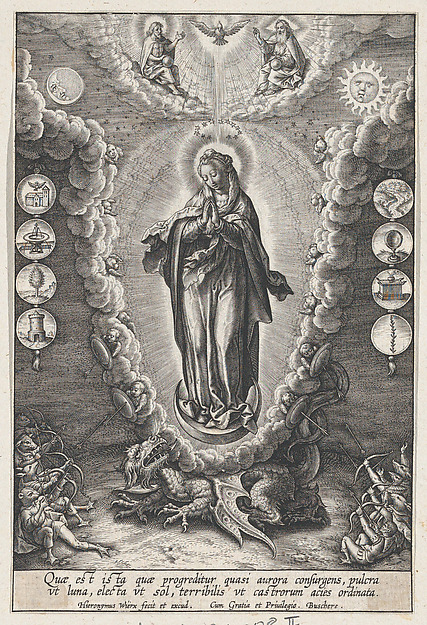
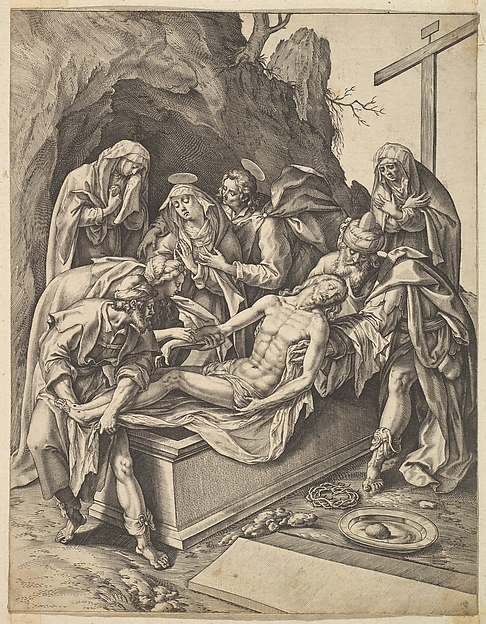
Painter of the Bible
Hieronymus (Jerome) Wierix
Hieronymus Wierix was the most prolific of the three Wierix brothers — Antwerp engravers whose output, taken together, dominated Catholic devotional printmaking in the Spanish Netherlands across the late sixteenth and early seventeenth centuries.
_(After)_-_The_seduction_of_man.jpg%3Fwidth%3D600&w=2048&q=75)
Their faith
Why Hieronymus (Jerome) Wierix painted Christ
Hieronymus Wierix was born into a devout family in Antwerp, where his father, Antoon Wierix, was a painter. Growing up in a household steeped in artistic tradition, Hieronymus and his brothers were deeply influenced by their Catholic faith, which became the foundation for their work. Wierix trained under the renowned printmaker Hieronymus Cock, where he honed his skills in creating engravings that would serve the Catholic Church's mission during the Counter-Reformation. His dedication to the Jesuit order, which emphasized education and devotion, is evident in his extensive body of work, particularly in the Evangelicae Historiae Imagines, a monumental project that illustrated the Gospel readings with accompanying meditations. This devotion to scripture and the teachings of the Church fueled his prolific output, leading to over two thousand identifiable engravings that shaped Catholic visual culture.
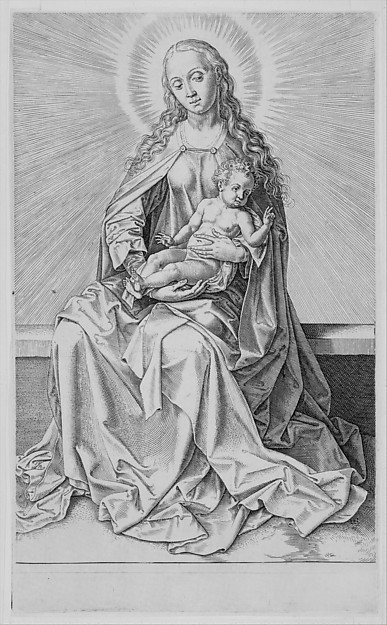
Wierix's faith profoundly influenced his artistic vision, as seen in his complete cycles of the Passion of Christ and the Life of the Virgin. His engravings, characterized by meticulous crosshatching and a soft tonal range, invite viewers into a contemplative space where they can reflect on the divine. The intimate treatment of devotional subjects in his works, such as the engravings for the Litany of the Virgin, reveals not only his technical prowess but also his deep reverence for the sacred narratives. Through his art, Wierix played a pivotal role in the Catholic Counter-Reformation, making spiritual themes accessible to the faithful. His engravings continue to inspire and uplift viewers today, reminding us of the enduring power of faith and the beauty of devotion captured through the artist's hand.
Life & work
Hieronymus Wierix was the most prolific of the three Wierix brothers — Antwerp engravers whose output, taken together, dominated Catholic devotional printmaking in the Spanish Netherlands across the late sixteenth and early seventeenth centuries. Born in Antwerp in 1553 to the painter Antoon Wierix, trained alongside his brothers Jan and Antonius II in their father's workshop and then under the great printmaker Hieronymus Cock at the publishing firm Aux Quatre Vents, he produced more than two thousand identifiable engravings during his life. He died in Antwerp in 1619.
His central project was the systematic visual program of the post-Tridentine Catholic Counter-Reformation as it took shape in Antwerp under Spanish rule. He worked for years on commissions from the Society of Jesus — the Jesuits, founded in 1534 and based in Rome — including the great Evangelicae Historiae Imagines of Jerónimo Nadal (Antwerp, 1593–1594), one of the most influential illustrated devotional books of the entire early modern period: 153 plates illustrating the Gospel readings for every Sunday and feast day, with extensive accompanying meditations. Hieronymus engraved a substantial portion of the plates personally, and the volume was reprinted, copied, and circulated by Jesuit missions from Mexico to China for the next two hundred years.
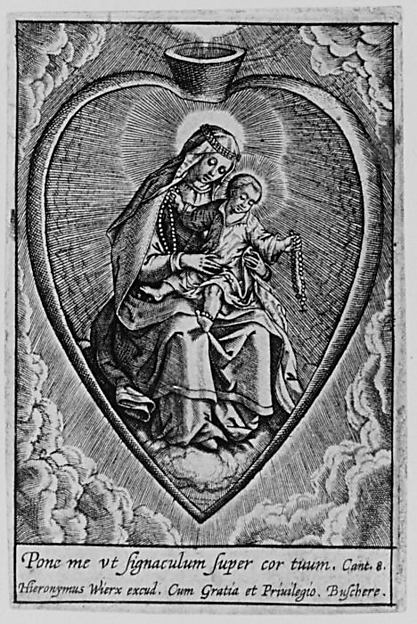
He produced complete cycles of the Passion of Christ, the Life of the Virgin, the Apostles, the Litany of the Virgin, the Cor Iesu, and almost every Catholic devotional theme — small-format engravings designed to be cut out and pasted into prayer books, larger sheets for distribution at confraternity meetings, and book illustrations for the Antwerp publishers Plantin-Moretus and the Jesuit press.
His personal style is unmistakable: meticulously crosshatched, restrained in expression, with a soft tonal range and an unusually intimate treatment of devotional subjects. His prints are among the most reproduced and copied religious images of the early modern period and shaped the visual vocabulary of Counter-Reformation Catholicism from Spain to the Philippines.
Notable works in detail
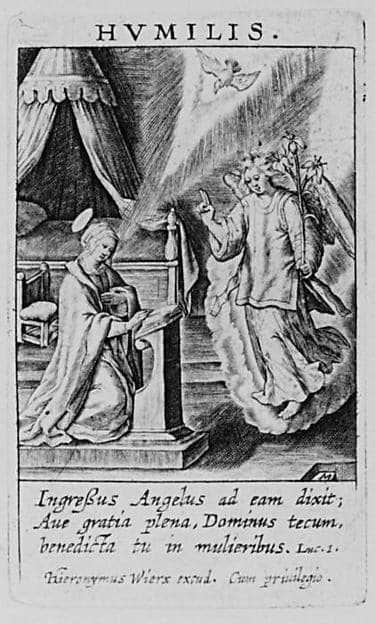
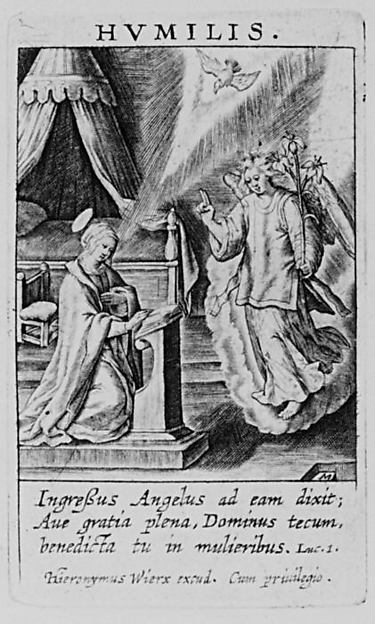
The Annunciation (Humilis), engraved by Hieronymus Wierix around 1545 in his Antwerp workshop, depicts the moment from Luke 1 in which the angel Gabriel appears to the Virgin Mary in her chamber to announce the conception of Christ. The Latin word Humilis (lowly, humble) inscribed at the foot of the print is the title of the iconographic series in which this plate belongs — a small set of devotional engravings emphasizing the Marian virtue of humility. Wierix composes the scene with characteristic Counter-Reformation Antwerp restraint: the Virgin kneels at her prayer-desk on the right, the angel kneels on the left with the lily of purity in one hand, the Holy Spirit descends as a small dove on a beam of golden light from the upper left. The print circulated through the Antwerp Jesuit publishing network in editions across the late sixteenth and seventeenth centuries.
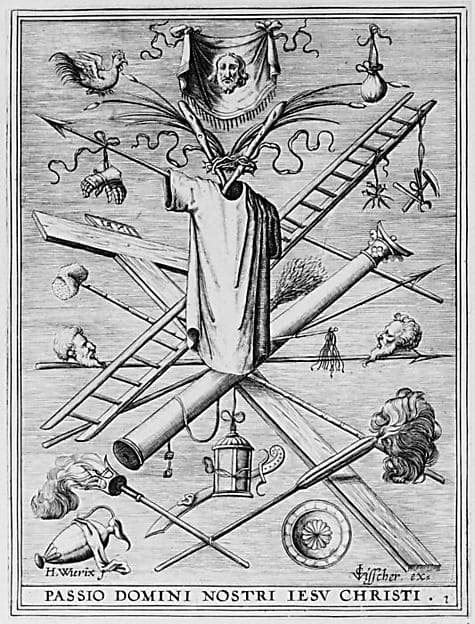
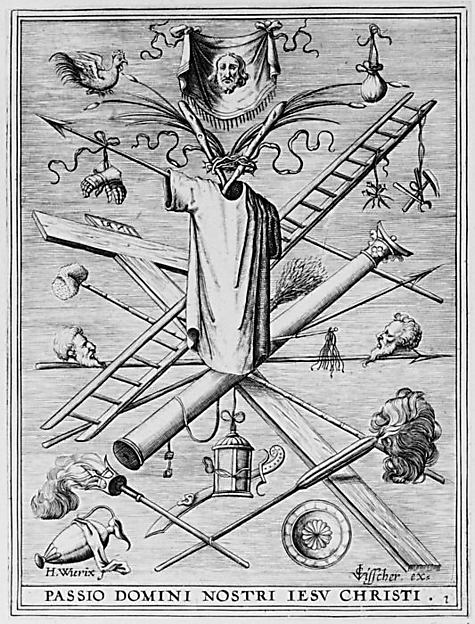
Christ's Robe Surrounded by the Instruments of the Passion, engraved by Hieronymus Wierix around 1560 in his Antwerp workshop, depicts the iconographic subject of the Arma Christi — the so-called instruments of the Passion — arranged around the central seamless robe of Christ that the Roman soldiers cast lots for at the foot of the cross. Wierix arranges the symbols (the cross, the nails, the crown of thorns, the spear, the sponge, the dice, the rooster, the column of the scourging, the ladder, the scourges) in formal symmetry around the central garment, with attendant angels in the corners holding small banners with Latin inscriptions. The Arma Christi devotion was a particular preoccupation of late-medieval and Counter-Reformation Catholic spirituality, and the Wierix engravings of the subject circulated through Catholic devotional publishing for over a century.
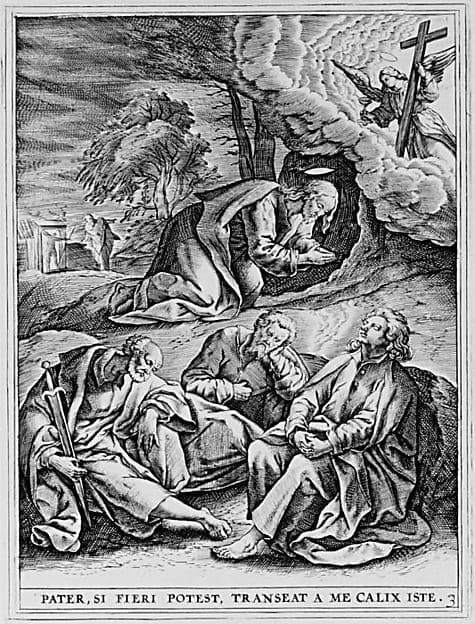
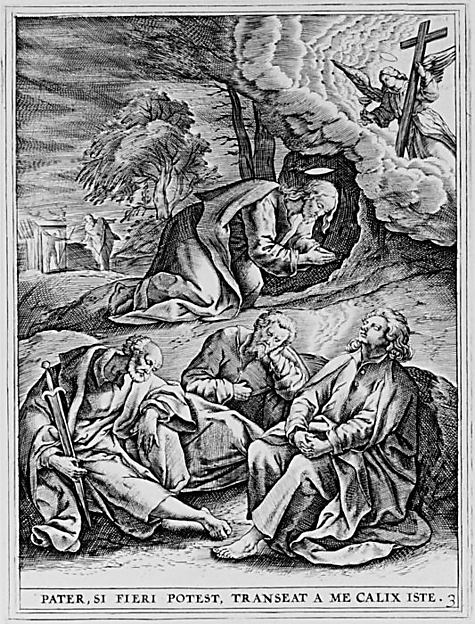
Christ Praying in the Garden on the Mount of Olives, engraved by Hieronymus Wierix around 1560 in his Antwerp workshop, depicts the Agony in the Garden as recorded in the Synoptic Gospels: Christ kneels in prayer before the angel bearing the cup of the Passion, while the three sleeping disciples — Peter, James, and John — are gathered in the foreground and Judas with the Roman soldiers approach through the garden gate at the rear. Wierix stages the scene with characteristic Antwerp Counter-Reformation devotional restraint: the figures are clearly drawn and emotionally legible without dramatic Mannerist exaggeration, the composition is built on a strong vertical axis from the kneeling Christ to the descending angel, and the chromatic-tonal range is achieved entirely through the tightly cross-hatched engraved line. The print circulated through Catholic devotional publishing networks across Europe and the Spanish overseas missions.