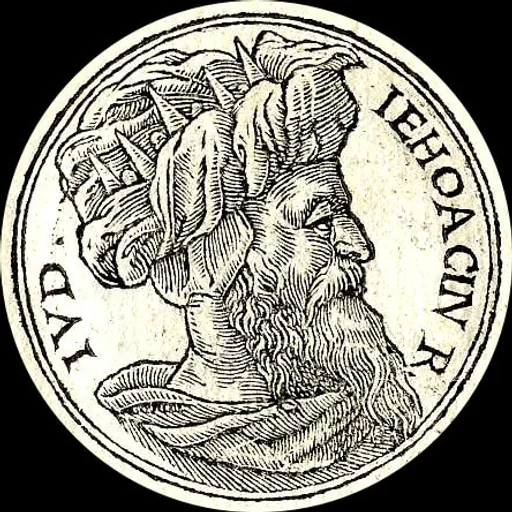
Who was Jehoiachin in the Bible?
Jehoiachin was a young king of Judah who reigned only a few months before being carried away as a captive to Babylon.
Exiled King of Judah
6th century BC
Jehoiachin was a young king of Judah who reigned only a few months before being carried away as a captive to Babylon.
Follow the reading trailBEYOND THE NAME
He came to the throne at a young age and did evil in the sight of the Lord, reigning barely three months before Nebuchadnezzar took him, the temple treasures, and the leading citizens into Babylonian exile. He spent decades as a prisoner, yet the record notes that he was later released from prison and given a seat of honor at the king’s table. His captivity marked the near end of the kingdom of Judah as it had been.
Themes in the authored commentary
FOLLOW THE PASSAGES
These are chapter studies associated with this record. Their order follows the books and chapters, rather than a reconstructed timeline of the person’s life.
young king who surrenders to Nebuchadnezzar and is exiled to Babylon with the temple treasures
Nebuchadnezzar comes up out of the north, and the door on Jerusalem begins to close. Jehoiakim bows, pays tribute for three years, then rebels - and raiding bands pour over the land. He dies. His son Jehoiachin, eighteen years old, lasts three months before he walks out the gate to surrender. The first great wave of Judah goes to Babylon: the king, the princes, the craftsmen, the mighty. Behind them the city stands stripped, a puppet on its throne.
Chapter overview from the authored study guide.exiled king of Judah released from prison and honored by Evil-merodach
Babylon’s army rings Jerusalem and waits. For a year and a half the siege tightens, until there was no bread for the people of the land (v. 3) and the wall breaks. Zedekiah runs in the dark and is overtaken on the plains of Jericho. They kill his sons before his eyes, then put out his eyes, so their slaughter is the last thing he sees. The temple burns, the walls come down, the people are marched east. So Judah was carried away out of their land (v. 21). A covenant long abandoned, come due at last in fire.
Chapter overview from the authored study guide.addressed alongside the queen mother as those who will go into captivity
Jeremiah 13 begins not with words but with a sign the prophet carries on his own body. The LORD tells him to buy a linen girdle - a belt or waistcloth - and bind it to his loins, but never to put it in water. Later he is sent on a long journey to bury it in a hole of the rock by the Euphrates. After many days he is told to dig it up, and finds it marred, it was profitable for nothing (v. 7).
Chapter overview from the authored study guide.called Coniah, declared childless of successors and to be cast into exile
God sends the prophet down from the temple to the palace, and the word he carries is addressed to the king on the throne of David (v. 2). It is not a private rebuke; it is laid across the whole royal house, and it can be stated in a single line: Execute ye judgment and righteousness, and deliver the spoiled out of the hand of the oppressor: and do no wrong, do no violence to the stranger, the fatherless, nor the widow (v. 3). The throne is held on condition. If ye do this thing indeed, kings keep riding in through these gates (v. 4); but if ye will not hear… this house shall become a desolation (v. 5).
Chapter overview from the authored study guide.exiled king of Judah released from prison and given a seat of honor by Evil-merodach
Jeremiah 52 is the final chapter of the book, and it does not read like the rest of it. There are no oracles here, no thus saith the LORD, no weeping prophet pleading with a stubborn people. It is a chronicle - a sober historical appendix that retells, almost word for word with the close of 2 Kings, the fall of Jerusalem in 587 BC. Everything Jeremiah had announced for forty years now becomes dated, documented history: the siege under Nebuchadrezzar (vv. 4-5), the famine and the breach (vv. 6-7), the flight and capture of Zedekiah (vv. 8-9), the slaughter of his sons and the putting out of his eyes (vv. 10-11).
Chapter overview from the authored study guide.exiled king of Judah who heard Baruch's reading and wept in Babylon
Baruch reads a book to the exiled community in Babylonia. The people respond with tears, fasting, prayer, and a collection sent to those still in Jerusalem. Exile has not severed their responsibility for one another.
Chapter overview from the authored study guide.THE PEOPLE AROUND THE PERSON
Recorded parents
Recorded children
Relationships follow the source graph. Some are interpretive or uncertain, and individual verse citations are not yet available for every connection.
STUDY & INTERPRETATION
Jehoiachin’s short, troubled reign in 2 Chronicles 36 stands among the closing scenes of the monarchy, when one king after another fell short and the long-warned exile finally came. His deportation to Babylon emptied Jerusalem of its treasures and its leaders, and to many it looked as though the promises to David’s house had failed. Yet the Scriptures take care to record his eventual release and lifting up at the foreign king’s table, a small but stubborn sign that the line of David had not been wholly cut off. His name reappears in the genealogy of Jesus, so that the kingdom which seemed extinguished in captivity is the very line through which the promised Son of David would come.
From the Learn of Christ person commentary. Read alongside the linked Scripture passages.KEEP SCRIPTURE CLOSE
8 authored chapter guides feature this person. This is guide coverage, not an exhaustive count of biblical mentions.
ASK A BETTER QUESTION
Identity, story, early-life sources, family, and where to read.
Names and spellings in the source: Jehoiachin · Joyachin · Jeconiah · Coniah · Jechoniah · Jechonias
Jehoiachin was a young king of Judah who reigned only a few months before being carried away as a captive to Babylon.
He came to the throne at a young age and did evil in the sight of the Lord, reigning barely three months before Nebuchadnezzar took him, the temple treasures, and the leading citizens into Babylonian exile. He spent decades as a prisoner, yet the record notes that he was later released from prison and given a seat of honor at the king’s table. His captivity marked the near end of the kingdom of Judah as it had been.
The individualized passage index associates this Jehoiachin record with 2 Kings, 1 Chronicles, 2 Chronicles, Esther, Jeremiah, Ezekiel, Matthew. There are 21 distinct indexed verse references in the 66-book Bible. Browse the book-by-book list below; it separates this identity from other people who share the name. Source assignments and textual identifications can require interpretation.
A separate childhood account for Jehoiachin is not provided in our current authored profile sources. Begin with 2 Kings 24:6 and the passages linked here for the evidence that is available. The first indexed reference to a name is not a birth record. This profile does not establish a birth date, schooling, or childhood events beyond what its sources state.
Jehoiachin’s source record lists Jehoiakim (father), Nehushta (mother), Zedekiah (child, uncertain), Shealtiel (child). These are source-graph relationships; legal family, uncertain identifications, and ancestral language require the cautions below. Individual verse evidence is not yet retained for every family edge.
Jehoiachin’s short, troubled reign in 2 Chronicles 36 stands among the closing scenes of the monarchy, when one king after another fell short and the long-warned exile finally came. His deportation to Babylon emptied Jerusalem of its treasures and its leaders, and to many it looked as though the promises to David’s house had failed.
Answers draw on our existing authored biography and linked chapter studies. Where supplied, verse assignments come from the individualized STEP Bible index. Childhood answers distinguish documented events from gaps in the available sources.
FIND THE PERSON IN THE TEXT
21 distinct verse references in the source’s 66-book index. These are indexed name assignments, rather than every indirect allusion to this person. A name may also refer to descendants, a tribe, or a nation; read each passage to distinguish that usage from the individual.
“So Jehoiakim slept with his fathers: and Jehoiachin his son reigned in his stead.”
2 Kings 24:6 · King James Version
“Now the rest of the acts of Jehoiakim, and his abominations which he did, and that which was found in him, behold, they are written in the book of the kings of Israel and Judah: and Jehoiachin his son reigned in his stead.”
2 Chronicles 36:8 · King James Version
“Which Nebuchadnezzar king of Babylon took not, when he carried away captive Jeconiah the son of Jehoiakim king of Judah from Jerusalem to Babylon, and all the nobles of Judah and Jerusalem;”
Jeremiah 27:20 · King James Version
“And after they were brought to Babylon, Jechonias begat Salathiel; and Salathiel begat Zorobabel;”
Matthew 1:12 · King James Version
References are adapted from STEP Bible / Tyndale House TIPNR (CC BY 4.0). Deduplicated, matched to this identity, and checked against the bundled KJV’s verse bounds. Interpretive assignments and translation/versification differences may remain. This index is separate from evidence for individual family relationships.
YOUR OWN OBSERVATIONS
Notes, saved people, and study marks stay in this browser. They do not sync to your account.
KEEP EXPLORING
People featured in the same study guides. Sharing a chapter does not establish a family relationship.