2 Kings 25
People in this chapter
Babylon's army rings Jerusalem and waits. For a year and a half the siege tightens, until there was no bread for the people of the land (v. 3) and the wall breaks. Zedekiah runs in the dark and is overtaken on the plains of Jericho. They kill his sons before his eyes, then put out his eyes, so their slaughter is the last thing he sees. The temple burns, the walls come down, the people are marched east.1 So Judah was carried away out of their land (v. 21).
A covenant long abandoned, come due at last in fire.
Tap any highlighted phrase to jump to the commentary that unpacks it.
2 Kings 25:1-4The Long Siege and the Breach of the Wall
1And it came to pass in the ninth year of his reign, in the tenth month, in the tenth day of the month, that Nebuchadnezzar king of Babylon came, he, and all his host, against Jerusalem, and pitched against it; and they built forts against it round about. 2And the city was besieged unto the eleventh year of king Zedekiah. 3And on the ninth day of the fourth month the famine prevailed in the city, and there was no bread for the people of the land. 4And the city was broken up, and all the men of war fled by night by the way of the gate between two walls, which is by the king’s garden: (now the Chaldees were against the city round about:) and the king went the way toward the plain.
The chapter opens with dates set down like the entries of a war diary: the ninth year… the tenth month… the tenth day (v. 1). The precision is deliberate. This is no vague legend of a city's fall but a remembered catastrophe, dated to the day, the kind of date a people carries in its bones long afterward. Nebuchadnezzar comes he, and all his host, and the army does not storm the walls; it builds forts around the city and waits.
A siege is a slow strangling. The narrator lets the months pass in a single verse - the city was besieged unto the eleventh year (v. 2) - roughly a year and a half of tightening hunger, until the famine prevailed in the city, and there was no bread for the people of the land (v. 3). The famine is the real conqueror; the wall is only the last thing to break. Hunger does not distinguish between the powerful and the poor, and a city that will not yield is finally undone not by swords but by an empty granary.
The horror here is quiet and total: a whole population worn down to the point where there is simply nothing left to eat.1
When the wall is at last broken up (v. 4), the men of war flee by night through the gate between the two walls, by the king's garden, and the king flees with them, taking the way toward the plain. There is a bitter geography in his route. Zedekiah runs toward the plains of Jericho - the very ground where Israel first crossed the Jordan into the land under Joshua, where the walls of a city once fell down before them at the LORD's command.
Now the last king of Judah runs across that same plain in the dark, and there the army of the Chaldees pursued after the king, and overtook him (v. 5), his own army scattering from him as he is taken. The man who would not submit to the warning is run down on the open ground and brought to Riblah to face the king of Babylon, where they gave judgment upon him (v. 6). The flight changes nothing.
The end he tried to outrun is waiting for him at the edge of the plain.
2 Kings 25:5-7The King Overtaken and Blinded
5And the army of the Chaldees pursued after the king, and overtook him in the plains of Jericho: and all his army were scattered from him. 6So they took the king, and brought him up to the king of Babylon to Riblah; and they gave judgment upon him. 7And they slew the sons of Zedekiah before his eyes, and put out the eyes of Zedekiah, and bound him with fetters of brass, and carried him to Babylon.
2 Kings 25:8-21The House of the LORD Burned; Judah Carried Away
8And in the fifth month, on the seventh day of the month, which is the nineteenth year of king Nebuchadnezzar king of Babylon, came Nebuzaradan, captain of the guard, a servant of the king of Babylon, unto Jerusalem: 9And he burnt the house of the LORD, and the king’s house, and all the houses of Jerusalem, and every great man’s house burnt he with fire. 10And all the army of the Chaldees, that were with the captain of the guard, brake down the walls of Jerusalem round about. 11Now the rest of the people that were left in the city, and the fugitives that fell away to the king of Babylon, with the remnant of the multitude, did Nebuzaradan the captain of the guard carry away. 12But the captain of the guard left of the poor of the land to be vinedressers and husbandmen.
A month after the wall is breached, Nebuzaradan arrives to finish the work, and the order in which he burns the city is itself a sermon. First named is the house of the LORD (v. 9) - the temple Solomon built and dedicated, the place toward which the people had prayed, where the sacrifices were offered and the holy things were kept. It burns first, before the king's house, before every great house, before the whole city.
The most sacred building in the world of Judah is reduced to ash, and the army brake down the walls of Jerusalem round about (v. 10), so that the city is not only emptied but laid open, defenceless, undone. For a people who had come to treat the temple as an unbreakable guarantee - surely the LORD would never let His own house fall - the burning is a theological earthquake. It says that the building was never a charm; the covenant it served had been broken, and the holiness it housed could not be presumed upon forever.
The people are carried away - those left in the city, the deserters who had gone over to Babylon, the remnant of the multitude, all swept up and marched into exile (v. 11). And then a single, strange mercy is recorded: the captain of the guard left of the poor of the land to be vinedressers and husbandmen (v. 12). It is a quiet reversal of every ordinary value. In this moment, to have been wealthy, connected, important, is to be deported or executed; to have had nothing worth taking is to be left in the land, alive, tending the vines.
The poor are spared precisely because they are poor - the last, faint echo in this dark chapter of a recurring scriptural pattern, that God's eye rests on the lowly, and that the meek, in the end, inherit the earth. The land is not left utterly empty. Even now, in the ruin, someone remains to prune a vine and work the ground, and life of a diminished kind goes on.
13And the pillars of brass that were in the house of the LORD, and the bases, and the brasen sea that was in the house of the LORD, did the Chaldees break in pieces, and carried the brass of them to Babylon. 14And the pots, and the shovels, and the snuffers, and the spoons, and all the vessels of brass wherewith they ministered, took they away. 15And the firepans, and the bowls, and such things as were of gold, in gold, and of silver, in silver, the captain of the guard took away. 16The two pillars, one sea, and the bases which Solomon had made for the house of the LORD; the brass of all these vessels was without weight. 17The height of the one pillar was eighteen cubits, and the chapiter upon it was brass: and the height of the chapiter three cubits; and the wreathen work, and pomegranates upon the chapiter round about, all of brass: and like unto these had the second pillar with wreathen work.
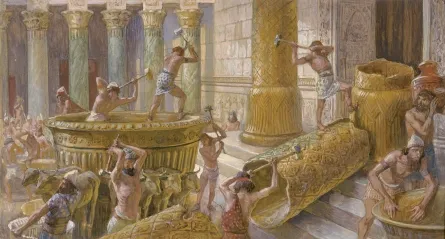
The narrative now slows almost to an inventory, lingering over the bronze of the temple with what feels like grief: the great pillars, the bases, the brasen sea, all broken in pieces and the metal carried to Babylon (v. 13); the pots and shovels and snuffers and spoons, the firepans and bowls, the gold taken as gold and the silver as silver (vv. 14-15). The two bronze pillars had names - Jachin and Boaz - and had stood at the temple porch since Solomon's day; the molten sea was a marvel of craft, the bronze of it without weight (v. 16), too vast to be measured.
The text dwells on the height of the pillars, the carved wreathen work and the pomegranates worked round the capitals (v. 17), as one might dwell on the features of a face one is losing. Why catalogue the furniture of a burning house? Because these were not mere objects; they were the visible glory of the worship of God, made by Solomon for His house, and their breaking is the breaking of an entire world of holiness.
The conqueror weighs them only as metal. The narrator remembers them as the beauty of the LORD's house, now hammered apart and hauled away.
18And the captain of the guard took Seraiah the chief priest, and Zephaniah the second priest, and the three keepers of the door: 19And out of the city he took an officer that was set over the men of war, and five men of them that were in the king’s presence, which were found in the city, and the principal scribe of the host, which mustered the people of the land, and threescore men of the people of the land that were found in the city: 20And Nebuzaradan captain of the guard took these, and brought them to the king of Babylon to Riblah: 21And the king of Babylon smote them, and slew them at Riblah in the land of Hamath. So Judah was carried away out of their land.
The last act of the destruction is the removal of Judah's leadership, named one office at a time. The captain of the guard takes Seraiah the chief priest, and Zephaniah the second priest, and the three keepers of the door (v. 18) - the men who tended the holy place and guarded its thresholds; and then the military and civil officers, the man over the men of war, the king's counsellors, the scribe who mustered the army (v. 19).
All are carried to Riblah, and there the king of Babylon smote them, and slew them (v. 21). The priesthood, the army, the court - every structure that held the nation together - is executed in a single stroke. And then comes the sentence the whole chapter has been moving toward, stated with terrible economy: So Judah was carried away out of their land. There is no lament attached, no explanation; just the flat fact, like a door closing.
The covenant people are severed from the covenant land. The king is blinded and gone, the temple is ash, the priests are dead, the leaders are slain, and the land lies behind them as they are marched east. It reads like the end of everything.
2 Kings 25:22-26Gedaliah Set Over the Remnant; the Flight to Egypt
22And as for the people that remained in the land of Judah, whom Nebuchadnezzar king of Babylon had left, even over them he made Gedaliah the son of Ahikam, the son of Shaphan, ruler. 23And when all the captains of the armies, they and their men, heard that the king of Babylon had made Gedaliah governor, there came to Gedaliah to Mizpah, even Ishmael the son of Nethaniah, and Johanan the son of Careah, and Seraiah the son of Tanhumeth the Netophathite, and Jaazaniah the son of a Maachathite, they and their men. 24And Gedaliah sware to them, and to their men, and said unto them, Fear not to be the servants of the Chaldees: dwell in the land, and serve the king of Babylon; and it shall be well with you. 25But it came to pass in the seventh month, that Ishmael the son of Nethaniah, the son of Elishama, of the seed royal, came, and ten men with him, and smote Gedaliah, that he died, and the Jews and the Chaldees that were with him at Mizpah. 26And all the people, both small and great, and the captains of the armies, arose, and came to Egypt: for they were afraid of the Chaldees.
A small coda follows the great destruction, and it traces how even the surviving remnant slips away. Babylon sets a man named Gedaliah over the poor who were left - a man of a notable family, grandson of Shaphan the scribe who had served in Josiah's reforms. The scattered captains of the armies come in to him at Mizpah, and Gedaliah gives them a steadying word, sealed with an oath: Fear not to be the servants of the Chaldees: dwell in the land, and serve the king of Babylon; and it shall be well with you (v. 24).
It is the same counsel Jeremiah had pressed on Zedekiah - survival through submission, life found by accepting the loss. For a moment a fragile path forward opens: stay on the land, work it, live under the new order, and there can yet be a future here. Gedaliah is a quiet, wise figure. He offers the remnant the one thing that might have let them remain: the humility to accept what cannot be changed and to build, quietly, inside it.
But the fragile peace is shattered almost at once. Ishmael, a man of the seed royal (v. 25) - of the old Davidic house, perhaps nursing a claim to a throne that no longer exists - comes with ten men and murders Gedaliah, killing the Jews and the Chaldeans who were with him at Mizpah. It is the old refusal flaring up one last time: the same proud insistence on independence that had ruined Zedekiah now destroys the last shelter the remnant had.
And the result is flight. All the people, both small and great… arose, and came to Egypt: for they were afraid of the Chaldees (v. 26). It is a heartbreaking final image. The people of the covenant, who were brought up out of Egypt with a mighty hand at the founding of the nation, now run back down into Egypt at its end, abandoning the promised land in fear. The exodus is undone in reverse.
The land lies emptied behind them, and the book's narrative of Judah in her own country closes with her children fleeing the wrong way down the road their fathers had walked to freedom.
2 Kings 25:27-30A Captive King Lifted Up: The Door of Hope
27And it came to pass in the seven and thirtieth year of the captivity of Jehoiachin king of Judah, in the twelfth month, on the seven and twentieth day of the month, that Evilmerodach king of Babylon in the year that he began to reign did lift up the head of Jehoiachin king of Judah out of prison; 28And he spake kindly to him, and set his throne above the throne of the kings that were with him in Babylon; 29And changed his prison garments: and he did eat bread continually before him all the days of his life. 30And his allowance was a continual allowance given him of the king, a daily rate for every day, all the days of his life.
After all the darkness - the famine, the blinding, the burning, the murder, the flight - the book of Kings ends on a scene no reader would have predicted: a prison door swinging open. In the seven and thirtieth year of the captivity of Jehoiachin king of Judah (v. 27) - nearly four decades after this Davidic king was carried to Babylon as a teenager - a new Babylonian king, Evilmerodach, comes to the throne, and in his first year he did lift up the head of Jehoiachin king of Judah out of prison. The dating matters: this is recent news to the book's first readers, the exiles themselves, who would have heard it as a living rumor of hope.
The king who had seemed swallowed by Babylon is suddenly, after a lifetime in chains, brought out into the light. Notice that nothing about the disaster is reversed: the temple is still ash, the land still lost, the exile still in force. God does not here undo the judgment. But into the unrelieved sentence of the book He places one quiet, deliberate act of favor - and the whole long history of the kings comes to rest on an opened cell.
The favor shown to Jehoiachin comes in four unhurried strokes, and each one matters. First, Evilmerodach spake kindly to him (v. 28): warmth, a change in how the captive is seen. Second, he set his throne above the throne of the kings that were with him in Babylon - the exiled king of Judah given precedence over the other conquered royalty in the city. Third, his prison garments are changed (v. 29). The clothes of captivity come off; the prisoner is remade as a guest.
And fourth, he did eat bread continually before him all the days of his life, with a continual allowance given him of the king, a daily rate for every day (vv. 29-30). He is brought to the king's own table and kept there, fed every day to the end. The book of Kings - that long, sober chronicle of crowns won and lost - closes on a once-condemned man in clean clothes, eating at a king's table by daily grace.
Something quieter than a coronation, and deeper: a sign that the line of David is not dead.
Research trail
Sources & further study
These references support the historical, linguistic, manuscript, and contextual notes in this chapter. Scripture remains the primary text; external sources are provided so readers can inspect the research directly.
- 2 Kings 25 - Translators' NotesThe NET Bible's detailed footnotes on 2 Kings 25 - the chronology of the siege and the breach of the wall (vv. 1-4), the burning of the temple and the inventory of the bronze carried off (vv. 9-17), the execution of the leaders at Riblah (vv. 18-21), and the closing note on Jehoiachin's release (vv. 27-30).
- 2 Kings 25 · Hebrew + classical Jewish commentaryThe Hebrew text of 2 Kings 25 with Rashi, Radak, and other classical commentators side by side - useful for the root galah (vv. 11, 21, the “carrying away” into exile) and the noun golah behind it, and for the idiom nasa rosh (v. 27, “lift up the head,” the language of a prisoner restored to favor).
- 2 Kings 25 ↔ Jeremiah 39 · 52 · Deuteronomy 28 · Matthew 1Traces the threads tying 2 Kings 25 to the rest of Scripture - the fall of Jerusalem retold in Jeremiah 39 and 52 and 2 Chronicles 36, the covenant warnings of Deuteronomy 28 come to pass, and the release of Jehoiachin (vv. 27-30) read alongside his place in the genealogy of the Messiah (Matt. 1:11-12).
Where this echoes in Scripture
The King Overtaken and Blinded
- Jeremiah 39:1-7they took the king, and carried him up... to Riblah... they slew the sons of Zedekiah... put out Zedekiah’s eyes, and bound him with chains.The same events of verses 4-7, recorded by the prophet who lived through the siege.
- Deuteronomy 28:49-52The LORD shall bring a nation against thee from far... and they shall besiege thee in all thy gates... until thy high and fenced walls come down.The covenant warning, generations old, that the siege of verses 1-4 brings to pass.
- Ezekiel 12:13I will bring him to Babylon... yet shall he not see it, though he shall die there.The prophet's riddle of the blinded king (v. 7) - carried to Babylon, yet never seeing it.
- 2 Chronicles 36:15-16the LORD God... sending... his messengers... but they mocked the messengers of God... until there was no remedy.The long refusal that stands behind the fall - warnings spurned until judgment came.
- Lamentations 4:9-10They that be slain with the sword are better than they that be slain with hunger... the hands of the pitiful women have sodden their own children.The famine of verse 3 from the inside - the unspeakable cost of the siege.
- Deuteronomy 28:36The LORD shall bring thee, and thy king which thou shalt set over thee, unto a nation which neither thou nor thy fathers have known.The covenant warning that the king (v. 7) and people are carried to a foreign land.
- Galatians 6:7Be not deceived; God is not mocked: for whatsoever a man soweth, that shall he also reap.The principle behind the reckoning - a holiness that will not finally be mocked.
The House of the LORD Burned; Judah Carried Away
- Psalm 74:4-7They have set fire upon thy sanctuary, they have defiled by casting down the dwelling place of thy name to the ground.The burning of the temple (v. 9) sung as a lament - the sanctuary of God given to the flames.
- Jeremiah 7:4Trust ye not in lying words, saying, The temple of the LORD, The temple of the LORD, The temple of the LORD, are these.The warning, before the fact, against the false guarantee the burning of verse 9 exposed.
- John 2:19-21Destroy this temple, and in three days I will raise it up... But he spake of the temple of his body.The temple burned here (v. 9) answered by the temple no army can destroy - raised on the third day.
- 1 Kings 7:15-22For he cast two pillars of brass... and the chapiters that were upon the top of the pillars were of lily work.The bronze pillars and capitals catalogued here (vv. 13-17) as they were when Solomon first made them.
- Revelation 21:22And I saw no temple therein: for the Lord God Almighty and the Lamb are the temple of it.The final answer to the ruined temple (v. 9) - a city whose temple is God Himself.
- 1 Corinthians 3:16Know ye not that ye are the temple of God, and that the Spirit of God dwelleth in you?The indwelling that outlasts the burned house (v. 9) - God now making His people His temple.
Gedaliah Set Over the Remnant; the Flight to Egypt
- Jeremiah 40:7-12Gedaliah... sware unto them... Fear not to serve the Chaldeans: dwell in the land, and serve the king of Babylon, and it shall be well with you.The fuller account of Gedaliah's governorship and oath summarized in verses 22-24.
- Jeremiah 41:1-3Ishmael the son of Nethaniah... smote Gedaliah... that he died... and the Chaldeans that were found there.The murder of Gedaliah (v. 25) told in detail by the prophet who lived through it.
- Jeremiah 42:13-16if ye wholly set your faces to enter into Egypt... then it shall come to pass, that the sword... shall overtake you there.The warning against the flight to Egypt (v. 26) - running the wrong way down the road of the exodus.
- Deuteronomy 17:16he shall not... cause the people to return to Egypt... Ye shall henceforth return no more that way.The command the flight of verse 26 reverses - the people forbidden to go back the way they came.
- Hosea 11:1When Israel was a child, then I loved him, and called my son out of Egypt.The exodus undone in verse 26 - a people called out of Egypt now fleeing back into it.
A Captive King Lifted Up: The Door of Hope
- Jeremiah 52:31-34Evilmerodach... lifted up the head of Jehoiachin king of Judah... and changed his prison garments: and he did continually eat bread before him.The same closing scene (vv. 27-30), repeated almost word for word to end the book of Jeremiah.
- Matthew 1:11-12Josias begat Jechonias... about the time they were carried away to Babylon... Jechonias begat Salathiel.The exiled king whose head was lifted (v. 27) standing in the genealogy of the Messiah.
- Psalm 113:7-8He raiseth up the poor out of the dust, and lifteth up the beggar from the dunghill; to set them among princes.The God behind the lifted head of verse 27 - who raises the lowly and seats them among princes.
- 2 Samuel 7:16And thine house and thy kingdom shall be established for ever before thee: thy throne shall be established for ever.The promise to David that the surviving line of verses 27-30 keeps alive through the exile.
- Luke 1:32-33the Lord God shall give unto him the throne of his father David... and of his kingdom there shall be no end.The throne kept smouldering through the exile (vv. 27-30) given at last to David's greater Son.
- Isaiah 61:10he hath clothed me with the garments of salvation, he hath covered me with the robe of righteousness.The changed prison garments (v. 29) as a picture of the clothing God gives the captive He frees.
- Luke 22:30That ye may eat and drink at my table in my kingdom, and sit on thrones.The captive king fed at a foreign table (vv. 29-30) answered by a place at the King's own.
- Revelation 19:9Blessed are they which are called unto the marriage supper of the Lamb.The table where the freed captive eats (vv. 29-30) opened at last to all His people.