Jeremiah 52
People in this chapter
Jeremiah 52 is the final chapter of the book, and it does not read like the rest of it. There are no oracles here, no thus saith the LORD, no weeping prophet pleading with a stubborn people. It is a chronicle - a sober historical appendix that retells, almost word for word with the close of 2 Kings, the fall of Jerusalem in 587 BC. Everything Jeremiah had announced for forty years now becomes dated, documented history: the siege under Nebuchadrezzar (vv. 4-5), the famine and the breach (vv. 6-7), the flight and capture of Zedekiah (vv. 8-9), the slaughter of his sons and the putting out of his eyes (vv. 10-11).
The prophet himself is never mentioned. He does not need to be. The whole chapter is his vindication, written in stone and ash.1
Tap any highlighted phrase to jump to the commentary that unpacks it.
Jeremiah 52:1-11The City Was Broken Up
1Zedekiah was one and twenty years old when he began to reign, and he reigned eleven years in Jerusalem. And his mother’s name was Hamutal the daughter of Jeremiah of Libnah. 2And he did that which was evil in the eyes of the LORD, according to all that Jehoiakim had done. 3For through the anger of the LORD it came to pass in Jerusalem and Judah, till he had cast them out from his presence, that Zedekiah rebelled against the king of Babylon. 4And it came to pass in the ninth year of his reign, in the tenth month, in the tenth day of the month, that Nebuchadrezzar king of Babylon came, he and all his army, against Jerusalem, and pitched against it, and built forts against it round about. 5So the city was besieged unto the eleventh year of king Zedekiah. 6And in the fourth month, in the ninth day of the month, the famine was sore in the city, so that there was no bread for the people of the land. 7Then the city was broken up, and all the men of war fled, and went forth out of the city by night by the way of the gate between the two walls, which was by the king’s garden; (now the Chaldeans were by the city round about:) and they went by the way of the plain. 8But the army of the Chaldeans pursued after the king, and overtook Zedekiah in the plains of Jericho; and all his army was scattered from him. 9Then they took the king, and carried him up unto the king of Babylon to Riblah in the land of Hamath; where he gave judgment upon him. 10And the king of Babylon slew the sons of Zedekiah before his eyes: he slew also all the princes of Judah in Riblah. 11Then he put out the eyes of Zedekiah; and the king of Babylon bound him in chains, and carried him to Babylon, and put him in prison till the day of his death.
The chapter opens not with the siege but with the man on the throne and the reason the siege came: Zedekiah… did that which was evil in the eyes of the LORD, according to all that Jehoiakim had done. For through the anger of the LORD it came to pass… that Zedekiah rebelled against the king of Babylon (vv. 2-3). This is the chronicle's way of refusing to let the disaster be read as mere politics.
It would have been easy to record the fall of Jerusalem as a tale of empires - a small kingdom crushed between Babylon and Egypt, a doomed rebellion, the ordinary cruelty of the strong against the weak. The text will not allow it. Before a single Babylonian forms up against the walls, it tells us the deeper cause: this came to pass through the anger of the LORD, because of a king and a people who did evil in the eyes of the LORD. The catastrophe about to unfold is the long-warned consequence of a covenant abandoned.
Babylon is the instrument; the reckoning is God's, and it is moral.
The narrative then nails down the siege with the precision of a war diary - year, month, and day: it began in the ninth year… in the tenth month, in the tenth day of the month (v. 4) and ground on until the eleventh year of king Zedekiah (v. 5), roughly a year and a half of encirclement. The dates are recorded so exactly because this is the moment everything Jeremiah had said either proves true or proves empty, and the text wants no vagueness about it.
By the end, the city is starving: the famine was sore in the city, so that there was no bread for the people of the land (v. 6). There is a bitter irony folded into that phrase. Jerusalem had treated the temple of the LORD as a guarantee - The temple of the LORD… are these (Jer. 7:4) - as though God's house in their midst made them untouchable no matter how they lived. Now there is no bread in the city of the One who is the bread of life.
The siege strips away every false security one layer at a time, until a defended capital is reduced to hunger inside its own walls. Hold that phrase - no bread - in mind; the book will end on its exact reversal.
When the walls finally fail, the king runs. Then the city was broken up, and all the men of war fled… by night by the way of the gate between the two walls, which was by the king's garden (v. 7). Zedekiah slips out under cover of darkness, by a hidden gate, taking the road to the plain - the flight of a man who would not face the truth when it was spoken to him and now cannot face the consequence.
He had been told plainly, again and again, that surrender meant life and resistance meant ruin (Jer. 38:17-18); he chose neither faith nor surrender, only escape. And escape fails: the army of the Chaldeans pursued after the king, and overtook Zedekiah in the plains of Jericho; and all his army was scattered from him (v. 8). The plains of Jericho - where centuries before Israel had first entered the land in triumph - are now where its last reigning king is run down, alone, his soldiers melting away.
He is dragged north to Riblah, to Nebuchadrezzar's field headquarters, and there judgment is passed upon him (v. 9). The man who would not heed the word of God is brought, at last, before a human throne to be sentenced.
What follows is among the bleakest scenes the prophets record, and the text refuses to look away from it: the king of Babylon slew the sons of Zedekiah before his eyes: he slew also all the princes of Judah in Riblah. Then he put out the eyes of Zedekiah (vv. 10-11). The cruelty is calculated. The last sight ever granted to Zedekiah is the killing of his own children; that image is burned in, and then his eyes are destroyed, so that the horror is the one picture he carries blind into a Babylonian prison till the day of his death. There is a grim, unspoken justice threaded through it that the prophets had foreseen.
This was the king who would not see - who had eyes and would not read the plain word of God, who summoned Jeremiah in secret and still would not obey what he heard. Ezekiel had spoken a riddle of this very fate: the prince would be brought to Babylon, yet shall he not see it, though he shall die there (Ezek. 12:13). The blinding makes outward and literal what had long been true inwardly.
It is not presented as anything but appalling; the chapter lets it stand in its full weight, a warning written in the dark of how a long refusal to see finally ends.
Jeremiah 52:12-23The House of the LORD Burned
12Now in the fifth month, in the tenth day of the month, which was the nineteenth year of Nebuchadrezzar king of Babylon, came Nebuzaradan, captain of the guard, which served the king of Babylon, into Jerusalem, 13And burned the house of the LORD, and the king’s house; and all the houses of Jerusalem, and all the houses of the great men, burned he with fire: 14And all the army of the Chaldeans, that were with the captain of the guard, brake down all the walls of Jerusalem round about. 15Then Nebuzaradan the captain of the guard carried away captive certain of the poor of the people, and the residue of the people that remained in the city, and those that fell away, that fell to the king of Babylon, and the rest of the multitude. 16But Nebuzaradan the captain of the guard left certain of the poor of the land for vinedressers and for husbandmen. 17Also the pillars of brass that were in the house of the LORD, and the bases, and the brasen sea that was in the house of the LORD, the Chaldeans brake, and carried all the brass of them to Babylon. 18The caldrons also, and the shovels, and the snuffers, and the bowls, and the spoons, and all the vessels of brass wherewith they ministered, took they away. 19And the basons, and the firepans, and the bowls, and the caldrons, and the candlesticks, and the spoons, and the cups; that which was of gold in gold, and that which was of silver in silver, took the captain of the guard away. 20The two pillars, one sea, and twelve brasen bulls that were under the bases, which king Solomon had made in the house of the LORD: the brass of all these vessels was without weight. 21And concerning the pillars, the height of one pillar was eighteen cubits; and a fillet of twelve cubits did compass it; and the thickness thereof was four fingers: it was hollow. 22And a chapiter of brass was upon it; and the height of one chapiter was five cubits, with network and pomegranates upon the chapiters round about, all of brass. The second pillar also and the pomegranates were like unto these. 23And there were ninety and six pomegranates on a side; and all the pomegranates upon the network were an hundred round about.
A month after the breach, the demolition is made deliberate and complete. Nebuzar-adan, captain of the guard… came… into Jerusalem, and burned the house of the LORD, and the king's house; and all the houses of Jerusalem… And… brake down all the walls of Jerusalem round about (vv. 12-14). The order of the burning is telling. The first building named is not the palace but the house of the LORD. The temple - the center of the nation's worship and identity, the place the people had treated as a charm that made them untouchable (Jer. 7:9-11) - goes up in flames first.
Then the king's house, then the homes of the great, then the walls themselves, pulled down stone by stone all the way around. Everything the people had counted on as permanent is gone: the sanctuary, the throne, the defenses. It is worth sitting with how total this is. The visible religion of Judah is reduced to ash, and the question the ruin forces is the one the prophets had been asking all along: when the building is gone, is the faith gone with it?
A temple can be burned; the God who filled it cannot. Judah would have to learn, in a land without a temple, that the LORD was never contained by the house they let burn.
Two verses about the people frame a quiet reversal. The strong are deported - Nebuzar-adan… carried away captive… the residue of the people that remained in the city, and those that fell away… and the rest of the multitude (v. 15) - but he left certain of the poor of the land for vinedressers and for husbandmen (v. 16). The mighty are marched off; the lowly, those with no power and nothing worth seizing, are left in the land to tend the vines and work the fields.
There is a pattern here that runs all through Scripture: the proud are scattered and the humble are kept, the great are emptied and the least are given the soil to work (1 Sam. 2:7-8; Luke 1:52-53). Even in a chapter dominated by loss, the eye of the account lingers on the ones who had nothing, and they are not erased. The land is not left an empty wasteland; a seed of the poor remains in it, holding the ground, a small living pledge that the story of this people is not finished.
The same hand that brings down what the proud trusted keeps a remnant of the lowly alive in the ruins.
Then the chronicle does something striking: it slows down, almost to a halt, to inventory the temple's bronze. For seven verses it catalogues what was carried off - the pillars of brass… and the brasen sea… the caldrons… the shovels… the snuffers… the bowls… the spoons (vv. 17-19) - and then describes the two great pillars in loving, exact detail: eighteen cubits high, a span of twelve, four fingers thick, hollow, crowned with chapiters of network and pomegranates, ninety and six on a side (vv. 20-23).
Why dwell so long on furniture in the middle of a national tragedy? Because these were not ordinary objects. The two bronze pillars, Jachin and Boaz, and the great molten sea had stood at the entrance of Solomon's temple for nearly four hundred years; their metal, the text says twice with quiet awe, was without weight - beyond measuring (v. 20). They were the visible glory of Israel's worship, monuments to the golden age.
And now they are smashed for scrap and hauled to Babylon. The slow, grieving care of the inventory is itself a kind of lament: the chronicler counts each broken piece the way mourners count what is lost, refusing to let the glory of the house pass away unremembered.
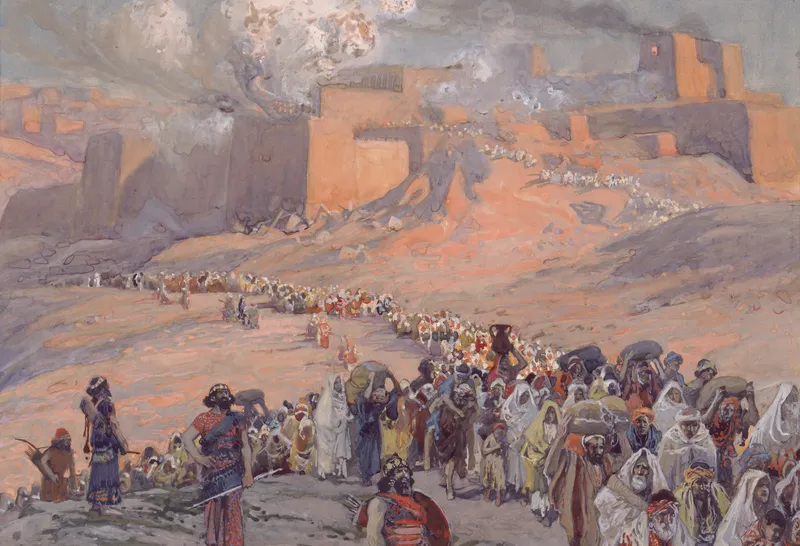
Jeremiah 52:24-30Carried Away Captive Out of His Own Land
24And the captain of the guard took Seraiah the chief priest, and Zephaniah the second priest, and the three keepers of the door: 25He took also out of the city an eunuch, which had the charge of the men of war; and seven men of them that were near the king’s person, which were found in the city; and the principal scribe of the host, who mustered the people of the land; and threescore men of the people of the land, that were found in the midst of the city. 26So Nebuzaradan the captain of the guard took them, and brought them to the king of Babylon to Riblah. 27And the king of Babylon smote them, and put them to death in Riblah in the land of Hamath. Thus Judah was carried away captive out of his own land. 28This is the people whom Nebuchadrezzar carried away captive: in the seventh year three thousand Jews and three and twenty: 29In the eighteenth year of Nebuchadrezzar he carried away captive from Jerusalem eight hundred thirty and two persons: 30In the three and twentieth year of Nebuchadrezzar Nebuzaradan the captain of the guard carried away captive of the Jews seven hundred forty and five persons: all the persons were four thousand and six hundred.
The chronicle now turns from buildings to men, and specifically to the leadership of the nation. The captain of the guard took Seraiah the chief priest, and Zephaniah the second priest, and the three keepers of the door (v. 24), along with a senior military officer, seven royal counsellors, the chief recruiting scribe, and sixty ordinary men of the land (v. 25). These are the heads of every order that had governed Judah - the priesthood, the army, the court, the administration.
They are taken to Riblah, to Nebuchadrezzar, and there the king of Babylon smote them, and put them to death (vv. 26-27). It is the deliberate decapitation of a society: the men who led the institutions are killed, and the institutions die with them. Among the executed is Seraiah the chief priest, the very office that stood between the people and God in the temple now gone. The priesthood that had grown corrupt, the court that had refused the prophet's counsel, the leaders who had told the people peace, peace; when there is no peace (Jer. 6:14) - all are gathered up and brought to account.
The judgment falls heaviest on those who had the most responsibility and the most light, and used neither.
The section ends on a clause of stark finality and then a column of numbers: Thus Judah was carried away captive out of his own land (v. 27), followed by a careful tally of the deportations - three thousand Jews and three and twenty… eight hundred thirty and two persons… seven hundred forty and five persons: all the persons were four thousand and six hundred (vv. 28-30). At first the numbers seem strangely small for the destruction of a nation, and they likely count only certain groups of leading captives across several waves rather than the whole population.
But the smallness is part of the point. The chronicler is not estimating; he is counting - person by person, year by year, as carefully as a man counts what he has lost. It is the same grieving exactness with which he counted the broken pillars. And the flat sentence that introduces the tally - Thus Judah was carried away captive out of his own land - is the saddest line in the book. The people promised this land as an inheritance, the people who had clung to it as proof of God's favor while abandoning the God who gave it, are marched out of it.
The land itself, the prophets had said, would at last keep its sabbaths in their absence (2 Chr. 36:21). Yet even this is not a sentence without end: Jeremiah himself had set a term on it - seventy years (Jer. 25:11) - and a counted exile, unlike an endless one, is an exile with a far edge.
Jeremiah 52:31-34He Did Eat Bread Before Him Continually
31And it came to pass in the seven and thirtieth year of the captivity of Jehoiachin king of Judah, in the twelfth month, in the five and twentieth day of the month, that Evilmerodach king of Babylon in the first year of his reign lifted up the head of Jehoiachin king of Judah, and brought him forth out of prison, 32And spake kindly unto him, and set his throne above the throne of the kings that were with him in Babylon, 33And changed his prison garments: and he did continually eat bread before him all the days of his life. 34And for his diet, there was a continual diet given him of the king of Babylon, every day a portion until the day of his death, all the days of his life.
After thirty-three verses of unrelieved ruin, the book turns - and the turn is so quiet it can be missed. And it came to pass in the seven and thirtieth year of the captivity of Jehoiachin king of Judah… that Evil-merodach king of Babylon… lifted up the head of Jehoiachin king of Judah, and brought him forth out of prison (v. 31). Jehoiachin is the other king of Judah in this story - the young king carried to Babylon eleven years before Jerusalem fell, who had spent thirty-seven years in a Babylonian cell.
He is the one through whom David's royal line ran; with Jerusalem burned and Zedekiah blinded and dead in prison, he was, humanly speaking, the last flicker of the dynasty - and that flicker was locked in a foreign jail. Then a new king of Babylon comes to the throne, and his first recorded act is to lift up the head of this forgotten prisoner and bring him out. The chronicler dates it precisely, as he has dated every disaster, because this small mercy is as much a fact of history as the fall itself.
The God who watched over His word to perform every judgment also watched over a promise no one could now see: that David shall never want a man to sit upon the throne of the house of Israel (Jer. 33:17). On the very last page of the book of judgment, that promise is kept alive by a prison door swinging open.
What is done for Jehoiachin is described with deliberate tenderness, each phrase a reversal of his long humiliation. Evil-merodach spake kindly unto him - literally spoke good things to him, the first kind words the chronicle records in the whole chapter - and set his throne above the throne of the kings that were with him in Babylon (v. 32). The prisoner is given a throne, and not merely a throne but the highest seat among all the captive kings in Babylon.
And changed his prison garments (v. 33): the rags of thirty-seven years are stripped away and royal clothing put on. The transformation is complete and it is all gift - Jehoiachin does nothing to earn it; he is simply lifted, spoken to, seated, reclothed. It is hard to read the sequence - raised from prison, given a place of honor, the old garments exchanged - without hearing the deep pattern of grace that runs through all of Scripture: the lowly lifted, the shamed honored, the filthy garments removed and rich robes given (Zech. 3:4; Luke 15:22).
A king who had nothing but a cell and prison clothes is given a seat and a robe by the hand of another. The chapter does not say he deserved it. That is precisely what makes it grace.
And then the book of Jeremiah - forty years of thundering judgment, fifty-one chapters of warning and woe - comes to rest on the gentlest image imaginable: a man eating at a table. He did continually eat bread before him all the days of his life. And for his diet, there was a continual diet given him of the king of Babylon, every day a portion until the day of his death, all the days of his life (vv. 33-34).
The repetition is the point: continually… all the days of his life… every day a portion… all the days of his life. This is not a single act of mercy but a settled, permanent provision - a place at the king's table secured for the rest of his days. Remember where this book's last movement began: in a besieged city where there was no bread (v. 6). It ends with a son of David given bread at a king's table, continually, to the end of his life.
The exact word of the hunger is answered by the exact word of the grace. The chronicler closes not with the smoke of the temple or the column of captives, but here - at a table, with a pardoned king being fed. It is a small light. It is not a homecoming; the throne is still in ruins and the people still in exile. But it is a true light, and a deliberate one: the line of David is alive, fed, and seated, and the long night ends with the faintest hint of dawn.
Research trail
Sources & further study
These references support the historical, linguistic, manuscript, and contextual notes in this chapter. Scripture remains the primary text; external sources are provided so readers can inspect the research directly.
- Jeremiah 52 - Translators' NotesThe NET Bible's detailed footnotes on Jeremiah 52 - the chronology of the siege (vv. 4-7), the inventory of the temple bronze carried to Babylon (vv. 17-23), the list of officials executed at Riblah (vv. 24-27), and the closing release of Jehoiachin under Evil-merodach (vv. 31-34).
- Jeremiah 52 · Hebrew + classical Jewish commentaryThe Hebrew text of Jeremiah 52 with Rashi, Radak, and other classical commentators side by side - useful for the idiom nasa rosh (v. 31, “lifted up the head,” the language of release and restored favor) and for the picture of table-fellowship in verse 33, where the pardoned king eats bread before his lord continually.
- Jeremiah 52 ↔ 2 Kings 24-25 · Matthew 1 · 2 Samuel 9Traces the threads tying Jeremiah 52 to its parallel in 2 Kings 24-25, to the genealogy where Jehoiachin (Jeconiah) stands in the line of Christ (Matt. 1:11-12), and to the table-fellowship of the pardoned - Mephibosheth seated to eat at David's table (2 Sam. 9:7) and the redeemed at the King's table (Luke 22:30).
Where this echoes in Scripture
The City Was Broken Up
- 2 Kings 25:1-7And the city was broken up... Then they put out the eyes of Zedekiah, and bound him with fetters of brass, and carried him to Babylon.The parallel account of the same fall - verses 4-11 told again at the close of Kings.
- Jeremiah 1:12Thou hast well seen: for I will hasten my word to perform it.The promise this chapter fulfills - God watching over His word until it comes to pass (v. 7).
- Ezekiel 12:13I will bring him to Babylon... yet shall he not see it, though he shall die there.The riddle of Zedekiah's blinding foretold - carried to Babylon, but never seeing it (vv. 10-11).
- Jeremiah 38:17-18If thou wilt assuredly go forth unto the king of Babylon’s princes, then thy soul shall live... but if thou wilt not go forth... this city shall be... burned with fire.The choice Zedekiah was offered and refused - surrender for life, played out in his flight and capture (vv. 7-9).
- Matthew 24:35Heaven and earth shall pass away, but my words shall not pass away.The certainty proved here - that what God speaks comes to pass to the letter.
The House of the LORD Burned
- 1 Kings 7:15-22For he cast two pillars of brass... And he set up the pillars in the porch of the temple... and he called the name of that on the right hand Jachin, and... the left Boaz.The making of the bronze pillars whose breaking is inventoried in verses 17-23 - Solomon's glory, now scrap.
- 2 Kings 25:8-17he burnt the house of the LORD, and the king’s house... The two pillars, one sea, and the bases which Solomon had made for the house of the LORD; the brass of all these vessels was without weight.The parallel account of the burning and the carried-off bronze - verses 12-23 retold.
- John 2:19-21Destroy this temple, and in three days I will raise it up... he spake of the temple of his body.The temple that, torn down, would rise - set against the house burned in verse 13.
- 1 Peter 2:5Ye also, as lively stones, are built up a spiritual house, an holy priesthood.The dwelling fire cannot reach - God's house rebuilt in His people after the house of verse 13 is gone.
- Revelation 21:22And I saw no temple therein: for the Lord God Almighty and the Lamb are the temple of it.The end of the trajectory begun in verse 13 - a city whose temple is God Himself.
Carried Away Captive Out of His Own Land
- 2 Kings 25:18-21the captain of the guard took Seraiah the chief priest... and the king of Babylon smote them... So Judah was carried away out of their land.The parallel account of the officials executed at Riblah - verses 24-27 retold.
- 2 Chronicles 36:21until the land had enjoyed her sabbaths: for as long as she lay desolate she kept sabbath, to fulfil threescore and ten years.The meaning the chronicler gives the emptied land - the carried-away captivity of verses 27-30 as the land's long-owed rest.
- Jeremiah 29:10-14After seventy years be accomplished at Babylon I will visit you... and I will bring you again into the place whence I caused you to be carried away captive.The far edge of the exile of verses 27-30 - a counted captivity with a promised return.
- Matthew 4:16The people which sat in darkness saw great light; and to them which sat in the region and shadow of death light is sprung up.The light sent to the exiled and dark - the homecoming that answers the carrying-away of verse 27.
- Luke 4:18he hath sent me... to preach deliverance to the captives... to set at liberty them that are bruised.The mission to captives - God's final answer to a people carried away (vv. 27-30).
He Did Eat Bread Before Him Continually
- 2 Kings 25:27-30Evil-merodach king of Babylon... did lift up the head of Jehoiachin king of Judah out of prison... and he did eat bread continually before him all the days of his life.The parallel close of Kings - the same release and table-fellowship that ends Jeremiah (vv. 31-34).
- Matthew 1:11-12Josias begat Jechonias and his brethren, about the time they were carried away to Babylon... Jechonias begat Salathiel.Jehoiachin (Jechonias) in the line of Christ - the preserved dynasty of verse 31 running down to Jesus.
- 2 Samuel 9:7thou shalt eat bread at my table continually.David seating the crippled heir of a fallen house - the table-fellowship of the pardoned that verse 33 echoes.
- Ephesians 2:6And hath raised us up together, and made us sit together in heavenly places in Christ Jesus.The lifting and seating of the lowly - the gospel pattern Jehoiachin's release pictures (vv. 31-32).
- Luke 22:30That ye may eat and drink at my table in my kingdom.The King's table held out to His own - the bread continually before the king of verse 33 brought to its fullness.