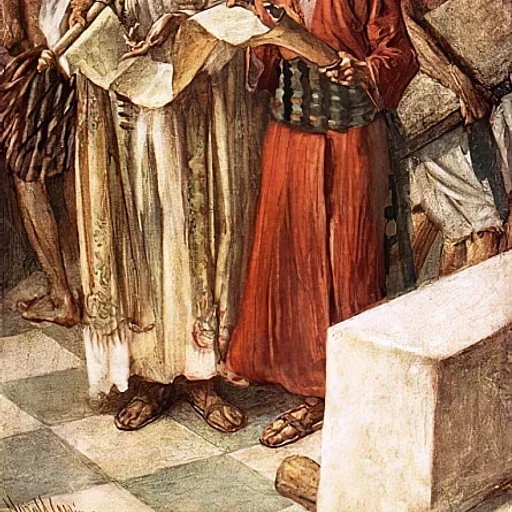
Who was Jeremiah in the Bible?
Jeremiah was a prophet who warned Jerusalem to turn back to God before it was destroyed.
Prophet of the exile
c. 627-580 BC
Jeremiah was a prophet who warned Jerusalem to turn back to God before it was destroyed.
Follow the reading trailBEYOND THE NAME
Jeremiah prophesied through the last decades of Judah, calling kings and people to repentance as Babylon’s shadow grew. He wept over the coming destruction, suffered rejection and imprisonment for his message, and saw Jerusalem fall just as he had warned; the opening of First Esdras recalls his word standing over Josiah’s era and the nation’s decline.
Themes in the authored commentary
These are other entries using this name. Compare their source passages before treating them as the same or different historical people.
These entries connect the study to the source’s recorded family context. Read their cautions when the family records or identifications differ.
FOLLOW THE PASSAGES
These are chapter studies associated with this record. Their order follows the books and chapters, rather than a reconstructed timeline of the person’s life.
prophet who laments the death of Josiah in a written lamentation
Josiah throws the greatest Passover since Samuel, and he pays for it himself. These were of the king’s substance (v. 7): thirty thousand lambs out of his own flocks, so no family in Jerusalem is shut out of the feast. He sets the priests in their courses, returns the ark to Solomon’s temple, gets the singers singing and the gatekeepers at their posts. For one shining week the nation worships the way it was always meant to.
Chapter overview from the authored study guide.proclaims the covenant and discovers a plot against his life by men of Anathoth
Jeremiah 11 returns to the foundation under everything else the prophet says: the covenant. The LORD sends him to repeat its terms in the streets of Jerusalem and the cities of Judah - the agreement made at Sinai by which Israel became God’s people and He became their God. Obey my voice, and do them… so shall ye be my people, and I will be your God (v. 4). It was never a cold contract; it was the bond that held a whole relationship together. Jeremiah is sent to pronounce the curse written into it long ago: Cursed be the man that obeyeth not the words of this covenant (v. 3).
Chapter overview from the authored study guide.tells Zedekiah that Babylon will take the city and survival means surrendering
The chapter opens in a moment of real terror. Nebuchadrezzar’s army is at the wall, the siege of Jerusalem has begun, and king Zedekiah sends two men - the priest Pashur and the priest Zephaniah - to the prophet with a request that is half plea and half hope: Enquire, I pray thee, of the LORD for us… if so be that the LORD will deal with us according to all his wondrous works, that he may go up from us (vv. 1-2). The king remembers the old stories - the night the Assyrian host melted away from these same walls in Hezekiah’s day - and he wants one more rescue like that. But Jeremiah’s reply turns every hope on its head.
Chapter overview from the authored study guide.purchases a field from his cousin Hanameel as a sign that normal life will resume in the land
The setting of Jeremiah 32 is almost unbearable. The army of Babylon has thrown its siege-works against Jerusalem; the city is starving; and the prophet himself is shut up in the court of the prison (v. 2), jailed by King Zedekiah for refusing to stop saying the city would fall. Into that moment - when every visible sign points to collapse - the LORD gives Jeremiah a strange instruction: buy a field. Not just any field, but family land at Anathoth, the priests’ town in Benjamin, ground about to be trampled by the invading army. His cousin Hanameel arrives with the offer exactly as God had said he would, and Jeremiah knows the word is real.
Chapter overview from the authored study guide.taken forcibly to Egypt, where he continues to prophesy judgment through symbolic acts
Jeremiah 43 opens on the heel of a broken oath. In the chapter before, the frightened survivors left in the land after Jerusalem’s fall had come to Jeremiah and pleaded with him to pray for direction, vowing, Whether it be good, or whether it be evil, we will obey the voice of the LORD our God (42:6). They waited ten days. The answer came, and it was clear: remain in the land and do not be afraid of the king of Babylon, for the LORD would build them and not pull them down - but if they set their faces to go into Egypt, the sword and famine they dreaded would overtake them there.
Chapter overview from the authored study guide.prophet listed among those Israel killed and whose message was spurned
God addresses His people through Ezra the scribe, and the words are stern. He had brought Israel out of Egypt with power, sustained them in the wilderness, given them prophets generation after generation. Yet they refused to listen. They despised the law He gave them. Now God announces a judgment that cuts deep: He will take His vineyard away from them and plant it with a people that will know Him.
Chapter overview from the authored study guide.THE PEOPLE AROUND THE PERSON
Recorded parents
Relationships follow the source graph. Some are interpretive or uncertain, and individual verse citations are not yet available for every connection.
STUDY & INTERPRETATION
Jeremiah was given the hardest of callings: to speak truth to a people who would not listen, and to grieve the ruin he could not stop. His life embodied the sorrow of God over a covenant broken again and again, yet his message was not only judgment. Through him the LORD promised a new covenant written on the heart, a day when sins would be remembered no more and every person would know God directly. That promise reaches its fullness in Christ, who at the last supper named the cup the new covenant in His blood, fulfilling the hope a weeping prophet held in the dark.
From the Learn of Christ person commentary. Read alongside the linked Scripture passages.KEEP SCRIPTURE CLOSE
54 authored chapter guides feature this person. This is guide coverage, not an exhaustive count of biblical mentions.
ASK A BETTER QUESTION
Identity, story, early-life sources, family, and where to read.
Names and spellings in the source: Jeremiah · Jeremias
Jeremiah was a prophet who warned Jerusalem to turn back to God before it was destroyed.
Jeremiah prophesied through the last decades of Judah, calling kings and people to repentance as Babylon’s shadow grew. He wept over the coming destruction, suffered rejection and imprisonment for his message, and saw Jerusalem fall just as he had warned; the opening of First Esdras recalls his word standing over Josiah’s era and the nation’s decline.
The individualized passage index associates this Jeremiah record with 2 Chronicles, Ezra, Jeremiah, Daniel, Matthew. There are 122 distinct indexed verse references in the 66-book Bible. Browse the book-by-book list below; it separates this identity from other people who share the name. Source assignments and textual identifications can require interpretation.
A separate childhood account for Jeremiah is not provided in our current authored profile sources. Begin with 2 Chronicles 35:25 and the passages linked here for the evidence that is available. The first indexed reference to a name is not a birth record. This profile does not establish a birth date, schooling, or childhood events beyond what its sources state.
Jeremiah’s source record lists Hilkiah (father). These are source-graph relationships; legal family, uncertain identifications, and ancestral language require the cautions below. Individual verse evidence is not yet retained for every family edge.
Jeremiah was given the hardest of callings: to speak truth to a people who would not listen, and to grieve the ruin he could not stop. His life embodied the sorrow of God over a covenant broken again and again, yet his message was not only judgment.
Answers draw on our existing authored biography and linked chapter studies. Where supplied, verse assignments come from the individualized STEP Bible index. Childhood answers distinguish documented events from gaps in the available sources.
FIND THE PERSON IN THE TEXT
122 distinct verse references in the source’s 66-book index. These are indexed name assignments, rather than every indirect allusion to this person. A name may also refer to descendants, a tribe, or a nation; read each passage to distinguish that usage from the individual.
“And Jeremiah lamented for Josiah: and all the singing men and the singing women spake of Josiah in their lamentations to this day, and made them an ordinance in Israel: and, behold, they are written in the lamentations.”
2 Chronicles 35:25 · King James Version
“The word that came to Jeremiah from the LORD in the tenth year of Zedekiah king of Judah, which was the eighteenth year of Nebuchadrezzar.”
Jeremiah 32:1 · King James Version
“And Ebedmelech the Ethiopian said unto Jeremiah, Put now these old cast clouts and rotten rags under thine armholes under the cords. And Jeremiah did so.”
Jeremiah 38:12 · King James Version
“And they said, Some say that thou art John the Baptist: some, Elias; and others, Jeremias, or one of the prophets.”
Matthew 16:14 · King James Version
References are adapted from STEP Bible / Tyndale House TIPNR (CC BY 4.0). Deduplicated, matched to this identity, and checked against the bundled KJV’s verse bounds. Interpretive assignments and translation/versification differences may remain. This index is separate from evidence for individual family relationships.
YOUR OWN OBSERVATIONS
Notes, saved people, and study marks stay in this browser. They do not sync to your account.
KEEP EXPLORING
People featured in the same study guides. Sharing a chapter does not establish a family relationship.