Ezra 1
People in this chapter
The book of Ezra opens in the first year of Cyrus king of Persia - a pagan emperor who has just swallowed Babylon and inherited the largest empire the world had yet seen. And before a single Israelite voice is heard, it is Cyrus who speaks. We are told why: the LORD stirred up the spirit of Cyrus king of Persia. The first cause of everything that follows is not Persian policy or political calculation but the hidden hand of God moving in the heart of a man who did not know Him.
The king makes a proclamation that will reverse the great tragedy of the age: the exiles may return, the holy city may rise again, and the house of the LORD may be rebuilt.1
Tap any highlighted phrase to jump to the commentary that unpacks it.
Ezra 1:1-2The LORD Stirs the Spirit of a King
1Now in the first year of Cyrus king of Persia, that the word of the LORD by the mouth of Jeremiah might be fulfilled, the LORD stirred up the spirit of Cyrus king of Persia, that he made a proclamation throughout all his kingdom, and put it also in writing, saying, 2Thus saith Cyrus king of Persia, The LORD God of heaven hath given me all the kingdoms of the earth; and he hath charged me to build him an house at Jerusalem, which is in Judah.
The very first thing the book tells us about Cyrus's decree is its deepest cause: it happened that the word of the LORD by the mouth of Jeremiah might be fulfilled. Decades earlier, in the darkest hour of the nation, Jeremiah had spoken an astonishing word - that the captivity in Babylon would last seventy years, and then end: After seventy years be accomplished at Babylon I will visit you, and perform my good word toward you, in causing you to return to this place (Jer. 29:10).2 To the exiles weeping by the rivers of Babylon, with the temple in ashes and the throne of David empty, that promise must have seemed impossibly remote.
Who would ever let them go? And yet here, on schedule, to the very turning of the years, the word comes true. The chapter opens by insisting that what follows is the keeping of a promise. The God who spoke through Jeremiah is the God who now moves Cyrus, and His word has not fallen to the ground.
Notice exactly what Cyrus says: it is the LORD God of heaven - the God of Israel - who has given me all the kingdoms of the earth, and who hath charged me to build him an house at Jerusalem. Whether the king grasped the full identity of the One he names, or was simply acknowledging the deity of a conquered people in the manner of an enlightened Persian policy, his words are remarkable on any reading.3 A pagan emperor speaks the language of divine commission: God Himself has charged him with a task, and the task is to rebuild the house of the LORD.
The greatest power on earth describes itself, without embarrassment, as an instrument in the hand of the God of a small and broken people. The empire that conquers Babylon turns out to be serving a purpose older and higher than its own - the restoration of a sanctuary in Judah it could easily have ignored.
Ezra 1:3-4The Open Summons Home
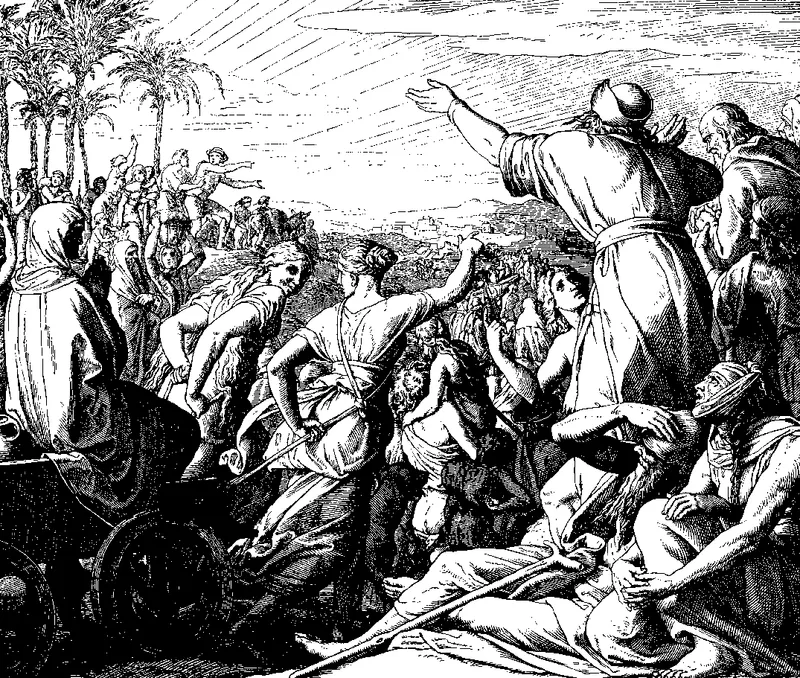
3Who is there among you of all his people? his God be with him, and let him go up to Jerusalem, which is in Judah, and build the house of the LORD God of Israel, (he is the God,) which is in Jerusalem. 4And whosoever remaineth in any place where he sojourneth, let the men of his place help him with silver, and with gold, and with goods, and with beasts, beside the freewill offering for the house of God that is in Jerusalem.
The decree does not conscript; it invites. Who is there among you of all his people? his God be with him, and let him go up to Jerusalem. The door is thrown open to whoever has the heart to walk through it - no quota, no compulsion, no selection of the worthy. The phrase let him go up is the ancient pilgrim language of Scripture; one always goes up to Jerusalem, for the city sits high in the Judean hills, and to ascend to it is to ascend toward the house of God.
After seventy years in a foreign land, the summons is not merely to relocate but to come home to the place where God had set His name. And the blessing tucked into the invitation - his God be with him - is the very thing the exiles had feared was lost: that the LORD would go up with them, that the journey home was His doing and under His care.
The decree does more than permit the return; it mobilizes the whole community behind it. Those who stay are charged to help those who go - to send them out provisioned with silver, and with gold, and with goods, and with beasts, and over and above all that, with the freewill offering for the house of God. The going and the staying are bound together in one work. Not everyone will make the long and dangerous journey; but everyone is to have a hand in it, strengthening the goers with what they need for the road and for the rebuilding.
There is a quiet echo here of an older deliverance: when Israel came out of Egypt, the people were sent away laden with the silver and gold of their neighbors (Exod. 12:35-36). Once again a captive people is released laden with gifts, sent toward the house of God with the resources to restore it.
Ezra 1:5-6Those Whose Spirit God Raised
5Then rose up the chief of the fathers of Judah and Benjamin, and the priests, and the Levites, with all them whose spirit God had raised, to go up to build the house of the LORD which is in Jerusalem. 6And all they that were about them strengthened their hands with vessels of silver, with gold, with goods, and with beasts, and with precious things, beside all that was willingly offered.
The response to the decree is described with the same verb that began it. The leaders rise - the chief of the fathers of Judah and Benjamin, and the priests, and the Levites - but the text reaches past rank to name the true company of the returning: all them whose spirit God had raised. These were those in whom God had awakened a willingness to go. The echo of verse 1 is unmistakable and deliberate: God stirred the spirit of Cyrus, and now God has raised the spirit of His people - the very same Hebrew word, the very same hidden hand.
The miracle of the homecoming is double. It is not only that God moved a pagan king to open the door; it is that God moved ordinary men and women to walk through it - to leave the security of a settled life in Babylon, where many had been born and had prospered, and undertake a long journey to a broken city to rebuild a sanctuary most of them had never seen. Such willingness does not arise on its own.
It, too, is the work of God awakening a sleeping heart.
Just as the decree had charged, those who remained strengthened their hands - the goers are sent out laden with vessels of silver, with gold, with goods, and with beasts, and with precious things, beside all that was willingly offered. The phrase strengthened their hands is worth holding onto: it is the language of making someone strong enough for a task they could not manage alone. The returning remnant was small, and the work ahead was enormous; left to their own resources they would have been overwhelmed before they began.
So the community closes around them. Those who stayed gave until the hands of the goers were strong. And the giving is repeatedly marked as willing - an offering poured out gladly, the response of hearts that God had also touched. A whole people, going and staying alike, is being knit into a single act of restoration. No one rebuilds the house of God alone.
Ezra 1:7-11The Vessels Brought Forth and Numbered
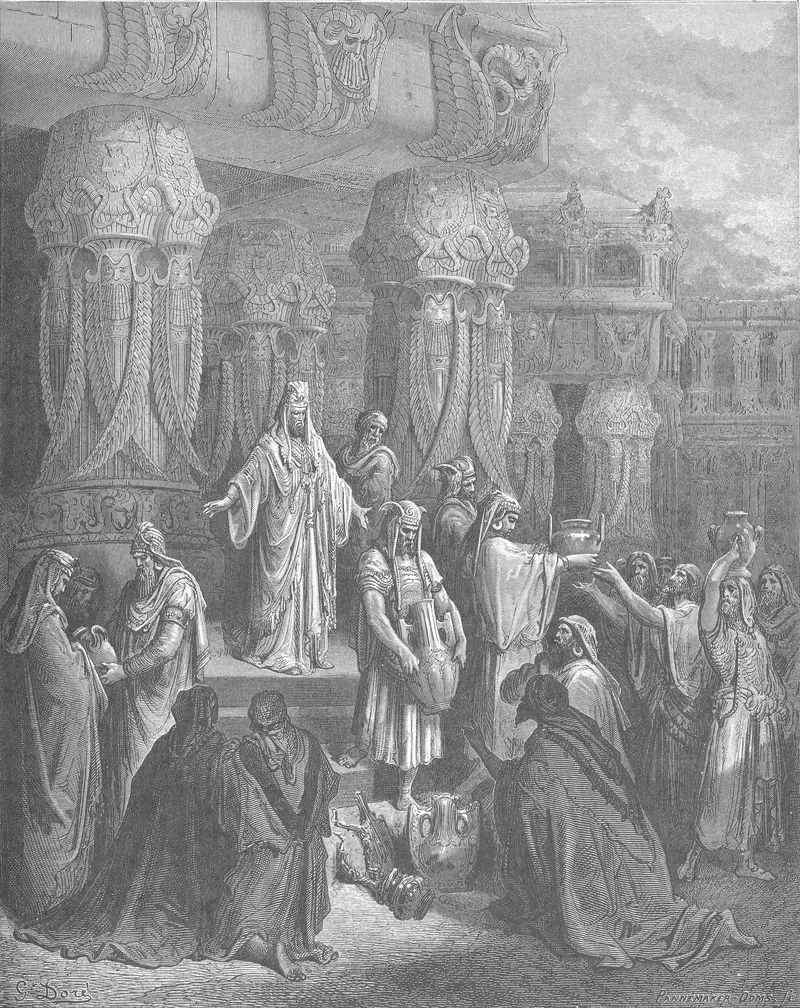
7Also Cyrus the king brought forth the vessels of the house of the LORD, which Nebuchadnezzar had brought forth out of Jerusalem, and had put them in the house of his gods; 8Even those did Cyrus king of Persia bring forth by the hand of Mithredath the treasurer, and numbered them unto Sheshbazzar, the prince of Judah. 9And this is the number of them: thirty chargers of gold, a thousand chargers of silver, nine and twenty knives, 10Thirty basons of gold, silver basons of a second sort four hundred and ten, and other vessels a thousand. 11All the vessels of gold and of silver were five thousand and four hundred. All these did Sheshbazzar bring up with them of the captivity that were brought up from Babylon unto Jerusalem.
The chapter ends where the tragedy had once ended - with the vessels of the temple. When Nebuchadnezzar destroyed Jerusalem, he stripped the house of the LORD of its sacred furnishings and carried them to Babylon, where he put them in the house of his gods. That was the whole meaning of the act: the holy instruments of Israel's worship, displayed as trophies in a pagan temple, a public declaration that Babylon's gods had defeated the God of Judah.
For seventy years the vessels sat there, mute witnesses to a conquest. And now Cyrus brought forth the vessels of the house of the LORD - he does not keep them, does not melt them down, does not leave them among the spoils. He brings them out of the house of false gods and gives them back, to be carried home and set once more to their proper use.1 What had been taken as a sign of God's defeat is restored as a sign of His faithfulness.
The desecration is undone.
The vessels are counted out with care, numbered - counted out, piece by piece, by the hand of Mithredath the treasurer and entrusted to Sheshbazzar, the prince of Judah. The text then gives the full inventory, item by item, down to the grand total: five thousand and four hundred.1 Why does Scripture pause to record an accountant's ledger? Because the precision is itself the point. What was plundered is restored in full and to the count; nothing is quietly skimmed, nothing forgotten, nothing left behind.
The God who allowed the vessels to be carried away in judgment has not lost track of a single one of them through seventy years in a foreign land. And the restoration is orderly and accountable, placed into named hands - a treasurer who counts, a prince who receives. This is how God restores: completely and carefully, every lost thing numbered and brought home.
Research trail
Sources & further study
These references support the historical, linguistic, manuscript, and contextual notes in this chapter. Scripture remains the primary text; external sources are provided so readers can inspect the research directly.
- Ezra 1 - Translators' NotesThe NET Bible's detailed footnotes on Ezra 1 - the force of the LORD “stirring up” Cyrus's spirit, the wording of the royal proclamation, the identity of Sheshbazzar the prince of Judah, and the difficult vessel-counts in verses 9-11.
- Ezra 1 ↔ Jeremiah 29 · Isaiah 61 · Luke 4Traces the threads tying the decree of Cyrus back to Jeremiah's seventy-year word (Jer. 29:10) and forward to the release of the captives the Anointed One proclaims - to proclaim liberty to the captives (Isa. 61:1), read by the Lord Jesus over Himself in Luke 4:18.
- The Cyrus CylinderA clay cylinder from Babylon, c. 539 BC, on which Cyrus records his policy of returning captive peoples to their homelands and restoring their sanctuaries - an extra-biblical witness to the very kind of decree Ezra 1 describes, in which a Persian king credits a god with charging him to rebuild a temple.
- Ezra 1 · Hebrew + classical Jewish commentaryThe Hebrew text of Ezra 1 with Rashi, Ibn Ezra, and other classical commentators side by side - useful for the verb he'ir / uwr (the LORD “stirred up” the spirit of Cyrus in v. 1 and “raised” the spirit of the people in v. 5), and for the meticulous inventory of the temple vessels in verses 9-11.
Where this echoes in Scripture
The LORD Stirs the Spirit of a King
- Proverbs 21:1The king's heart is in the hand of the LORD, as the rivers of water: he turneth it whithersoever he will.The truth underneath Cyrus's decree - even an emperor's heart is turned wherever God directs it.
- Jeremiah 29:10After seventy years be accomplished at Babylon I will visit you, and perform my good word toward you, in causing you to return to this place.The word being fulfilled in verse 1 - the seventy-year promise that the captivity would end on schedule.
- Isaiah 44:28That saith of Cyrus, He is my shepherd, and shall perform all my pleasure: even saying to Jerusalem, Thou shalt be built.Cyrus named more than a century before he reigned - the foreign king appointed to order Jerusalem rebuilt.
- Acts 4:28For to do whatsoever thy hand and thy counsel determined before to be done.The same sovereignty over rulers who do not know God - their decisions folded into His settled purpose.
The Open Summons Home
- Isaiah 61:1The LORD hath anointed me… to proclaim liberty to the captives, and the opening of the prison to them that are bound.The greater release the decree foreshadows - the liberty the Anointed One comes to proclaim.
- Luke 4:18He hath anointed me… to preach deliverance to the captives… to set at liberty them that are bruised.The Lord Jesus reading Isaiah's promise of liberty over Himself - the captives' release fulfilled in Him.
- Exodus 12:35-36And they… borrowed of the Egyptians jewels of silver, and jewels of gold… And they spoiled the Egyptians.The older deliverance echoed here - a freed people sent out laden with silver and gold, not empty-handed.
- Matthew 11:28Come unto me, all ye that labour and are heavy laden, and I will give you rest.The open summons widened to all the earth - the same “whoever will” that Cyrus's decree extended to the exiles.
Those Whose Spirit God Raised
- Philippians 2:13For it is God which worketh in you both to will and to do of his good pleasure.The willingness of those who rose up - the desire itself worked in them by God, as in every willing heart.
- John 6:44No man can come to me, except the Father which hath sent me draw him.The same awakening - the spirit roused and drawn toward God by grace, awakening a willing one.
- Haggai 1:14And the LORD stirred up the spirit of Zerubbabel… and the spirit of all the remnant of the people; and they came and did work.The same verb again, later in the rebuilding - God stirring the remnant's spirit to take up the work of His house.
- Ezra 7:27Blessed be the LORD God of our fathers, which hath put such a thing as this in the king's heart.Ezra's own praise for the same providence - God placing His purposes within the hearts He moves.
The Vessels Brought Forth and Numbered
- John 2:19Destroy this temple, and in three days I will raise it up… he spake of the temple of his body.The true temple the rebuilt house foreshadows - the dwelling of God that, once raised, can never be cast down.
- 2 Chronicles 36:7Nebuchadnezzar also carried of the vessels of the house of the LORD to Babylon, and put them in his temple at Babylon.The plundering now reversed - the very vessels Cyrus brings forth and numbers home in this chapter.
- Jeremiah 27:22They shall be carried to Babylon… until the day that I visit them… and bring them up, and restore them to this place.The promise about the vessels themselves - carried off, but sworn to be brought up and restored, fulfilled here.
- 1 Peter 2:5Ye also, as lively stones, are built up a spiritual house, an holy priesthood.The restoration widened - the people gathered to Christ becoming themselves the house and temple of God.