- Starting price
- ~$17 paperback
- Free tier
- No
- Platforms
- Print · Kindle · Audiobook
- Developer
- Thomas Nelson
- Launched
- 2012
- Updated
- May 31, 2026
The verdict
Love Does has quietly become the book people hand to a friend who finds faith too heavy and too theoretical. It is short, warm, and built around one infectious idea - that love is a verb - told through stories that are almost too good to be true. It works beautifully as inspiration and stumbles only if you came looking for teaching.
Try Love Does ↗Opens bobgoff.com
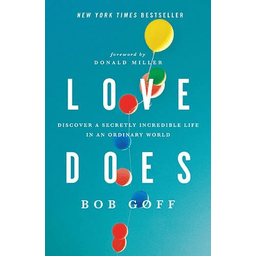
Love Does is not a theology book, and it never pretends to be. It is a collection of true stories - short, funny, occasionally jaw-dropping - strung together by a single conviction that Bob Goff repeats until it sticks: love is not a feeling you sit with, it is something you go and do. Goff is a lawyer, an honorary consul, the founder of a nonprofit working in conflict zones, and by his own account a man who has never met a whim he could resist. Each chapter is one of his escapades, and each lands on a small, plain point about following Jesus with your hands and feet instead of just your head.
It doesn’t try to be a systematic anything. It doesn’t try to walk you verse by verse through Scripture. It doesn’t try to talk you out of your doubts with an argument. Instead Goff tells you about the time he applied to law school by camping outside the dean’s office, or shipped his kids around the world to interview heads of state, or kept a sailboat in a parking lot for years, and then turns each of those stories - gently, almost offhandedly - into a nudge toward a more active, less anxious faith. By the end you have either fallen for the voice completely or grown a little restless waiting for him to slow down and dig deeper.
Released in 2012 by Thomas Nelson, Love Does became a runaway bestseller, crossing more than a million copies sold and spawning a study guide, a youth edition, and several follow-ups (Everybody Always, Dream Big, Live in Grace, Walk in Love). Goff also directed the proceeds of his writing and speaking toward the nonprofit work the stories describe, which is part of the book’s appeal - the author is visibly trying to live the thing he is selling. It remains the book people press into the hands of a friend who says faith feels too complicated, too gloomy, or too far from real life.
✓ The good
- Short and effortless to read - around 230 pages of brisk, conversational chapters you can finish on a single flight
- One genuinely sticky idea - "love does" reframes faith as action in a way readers remember long after the stories blur together
- The stories carry it - Goff is a natural storyteller, and the best chapters are funny, surprising, and hard to put down
- Disarming for skeptics and the faith-weary - it lands with people who find heavier Christian books gloomy, guilt-driven, or overly theoretical
- The author is visibly living it - Goff’s nonprofit work and his choice to channel proceeds toward it give the book a credibility most inspirational titles lack
- A mature ecosystem around it - a study guide, a youth edition, an audiobook Goff narrates himself, and free supplementary material make it easy to use in groups
- Relentlessly hopeful - where a lot of Christian-living writing leans on conviction or critique, Love Does runs on encouragement and possibility
✗ Watch out
- Light on theology and Scripture exposition - Goff references the Bible warmly but rarely works through a text; this is stories, not teaching
- The upbeat anecdotal style can feel thin - readers wanting substance sometimes finish a chapter unsure what they were meant to take from it
- Takeaways can feel simple - the lesson at the end of each story is often a single tidy line, and a few land closer to a greeting card than a sermon
- The stories can read as aspirational rather than attainable - not every reader has a sailboat, a law degree, or the means to fly around the world
- Loosely structured - it is a string of essays rather than a built argument, so it can feel like it never quite accumulates into a whole
- Not a discipleship roadmap - it inspires the impulse to act but leaves the "how, exactly" largely to the reader (yet)
Best for
- Readers who find most Christian books too heavy or too theoretical
- New or returning believers who need encouragement more than instruction
- Small groups and youth groups wanting a warm, low-barrier study
- Anyone in a season where faith feels stuck in their head instead of their hands
Avoid if
- You want careful Scripture exposition or verse-by-verse teaching
- You prefer a tightly argued book over a collection of stories
- You find relentlessly upbeat, anecdotal writing unsatisfying
- You are looking for a step-by-step plan for spiritual growth
What Love Does is
Love Does is a story-driven christian-living book by Bob Goff, published in 2012 by Thomas Nelson. It is built from short autobiographical chapters - most under ten pages - each recounting an episode from Goff’s unusually adventurous life and then drawing out a brief, practical point about living out faith through action rather than sentiment. The recurring thesis, captured in the title, is that genuine love expresses itself in what a person actually does, and that following Jesus is meant to be active, immediate, and a little reckless rather than cautious and abstract.
Goff is a lawyer who founded Love Does (formerly Restore International), a nonprofit operating in places like Uganda, Somalia, Iraq, and Nepal, and he has long directed proceeds from his books and speaking toward that work. That biographical thread runs underneath the writing and gives the stories their stakes - the book reads less like a set of lessons handed down and more like an invitation from someone who is plainly trying to live the idea himself. It has become a staple across a broad evangelical readership, popular in small groups, youth ministries, and with readers picking up their first Christian book in years.
Why readers keep handing Love Does to skeptical friends
A lot of Christian books assume the reader is already in. They open with doctrine, lean on insider vocabulary, and ask for conviction before they have earned attention. Love Does does the opposite. It opens with a story about a kid trying to get into law school by sheer stubbornness, and it keeps the reader laughing for several pages before the faith point arrives almost in passing. That low barrier to entry is the whole appeal. It is the book people give to a friend who finds church culture exhausting, because it never once feels like homework.
The other thing it does differently is sell action instead of guilt. Where some popular Christian writing motivates by sharpening the reader’s sense of where they fall short, Goff motivates by making the next loving thing sound like an adventure you would be foolish to miss. This sounds like a small distinction. In practice it changes who finishes the book. Readers who go numb under conviction-heavy writing often sail through Love Does and come out the other side wanting to do something - which, for a book whose entire argument is that love is a verb, is exactly the point.
The "love does" thesis: faith as a verb
The organizing idea of the book is right there in the title, and Goff returns to it from a dozen angles. His claim is that love, in the way Jesus talked about it, is not primarily an emotion you cultivate or a position you hold - it is a thing you do, repeatedly, often inconveniently, and usually before you feel ready. Whimsy is the word he reaches for most: the willingness to act on a good impulse immediately instead of studying it, scheduling it, or talking yourself out of it. Across the chapters this gets applied to forgiveness, to vocation, to parenting, to friendship, and to showing up for people in trouble.
The reason the thesis carries the book is that it is genuinely portable. A reader does not need Goff’s biography to apply it - the idea that the gap between what we say we believe and what we actually do is closed by action, not by more feeling or more thinking, lands on almost anyone. It is also where the book is most exposed. Because Goff makes the point through story rather than teaching, the thesis can feel underdeveloped to a reader who wants it grounded, qualified, and connected to a fuller picture of the Christian life. The simplicity is the appeal and the limitation at the same time.
Goff’s storytelling voice: the love-it-or-want-more factor
Love Does does not sound like a sermon or a study. It sounds like a charming, slightly unbelievable friend telling you about his week over coffee - digressive, warm, self-deprecating, prone to landing a serious point with a joke. The stories themselves do a lot of the work: there is the parking-lot sailboat, the kids interviewing world leaders, the office on the end of a pier, the law-school stakeout. Goff’s gift is making each escapade feel both extraordinary and like something the reader could plausibly imitate in their own smaller way, and his self-narrated audiobook leans into that intimacy even further.
That same voice is the source of the book’s main divide. The breeziness that makes it so easy to read is the breeziness that leaves some readers wanting more weight. The lesson at the end of a chapter is often a single sentence, and a reader looking for substance can finish feeling charmed but underfed. It is the kind of book that works best when met for what it is - encouragement and a nudge, delivered by a likable storyteller - rather than as a source of careful instruction. Readers who take it on those terms tend to love it; readers expecting depth tend to wish it slowed down.
The nonprofit backbone: a book trying to live its own idea
Behind the lighthearted tone is a real-world enterprise. Many of the stories trace back to the nonprofit Goff founded, which has pursued justice and education work in conflict-affected regions, and Goff has publicly directed proceeds from his writing toward that work. The book is, in a sense, evidence for its own thesis - the author is not theorizing about love-as-action from a desk, he is reporting from a life he has visibly arranged around it. For a genre full of titles that prescribe more than they practice, that gives Love Does an unusual credibility.
This backbone is also why the book has held its place rather than fading after its 2012 moment. The stories keep a foot in something larger than self-improvement, which gives the encouragement somewhere concrete to point. It does not make Love Does a manual for doing the work - the operational "how" is almost entirely absent, and a reader inspired to act is largely left to figure out their own next step. But it does keep the book from feeling like pure motivation, and it is a good part of why readers trust the voice telling them love is a verb.
Pricing
Paperback
~$17
The standard Thomas Nelson edition. What most readers end up with and what small groups buy in bulk.
Kindle
~$10
Full text, highlights and notes sync across devices. The cheapest way in if you already read on a phone or tablet, and it goes on sale regularly.
Audiobook
~$15
Around six hours, narrated by Goff himself. His delivery is a real draw - many readers say the stories land better in his own voice than on the page.
Study Guide / DVD
~$20+
A companion study guide and video sessions for small groups. The setup most leaders use to stretch the book across six to eight weeks.
Love Does for Kids
~$18
A youth-and-family adaptation co-written with Goff’s daughter, retelling the stories for younger readers. A separate purchase aimed at a different audience.
Love Does is inexpensive by any measure. The paperback runs around $17 new, often less used or in bulk for a group, and the Kindle edition is typically about ten dollars and goes on sale several times a year. For most readers, the paperback is the balanced default - cheap, durable, and easy to pass along once you are done.
The audiobook runs roughly $15 and clocks in around six hours, and it is one of the few cases where the audio edition is arguably the better one. Goff narrates it himself, and his conversational, slightly mischievous delivery suits material that already reads like a story told aloud. For readers who already have an audiobook credit, this is often the most rewarding way in.
For small groups, the picture is a little more involved than a single paperback. A companion study guide and a set of video sessions exist, and buying a stack of paperbacks plus the study materials typically runs somewhat higher than the book alone. Many leaders keep it simple, hand out the paperbacks, and lean on the discussion questions and freely available material rather than the full video kit.
There is also Love Does for Kids - a separate youth-and-family adaptation around $18 - for readers who want to share the idea with younger children. Most adult readers do not need it. The core paperback is the version nearly every quotation and study is keyed to, and the one to start with.
Where Love Does falls behind
Light Scripture work. Goff mentions the Bible warmly and often, but he almost never slows down to work through a passage the way a study Bible, a commentary, or a Bible Project video would. The book assumes you want a story and a takeaway, not analysis. Readers who want their reading anchored in close engagement with the text will need to pair it with something that does that work.
Thin theology. Because Love Does is built from anecdotes rather than teaching, the ideas stay at the surface. The thesis that love is a verb is true and useful, but the book rarely develops it, qualifies it, or situates it inside a larger account of the Christian life. That is the right call for what Goff set out to write. It does mean the book is a spark, not a curriculum, on the deeper questions of doctrine and discipleship.
Takeaways that can feel simple. The lesson at the close of a chapter is frequently a single tidy sentence, and a handful land closer to a greeting card than to a sermon. For readers who connect with Goff’s voice, the simplicity reads as clarity; for readers wanting more substance, a few of the points feel slighter than the story that delivered them.
Aspirational stakes. Many of the stories turn on resources, access, or sheer audacity - a sailboat, a law practice, the means to fly a family around the world - that the average reader does not share. Goff frames them as invitations rather than benchmarks, but a reader can still close the book feeling that the adventurous life it celebrates is easier to admire than to copy.
No real roadmap. The book is excellent at generating the impulse to act and weak on telling you what to actually do. The inspiration is genuine, but the "now what" gap is real, which is part of why the study guide and Goff’s follow-up books exist to carry the reader past the initial spark.
Love Does vs. Radical (Platt) vs. The Purpose Driven Life
These three get recommended to the same restless reader more often than you would expect, and all three try to move a comfortable Christian toward a more active, less passive faith. They go about it in almost opposite tones.
Different strengths. Love Does is the warmest and most story-driven - Goff motivates with delight and adventure, and he is happy to keep the theology light so the encouragement stays front and center. Radical, by David Platt, pushes a similar call toward action but with far more sustained argument, a sharp focus on money and global missions, and a willingness to make the reader uncomfortable that Goff deliberately avoids. The Purpose Driven Life, by Rick Warren, is a different category again: forty short chapters built as a forty-day journey, broader in audience and gentler in register, more concerned with helping a reader find their place than with sending them out the door on an adventure.
In practice, the choice comes down to what a reader needs. Love Does is the book for someone who finds faith too heavy and needs to be charmed back into motion. Radical is for someone ready to be challenged and argued with about how they spend their life. Purpose Driven Life is the one a church hands to every new attender looking for direction. Many readers, over a few years, end up reading more than one.
The bottom line
Love Does is the right book for a specific job. If you are a reader who finds most Christian books too heavy or too theoretical, or someone trying to coax a faith-weary friend back into motion, this is one of the most disarming and effective short books on the shelf - warm, funny, and built around an idea that sticks. If you came for careful Scripture exposition, developed theology, or a concrete plan for spiritual growth, you will want to pair it with something sturdier or look elsewhere. The voice and the stories are the whole product, and readers who take them for what they are tend to finish wanting to go do something - which is exactly what Goff was hoping.
Alternatives to Love Does
 Crazy LoveFrancis Chan’s short, confrontational call to abandon comfortable Christianity - same length and similar audience, far more urgent and convicting in tone.
 RadicalDavid Platt’s case for trading the American dream for a more demanding faith - a more structured, missions-focused argument than Goff’s breezy stories.
 The Purpose Driven LifeRick Warren’s forty-day journey toward finding your purpose - gentler and broader than Love Does, the book most churches give new attenders.
 Get Out of Your HeadJennie Allen’s practical guide to interrupting toxic thought spirals - more of a how-to where Love Does is pure inspiration.
Frequently asked questions
Is Love Does a theology book or a memoir?
Closer to a memoir. It is a collection of short, true stories from Bob Goff’s life, each ending in a brief point about living out faith through action. It references the Bible warmly but does not work through Scripture or teach doctrine in any systematic way. Read it as inspiration and encouragement rather than instruction.
What tradition is Bob Goff writing from?
Goff writes from a broadly evangelical perspective, and Love Does stays close to themes - love expressed in action, following Jesus with your whole life, generosity toward others - that readers across many denominations share. The book is light on doctrinal specifics, which is part of why it reaches such a wide audience.
Is Love Does good for a small group?
Yes. The chapters are short and self-contained, the tone is welcoming, and there is a companion study guide plus video sessions made for groups. It is a popular low-barrier pick for youth groups and for adult groups that want encouragement and discussion rather than a heavy study. The stories give people plenty to talk about.
Is the audiobook worth it?
For many readers, yes - arguably more than the print edition. Goff narrates it himself, and his conversational, slightly mischievous delivery suits material that already reads like a story told out loud. If you commute or prefer to listen, the roughly six-hour audiobook is a strong way to experience it.
What are the follow-up books to Love Does?
Goff went on to write Everybody Always (on loving difficult people), Dream Big (on pursuing ambitions), Live in Grace, Walk in Love, and other titles, along with devotionals. Everybody Always is the most natural next read if Love Does resonated, carrying the same voice into the harder territory of loving people who are tough to love.
Is there a version for kids?
Yes. Love Does for Kids is a youth-and-family adaptation, co-written with Goff’s daughter, that retells the stories for younger readers. It is a separate purchase from the main book and is aimed at families wanting to share the central idea with children.
Who should skip Love Does?
Readers who want careful, verse-by-verse Scripture teaching, developed theology, or a step-by-step plan for spiritual growth will likely find it too light. It is a book of stories and encouragement, not exposition or a roadmap. If that is what you are after, a study Bible or a more structured discipleship resource will serve you better.
Sources & further reading
More Christian Living Books
 The Prodigal GodTim Keller’s 130-page reading of Luke 15 has quietly become one of the most-gifted Christian books of the last twenty years - and the reason is the title itself.
 Practicing the WayComer’s 2024 follow-up to The Ruthless Elimination of Hurry has quietly become the default spiritual-formation book in a thousand small groups - and the reasons are worth unpacking.
 Walking with God Through Pain and SufferingTim Keller’s most comprehensive book on suffering - part survey of how every culture has tried to explain pain, part biblical theology, part field manual for the people actually walking through it.
 FerventThe prayer book that turned “strategic, specific prayer” into a fill-in-the-blank battle plan - and rode the War Room moment to the top of the bestseller lists.
 A Grace DisguisedJerry Sittser lost his mother, his wife, and his four-year-old daughter in a single car crash - and the book he wrote about it has quietly become the one grieving people press into each other’s hands, because it refuses to tell you how to get over your loss.
 The Ruthless Elimination of HurryJohn Mark Comer’s 2019 breakout - a pastor’s case that hurry is the great spiritual enemy of our age - has quietly become the go-to slow-down book for an exhausted generation of Christians. Here’s what it actually delivers, and where it doesn’t.