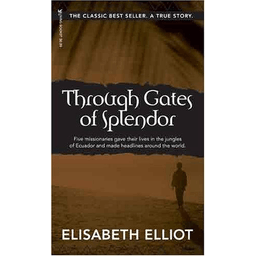
- Starting price
- ~$16 paperback
- Free tier
- No
- Platforms
- Print · Kindle · Audiobook
- Developer
- Tyndale House
- Launched
- 1957
- Updated
- May 31, 2026
The verdict
Through Gates of Splendor has quietly become the default missionary memoir of the twentieth century, and for good reason - it is short, it is built from the men’s own journals, and it is written by one of the women left behind. If you read one book about the cost and calling of missions, read this one.
Try Through Gates of Splendor ↗Opens tyndale.com
Through Gates of Splendor is Elisabeth Elliot’s account of five young American missionaries - her husband Jim Elliot, along with Nate Saint, Ed McCully, Pete Fleming, and Roger Youderian - who were killed in January 1956 while attempting to make peaceful contact with the Waorani, a remote people of the Ecuadorian rainforest then known to the outside world by the name “Auca.” The men had spent months flying over Waorani settlements, lowering gifts on a line from Nate Saint’s small plane, and learning a handful of phrases. When they finally landed on a sandbar they called “Palm Beach” and met the people they had prayed for, the encounter ended in spears. All five died on the riverbank within days of one another.
It is not an adventure story, exactly. It does not glorify danger. It does not lecture, and it does not pretend the deaths were anything other than a catastrophe at the time. What it does instead is something quieter and more difficult - it reconstructs, day by day, who these five men were, why they believed the risk was worth taking, and what happened on that sandbar, drawing on the missionaries’ own diaries and letters and on Nate Saint’s meticulous flight logs. Elisabeth Elliot was not a distant biographer. She was Jim Elliot’s wife, widowed at twenty-nine with a ten-month-old daughter, and she wrote the book within roughly a year of the killings.
Published in 1957 by Harper and reissued for decades by Tyndale House, the book became one of the most influential missionary works of the century. It sent thousands of readers into overseas service, gave the modern missions movement its most-quoted line - Jim Elliot’s journal entry, “He is no fool who gives what he cannot keep to gain what he cannot lose” - and has stayed continuously in print for more than sixty-five years. It is often read alongside Elliot’s later companion volume, Shadow of the Almighty, the fuller biography of Jim drawn from his journals. This review is for anyone trying to decide whether to start - or restart - with this particular copy on the shelf.
✓ The good
- Best-in-class as a missionary memoir - short, plain-spoken, and built from primary sources rather than secondhand legend
- Drawn directly from the men’s own diaries, letters, and flight logs - you read Jim Elliot’s and Nate Saint’s actual words, not a narrator’s paraphrase of them
- Written by an insider in the immediate aftermath - Elisabeth Elliot was Jim’s widow, and the proximity gives the account a weight a later biographer could not reproduce
- The most-quoted line in modern missions writing lives here - “He is no fool who gives what he cannot keep to gain what he cannot lose” - and the surrounding pages earn it
- Restrained rather than sensational - Elliot reports the spearing and the deaths without melodrama, which is exactly what makes the chapters land
- Universally read across Christian traditions - assigned in Catholic, Protestant, and Latter-day Saint settings as a study of calling and sacrifice
- A genuine primary source on a documented 1956 event - the timeline, the radio transcripts, and the search-party findings are all preserved in the text
✗ Watch out
- It is a 1957 memoir, and its framing and terminology reflect its era - the book uses the period name “Auca,” and modern readers will notice the mid-century missionary vocabulary throughout
- The Waorani perspective is largely absent - the book is told from the missionaries’ side, and readers who want the people’s own account need to go to later works (including Elliot’s own follow-ups and books by Steve Saint and Mincaye)
- It is one specific true story, not a how-to - readers looking for a manual on cross-cultural missions or contact ethics will not find a method here
- The pacing front-loads five separate biographies before the expedition begins - some readers stall in the early chapters before the narrative converges
- Light on theological framework - it is a witness, not a treatise, so readers wanting a developed theology of suffering or vocation will need a companion book
Best for
- Readers weighing a call to missions or overseas service
- Small groups studying sacrifice, calling, and the cost of obedience
- High school and college students
- Anyone who knows the famous Jim Elliot quote and wants the story behind it
Avoid if
- You want the Waorani people’s own account of the contact
- You want a how-to manual on cross-cultural missions
- You want a modern, fully reframed retelling free of 1950s vocabulary
- You prefer fiction over memoir and documentary narrative
What Through Gates of Splendor is
Through Gates of Splendor is a documentary narrative written by Elisabeth Elliot and first published in 1957, about a year after the events it describes. It runs roughly 250 pages and reconstructs the lives and the final expedition of five missionaries - Jim Elliot, Nate Saint, Ed McCully, Pete Fleming, and Roger Youderian - who were working in eastern Ecuador in the early 1950s. The book opens with a separate short biography of each man, traces the months of aerial contact with the Waorani (then called “Auca” by outsiders), and then follows the January 1956 landing on the Curaray River sandbar, the killings, the search party, and the immediate aftermath for the families left behind. It draws heavily on the men’s diaries, letters, and radio schedules and on Nate Saint’s detailed flight records.
It was originally published by Harper and has been reissued for decades by Tyndale House, an evangelical publisher, with later editions adding photographs and an epilogue. The story has been retold many times since - in Elliot’s own follow-up books, in the documentary Beyond the Gates of Splendor, and in the feature film End of the Spear - and the broad outlines of the event are well documented. Elisabeth Elliot herself later lived among the Waorani with her young daughter, and several of the men who took part in the killings eventually became members of the same Christian community, a development the original 1957 text only begins to foreshadow.
Why readers across every Christian tradition keep returning to Through Gates of Splendor
The single biggest practical difference between Through Gates of Splendor and almost every other missionary book is that Elisabeth Elliot does not write from the outside. She is not a journalist who flew in to cover a story, and she is not a hagiographer assembling a legend a generation later. She is one of the five widows, writing within a year of the deaths, with access to her own husband’s journals and to the diaries and flight logs of the four other men. The result reads less like a biography and more like a primary source - you are reading Jim Elliot’s actual words about why he was going, and Nate Saint’s actual notes about the drop flights, set into a narrative by someone who knew exactly what those words cost.
That proximity is the reason readers across every Christian tradition return to the book. The faith is rendered through the men’s own diaries and through scene - the gift drops, the first friendly contact, the last radio call - rather than through sermonizing. Elliot keeps her own grief almost entirely off the page, which paradoxically makes the loss land harder. It is the thoughtful reader’s book on what it means to count a calling worth more than safety, and it has been received as their own by Catholics, Latter-day Saints, Orthodox, evangelicals, and mainline Protestants alike.
Five lives before the sandbar: who the men actually were
Roughly the first half of the book is given over to introducing the five missionaries one at a time, and it is the section that keeps the rest of the story from reading as abstract martyrdom. Jim Elliot was a Wheaton College graduate and a gifted speaker who had wrestled openly in his journals with whether to stay in the United States or go overseas; it is from those journals that the book’s most famous line is drawn. Nate Saint was the pilot and the technical mind of the group - a missionary aviator who had engineered a method of lowering gifts on a long line from a circling plane so the bucket would hang nearly stationary over a clearing. Ed McCully had been a college athlete and law student, Pete Fleming a thoughtful and somewhat reluctant volunteer, and Roger Youderian a former paratrooper who had jumped at Bastogne before turning to mission work.
Elliot lets each man’s own words and the recollections of those close to him do most of the work, and the effect is to make five names that history compresses into a single event read as five distinct people with families, doubts, and reasons. By the time the expedition begins, the reader knows whose plane it is, whose wife is on the other end of the radio, and whose baby is waiting at home. That investment is deliberate. It is what turns the later chapters from a news item into a loss the reader actually feels, and it is why the book has outlasted the dozens of magazine articles written about the same event at the time.
Operation Auca: the gift drops, the contact, and the killings
The central movement of the book is the contact attempt the men called “Operation Auca,” using the period name for the Waorani. For about thirteen weeks in late 1955, Nate Saint flew his small plane in tight spirals over Waorani settlements while the others lowered gifts on the line - a machete, a cooking pot, buttons, a model plane, eventually photographs of the men themselves so the people would recognize their faces. In return the Waorani began sending gifts back up the line. Encouraged, the five built a base on a sandbar in the Curaray River, which they named “Palm Beach,” and in early January 1956 they landed there to wait for face-to-face contact. A first peaceful meeting with three Waorani - including a young woman and a man the missionaries nicknamed “George” - seemed to confirm that the long approach was working.
Then, on January 8, 1956, a larger group came to the sandbar, and the encounter turned to violence. All five men were speared to death along the river. Elliot reconstructs the timeline from Nate Saint’s flight notes, the missionaries’ last radio schedule with their wives, and the findings of the search party that recovered the bodies and the damaged plane days later. She does not sensationalize any of it; the spearing is reported in restrained, almost clinical prose, which is precisely what gives it force. The killings were front-page news around the world in 1956 - Life magazine ran a ten-page photo essay - and the book’s account remains the most complete and the most humane retelling of what happened on that riverbank.
The widows, the aftermath, and the costly idea at the center of the book
The final chapters turn to what the deaths meant and to the women and children left behind, and this is where the book makes its quietest and most lasting argument. Five wives were widowed and nine children left without fathers, and Elliot - herself one of those widows - refuses to package the loss as a tidy victory. Instead she lets the men’s own stated convictions stand: that the people on that sandbar were worth reaching, and that a life spent for that purpose was not a wasted one. Jim Elliot’s journal line, written years before he died - “He is no fool who gives what he cannot keep to gain what he cannot lose” - functions as the spine of the whole book, and Elliot sets it in the context of a young man genuinely counting the cost rather than a slogan.
What the original 1957 text can only hint at is what came next, and it is part of why the book endures. Elisabeth Elliot, along with Nate Saint’s sister Rachel, later went to live among the Waorani, bringing Elliot’s young daughter with her, and over the following years a number of the same men involved in the killings became part of that Christian community. That longer story is told more fully in Elliot’s later writing and in books by Nate Saint’s son Steve and by Mincaye, one of the Waorani men - and modern readers who want the people’s own perspective should seek those out. But the seed of it is here, in a widow’s decision to write about the men who killed her husband without bitterness, and to leave the door open to a reconciliation she could not yet have foreseen.
Pricing
Paperback
~$16
The standard Tyndale House edition - the copy most readers own, and the one most small groups and youth ministries buy in bulk.
Kindle
~$10
The full text in digital form, including the photo sections - highlighting and note-syncing make it a strong pick for study groups.
Audiobook
~$15
Narrated unabridged. The documentary pacing and the quoted journals carry well in audio for commuters and re-listeners.
Hardcover
~$25
Library-quality binding for readers who want a keepsake edition or plan to reread it across decades.
Through Gates of Splendor + Shadow of the Almighty (set)
~$28
The two-book pairing most readers eventually want - the expedition account plus the full journal-based biography of Jim Elliot.
For a book this widely read, Through Gates of Splendor is genuinely inexpensive. The standard Tyndale House paperback runs around $16 new, and used copies routinely turn up in church libraries and thrift stores for a dollar or two - it is the way most readers acquire their first one.
The Kindle edition at roughly $10 is the right pick for highlighters and small groups working across cities - the quoted journal entries and key passages sync cleanly across devices, and the digital edition preserves the photo sections.
The audiobook at around $15 suits the material well. The documentary pacing and the long stretches of quoted diary read naturally aloud, and the famous lines carry more weight spoken than they sometimes do on the page.
Most readers eventually want the companion volume. The roughly $28 set pairing this book with Shadow of the Almighty - Elliot’s fuller, journal-based biography of Jim Elliot - is the natural purchase for anyone who finishes the expedition account wanting the deeper story of the man behind the most-quoted line. The standalone paperback is the balanced default and the copy you will reach for first.
Where Through Gates of Splendor falls behind
A product of 1957. The book’s framing and terminology reflect its era - it uses the period name “Auca” for the Waorani throughout and carries the mid-century missionary vocabulary of its decade. None of it is malicious, but a reader in 2026 will register the distance, and it is worth knowing going in rather than being caught off guard.
The Waorani perspective is mostly missing. By design and by circumstance, the 1957 text is told from the missionaries’ side; the people on the sandbar are seen almost entirely from the air and across a language barrier. Readers who want the Waorani account of the contact - including how the men involved later understood it - need to go to later works, among them Elisabeth Elliot’s own follow-up books and titles by Steve Saint and by Mincaye, one of the Waorani participants.
Not a how-to. This is one specific true story, not a manual on cross-cultural missions or first-contact ethics. Readers looking for a method - how to approach an isolated people, how to weigh the risks - will not find a transferable system here, and reasonable readers today have debated the wisdom of the approach itself. The book is a witness to one expedition, not a model to copy.
Front-loaded structure. The opening chapters move through five separate biographies before the expedition converges, and some readers stall there. Push through - the early investment in who the men were is exactly what makes the sandbar chapters land.
Light on theological framework. The book is a witness, not a treatise. Readers wanting a developed theology of suffering, calling, or sacrifice should pair it with something like J. I. Packer’s Knowing God - Through Gates of Splendor is what the conviction looks like in practice, not the argument for it.
Through Gates of Splendor vs. The Hiding Place vs. God’s Smuggler
These three books form the standard short list of twentieth-century Christian biography and memoir read in English-speaking churches, and each does something different.
Through Gates of Splendor is the missionary-calling book, written in the third person by an insider in the immediate aftermath and built from the five men’s own journals and flight logs. The Hiding Place, Corrie ten Boom’s 1971 memoir, is the survivor’s first-person account of hiding Jews in occupied Holland and surviving Ravensbrück - shorter, more intimate, and built around a single act of forgiveness years after the war. God’s Smuggler is Brother Andrew’s memoir of carrying Bibles across closed Cold War borders - the most adventure-paced of the three, and the one most focused on the mechanics of a single audacious vocation pursued over decades.
Different strengths. Through Gates of Splendor is the best on missionary calling and the willingness to risk everything for it. The Hiding Place is the best on forgiveness as a lived practice. God’s Smuggler is the best on faith expressed as sustained, practical daring. Most serious readers eventually own all three; if your specific question is what it means to be called to the unreached and to count the cost, Through Gates of Splendor is the place to start.
The bottom line
Through Gates of Splendor is the rare missionary book that earns its reputation. It is short enough to read in a weekend, plain enough for a teenager, and weighty enough to redirect a life - which is exactly what it has done for thousands of readers since 1957. Elisabeth Elliot is not asking you to admire five martyrs; she is asking you to read the men’s own words, follow them to a sandbar on the Curaray River, and decide for yourself whether a calling can be worth that. Its framing belongs to its decade and the Waorani voice came later, in other books. But as the firsthand account of why five young men went and what it cost, it remains unmatched. Real gaps, but they are worth knowing about going in rather than dealbreakers.
Alternatives to Through Gates of Splendor
 God’s SmugglerBrother Andrew’s memoir of carrying Bibles across closed Cold War borders - the same era’s missionary daring, told first-person and adventure-paced.
 The Hiding PlaceCorrie ten Boom’s wartime memoir of sheltering Jews and surviving Ravensbrück - the closest twentieth-century parallel for accessibility and cross-tradition reach.
 JoniJoni Eareckson Tada’s memoir of the diving accident that left her quadriplegic and the faith that followed - a kindred firsthand story of suffering and calling.
 Tortured for ChristRichard Wurmbrand’s account of imprisonment for his faith under communist Romania - the persecuted-church companion to Elliot’s missionary witness.
Frequently asked questions
Is Through Gates of Splendor a true story?
Yes. It is Elisabeth Elliot’s documentary account of a well-documented 1956 event - the killing of five missionaries (Jim Elliot, Nate Saint, Ed McCully, Pete Fleming, and Roger Youderian) in eastern Ecuador. It draws on the men’s own diaries, letters, and flight logs, and the killings were covered worldwide at the time, including a major photo essay in Life magazine.
Who were the Waorani, and why does the book say “Auca”?
The Waorani are an Indigenous people of the Ecuadorian Amazon. In the 1950s outsiders, including the missionaries, commonly called them “Auca,” a term from a neighboring language that the book uses throughout because that was the name in use when it was written. Modern readers and later works use “Waorani,” which is the people’s own name.
What is the famous Jim Elliot quote, and is it in this book?
Yes. The line “He is no fool who gives what he cannot keep to gain what he cannot lose” comes from Jim Elliot’s journal, written years before the expedition, and Elisabeth Elliot sets it within Through Gates of Splendor. It has become the single most-quoted sentence in modern missions writing.
How long is the book, and is it hard to read?
About 250 pages in the standard Tyndale House paperback, and most readers finish it in a weekend. The prose is plain and documentary. The main thing to know is that the opening chapters introduce all five men one at a time before the expedition begins, which some readers find slow until the story converges.
What tradition does Elisabeth Elliot write from?
Elisabeth Elliot wrote from an evangelical Protestant perspective, and the book was reissued for decades by Tyndale House, an evangelical publisher. The story itself is read and assigned across Christian traditions - Catholic, Protestant, Orthodox, and Latter-day Saint readers all study it as an account of calling and sacrifice.
What happened to the Waorani after the killings?
The original 1957 text only begins to hint at it, but Elisabeth Elliot and Nate Saint’s sister Rachel later went to live among the Waorani, and over the following years a number of the men involved in the killings became part of that Christian community. That longer story - including the Waorani’s own perspective - is told in Elliot’s later books and in works by Nate Saint’s son Steve and by Mincaye, one of the Waorani men.
What should I read after Through Gates of Splendor?
The natural next read is Shadow of the Almighty, Elisabeth Elliot’s fuller biography of Jim Elliot drawn from his journals. For the Waorani perspective and the later reconciliation, look to Steve Saint’s End of the Spear. For kindred firsthand stories of faith under pressure, Corrie ten Boom’s The Hiding Place and Brother Andrew’s God’s Smuggler both pair well.
Sources & further reading
More Christian Biographies
God’s SmugglerThe Dutch missionary’s 1967 memoir about driving a blue Volkswagen Beetle full of Bibles past Soviet border guards - and the prayer that became a generation’s shorthand for trusting God in impossible places.Tortured for ChristThe Romanian pastor’s 1967 account of fourteen years in communist prisons - written in three days after his release, and the book that launched Voice of the Martyrs.JoniJoni Eareckson Tada’s account of the diving accident that left her a quadriplegic at seventeen - and the long, unglamorous climb out of despair that followed - told without flinching and without tidy answers. Just As I AmBilly Graham’s own account of a North Carolina farm boy who became the twentieth century’s best-known evangelist - the crusades, the presidents, and the doubts in between.
 The Cross and the SwitchbladeThe skinny country preacher who left rural Pennsylvania for the gang-run streets of 1950s New York - and the conversion of switchblade-carrying gang leader Nicky Cruz that turned one man’s hunch into a worldwide ministry.
 A Severe MercySheldon Vanauken’s memoir of a great love, a shared turn toward faith at Oxford, a friendship with C.S. Lewis, and the early death that gave the book its name - the rare grief memoir that has outlived its decade.