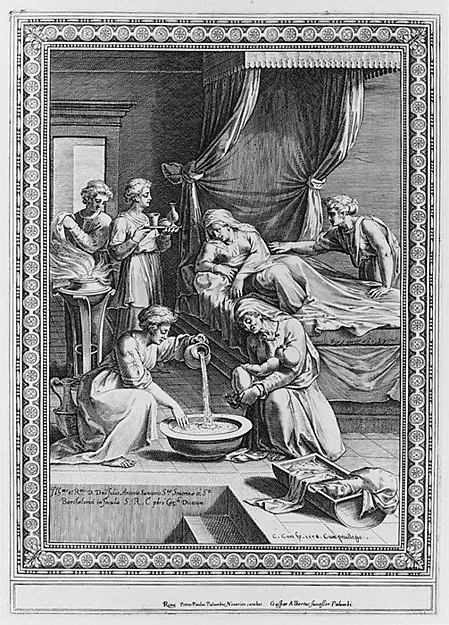
Painter of the Bible
Cornelis Cort
Cornelis Cort was the leading Netherlandish reproductive engraver of the late sixteenth century and the artist whose Italian period transformed the technical possibilities of European engraving for two generations.

Their faith
Why Cornelis Cort painted Christ
Cornelis Cort was deeply immersed in the religious and artistic culture of the late Renaissance, which profoundly influenced his work as an engraver. Although specific details about his personal faith are sparse, his extensive output of religious engravings indicates a strong commitment to Christian themes. Working in the Counter-Reformation context, Cort's art served to inspire devotion and reflect the spiritual fervor of his time. His collaboration with prominent artists like Titian and Federico Zuccaro allowed him to engrave significant biblical scenes, which would have resonated with the faith of the communities they served. It is likely that his daily life was infused with the devotional practices common among artists of his era, as they often sought divine inspiration in their work, praying and meditating on scripture as they created.
Cort's engravings, such as the "Baptism of Christ" and the "Crucifixion," reveal a profound spiritual vision that aimed to convey the depth of Christian narratives. His ability to capture the emotional intensity of these scenes speaks to his dedication to portraying sacred subjects with reverence and beauty. The tonal richness and atmospheric quality of his work invite viewers to reflect on the divine mysteries of faith. Even today, Cort's engravings continue to inspire and uplift those who encounter them, reminding us of the enduring power of art to communicate the love of Christ and the significance of His sacrifice. Through his artistry, Cort's devotion transcends time, reaching hearts and minds with the message of hope and redemption.
Life & work
Cornelis Cort was the leading Netherlandish reproductive engraver of the late sixteenth century and the artist whose Italian period transformed the technical possibilities of European engraving for two generations. Born in Hoorn in the northern Netherlands around 1533, trained in Antwerp in the workshop of the great printmaker Hieronymus Cock at the publishing firm Aux Quatre Vents, he traveled to Venice around 1565 — invited there by Titian to engrave the painter's compositions — and after a brief return to the Netherlands settled permanently in Rome by 1571. He died in Rome in 1578, in his mid-forties.
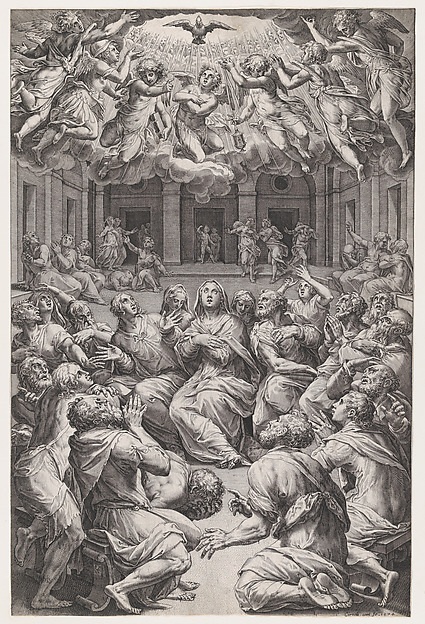
His engraving technique developed in two distinct phases. In the Netherlandish years he worked in the dense, parallel-hatched manner standard in the Antwerp engravers around Cock; in Italy, working with Titian and then with Federico Zuccaro and other Roman painters, he developed a long, swelling, sweeping line — laid down with a curved-handle burin in long parallel sequences — that gave his engravings a tonal richness and a sense of atmospheric distance the Antwerp tradition had never achieved. The Goltzius generation in the Netherlands directly studied and copied Cort's Roman line.
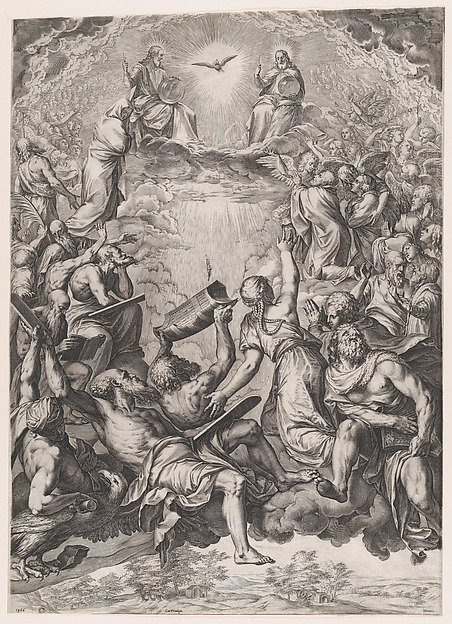
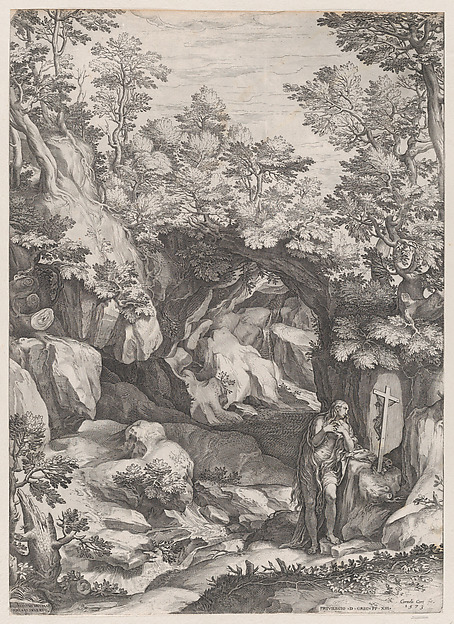
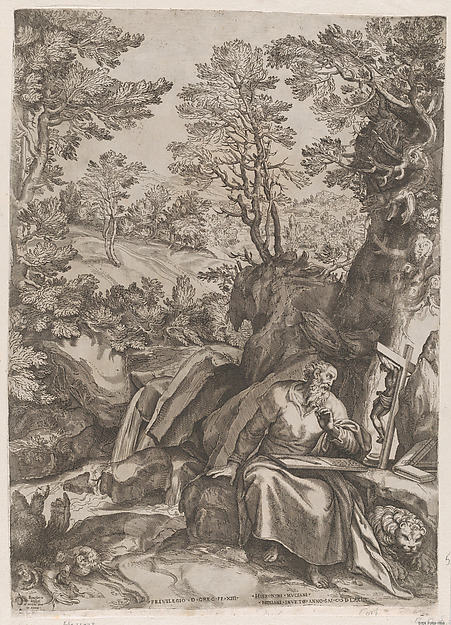
His religious engraved output is large. After Titian he engraved the Magdalene, the Saint Peter Martyr (whose original painting was destroyed by fire in the nineteenth century — Cort's plate is now the principal record), the great Gloria for Charles V, and several Madonnas. After Federico Zuccaro he engraved the Adoration of the Shepherds, the Conversion of Saul, the Baptism of Christ, the Crucifixion, and a long sequence of altarpieces. His independent religious plates — the Saint Jerome, the Penitent Magdalene, the Saint Catherine — circulated through Roman publishers and supplied the Counter-Reformation devotional market with high-quality reproductive imagery from the most authoritative Italian sources.
He worked closely with the Roman publisher Antonio Lafreri (whose great compendium volumes of Roman antiquities and contemporary religious art carried Cort's plates across Europe), and his Italian engravings remain the principal record of many High Renaissance and post-Tridentine paintings whose originals are lost or damaged. He died in Rome and was buried at Santa Maria dell'Anima.
Notable works in detail
met-418442
Saint John the Baptist in the Wilderness, engraved by Cornelis Cort around 1565 (in his Italian years working closely with Titian and the Roman painters) and now in the Metropolitan Museum of Art in New York, depicts the cousin of Christ in his desert ministry of fasting and preaching as recorded in the Gospels. The Baptist is shown in the foreground in his camel-hair garment, his hand gesturing in the act of preaching toward an unseen audience, with the small reed cross identifying him as the precursor of Christ; the rocky wilderness opens out behind into a panoramic landscape with distant hills. Cort's engraved line — the long swelling parallel strokes laid down with a curved-handle burin that became the Cort signature — gives the print an atmospheric tonal range that no Antwerp engraving of the same period had achieved. The print circulated through the Roman publishing market of Antonio Lafreri and his successors.
met-418554
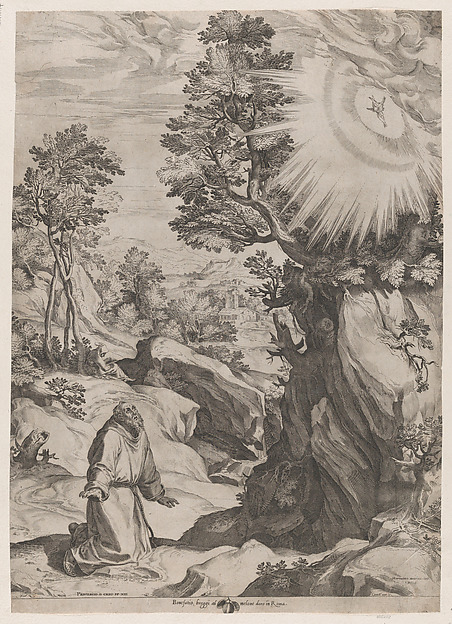
Saint Jerome in the Desert, engraved by Cornelis Cort around 1565 in his Italian workshop years, depicts the early Church Father in the conventional iconographic posture of his hermit years — half-naked, kneeling on his rocks, beating his breast with a stone in penitence — set against a rocky desert landscape with distant hills. Cort's engraved line gives the print a particular atmospheric depth: the foreground figure of Jerome is sharply outlined and plastically modeled, the middle distance fades into soft tonal gray, and the distant hills almost disappear into a pale gray atmospheric haze. The print is one of the principal early Cort treatments of the Jerome subject, a particular preoccupation of Counter-Reformation Italian devotional painting and printmaking.
met-416726
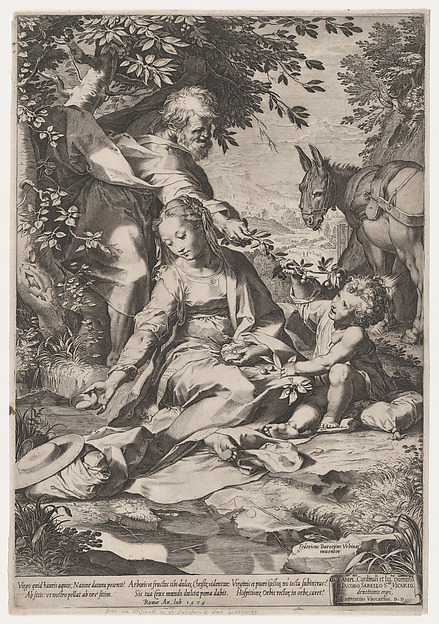
The Flight into Egypt, engraved by Cornelis Cort around 1571 in his Italian workshop years (probably after a composition by the Bologna painter Lavinia Fontana or one of her circle), depicts the apocryphal subject of the Holy Family fleeing from King Herod's persecution. Cort stages the scene as a panoramic Italian landscape encounter: the Virgin riding on the donkey holding the Christ Child, Joseph leading the donkey on foot, a small attending angel guiding them along a winding road through hills with distant towns and a soft sky. The print is one of the standard late-sixteenth-century Italian-engraved treatments of the subject and was widely copied through the Roman and Antwerp publishing networks for over a century after its first publication.
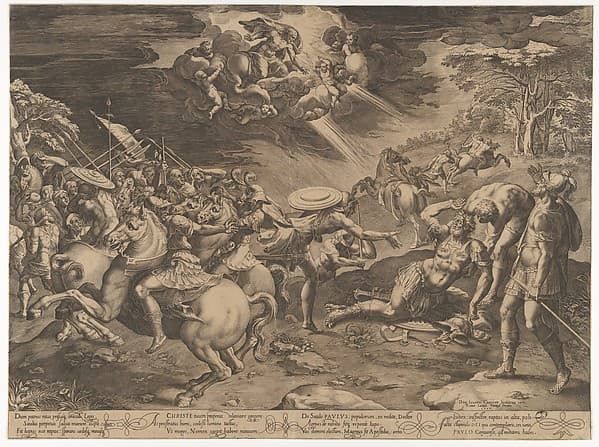
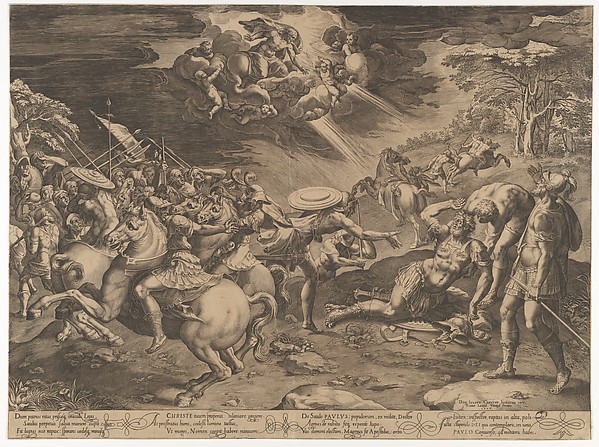
The Conversion of Saint Paul, engraved by Cornelis Cort in 1576 (in his late Italian years working in Rome) after a composition by Federico Zuccaro, depicts the moment from Acts 9 in which Saul falls from his horse on the road to Damascus blinded by the light from heaven. Cort stages the scene with characteristic Italian Mannerist density: Saul fallen on the ground in the foreground, his horse rearing in alarm beside him, the divine appearing as a foreshortened Christ in the upper register pulling apart the clouds and dispatching a stream of figures down toward the earthbound apostle. The print is among the principal late-Cort religious engravings and a defining example of the reproductive engraving tradition that carried Federico Zuccaro's Roman compositions across Europe.