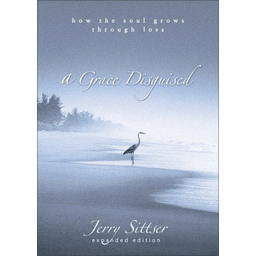
- Starting price
- ~$17 paperback
- Free tier
- No
- Platforms
- Print · Kindle · Audiobook
- Developer
- Zondervan
- Launched
- 1995
- Updated
- May 31, 2026
The verdict
A Grace Disguised has quietly become the book grieving people give to other grieving people. It does not promise to get you over your loss - it argues that loss can enlarge the soul rather than diminish it, and it earns that claim because the author has buried three generations of his own family in one afternoon. It is reflective rather than step-by-step, and it sits in the grief rather than rushing you out of it.
Try A Grace Disguised ↗Opens zondervan.com
A Grace Disguised is Jerry Sittser’s 1995 reflection on catastrophic loss - and it begins with the single afternoon that produced it. In 1991, a drunk driver hit the Sittser family minivan head-on. In the space of a few minutes Sittser lost three generations at once: his mother, his wife Lynda, and his four-year-old daughter Diana Jane. He survived, and so did three of his children, and he was left to raise them while standing in a grief most people are never asked to imagine. The book is what he wrote out of the years that followed.
It is not a manual. It does not give you stages to pass through or a timeline to hit. It does not promise that the pain will lift if you pray correctly, journal faithfully, or simply wait long enough. Sittser is explicit that he is not interested in how to recover from loss - as though grief were a detour back to the life you had - but in how the soul can grow through loss into something it could not have become otherwise. The subtitle is the whole argument in five words: How the Soul Grows through Loss.
Since it first appeared the book has been expanded twice (the editions readers buy now include later reflection and a study guide), translated widely, and absorbed into the working shelf of hospice chaplains, grief counselors, pastors, and ordinary people who have just been handed a diagnosis or a phone call. It is read across Christian traditions and, often enough, by people who would not call themselves religious at all - because the thing it describes, the slow refusal of grief to be hurried, is something nearly everyone eventually recognizes.
✓ The good
- Written from inside the worst case - Sittser lost his mother, wife, and young daughter in one crash, so the book never reads as theory; every claim is paid for
- Refuses cheap comfort - it does not offer five steps, a timeline, or the promise that the pain will pass, which is exactly why grieving readers trust it
- Reframes the goal of grief - Sittser argues the aim is not to “recover” the old life but to let loss enlarge the soul, a frame that lands hard for people stuck waiting to feel normal again
- Honest about the disorientation - the chapters on darkness, on the unfairness of who lives and who dies, and on the temptation to numb out name things most grief books skip
- Read across traditions and even by non-religious grievers - the reflection is broadly Christian but rarely tribal, which is why it travels so widely on hospice and counseling shelves
- Short and re-readable - around 200 pages, written in plain reflective prose, the kind of book people return to on anniversaries of a death
- The expanded editions add real value - later reflection written years further out, plus a discussion guide that makes it workable for grief groups
✗ Watch out
- It sits in the grief rather than relieving it - Sittser deliberately stays inside the loss instead of offering quick answers, and readers who came for reassurance should know that going in
- Reflective, not step-by-step - there is no plan, no checklist, no “what to do on day three”; readers who want concrete grief tasks will need a companion book
- Rooted in one man’s specific tragedy - the loss is sudden, violent, and multiple, and a reader grieving a long illness, a miscarriage, or a divorce may have to do some translating
- The early chapters are heavy by design - a freshly bereaved reader sometimes finds the opening too close to the bone to read in the first weeks
- Light on the practical scaffolding of mourning - logistics, the body’s side of grief, returning to work, supporting grieving children day to day are not its subject
Best for
- Anyone carrying a sudden or catastrophic loss
- Readers tired of grief books that promise quick recovery
- Pastors, chaplains, and counselors sitting with the bereaved
- Grief groups wanting a reflective text with discussion questions
Avoid if
- You want a step-by-step plan for getting through grief
- You are freshly bereaved and not yet ready for heavy reflection
- You want practical logistics of mourning rather than meaning
- You prefer a brisk, takeaway-driven self-help register
What A Grace Disguised is
A Grace Disguised is a roughly 200-page work of reflective Christian-living writing about catastrophic loss, organized not as a recovery plan but as a sustained meditation. Across its chapters Sittser moves through the territory grief actually covers: the sudden plunge into darkness, the unfairness of survival, the temptation to escape the pain through anger or numbness or busyness, the slow and uneven return of life, and the strange discovery that the soul can be enlarged by what it has suffered rather than only shrunk by it. It opens with the night of the crash and never lets the reader forget that the author is writing about his own family.
The expanded editions now in print add reflection written years further out from the accident - Sittser revisiting his own earlier claims with the perspective of more time - along with a discussion guide that makes the book usable in grief groups and small groups. It is broadly Christian in frame: Sittser is a professor of theology and writes openly about wrestling with God in the wreckage. But it is not denominationally pointed, which is why it is recommended across Christian traditions and read often by grievers who hold no faith at all.
Why grieving people keep handing this one to other grieving people
The single biggest practical difference between A Grace Disguised and most other grief books is what it refuses to do. It refuses to tell you how to get over your loss. Most books written for the bereaved - even the kind and well-meant ones - are organized around return: here are the stages, here is roughly how long it takes, here is how to know you are healing, here is the life waiting on the other side. Sittser rejects that whole shape. He argues that catastrophic loss is not a detour back to the old life but a permanent alteration, and that the real question is not how fast you recover but who you become.
That assumption is unusual, and it is why the book lands for the readers it lands for. A person who has just buried a spouse or a child does not, usually, find comfort in being told the pain will pass - because in the early grief it feels like a betrayal of the dead to imagine wanting it to. Sittser meets that reader exactly where they are. He is not standing on the far shore waving them across; he is sitting in the water beside them, and he has lost more than they have. That is the rarest thing a grief book can offer, and it is the reason this one gets passed hand to hand.
The thesis: loss can enlarge the soul, not only diminish it
Sittser’s central claim is right there in the subtitle - How the Soul Grows through Loss - and the book exists to make it believable. He starts from the obvious truth that catastrophic loss shrinks a person: it takes away, it amputates, it leaves a hole where a wife or a mother or a daughter used to be. He does not pretend otherwise. But he argues that the same loss that diminishes the soul can also, paradoxically and slowly, expand its capacity - for sorrow, yes, but also for compassion, for gratitude, for attention to the living, for a depth of feeling the unwounded life never reaches. The grace of the title is disguised precisely because it arrives wearing the face of the worst thing that ever happened to you.
What keeps this from being a platitude is that Sittser refuses to let it become one. He is wary of the move that turns suffering into a tidy lesson, and he says so. The growth he describes is not a reward for grieving correctly and not a trade he would ever have agreed to - he would give all of it back to have his family returned. The point is not that loss is good. The point is that the soul does not have to be destroyed by it, and that something real and even beautiful can grow in the ruins without ever justifying the ruin. Readers who have been told too quickly that their suffering “happened for a reason” find in Sittser someone who has earned the right to talk about meaning and still will not cheapen it.
Sitting in the darkness instead of rushing toward the light
One of the book’s most-cited images comes from its handling of the night. Early on, Sittser describes the instinct - his own, and everyone’s - to escape the darkness of grief by sprinting toward the nearest sunrise: to stay busy, to numb the feeling, to force a recovery, to chase the west and the setting sun in a doomed attempt to outrun the dark. He concludes, slowly, that the only way through is the opposite: to turn east, into the darkness, and wait. To let the grief be as large as it actually is rather than managing it down to a size that does not frighten the people around you.
That refusal to hurry is the spine of the whole book, and it is why it is reflective rather than step-by-step. There is no chapter that tells you what to do on the third day or the third month. Instead Sittser keeps modeling a posture - the willingness to stay present to loss without demanding that it resolve on schedule. For a reader being pressured by a culture, or a church, or their own exhaustion to be “doing better by now,” this is enormously freeing. It also means the book is not the right first tool for someone who needs concrete tasks and a timeline; it is a companion for the inner work, not a manual for the outer logistics, and it knows the difference.
Wrestling honestly with God, fairness, and the questions grief raises
Sittser is a professor of theology, and he does not pretend the accident left his faith intact and untroubled. The book wrestles openly with the questions catastrophic loss forces: why his family and not someone else’s, why a drunk driver walked away while his wife and daughter did not, what to do with a God who could have stopped it and did not. He does not answer these questions so much as refuse to flee them. He stays in the argument, the way Job stays in the argument, and what emerges is not a proof but a hard-won and provisional trust - the kind that has looked the worst in the face and is still, somehow, willing to keep talking to God.
This is where the book’s broad readership comes from. Sittser writes from inside the Christian tradition, but he writes about the parts of it that the bereaved of many backgrounds end up standing in front of - the unfairness, the silence, the question of whether suffering means anything at all. He does not hand the reader a denominational settlement of those questions, and he does not insist that the reader land where he landed. That restraint is why hospice workers give the book to patients of every faith and none, and why it sits as comfortably on a counselor’s shelf as on a pastor’s. It takes the questions seriously enough not to close them prematurely.
Pricing
Paperback
~$17
The standard Zondervan edition and the copy most readers own. Current printings are the expanded edition with later reflection and a discussion guide - the version to buy.
Kindle
~$12
Standard ebook edition. Highlights sync across devices, which matters for a book readers underline and return to on grief anniversaries.
Audiobook
~$15
Unabridged narration, included with some Audible memberships. The reflective prose holds up well read aloud; many readers listen on the commute that grief made hard to face.
Hardcover
~$25
Available in some printings. Same text as the paperback - choose for durability if you mark up books or intend to lend it repeatedly, which people do.
A Grace Disguised is not free. Used paperbacks turn up constantly at library sales and secondhand shops for a few dollars, which is how a lot of grieving people get their copy - usually handed to them by someone who has been through it. A new Zondervan paperback runs around $17 and is the everyday default. One thing to check when buying secondhand: the current printings are the expanded edition, with later reflection and a discussion guide, and you want that version rather than the slimmer 1995 original.
The Kindle edition at around $12 is the right pick for highlighters and for anyone who wants the book on their phone in the small hours when grief tends to surface. Digital highlights sync across devices, which matters for a book readers return to on the anniversary of a death.
The audiobook at around $15 - included with some Audible memberships - works well because the prose is reflective rather than instructional; there are no exercises to do by hand. A number of readers listen in the car, which is often exactly the place grief had made hard to be alone.
If you are buying it as a gift for someone who is grieving - which is the most common reason this book gets bought - the paperback is the natural choice and the one we mark as best value. The hardcover at around $25 exists for durability and for people who lend the book repeatedly. Most readers do not need the hardcover. The expanded paperback is the balanced default.
Where A Grace Disguised falls behind
No step-by-step plan. This is the book’s defining choice, not an oversight. Sittser offers no stages, no timeline, no checklist of grief tasks. A reader who needs concrete structure - what to do this week, how to know you are progressing - will have to bring a second, more practical book alongside it. A Grace Disguised tends the inner life and leaves the logistics to someone else.
It stays inside the grief. The book deliberately sits in the loss rather than pulling the reader out of it, and the early chapters in particular are heavy. For a person in the first raw weeks, that closeness is sometimes too much; several readers report having to set it down and come back a few months later. The honesty is the point, but it is a real consideration for timing.
Rooted in one specific tragedy. Sittser’s loss was sudden, violent, and multiple - a crash that took three generations at once. A reader grieving a long terminal illness, a miscarriage, a suicide, or the slow loss of divorce will find the core insight transfers, but may have to translate the particulars. The book does not try to cover every shape of loss; it goes deep on one and trusts the depth to reach the rest.
Light on the practical and physical side of mourning. The body’s role in grief, returning to work, the day-to-day mechanics of supporting grieving children, the financial and legal aftermath of a death - none of that is Sittser’s subject. He is after meaning and the soul’s slow enlargement, and he leaves the operational side of bereavement to the many books that handle it directly.
Reflective register won’t suit every reader. The book is meditative, sometimes circling the same wound from a new angle rather than advancing a checklist. Readers who prefer brisk, takeaway-driven writing may find the pace slow. That slowness is intentional - Sittser is modeling the refusal to hurry that the whole book argues for - but it is worth knowing your own preference before you start.
A Grace Disguised vs. A Grief Observed vs. Walking with God Through Pain and Suffering
These three are the most-handed-out books for the grieving, and they do genuinely different jobs. A Grace Disguised (Sittser, 1995) is the sustained reflection from inside catastrophic, multiple loss - its argument is that the soul can grow through grief, and its gift is that it refuses to hurry you. A Grief Observed (C. S. Lewis, 1961) is the raw journal - Lewis writing in real time after his wife’s death, four notebooks of unedited grief that is shorter, angrier, and more immediate than Sittser, with no thesis at all, just a man watching his own faith get stress-tested. Walking with God Through Pain and Suffering (Tim Keller, 2013) is the comprehensive treatment - part survey of how different cultures and philosophies handle suffering, part biblical-theological argument, part pastoral counsel, far longer and more systematic than the other two.
Different strengths. Sittser is the one to read when you are inside a specific devastating loss and need a companion who has been further down the same road. Lewis is the one to read when you want company in the rawness - the book that says the things grief actually thinks, including the ugly ones, in fifty unforgettable pages. Keller is the one to read when your grief has turned into questions you want worked through carefully - why suffering, what the Christian tradition says about it, how to think as well as feel your way through. Many people end up reading all three: Sittser or Lewis first because someone hands it to them in the acute phase, Keller later when the mind is ready to engage.
All three are read widely across Christian traditions, and Sittser and Lewis in particular are common on hospice and secular counseling shelves because neither presses a denominational settlement on the reader. Keller writes from a Reformed Presbyterian perspective and is the most explicitly theological of the three, though the cross-cultural survey in his opening chapters is used well beyond it.
The bottom line
A Grace Disguised is not the right book for everyone, and it is not trying to be. It will frustrate a reader who wants stages, a timeline, or the promise that the pain will pass - it offers none of those on purpose. But for someone carrying a sudden or catastrophic loss, sitting with the unfairness of who lived and who died, and quietly sick of being told to get over it, this is the book to reach for. Sittser is not waving from the far shore. He is in the water beside you, he has lost more than most, and what he has to say about the soul growing through grief is something he paid for in full. Read it when you are ready for it, give it to someone who has just been handed the worst news of their life, and let it sit in the grief with them rather than rush them out of it.
Alternatives to A Grace Disguised
 A Grief ObservedC. S. Lewis’s raw real-time journal after his wife’s death - shorter, angrier, and more immediate than Sittser, with no thesis, just grief watched as it happens.
 Walking with God Through Pain and SufferingTim Keller’s comprehensive treatment of suffering - cross-cultural survey, biblical-theological argument, and pastoral counsel. Longer and more systematic than Sittser.
 JoniJoni Eareckson Tada’s memoir of the diving accident that left her quadriplegic and the long wrestle with God that followed. Suffering told as a life story rather than a reflection.
 Streams in the DesertL. B. Cowman’s daily devotional written out of her own grief - a year of short readings for hard seasons. A companion for the bereaved who want something brief and daily.
Frequently asked questions
What happened to Jerry Sittser?
In 1991 a drunk driver hit the Sittser family minivan head-on. Jerry Sittser lost three family members in the crash: his mother, his wife Lynda, and his four-year-old daughter Diana Jane. He and three of his children survived. A Grace Disguised is his reflection on the grief and transformation that followed, written over the years after the accident.
Is A Grace Disguised a Christian book?
Yes, it is written from inside the Christian tradition - Sittser is a professor of theology and wrestles openly with God throughout. But it is not denominationally pointed, and it is read widely across Christian traditions as well as by grievers who hold no particular faith. Hospice workers and counselors often recommend it to patients of every background because it takes the hard questions seriously without forcing a settlement.
Does the book tell you how to get over grief?
No, and that is deliberate. Sittser explicitly rejects the idea that the goal of grief is to “recover” the old life. He argues instead that catastrophic loss permanently changes you, and that the real question is who you become - whether the soul is only diminished by loss or can also, slowly, be enlarged by it. There are no stages, no timeline, and no promise that the pain will pass.
Should I buy the original or the expanded edition?
Buy the expanded edition, which is the version in print now. It adds reflection Sittser wrote years further out from the accident, with the perspective of more time, plus a discussion guide that makes it usable for grief groups. Used copies of the slimmer 1995 original still circulate - check the cover and copyright page before buying secondhand.
Is this a good book for someone who is freshly bereaved?
It can be, but timing matters. The book sits inside the grief rather than pulling you out of it, and the early chapters are heavy by design. Some readers find it exactly right in the first weeks; others need to set it down and return a few months later when the rawest edge has dulled. It is often given early and read fully later - and that is a perfectly normal way to use it.
Will A Grace Disguised help if my loss wasn’t a sudden accident?
Often, yes, though you may have to translate. The book is rooted in one specific tragedy - a sudden, violent, multiple loss - and a reader grieving a long illness, a miscarriage, a suicide, or a divorce will find the particulars different. But the core insight, that the soul can grow through loss and does not have to be hurried, transfers broadly. Many readers grieving very different losses report that it reached them anyway.
What should I read alongside or after it?
For company in the rawness of early grief, C. S. Lewis’s A Grief Observed pairs naturally. For a careful, systematic treatment of why suffering exists and how to think through it, Tim Keller’s Walking with God Through Pain and Suffering is the standard companion. For a daily, brief format, L. B. Cowman’s Streams in the Desert offers short readings for hard seasons. Many readers move from Sittser to one of these as their grief shifts from feeling toward questions.
Sources & further reading
More Christian Living Books
 The Prodigal GodTim Keller’s 130-page reading of Luke 15 has quietly become one of the most-gifted Christian books of the last twenty years - and the reason is the title itself.
 Practicing the WayComer’s 2024 follow-up to The Ruthless Elimination of Hurry has quietly become the default spiritual-formation book in a thousand small groups - and the reasons are worth unpacking.Walking with God Through Pain and SufferingTim Keller’s most comprehensive book on suffering - part survey of how every culture has tried to explain pain, part biblical theology, part field manual for the people actually walking through it.
 FerventThe prayer book that turned “strategic, specific prayer” into a fill-in-the-blank battle plan - and rode the War Room moment to the top of the bestseller lists.
 The Ruthless Elimination of HurryJohn Mark Comer’s 2019 breakout - a pastor’s case that hurry is the great spiritual enemy of our age - has quietly become the go-to slow-down book for an exhausted generation of Christians. Here’s what it actually delivers, and where it doesn’t.
 Don't Waste Your LifeJohn Piper's 2003 manifesto against drifting through a comfortable life has quietly become the book that wrecks twenty-somethings in the best possible way - and it's still free as a PDF.