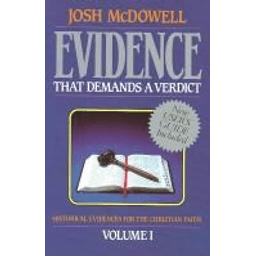
- Starting price
- ~$25 hardcover
- Free tier
- No
- Platforms
- Print · Kindle
- Developer
- Thomas Nelson
- Launched
- 1972 (fully rewritten 2017)
- Updated
- May 31, 2026
The verdict
Evidence That Demands a Verdict is the most comprehensive single-volume evidential apologetics handbook in print, and that is exactly what to expect from it - a reference, not a read. The 2017 rewrite by Sean McDowell keeps Josh McDowell's original sweep while refreshing decades of scholarship. Buy it to look things up, not to read straight through.
Try Evidence That Demands a Verdict ↗Opens josh.org
Evidence That Demands a Verdict has quietly become the book apologetics-minded Christians own and almost never finish. It sits on the shelf next to the study Bible, dog-eared at the chapters someone needed once, mostly unread everywhere else. That is not a knock - it is the nature of the thing. This is a reference compendium, closer to a one-volume encyclopedia of evidences for the Christian faith than to a book you take to the beach. At well over 800 pages in the current edition, it was built to be consulted, not consumed.
It does not tell a story. It does not build a single argument from first principles. It does not assume you will read it in order. What it does is gather, organize, and footnote the evidential case for Christianity across every major front - the transmission and reliability of the biblical manuscripts, the historicity of the resurrection, fulfilled prophecy, the historical Jesus, and the standard skeptical challenges to each - and lay them out with the citations attached. When a small-group leader gets a hard question about how many New Testament manuscripts survive, or how the canon was formed, this is the book that has the table.
The lineage matters. Josh McDowell first published Evidence That Demands a Verdict in 1972, drawing on years of campus debates where he kept getting the same objections from skeptical students and started compiling answers. It sold in the millions and shaped a generation of lay apologists. In 2017, his son Sean McDowell - himself a professor of apologetics - led a complete rewrite, updating the scholarship, pruning arguments that had not aged well, and reorganizing the whole thing for a new century. The result is described on its own cover as "Life-Changing Truth for a Skeptical World," and whatever else it is, it is thorough.
✓ The good
- The most comprehensive single-volume evidential apologetics reference in print - manuscript evidence, the resurrection, prophecy, and the historical Jesus all under one cover
- Fully rewritten in 2017 by Sean McDowell - decades of dated material was pruned and the scholarship refreshed rather than just reprinted
- Exhaustively footnoted - nearly every claim is sourced, which makes it genuinely useful as a citation tool for teachers, students, and small-group leaders
- Excellent on manuscript transmission and the bibliographical test - the tables comparing New Testament manuscript counts to other ancient texts are the most-photocopied pages in the book
- Strong resurrection section - surveys the empty tomb, the post-resurrection appearances, and the standard naturalistic counter-explanations, with responses to each
- Organized for lookup - the table of contents and index let you find the specific objection you are facing without reading the surrounding 700 pages
- A career's worth of campus apologetics distilled - Josh McDowell built this from real objections raised by real skeptics, and that origin still shows in the question selection
✗ Watch out
- Not a cover-to-cover read - it is a dense reference handbook, and readers who try to read it straight through usually stall out
- The sheer volume can overwhelm - 800-plus pages of evidence, tables, and footnotes is a lot to navigate for someone new to apologetics
- The evidential method is one approach among several - presuppositional and experiential readers build their case differently and may find the whole framework less persuasive
- Some arguments are contested by critics - the manuscript and resurrection claims in particular are vigorously debated by skeptical scholars, and the book mostly presents one side of those debates
- Reference density crowds out readability - there is little narrative momentum to carry a reluctant reader, unlike a book such as The Case for Christ
- Best used as a lookup tool, not a first apologetics book - newcomers are usually better served starting somewhere shorter and more conversational
Best for
- Teachers, students, and small-group leaders who need a citable reference
- Apologetics readers who want the evidence organized and footnoted in one place
- Anyone fielding recurring skeptical questions who wants the data on hand
- Owners of a shorter apologetic who want the deeper source material behind it
Avoid if
- You want one accessible book to read straight through - try a narrative apologetic instead
- You are new to the topic and want a gentle on-ramp rather than 800 pages
- You prefer a presuppositional or experiential approach over the evidential method
- You want a balanced panel of skeptical and believing scholars rather than an evidential brief
What Evidence That Demands a Verdict is
Evidence That Demands a Verdict is an evidential apologetics handbook - a single-volume reference that gathers and footnotes the historical, textual, and prophetic evidences for the Christian faith. It is organized topically rather than narratively, with sections on the reliability of the biblical manuscripts, the formation of the canon, the historicity of the resurrection, fulfilled prophecy, the historical Jesus, and the standard objections raised against each. At more than 800 pages, it functions as a desk reference: you consult the chapter you need, not the book as a whole.
The current edition is a complete 2017 rewrite of Josh McDowell's 1972 original, led by his son Sean McDowell. The method throughout is evidential - it argues from publicly examinable historical and textual data toward the conclusion that the Christian claims can withstand scrutiny. That is one recognized approach to apologetics among several; readers who favor a presuppositional or experiential method will frame the same questions differently. The book wears its evidential commitment openly, and its strength is the breadth and citation density it brings to that approach.
Why apologetics teachers keep Evidence on the desk
Most apologetics books are arguments. Evidence That Demands a Verdict is a database. That is the single biggest practical difference between it and almost everything else on the shelf. A narrative apologetic like The Case for Christ walks you through one investigation in order; Evidence assumes you already have a specific question - How early are the Gospel manuscripts? How was the canon decided? What are the naturalistic explanations for the empty tomb, and what is said in response? - and gives you the organized, sourced answer to that question without requiring the surrounding chapters.
This is why the people who get the most out of it are not first-time readers but teachers, students writing papers, and small-group leaders who keep getting asked the same hard questions. The footnotes are the feature. When you need to cite how many New Testament manuscripts survive, or which ancient historians mention Jesus, the table is there with the references attached. Treated as a reference handbook rather than a cover-to-cover read, it does a job no shorter apologetic can: it is the place you look things up.
The manuscript evidence: the bibliographical test, with the tables attached
The book's most-used section is its treatment of the biblical manuscripts and what apologists call the bibliographical test - the comparison of the New Testament's manuscript record to that of other ancient texts. Here the McDowells lay out the counts: how many Greek manuscripts of the New Testament survive, how soon after the original composition the earliest copies are dated, and how that record stacks up against works like the writings of the classical historians. The presentation is tabular and citation-heavy, exactly what a teacher needs when a student asks how we know the text was transmitted faithfully.
The argument the section advances is that the New Testament is, by the ordinary standards historians apply to ancient documents, exceptionally well attested. Critics push back on how the comparison is framed - they note that manuscript quantity is not the same as textual certainty, and that some of the popular numbers have been stated loosely in the past. The 2017 edition is more careful with these figures than older printings were, and it cites current textual scholarship. As a starting point for the manuscript question, with the sources right there to follow, it remains one of the most useful compilations a non-specialist can own.
The resurrection case: empty tomb, appearances, and the counter-explanations
A substantial block of the book is devoted to the resurrection, which evidential apologetics treats as the central historical claim of Christianity. The McDowells survey the lines of evidence usually marshaled here - the reports of the empty tomb, the post-resurrection appearances to individuals and groups, the transformation of the disciples, and the early date of the resurrection proclamation. Each is laid out with its supporting citations, and then the standard naturalistic counter-explanations are stated and answered in turn: the swoon theory, the hallucination theory, the stolen-body theory, the legend hypothesis.
What makes this section a reference rather than a polemic is the structure. Each skeptical explanation gets named, summarized, and then engaged, so a reader fielding a particular objection can turn directly to it. These are live debates in New Testament scholarship - skeptical historians contest both the data and the inferences drawn from it - and the book argues a definite position rather than refereeing a neutral panel. Read with that in mind, it is a thorough catalog of the evidential resurrection argument and the responses its proponents give to the most common challenges.
Fulfilled prophecy and the historical Jesus: the rest of the evidential case
Beyond manuscripts and the resurrection, the handbook covers two further fronts that round out the evidential method. The first is fulfilled prophecy - the argument that specific Old Testament passages anticipate features of Jesus's life, death, and identity, presented with the texts laid side by side. The second is the historical Jesus: the extra-biblical sources that mention him, the question of what can be established about his life by ordinary historical method, and responses to theories that he was a later invention or a purely mythical figure.
These sections show both the reach and the limits of a reference like this. The reach is obvious - almost any evidential question a reader brings will have a corresponding chapter with sources. The limit is that prophecy arguments in particular are interpreted differently across scholarly and religious traditions, and the book argues for a specific reading rather than surveying the range. As with the rest of the volume, the value is in having the material organized and footnoted in one place, so the reader can follow the citations and weigh the case rather than take the conclusion on the authors' say-so.
Pricing
Hardcover
~$25
The large 2017 fully-updated edition. The reference copy most people keep on the shelf.
Paperback
~$22
Same updated text in a softcover binding - lighter for the price.
Kindle
~$15
Searchable digital edition - arguably the best format for a reference book, since you can jump straight to a term.
New Evidence (older edition)
~$20 used
The pre-2017 "New Evidence That Demands a Verdict" still circulates used; fine, but the 2017 rewrite is the current scholarship.
Evidence That Demands a Verdict is not free. The current 2017 hardcover runs around $25 - call it the reference default, since this is a book you keep rather than pass along, and the hardcover binding survives years of being pulled off the shelf. The paperback at roughly $22 is the same updated text in a lighter, slightly cheaper form.
The Kindle edition at about $15 is, for once, arguably the best format rather than a compromise. This is a lookup book, and digital search is exactly what a lookup book wants - you can jump straight to a term or an objection instead of working the index. For readers who plan to use it the way it is meant to be used, the searchable edition earns its place.
There is one wrinkle worth knowing. An earlier edition titled New Evidence That Demands a Verdict still circulates widely, often used for around $20, and a lot of older church libraries have it. It is not wrong, but it predates the 2017 rewrite, so its scholarship and some of its figures are a generation behind. Most readers do not need the older edition. The 2017 hardcover is the balanced default and the one keyed to current sources.
Where Evidence That Demands a Verdict falls behind
Not a read. This is the headline limitation and it is by design - Evidence is a reference handbook, not a narrative, and a reader who tries to go cover to cover almost always stalls. If what you want is a book to read straight through and be carried along by, this is the wrong tool. Reach for a narrative apologetic and keep Evidence on the shelf for when you need a citation.
Sheer volume. Eight hundred-plus pages of tables, arguments, and footnotes is a lot to navigate, and for someone brand-new to apologetics the density can overwhelm rather than orient. The organization helps, but the book assumes you can find your own way to the question you have. Newcomers are usually better served starting somewhere shorter.
One method among several. The evidential approach - arguing from publicly examinable historical and textual data - is a recognized apologetic method, but it is not the only one. Presuppositional apologists begin from different starting commitments, and experiential approaches lean on the lived encounter rather than the historical case. Readers in those camps will find the whole framework less central to how they would make the argument.
Contested at the edges. Several of the book's signature claims - the manuscript comparisons, the inferences drawn from the resurrection data, the prophecy readings - are vigorously debated by skeptical scholars, and the book argues a position rather than refereeing the debate. That is a fair thing for an apologetic to do, but a reader expecting a neutral survey of both sides will feel the one-sidedness. The footnotes at least point toward the wider literature.
Thin on the philosophical front. Evidence is overwhelmingly a historical and textual case. The philosophical arguments for the existence of God - the cosmological, design, and moral arguments - are not where this book spends its pages. A reader whose questions are metaphysical rather than historical will want a companion volume built for that purpose.
Evidence That Demands a Verdict vs. The Case for Christ vs. Cold-Case Christianity
These three are the evidential apologetics shortlist, and they do genuinely different jobs. Evidence That Demands a Verdict (McDowell, 1972; rewritten 2017) is the reference compendium - the 800-page handbook you consult for the organized, footnoted data on a specific question. The Case for Christ (Lee Strobel, 1998) is the narrative on-ramp - a former journalist interviewing scholars, written to be read cover to cover by a skeptic who would never open a reference book. Cold-Case Christianity (J. Warner Wallace, 2013) is the forensic frame - a former homicide detective applying cold-case evidence methodology to the Gospels.
Different strengths. Strobel is the book you hand a skeptical friend because it reads like long-form journalism and pulls non-readers through. Wallace is the book for someone who responds to a detective's evidence-weighing instincts. McDowell is not really competing for that reader at all - it is the depth behind the other two, the place you go when Strobel or Wallace raised a point and you want the tables, the manuscript counts, and the citations. If you are starting from zero, start with Strobel or Wallace. If you already field hard questions and want the source material, keep McDowell on the desk.
They layer well rather than compete. A common pattern is to read Strobel or Wallace first for the accessible case, then use Evidence as the reference that backs it - looking up the specific manuscript figure, the specific counter-explanation, the specific prophecy text. All three argue from a broadly evangelical evidential frame; the historical claims they share - manuscript reliability, the empty tomb, the post-resurrection appearances - are engaged across many traditions, even as skeptical scholars contest the inferences.
The bottom line
Evidence That Demands a Verdict is the most comprehensive single-volume evidential apologetics handbook in print, and the smartest way to own it is to know what it is: a reference, not a read. The 2017 rewrite keeps Josh McDowell's original breadth while bringing Sean McDowell's updated scholarship to bear, and the footnotes make it genuinely useful for teachers, students, and anyone fielding recurring skeptical questions. It will overwhelm a newcomer and frustrate a reader looking for narrative momentum - those are real limitations, but they are worth knowing about going in rather than dealbreakers. Buy a shorter apologetic to read; buy this one to look things up.
Alternatives to Evidence That Demands a Verdict
 The Case for ChristLee Strobel's investigative-journalist apologetic - the narrative on-ramp that reads cover to cover, where Evidence is the reference behind it.
 The Case for FaithStrobel's follow-up taking on the emotional and philosophical objections - evil, suffering, hell - that the evidential handbooks mostly set aside.
 On GuardWilliam Lane Craig's accessible guide to the philosophical arguments for God - the metaphysical case Evidence largely leaves to other volumes.
 Cold-Case ChristianityJ. Warner Wallace, a former cold-case homicide detective, applies forensic-evidence methodology to the Gospels - the closest cousin to the McDowell evidential approach.
Frequently asked questions
Is Evidence That Demands a Verdict a good first apologetics book?
For most readers, no - not because it is weak, but because it is a reference handbook rather than a narrative read. Newcomers usually do better starting with something shorter and more conversational, like The Case for Christ, then turning to Evidence when they want the deeper, footnoted source material behind a specific question.
What is the difference between the 1972 and 2017 editions?
The 2017 edition is a complete rewrite led by Sean McDowell, Josh McDowell's son. It keeps the original's evidential sweep but refreshes the scholarship, prunes arguments and figures that had not aged well, and reorganizes the material for a modern reader. There is also an intermediate edition titled New Evidence That Demands a Verdict that predates the 2017 rewrite. The 2017 edition is the current one.
Should I read it cover to cover?
Most readers should not. At more than 800 pages of tables, arguments, and footnotes, it is built to be consulted by topic, not read straight through. Use the table of contents and index to find the specific question you are facing. The Kindle edition is especially handy for this because you can search it directly.
What kind of apologetics method does it use?
It uses the evidential method - arguing from publicly examinable historical and textual data (manuscripts, the resurrection accounts, prophecy, extra-biblical sources) toward the reliability of the Christian claims. That is one recognized approach among several; presuppositional and experiential apologists build their case from different starting points and may find the framework less central to how they argue.
Are its arguments accepted by everyone?
No - several of its signature claims, especially the manuscript comparisons and the inferences drawn from the resurrection evidence, are actively debated by skeptical scholars. The book argues a definite position rather than presenting a neutral panel. Its footnotes point toward the wider literature, so a reader can follow the sources and weigh the case independently.
How does it compare to The Case for Christ?
They do different jobs. The Case for Christ is a narrative, written to be read cover to cover by a skeptic. Evidence That Demands a Verdict is a reference compendium you consult for organized, sourced data. Many readers use Strobel as the accessible on-ramp and Evidence as the deeper reference that backs it up.
Which format should I buy?
The 2017 hardcover (~$25) is the right default for a book you will keep and pull off the shelf for years. The paperback (~$22) is a lighter, slightly cheaper option with the same text. For a reference book, though, the Kindle edition (~$15) is genuinely worth considering - searching for a term or objection is faster than working the index.
Sources & further reading
More Apologetics Books
 The Reason for GodTim Keller’s 2008 apologetic has quietly become the default gift for the smart, secular friend who has questions - and it earns the reputation.
 Making Sense of GodTim Keller’s 2016 “prequel” to The Reason for God doesn’t argue that God exists - it argues that the things you already want make more sense inside Christianity than outside it, and it’s the book for the skeptic who isn’t ready for the argument yet.
 TacticsGreg Koukl wrote the book that teaches you how to talk about faith without it turning into an argument - the one most people reach for when "I never know what to say" is the real problem.On GuardWilliam Lane Craig’s 2010 primer takes the formal arguments from his heavyweight Reasonable Faith and redraws them as flowcharts a layperson can actually follow - apologetics taught like a skill, not a sermon.The Case for ChristLee Strobel’s investigative-journalist apologetic has quietly become the default gift book for skeptical friends - and the on-ramp into apologetics for an entire generation of readers.
 Total TruthThe book that taught a generation of evangelicals to think in terms of worldview - and to stop letting their faith get filed under "private values" while everyone else got "public facts."