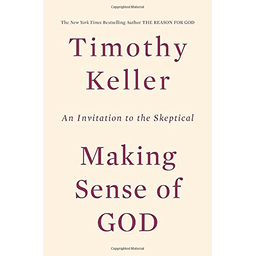
- Starting price
- ~$18 paperback
- Free tier
- No
- Platforms
- Print · Kindle · Audiobook
- Developer
- Viking / Penguin
- Launched
- 2016
- Updated
- May 31, 2026
The verdict
The book for the skeptic who isn’t ready to argue about whether God exists yet - Keller spends 250 pages on the prior question of whether Christianity even makes sense of the things every modern person wants. It is denser and slower than The Reason for God, but for the right reader it does work nothing else on the shelf does.
Try Making Sense of God ↗Opens penguinrandomhouse.com
Making Sense of God has quietly become the book Christians reach for when The Reason for God is the wrong tool. Timothy Keller published it in 2016, eight years after his bestselling apologetic, and he is explicit about why: he kept meeting people for whom the older book did not connect. They were not asking whether the arguments for God held up. They had not gotten that far. They simply assumed that belief was a relic - that a thinking, modern person had obviously moved past religion - and so the case for Christianity never even got a hearing. This book is written for them.
It does not try to prove that God exists. It does not walk through the resurrection evidence. It does not answer the seven objections of the earlier book. Instead it asks a prior and stranger question: does Christianity make better sense than secularism of the things human beings most want - meaning, satisfaction, freedom, a stable identity, hope in the face of death, and a basis for moral conviction? Keller’s wager is that the modern secular account of those things is far shakier than its confidence suggests, and that the Christian account, whatever else you think of it, is at least a live and serious option for an intelligent person.
Keller wrote it after nearly three decades pastoring Redeemer Presbyterian Church in Manhattan, and the influences are heavier and more academic than in his earlier work - the sociologist Charles Taylor and the philosopher Alasdair MacIntyre sit underneath whole chapters. That makes it the more demanding of the two books, and reviewers reliably split on which they prefer. But it occupies real estate nothing else quite covers, and for the reader who is not skeptical of the answers so much as skeptical that the questions even belong to religion anymore, it is the most useful book Keller wrote.
✓ The good
- Best-in-class for the reader who thinks faith is simply obsolete - Keller meets the late-modern assumption that religion is a settled, closed question and reopens it before any argument for God begins
- Engages the strongest secular thinkers on their own terms - Charles Taylor, Alasdair MacIntyre, Ernest Becker, Luc Ferry - so the book reads as genuinely intellectually serious rather than defensive
- Reframes the whole conversation around human longing - meaning, satisfaction, freedom, identity, hope, morality - which is far more inviting to a skeptic than a frontal argument about God’s existence
- The chapters on identity and freedom are the standouts - Keller’s critique of building a self entirely out of internal desire or external achievement lands hard regardless of where you stand
- Even-handed about secularism’s real attractions - he concedes the genuine appeal and moral seriousness of the secular view before pressing on its weak points, which keeps it lendable
- Pairs cleanly with The Reason for God - this is the on-ramp, that is the argument; read together they cover the full distance from indifference to belief
- The closing chapter pivots gracefully from plausibility to the actual Christian claim, so the book does not leave the reader stranded in the abstract
✗ Watch out
- It argues plausibility, not proof - by design it does not make the case that Christianity is true, only that it makes sense, so a reader looking for an argument will need The Reason for God as well
- Denser than a typical popular title - the reliance on academic sources (Taylor especially) means several chapters demand real attention and reward a second pass
- Slower to engage than the earlier book - the first hundred pages clear away secular assumptions before the positive case begins, and some readers stall there
- Reformed Presbyterian assumptions surface gently in the back half - not aggressively, but readers from other traditions will notice the framing in the chapters on sin and the self
- Less quotable and less lyrical than Lewis or even than Keller’s own Prodigal God - this is closely-argued prose, not aphorism
- Overlaps with The Reason for God in places - a reader who has absorbed the earlier book will find some terrain familiar, even though the angle is new
Best for
- The friend who assumes religion is simply outdated
- Thoughtful skeptics wrestling with meaning rather than evidence
- Adult classes and reading groups on faith and late-modern culture
- Pastors and campus ministers working with secular-leaning audiences
Avoid if
- You want a direct argument that God exists or that Jesus rose
- You want a short, breezy, highly quotable read
- You want a Catholic, Orthodox, or Latter-day Saint apologetic specifically
- You have never read any apologetics and want the simplest entry point first
What Making Sense of God is
Making Sense of God is a roughly 250-page general-audience book by Timothy Keller, published in 2016 by Viking, an imprint of Penguin. Keller frames it explicitly as a prequel to his 2008 bestseller The Reason for God: where that book argued for the truth of Christianity against common objections, this one steps back to a prior question and asks whether the Christian faith even makes sense of the things modern people most want. It is written for the skeptic who has not rejected the arguments for God so much as assumed the whole subject is closed.
The structure moves in three movements. The opening third clears away the late-modern assumption that religion is dying and that secularism is the neutral, obvious default - drawing heavily on the sociologist Charles Taylor to argue that the secular view is itself a faith with its own unproven beliefs. The long middle takes up human longings one at a time - meaning, satisfaction, freedom, identity, hope, and morality - and argues in each case that secularism struggles to deliver what it promises while Christianity offers a more coherent account. The closing chapters then pivot from plausibility toward the actual Christian claim about who God is.
Why skeptical readers prefer Making Sense of God
The single biggest practical difference between this book and almost every other apologetic is that it does not start with God. It starts with you - with what you already want and already believe matters. Most apologetics books assume the reader is asking whether Christianity is true. Keller noticed that a growing share of people are not asking that at all, because they assume the answer is obviously no and that only the uneducated or the frightened still believe. You cannot argue such a person into the faith, because they are not yet in the conversation. Making Sense of God is built to get them into it.
So Keller works from the inside of the reader’s own life outward. He takes the things a secular person prizes - freedom, an authentic self, a life of meaning, a reason to be moral, hope that survives death - and shows, patiently and without triumph, that the secular framework has a harder time grounding those things than it lets on. That posture is the model that respects the reader’s intelligence. It does not tell the skeptic they are foolish. It tells them they are right to want what they want, and then quietly asks whether their own worldview can pay for it. That is a different and gentler door than the one The Reason for God opens, and for the thoughtful person’s skeptic it is often the only door that opens at all.
Clearing the ground: secularism as a faith, not a default
The first third of the book is the part that does the heaviest lifting, and it is also the part most readers do not expect. Before Keller will argue that Christianity makes sense of anything, he spends roughly a hundred pages dismantling the assumption that secularism is the neutral ground from which religion looks like an add-on. Leaning hard on Charles Taylor’s account of how the modern West came to experience belief as one option among many rather than the air everyone breathed, Keller argues that the secular outlook is not the absence of faith but a faith of its own - a set of unprovable beliefs about meaning, value, and what a human being is, held with as much conviction as any creed.
This matters because it changes the burden of the conversation. As long as the skeptic believes their own view is simply rational and Christianity is the thing requiring justification, no positive case can land. Keller’s move is to level the field: everyone is believing something they cannot prove, including the committed secularist, and so the honest question is not faith versus reason but which faith makes better sense of life as it is actually lived. It is a slower opening than The Reason for God’s seven objections, and a few readers stall in it. But it is the foundation the rest of the book is built on, and skipping it is why some readers find the later chapters less persuasive than they should.
The longings: meaning, satisfaction, freedom, identity, hope
The long middle of the book is its heart, and it proceeds longing by longing. A chapter on meaning argues that a secular frame can supply meaning you create for yourself but not meaning that holds when life goes wrong, while Christianity offers a meaning given from outside that suffering cannot cancel. A chapter on satisfaction works through the old observation, from Augustine to Ernest Becker, that nothing finite ever quite fills the human appetite for it. The chapters on freedom and identity are the ones readers most often single out: Keller argues that the modern projects of total freedom and of a self built purely from inner desire or outward achievement are heavier burdens than they appear, and that both quietly collapse under their own weight.
What makes these chapters work is that Keller is not knocking down a straw man. He repeatedly grants the genuine appeal and the moral seriousness of the secular account before pressing on where it strains. He quotes secular and atheist thinkers approvingly and at length - Luc Ferry, Becker, Taylor - and concedes that Christians have often handled these same longings badly. The result is a sequence of chapters that a non-believer can read without feeling cornered, because Keller is not scoring points. He is asking, longing by longing, whether the reader’s own deepest wants fit more comfortably inside the Christian story than the secular one, and letting the reader weigh it.
The turn: from plausibility to the Christian claim
The third thing worth flagging is how the book ends, because a book that only argued plausibility would leave the reader stranded in the abstract. Having spent most of the book showing that Christianity makes better sense of human longing than secularism does, Keller uses the closing chapters to pivot from is-it-plausible toward who-is-this-God. He sketches the distinctively Christian claims - a God who is both transcendent and personal, a love at the center of reality, a salvation that comes as a gift rather than a reward - and shows how those specific claims are what actually ground the answers the middle chapters gestured toward.
This sounds like a small move. In practice it is what keeps the book from being merely a critique of secularism. The turn also functions as the natural handoff to The Reason for God: Making Sense of God argues that Christianity is worth taking seriously, and the closing chapters point the now-curious reader toward the question of whether it is true. Keller is candid that he has not, in this book, made that second case - he has cleared the ground for it. Most readers do not need to be argued all the way to certainty in one volume. They need the door opened far enough to walk through, and the final chapters open it.
Pricing
Paperback
~$18
The standard Penguin trade paperback. The version most reading groups standardize on and the one to lend.
Hardcover
~$28
The original 2016 Viking hardcover. Still findable, mostly for gift giving and library shelves.
Kindle
~$13
Identical text, highlights sync across devices. Handy for a book this footnote-heavy and re-readable.
Audiobook
~$20
Roughly 10 hours, narrated by Sean Pratt. Workable in audio, though the denser chapters reward the page.
Pricing on a book is simple, and Making Sense of God sits roughly where every Penguin trade paperback sits - around eighteen dollars for the standard edition, a bit more on the audiobook, a few dollars less on Kindle when it goes on sale.
For most readers the paperback is the right pick. It is the version reading groups standardize on, it is easy to lend, and the footnotes - of which there are many - are easier to flip to on the page than to chase through an e-reader. It is also a touch pricier than The Reason for God, which is worth noting only if you are buying both at once.
The Kindle edition is the value play if you highlight, since the marginalia and citations are heavy enough that being able to search and sync your notes genuinely helps. The audiobook runs about ten hours and is read by Sean Pratt; it is perfectly serviceable, though the denser middle chapters reward a reader who can stop and reread a paragraph, which is harder to do at a walking pace.
There is no separate discussion guide of the kind that ships with The Reason for God, so a group leader will want to build their own questions - the chapter structure, one longing per chapter, makes that easy enough. Most readers do not need any edition beyond the paperback. It is the balanced default and the copy you will mark up.
Where Making Sense of God falls behind
It argues plausibility, not proof. This is the book’s design rather than a flaw, but it is the thing to know going in: Making Sense of God sets out to show that Christianity is a serious, live option, not that it is true. A skeptic who finishes it convinced that the faith makes sense of life will still be left asking whether it actually happened - which is precisely the question The Reason for God takes up. The two books are halves of one project, and read alone this one feels deliberately incomplete.
Denser than its reputation suggests. Keller built whole chapters on Charles Taylor’s A Secular Age and on Alasdair MacIntyre, and while he translates them ably, the underlying material is academic philosophy and sociology. Several chapters reward a second reading, and a reader expecting the conversational ease of a typical popular Christian title will find this one slower and more demanding. That is a feature for some readers and a wall for others.
A slow front half. The opening hundred pages are spent clearing away the assumption that secularism is neutral ground before the positive case begins. The clearing is necessary, but it means the book takes a while to feel like it is going somewhere, and reader reviews that land lukewarm almost always stall in exactly this stretch. Readers who push through report that the middle chapters pay it off.
Reformed Presbyterian undertones in the back half. Keller was a Presbyterian Church in America pastor, and although he keeps the book broadly Christian rather than denominationally narrow, careful readers from Catholic, Orthodox, Wesleyan, Anabaptist, or Latter-day Saint backgrounds will notice the Reformed framing on a few specific points - most visibly in how he describes sin and the construction of the self. It is gentle, but it is there.
Overlap with the earlier book. A reader who has thoroughly absorbed The Reason for God will recognize some of the moves here, even though the entry point is genuinely different. The overlap is modest and the angle is fresh, but it is enough that buying both back to back delivers a little less new ground than the page counts imply.
Making Sense of God vs. The Reason for God vs. Mere Christianity
These three are the natural shortlist for a thoughtful skeptic, and they enter the conversation at three different points. Different strengths. Making Sense of God (Keller, 2016) starts before the argument, with the reader who assumes faith is obsolete, and asks whether Christianity makes sense of what they already want. The Reason for God (Keller, 2008) starts at the argument itself, taking the seven hardest objections and then making the positive case. Mere Christianity (Lewis, 1952) starts from the moral law and the shape of human longing and builds toward the Christian God in prose meant for a general audience.
The two Keller books are explicitly designed to work together, and the order matters. Making Sense of God is the on-ramp for someone who is not yet in the conversation - who would put The Reason for God down in chapter one because they have already decided the whole enterprise is beneath a serious adult. The Reason for God is the better single book for someone who is already wrestling with the objections and wants them engaged head-on. Read the prequel first if your reader is indifferent; read the original first if your reader is actively arguing.
Mere Christianity remains the most timeless and the most ecumenical of the three, the shortest, and the most quotable, and it is the safest single gift if you do not know your reader well. Lewis is the deepest at the level of the sentence. Keller is the more current and the more sociologically aware - he is writing for a reader steeped in late-modern assumptions that did not exist in Lewis’s day. All three are widely read across Catholic, Protestant, and other Christian traditions; Keller writes from a Reformed Presbyterian perspective while engaging broadly, and Lewis worked his manuscript to stay on the shared center by design.
The bottom line
Making Sense of God is not the Keller book to start with, and it is not trying to be - it is the one to reach for when the usual apologetic bounces off a reader who thinks faith is simply outdated. For that person it does work nothing else on the shelf quite does: it reopens a question they assumed was closed, on the ground of their own longings rather than on the battlefield of God’s existence. It is denser and slower than The Reason for God and pairs best read just before it. The gaps are real, but they are the gaps of a book doing one specific job unusually well, not dealbreakers.
Alternatives to Making Sense of God
 The Reason for GodKeller’s 2008 bestseller and the companion to this book - where Making Sense of God argues plausibility, this one makes the direct case against the seven hardest objections. Read this one second.
 Mere ChristianityC.S. Lewis’s 1952 classic, originally BBC radio talks. Shorter, more quotable, and the most ecumenical of the shortlist. The safest single gift for a skeptic.
 Counterfeit GodsKeller’s shorter book on idolatry - money, sex, power, success - and a gentler, more pastoral companion to the identity and satisfaction chapters here.
 The Prodigal GodKeller’s brief, accessible reading of the parable of the prodigal son. A far quicker entry into his thinking if Making Sense of God feels too dense.
Frequently asked questions
How is Making Sense of God different from The Reason for God?
The Reason for God argues that Christianity is true, taking on common objections and making a positive case. Making Sense of God steps back to a prior question and argues that Christianity even makes sense of what people want - meaning, freedom, identity, hope - without yet arguing that it is true. Keller calls it a prequel and wrote it for readers who would not pick up the earlier book because they assume faith is obsolete.
Which of the two Keller books should I read first?
It depends on the reader. If someone assumes religion is simply outdated and would not bother engaging an argument for God, start with Making Sense of God - it reopens the question. If someone is already wrestling with objections like suffering or exclusivity and wants them answered head-on, start with The Reason for God. The two are designed to work together.
Is Making Sense of God hard to read?
It is more demanding than most popular Christian books. Keller leans heavily on academic sources - the sociologist Charles Taylor and the philosopher Alasdair MacIntyre underpin whole chapters - so several sections reward a second reading. It is still written for a general audience, but it is denser and slower than The Reason for God, and the first hundred pages in particular take patience.
Does the book prove that God exists?
No, and it does not try to. By design it argues that Christianity is a plausible, serious, live option that makes good sense of human experience - not that it is true. The case for its truth is the job of The Reason for God. That is why the two books are best read as a pair, with this one first.
What tradition is Tim Keller writing from?
Keller was a pastor in the Presbyterian Church in America (PCA), in the Reformed tradition, but he wrote Making Sense of God for a broad skeptical audience rather than a denominational one. The Reformed framing surfaces gently in a few places, mainly in how he discusses sin and identity, but the book is read and recommended widely across Catholic, Protestant, and other Christian circles.
Is there a small-group or discussion version?
There is no separate discussion guide of the kind that accompanies The Reason for God, so a group leader will need to build their own questions. The chapter structure makes that straightforward, since the middle of the book takes up one human longing - meaning, satisfaction, freedom, identity, hope, morality - per chapter.
How long does it take to read?
About nine to eleven hours of reading at a steady pace, or roughly ten hours on the audiobook narrated by Sean Pratt. Because several chapters reward rereading, many readers and groups move through it more slowly than its page count suggests - six to eight weeks at a chapter or two per week is a common pace.
Sources & further reading
More Apologetics Books
The Reason for GodTim Keller’s 2008 apologetic has quietly become the default gift for the smart, secular friend who has questions - and it earns the reputation. TacticsGreg Koukl wrote the book that teaches you how to talk about faith without it turning into an argument - the one most people reach for when "I never know what to say" is the real problem.
 On GuardWilliam Lane Craig’s 2010 primer takes the formal arguments from his heavyweight Reasonable Faith and redraws them as flowcharts a layperson can actually follow - apologetics taught like a skill, not a sermon.
 The Case for ChristLee Strobel’s investigative-journalist apologetic has quietly become the default gift book for skeptical friends - and the on-ramp into apologetics for an entire generation of readers.
 Total TruthThe book that taught a generation of evangelicals to think in terms of worldview - and to stop letting their faith get filed under "private values" while everyone else got "public facts."
 Simply ChristianN.T. Wright's accessible case for the faith - the book reviewers reach for when they want a modern Mere Christianity, built not on a single argument but on four longings every human being already carries.