- Starting price
- ~$17 paperback
- Free tier
- No
- Platforms
- Print · Kindle · Audiobook
- Developer
- Harcourt / Mariner Books
- Launched
- 1948
- Updated
- May 31, 2026
The verdict
The Seven Storey Mountain is the 20th century’s most influential spiritual memoir, and it has aged into a genuine modern classic. It is the story of a worldly, intellectually restless young man who converts to Catholicism and disappears into a Trappist monastery - told in prose so alive that it pulled an entire postwar generation toward the contemplative life. The young Merton’s 1940s voice runs hot, and the book is long, but it remains the first book most people are handed when they ask what drew anyone to the silence of a monastery.
Try The Seven Storey Mountain ↗Opens harpercollins.com
The Seven Storey Mountain has quietly become the book people reach for when they want to understand why anyone, in the middle of the modern world, would walk away from it. It is the autobiography of Thomas Merton - born in France in 1915, orphaned young, educated at Cambridge and Columbia, a clever and worldly young man who read everything, argued about everything, and could not find anything solid to stand on. By the end of the book he is a Trappist monk in the hills of Kentucky, having taken vows of silence and stability in one of the most austere orders in the Catholic Church. The distance between those two men is the whole drama of the book.
It did not arrive as a quiet book, and it has never become one. Published in 1948, written by a monk barely out of his twenties at the Abbey of Gethsemani, it became an improbable bestseller in a country that had just come through a war and was not, on paper, in the market for a 400-page memoir about a man choosing enclosure and prayer. It does not promise self-improvement. It does not offer a program. It does not flatter the reader with the idea that faith is easy or that the narrator has it figured out. It simply tells one person’s story with enormous candor, and the candor is what landed - the book has been credited with sending an unusual number of its readers toward monasteries, retreats, and the contemplative tradition.
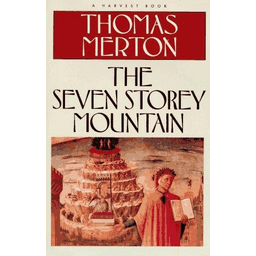
The title comes from Dante: the seven-story mountain of the Purgatorio, the terraced peak the soul climbs as it is purified of the seven deadly sins on the way toward God. Merton means it as a map of his own interior climb, from a directionless youth through a slow, stumbling conversion toward the monastic life. The voice is literary, allusive, and confessional in the old Augustinian sense - Merton is not narrating his life so much as examining it out loud, in front of God, looking for the pattern. It is the most widely read Catholic spiritual memoir of the modern era, and it has been read far beyond Catholic readers ever since it appeared.
✓ The good
- The most influential spiritual memoir of the 20th century - the book most often credited with introducing modern readers to the contemplative and monastic tradition
- Genuinely literary prose - Merton was a trained writer before he was a monk, and the sentences carry an energy and image-making most religious memoirs never reach
- Unusually honest about a misspent, searching youth - the worldly Columbia years are rendered without sanitizing, which is what makes the conversion land
- A rare inside view of cloistered monastic life - the Trappist horarium, the silence, the manual labor, the liturgy are described from within rather than observed from outside
- Widely read across traditions - a Catholic spiritual classic that Protestant, Orthodox, and other readers have long picked up for its portrait of conversion and the interior life
- The Augustinian structure works - like Confessions, it reads the chaos of a life backward and finds a shape in it, which is why it rewards re-reading
- A doorway to the rest of Merton - readers who finish it almost always go on to his later, quieter, more mature contemplative writing
✗ Watch out
- The young Merton’s 1940s tone can read as zealous and severe - the new convert is certain, sometimes harshly so, in ways the older Merton himself later softened
- It is long and discursive - 400-plus pages that wander through philosophy, travel, and interior argument before the monastery, and not every digression earns its length
- It predates Merton’s later, more ecumenical and interfaith writing - readers who love the older Merton sometimes find this early self narrower than the man he became
- Some period attitudes show their age - a handful of asides about the secular world and other belief systems reflect a mid-century, recently converted register that lands awkwardly today
- Not a how-to or a devotional - it is a memoir, not a manual; readers wanting structured spiritual practice will need to look to his later books or elsewhere
Best for
- Readers drawn to conversion stories and serious spiritual autobiography
- Anyone curious about monastic and contemplative life from the inside
- Readers who appreciate literary, Augustinian-style confessional prose
- Those wanting the on-ramp to Thomas Merton’s larger body of work
Avoid if
- You want a short, practical devotional rather than a long memoir
- You prefer the older, ecumenical Merton and find the early convert too severe
- You bounce off discursive mid-century prose with long philosophical detours
- You want a step-by-step guide to prayer or the spiritual life
What The Seven Storey Mountain is
The Seven Storey Mountain is Thomas Merton’s autobiography, published in 1948 and continuously in print since. It traces his life from a rootless childhood across France, England, and the United States, through his student years at Cambridge and Columbia, his early literary ambitions and dead-end pursuits, his gradual and halting conversion to Catholicism as a young man, and finally his decision to enter the Abbey of Gethsemani in Kentucky as a Trappist (Cistercian) monk. The arc is the climb of Dante’s purgatorial mountain, mapped onto one modern life.
It is a Catholic spiritual classic - Merton was a Catholic monk, and the book is shaped throughout by Catholic devotion, sacrament, and the monastic vocation. But it has never stayed inside Catholic readership. Like Augustine’s Confessions, which it consciously echoes, it tells a conversion story with enough literary force and psychological honesty that readers of many traditions, and of none, have picked it up to understand what a turn toward God can look like from the inside. It is best understood as a memoir of one man’s journey, not as a work of systematic theology or a manual of practice.
Why readers still climb the mountain with Merton
Most accounts of monastic life are written from the outside - a journalist visits, a scholar describes, an observer reports back on the strange men behind the wall. The Seven Storey Mountain is written from the inside by someone who got there the hard way. Merton does not present the monastery as exotic or the contemplative life as a curiosity. He presents it as the thing a particular restless, over-educated, modern mind was actually looking for the whole time without knowing it. That is a different and rarer book than the travelogue version, and it is why the memoir kept finding readers who had never given the cloister a second thought.
The other thing it has is the prose. Merton was a working writer before he was a monk, and he never stops being one on the page. The Columbia years crackle. The slow turn toward faith is rendered without the tidy, retrospective certainty that ruins most conversion narratives - you feel him stumbling, doubling back, talking himself in and out of things. By the time the monastery gate closes behind him, you have followed an actual person up an actual climb rather than watched a saint’s highlight reel. Readers across traditions come back to it for that honesty about the journey, not for any single doctrinal claim.
The conversion narrative: an Augustinian climb for the modern reader
The spine of the book is the conversion - the long, uneven movement from a young man who believed in nothing in particular to a man who gives his whole life to God in a monastery. Merton builds it the way Augustine built the Confessions, which he openly takes as his model: he reads his own past backward, looking for the moments where, in hindsight, he was being drawn toward something he could not yet name. A book bought almost at random. A church entered out of curiosity. A friendship, a conversation, a line of poetry that would not leave him alone. None of it feels engineered, and that is the craft - the turn arrives by accumulation, the way it usually does in a real life.
What keeps the narrative from preaching is Merton’s refusal to clean himself up. He renders the aimless, sometimes dissolute Columbia years with real candor, and he does not pretend the conversion fixed everything at once or that his motives were ever pure. The result is a conversion story a skeptic can follow without being condescended to, because the narrator is harder on himself than any outside critic would be. It is the section of the book that has done the most work on readers - the part people describe handing to a searching friend, the way an earlier generation handed out Confessions.
Inside the monastery: the Trappist life, described from within
The final stretch of the book takes the reader behind the wall of the Abbey of Gethsemani, and this is the material almost no other popular book of its era offered. Merton describes the Trappist day from the inside - the hours of liturgy that begin in the dark, the long silence, the manual labor in the fields, the deliberate stripping-away of the self that the Cistercian life is built around. He does not romanticize it. He is honest about the cold, the exhaustion, the tedium, and his own ongoing struggle with a writer’s ego inside a vocation built on disappearing. The monastery is rendered as a real place with a real rhythm, not a postcard.
This interior view is a large part of why the book mattered so much when it appeared. To a postwar readership that had no idea such a life still existed in the modern world - let alone in rural Kentucky - Merton made the contemplative vocation legible and even compelling without ever pitching it as a lifestyle. He is simply reporting, with a writer’s eye, on the world he had entered. Readers of every background have long picked the book up for exactly this: a clear-eyed, first-person account of what the silence is actually like, told by someone living inside it.
The prose and the literary self: Merton the writer who became a monk
The Seven Storey Mountain is, among other things, a book about a writer - and that tension runs through every page. Merton came to the monastery already shaped as a literary man: he had studied literature, written poetry and fiction, and lived inside books. He never sheds that. The memoir is allusive and image-rich, woven through with Dante, Augustine, Blake, and the poets of his youth, and it moves with the energy of someone who genuinely loves sentences. Part of the drama of the later chapters is precisely the friction between the writer who wants to make something and the monk who has vowed to let the self fall away.
That friction is also the book’s long-game payoff. The young Merton on these pages is intense, certain, and at times severe - a new convert with the volume turned up. Over the decades that followed, in dozens of later books, he became quieter, more searching, and far more open to other traditions, eventually becoming one of the century’s notable voices in interfaith dialogue. Reading The Seven Storey Mountain is reading the loud, brilliant first chapter of that longer story. It stands on its own, but it also points forward - which is why almost no one who finishes it stops here.
Pricing
Paperback
~$17
The standard Mariner Books trade paperback. The copy most people own and the one quotations are usually keyed to.
Kindle / ebook
~$13
Searchable and highlight-syncs across devices - handy for a book this quotable and this long.
Audiobook
~$20 or 1 Audible credit
A full unabridged recording; Merton’s literary prose carries well read aloud, though the runtime is substantial.
Used paperback
~$4-8
Widely available secondhand - the book has been in print continuously since 1948, so used copies are everywhere.
Fiftieth-anniversary edition
~$20
Includes a later introduction and a note on the original censorship of the manuscript - useful context for first-time readers.
The Seven Storey Mountain is not free. It has been in print without interruption since 1948, so the easiest and cheapest way in is a used paperback - they turn up at library sales, thrift stores, and online for four to eight dollars, which is how a lot of readers acquire their first copy. A new Mariner Books trade paperback runs around seventeen dollars and is the everyday default, the edition most quotations and page references are keyed to.
The Kindle edition runs around thirteen dollars, a little under the paperback, and highlighting syncs across devices - genuinely useful for a book this long and this quotable. The unabridged audiobook is around twenty dollars or a single Audible credit; Merton’s literary prose holds up well read aloud, though at this length the audio is a real time commitment rather than a weekend listen.
If you want context, the fiftieth-anniversary edition (around twenty dollars) is the one to pick - it adds a later introduction and a note on how the original manuscript was edited and censored before publication, which helps a first-time reader understand the book’s history. Most readers do not need the anniversary edition; the standard paperback is the balanced default and the copy you will mark up and lend out.
Where The Seven Storey Mountain falls behind
The early convert’s tone. The Merton of this book is young, recently converted, and certain, and the certainty sometimes runs hot - there are passages where the new monk is severe about the world he left and about other ways of believing. The older Merton himself grew uneasy with that tone. It is worth reading the book knowing the author later changed, rather than mistaking the loud first chapter for the whole man.
Length and digression. This is a 400-plus-page memoir that takes its time. Merton wanders through philosophy, travel, friendships, and long stretches of interior argument before the monastery arrives, and not every detour pays for itself. A reader who wants a tight narrative will feel the drift. The payoff is real, but you have to be willing to climb.
It predates the later, ecumenical Merton. The contemplative writer many readers most admire - open to other traditions, in dialogue across faiths, gentler and more questioning - largely comes after this book. Some readers who arrive through the later work find this early self narrower than expected. That is a fair reaction; the man genuinely grew, and this is where he started.
Not a practical guide. The Seven Storey Mountain is a memoir, not a devotional or a how-to. It will move you and it may make you curious about prayer and silence, but it does not teach a method. Readers who want structured spiritual practice will need Merton’s later books - or a different kind of book entirely.
The Seven Storey Mountain vs. Confessions vs. The Story of a Soul
These three are the spiritual-memoir shortlist, and they do genuinely different jobs across very different centuries. Confessions (Augustine, c. 400 AD) is the conversion-memoir archetype - the book that invented the form, reading a wayward life backward as a long, providential turn toward God, and the book Merton openly takes as his model. The Seven Storey Mountain (Merton, 1948) is the modern heir - Augustine’s structure applied to a 20th-century intellectual who ends up in a Trappist monastery, written by a literary man with a literary man’s ear. The Story of a Soul (Thérèse of Lisieux, published 1898) is the quieter counterpoint - the brief, interior memoir of a young Carmelite nun whose “little way” of small acts of love became one of the most beloved spiritual autobiographies ever written.
Different strengths. Augustine is the deepest and most foundational - sixteen centuries of Christian self-writing descend from it. Merton is the most accessible to a modern reader and the most vivid about the contemplative life as a living, present-day option. Thérèse is the gentlest and the shortest - a book about smallness and trust rather than dramatic conversion. If you want the modern story of a worldly mind turning toward the monastery, it is Merton. If you want the ancient source he is drawing on, read Confessions. If you want the tender, interior alternative to the dramatic-conversion arc, The Story of a Soul is the one.
All three are read well beyond their original audiences. Confessions is shared across nearly every Christian tradition. The Seven Storey Mountain and The Story of a Soul are Catholic spiritual classics that have long found readers of other traditions and of none, picked up for their portraits of conversion and the interior life rather than for any single doctrinal claim.
The bottom line
The Seven Storey Mountain is the spiritual memoir that defined the modern genre, and seventy-five years on it has fully earned its place as a classic. It is long, and the young Merton’s voice runs hot in places, but the prose is alive, the conversion is rendered with rare honesty, and the view inside the monastery is one almost no other book of its era offered. If you want to understand what could draw a brilliant, restless, modern person toward silence - and what the rest of Thomas Merton grew out of - this is still the book to start with.
Alternatives to The Seven Storey Mountain
 ConfessionsAugustine’s 4th-century autobiography - the conversion-memoir archetype Merton consciously echoes, and the source the whole genre descends from.
 The Story of a SoulThérèse of Lisieux’s brief, interior memoir - the gentle, “little way” counterpoint to Merton’s dramatic conversion arc.
 Rome Sweet HomeScott and Kimberly Hahn’s modern conversion story - a more recent, plainspoken account of a turn toward the Catholic Church.
 HallowA Catholic prayer and meditation app - where to go if Merton leaves you wanting a structured, daily contemplative practice.
Frequently asked questions
What is The Seven Storey Mountain about?
It is Thomas Merton’s 1948 autobiography, tracing his path from a rootless, worldly youth - educated at Cambridge and Columbia - through his conversion to Catholicism and his decision to enter the Abbey of Gethsemani in Kentucky as a Trappist monk. The title comes from the seven-story mountain of Dante’s Purgatorio, the soul’s climb toward God.
Who was Thomas Merton?
Thomas Merton (1915-1968) was a writer who became a Trappist (Cistercian) monk at the Abbey of Gethsemani. The Seven Storey Mountain made him one of the best-known spiritual writers of the 20th century, and over the following decades he wrote many more books, becoming a notable voice in contemplative spirituality and, later, in interfaith dialogue.
Is The Seven Storey Mountain only for Catholic readers?
No. It is a Catholic spiritual classic - Merton was a Catholic monk and the book is shaped by Catholic devotion and the monastic life - but it has been read widely beyond Catholic readers since it appeared. Like Augustine’s Confessions, it is picked up across traditions for its portrait of conversion and the interior life.
Is it hard to read?
It is readable but it is long - more than 400 pages - and discursive, with stretches of philosophy and interior argument before the monastery. The prose itself is vivid and literary rather than dense, but it asks for patience. A reader who wants a short, tight narrative will feel the wandering; one who settles in tends to find it rewarding.
Why is the early Merton sometimes called “severe”?
The book is written by a young, recently converted monk, and the new convert’s certainty runs hot in places - he can be sharp about the world he left and about other ways of believing. The older Merton himself grew uneasy with that tone and became gentler and more open over the decades that followed. Many readers find it helpful to read this as his loud first chapter rather than his final word.
What should I read after The Seven Storey Mountain?
Most readers go on to Merton’s later, quieter work - New Seeds of Contemplation and The Sign of Jonas are common next reads. For the conversion memoir he was modeling, read Augustine’s Confessions. For a gentler interior memoir, try Thérèse of Lisieux’s The Story of a Soul. For a structured daily contemplative practice rather than a memoir, an app like Hallow is a different but related on-ramp.
Which edition should I buy?
The standard Mariner Books paperback (around $17) is the right default for most readers, and used copies are easy to find for a few dollars since the book has never gone out of print. Pick the fiftieth-anniversary edition (around $20) if you want the added introduction and the note on the manuscript’s original editing. Choose the audiobook (around $20 or one Audible credit) if you prefer to listen, keeping in mind the substantial runtime.
Sources & further reading
More Catholic Books
 Catechism of the Catholic ChurchThe official, full-length compendium of Catholic doctrine - four pillars, ~2,865 numbered paragraphs, free online at the Vatican, and the reference nearly every other Catholic resource quotes.
 Compendium of the Catechism of the Catholic ChurchThe official 598-question summary of the full Catechism - Catholic doctrine in a portable question-and-answer format, with the complete text free at vatican.va.
 CatholicismBishop Robert Barron's richly illustrated tour of the Catholic faith - the companion book to the Word on Fire documentary series, written to walk a curious reader from Jesus to the last things.
 Introduction to ChristianityThe 1968 lectures that a young Joseph Ratzinger - later Pope Benedict XVI - turned into one of the 20th century's most cited works of Catholic theology, built section by section on the Apostles' Creed.
 Jesus of NazarethA sitting pope's personal, scholarly reading of the Gospels - three volumes that engage modern biblical criticism while searching for the Jesus the Gospels actually present.Story of a SoulThe spiritual autobiography of a young Carmelite nun who died at 24 - the small, warm book that taught a century of readers a path of holiness through little things done with great love.