Genesis 46
People in this chapter
Israel is old. He has lived a hundred and thirty years, seen Joseph alive against every expectation, and now stands at the edge of a wrenching choice: travel south into Egypt, where his family can be fed through the famine, or cling to Canaan, the land of the promise. He chooses to go. But before he crosses the southern border he stops at Beer-sheba - the place where Abraham once dug a well and swore an oath, the southern boundary of the promised land - and his first act is not to hurry but to offer sacrifice to the God of his father Isaac.1
Tap any highlighted phrase to jump to the commentary that unpacks it.
Genesis 46:1-7I Will Go Down With Thee, and Surely Bring Thee Up Again
1And Israel took his journey with all that he had, and came to Beersheba, and offered sacrifices unto the God of his father Isaac. 2And God spake unto Israel in the visions of the night, and said, Jacob, Jacob. And he said, Here am I. 3And he said, I am God, the God of thy father: fear not to go down into Egypt; for I will there make of thee a great nation: 4I will go down with thee into Egypt; and I will also surely bring thee up again: and Joseph shall put his hand upon thine eyes.
Israel does not bolt for Egypt. He pauses. And Israel took his journey with all that he had, and came to Beer-sheba, and offered sacrifices unto the God of his father Isaac (v. 1). Beer-sheba is no random waypoint; it is the well Abraham dug and the place where he swore an oath, the southern edge of the land of promise - the last ground that belongs to the covenant before the wilderness and Egypt begin.
And it is laden with Isaac's memory too, for there the LORD had appeared to Isaac and said, Fear not, for I am with thee. Notice what Israel does at this threshold: his first act is worship. Before he steps out of the land, he builds his pause around sacrifice to the God of his father Isaac. The phrasing matters - this is the same God his fathers knew, carried with him into the new country.
A frightened man at the edge of the unknown does not rush across; he stops, and offers, and waits to hear. The chapter is teaching its lesson before God says a word: when you stand at the border of a season you did not choose, the first move is not to run but to turn toward the God of your fathers.1
God answers the worship: And God spake unto Israel in the visions of the night, and said, Jacob, Jacob. And he said, Here am I (v. 2). The visions of the night have been the very signature of God's speech to this man - the ladder at Bethel when he first fled the land, the wrestling at Peniel, and now Beer-sheba as he leaves it for the last time. In the dark, when a word from God arrives without warning, Jacob still knows the voice.
And God calls his name twice - Jacob, Jacob - the doubled address Scripture saves for moments of tenderness and weight, as with Abraham, Abraham on the mountain and Moses, Moses at the bush and Samuel, Samuel in the night. It is the way you call to someone you love and do not want to startle. The old man's reply is the reply of every servant who has heard that call before him: Here am I. Two short words, and they hold everything - simply here am I, present and listening, ready for whatever the voice will say.
Then comes the word the whole chapter is built around: I am God, the God of thy father: fear not to go down into Egypt; for I will there make of thee a great nation: I will go down with thee into Egypt; and I will also surely bring thee up again (vv. 3-4). He does not promise to keep Israel out of Egypt; the going-down is real, and it will stretch into centuries.
What He promises is to be in it. Fear not to go down - God will make the descent with him: I will go down with thee. And the descent is never the last word. Listen to the two movements set side by side: I will go down with thee… and I will also surely bring thee up again. Down, then - surely - up. The little word surely is doing all the work; it turns the bringing-up from a hope into a guarantee.
Egypt is recast in a single sentence: not exile from God but a passage God will walk every step of, with the return already pledged before the journey has even begun. The promise that He will there make of thee a great nation looks past the famine to the multitude that will one day walk out at the Exodus - the seed kept alive and grown in the very place that looked like the end of the road.2
The promise ends on a small, intimate detail that is easy to pass over: and Joseph shall put his hand upon thine eyes (v. 4). To close a dying parent's eyes was a son's last act of love and honor, a sign that the one who died did not die alone or forgotten but was tended to the end by his own. God is telling the old man more than that he will reach Egypt and come up again in his descendants; He is telling him how his own life will close - in peace, with his beloved son beside him, the very son he had mourned as dead now near enough to lay a hand over his eyes.
There is great kindness in this. The promise does not merely cover the great arc of nation and return; it stoops to the deathbed and the hand of a son. The God who pledges to bring a whole people up again also cares how one tired man will breathe his last. And it answers the long ache of Jacob's life directly: the father who once cried that he would go down into the grave unto my son mourning is told instead that his son will be the one to close his eyes.
5And Jacob rose up from Beersheba: and the sons of Israel carried Jacob their father, and their little ones, and their wives, in the wagons which Pharaoh had sent to carry him. 6And they took their cattle, and their goods, which they had gotten in the land of Canaan, and came into Egypt, Jacob, and all his seed with him: 7His sons, and his sons’ sons with him, his daughters, and his sons’ daughters, and all his seed brought he with him into Egypt.
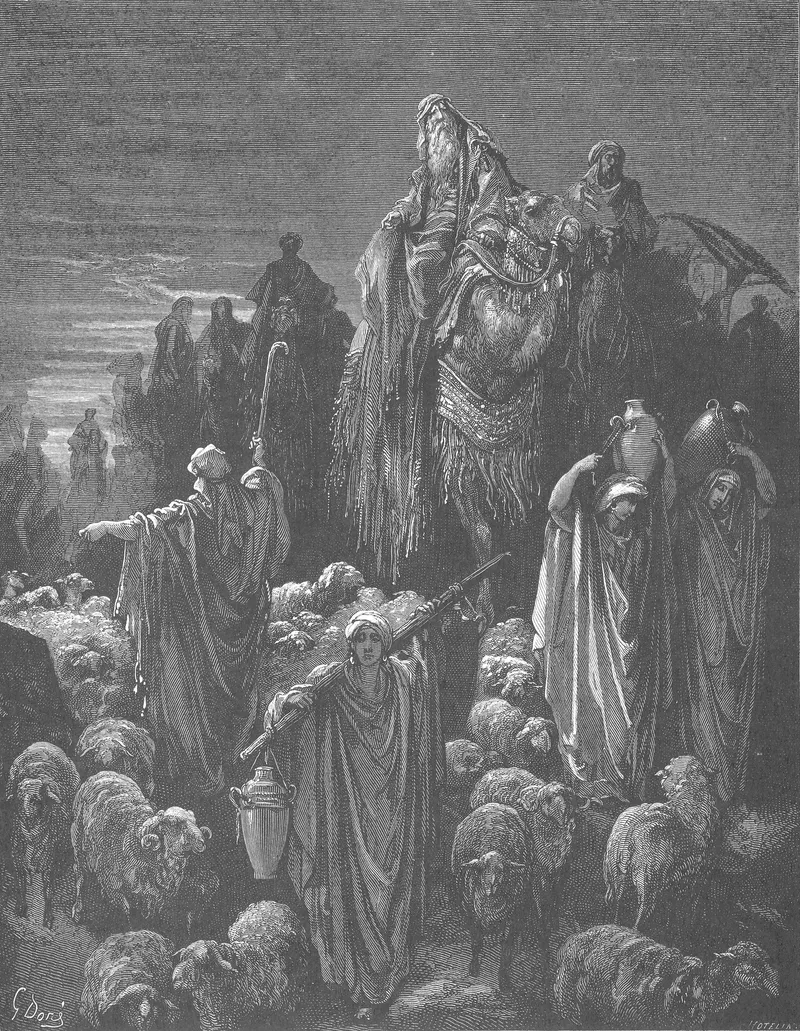
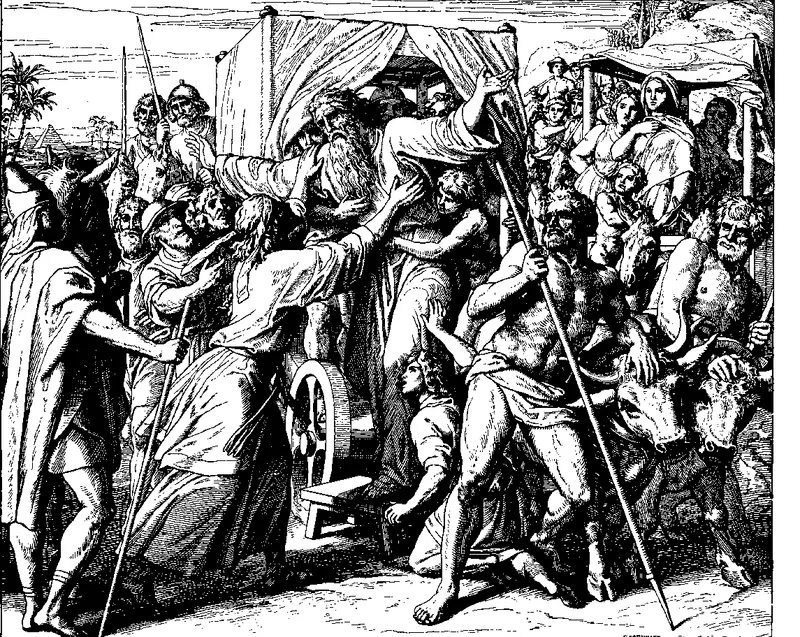
With the word from God behind him, Jacob acts: And Jacob rose up from Beer-sheba (v. 5). The fear has been met, and now the journey begins in earnest. The family travels in the wagons which Pharaoh had sent - a quiet sign that the machinery of an empire has been arranged in advance to receive this one household, because Joseph already stands second in all of Egypt. They bring everything: their cattle, their goods, the substance they had gotten in the land of Canaan. And then the text presses the point that matters most by repeating it: Jacob, and all his seed with him (v. 6), and again, his sons, and his sons' sons… his daughters, and his sons' daughters, and all his seed (v. 7).
No one is left behind. The whole family of promise - three generations, the little ones and the elderly, sons and daughters together - goes down as one intact household, carried whole into Egypt. The repetition of all his seed is the narrator's way of underlining that what descends into Egypt is precisely the line through which the promise to Abraham must travel. God said He would go down with him and bring him up again - and what goes down is the entire seed He has sworn to keep.
Genesis 46:8-27The Souls of the House of Jacob: Threescore and Ten
8And these are the names of the children of Israel, which came into Egypt, Jacob and his sons: Reuben, Jacob’s firstborn. 9And the sons of Reuben; Hanoch, and Phallu, and Hezron, and Carmi. 10And the sons of Simeon; Jemuel, and Jamin, and Ohad, and Jachin, and Zohar, and Shaul the son of a Canaanitish woman. 11And the sons of Levi; Gershon, Kohath, and Merari. 12And the sons of Judah; Er, and Onan, and Shelah, and Pharez, and Zarah: but Er and Onan died in the land of Canaan. And the sons of Pharez were Hezron and Hamul. 13And the sons of Issachar; Tola, and Phuvah, and Job, and Shimron. 14And the sons of Zebulun; Sered, and Elon, and Jahleel. 15These be the sons of Leah, which she bare unto Jacob in Padanaram, with his daughter Dinah: all the souls of his sons and his daughters were thirty and three.
It would be easy to read these verses as a dry interruption - a census wedged between the promise and the reunion. The text means something richer. And these are the names of the children of Israel, which came into Egypt (v. 8): this is the family of promise being counted as it crosses over, and the narrator wants every name written down. The roll is ordered by Jacob's wives, beginning with Leah - Reuben, Jacob's firstborn at the head - through her six sons and their children, closing, These be the sons of Leah… with his daughter Dinah: all the souls of his sons and his daughters were thirty and three (v. 15).
These are not strangers; they are the men whose stories fill the second half of Genesis. Reuben, who lost the birthright. Simeon and Levi, whose anger God will scatter. Judah, through whom the scepter will come, his sons listed with the candor Scripture never softens - Er and Onan died in the land of Canaan - and the line carried instead through Pharez, born of the painful story of Tamar. To read these names is to read the whole troubled, redeemed family at once.
God chose this household, with all its grief and failure, and He is carrying every member of it down into Egypt to keep the promise alive.
16And the sons of Gad; Ziphion, and Haggi, Shuni, and Ezbon, Eri, and Arodi, and Areli. 17And the sons of Asher; Jimnah, and Ishuah, and Isui, and Beriah, and Serah their sister: and the sons of Beriah; Heber, and Malchiel. 18These are the sons of Zilpah, whom Laban gave to Leah his daughter, and these she bare unto Jacob, even sixteen souls. 19The sons of Rachel Jacob’s wife; Joseph, and Benjamin. 20And unto Joseph in the land of Egypt were born Manasseh and Ephraim, which Asenath the daughter of Potipherah priest of On bare unto him. 21And the sons of Benjamin were Belah, and Becher, and Ashbel, Gera, and Naaman, Ehi, and Rosh, Muppim, and Huppim, and Ard. 22These are the sons of Rachel, which were born to Jacob: all the souls were fourteen. 23And the sons of Dan; Hushim. 24And the sons of Naphtali; Jahzeel, and Guni, and Jezer, and Shillem. 25These are the sons of Bilhah, which Laban gave unto Rachel his daughter, and she bare these unto Jacob: all the souls were seven.
The roll continues through the other three mothers, and the care of its arrangement says something tender. The sons of Zilpah and Bilhah - the handmaids - are counted with exactly the same dignity as the sons of Leah and Rachel: these are the sons of Zilpah… even sixteen souls (v. 18); these are the sons of Bilhah… all the souls were seven (v. 25). In a household riven for years by rivalry between wives, the final ledger makes no distinctions of rank.
Every branch is named, every child counted, all of them simply the souls of the house of Jacob. And the line of Rachel carries its own quiet weight: The sons of Rachel Jacob's wife; Joseph, and Benjamin (v. 19) - the two sons of the wife Jacob loved and lost, one of whom he had mourned as dead and is about to embrace alive. Joseph's own sons, Manasseh and Ephraim, are folded in though they were born in Egypt to an Egyptian mother (v. 20); the family of promise is already reaching to gather those born far from Canaan.
The list is not flattening these people into numbers. It is doing the opposite - insisting that each one, handmaid's son and favored wife's son alike, belongs to the household God is keeping.
26All the souls that came with Jacob into Egypt, which came out of his loins, besides Jacob’s sons’ wives, all the souls were threescore and six; 27And the sons of Joseph, which were born him in Egypt, were two souls: all the souls of the house of Jacob, which came into Egypt, were threescore and ten.
The roll closes with a careful sum: All the souls that came with Jacob into Egypt… were threescore and six; and the sons of Joseph, which were born him in Egypt, were two souls: all the souls of the house of Jacob, which came into Egypt, were threescore and ten (vv. 26-27). The arithmetic is drawn as a closed circle. Sixty-six came down in the migration itself; Joseph, already in Egypt, and his two Egyptian-born sons complete the count; with Jacob himself the house numbers seventy.
It is a small, whole, countable family - and that smallness is the point. God had promised at Beer-sheba to make of this man a great nation, and the chapter sets the promise against the figure that must grow into it: seventy souls. From these seventy, the book of Exodus will open by counting the same number again - all the souls that came out of the loins of Jacob were seventy souls - and then telling how they were fruitful, and increased abundantly… and the land was filled with them. The seventy who go down in fear become the multitude who come up at the Exodus.
This is what the household roll is really recording: the precise seed God is carrying into Egypt to keep alive through famine, the small beginning out of which He has sworn to bring a great people up again.2
Genesis 46:28-34Now Let Me Die, Since I Have Seen Thy Face
28And he sent Judah before him unto Joseph, to direct his face unto Goshen; and they came into the land of Goshen. 29And Joseph made ready his chariot, and went up to meet Israel his father, to Goshen, and presented himself unto him; and he fell on his neck, and wept on his neck a good while. 30And Israel said unto Joseph, Now let me die, since I have seen thy face, because thou art yet alive.
One small detail opens the reunion: And he sent Judah before him unto Joseph, to direct his face unto Goshen (v. 28). Of all the brothers, it is Judah who is sent ahead to find the way. The choice is quietly loaded. This is the same Judah who once said of the boy in the pit, Come, and let us sell him to the Ishmaelites, and who had a hand in the lie that left their father grieving for years.
Yet by now Judah is the one who had offered his own life as surety for Benjamin, the one whose plea before Joseph broke the whole story open. The brother who once led the selling of Joseph is now trusted to lead the family to Joseph. The text does not pause to moralize; it simply lets Judah go ahead. But the reader who has followed the story feels the weight of it. Real reconciliation has already happened among these brothers - the betrayal is behind them, the trust restored - and Judah's errand to Goshen is the proof.
It is fitting, too, that the one sent to prepare the way is Judah, the tribe through whom the One who reconciles all things will come.
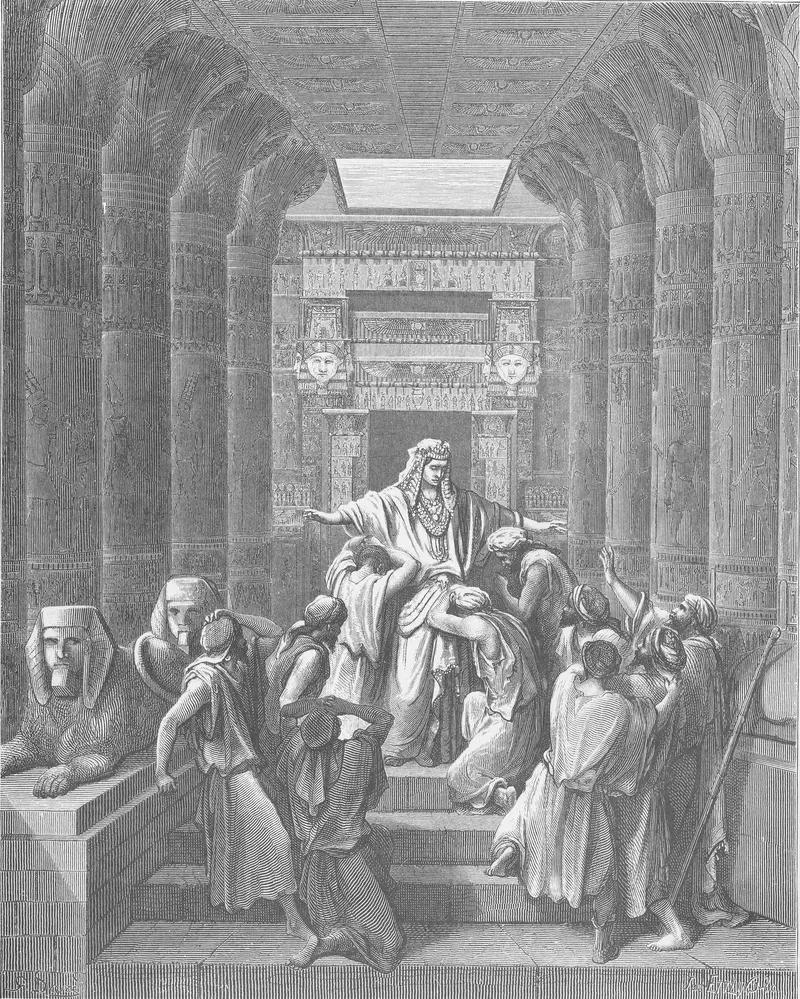
Then the meeting itself: And Joseph made ready his chariot, and went up to meet Israel his father, to Goshen, and presented himself unto him; and he fell on his neck, and wept on his neck a good while (v. 29). Consider who this is. Joseph is the second man in all of Egypt; he rides in his own chariot, wears Pharaoh's ring, holds the bread of nations in his hand. And every bit of that rank falls away the moment he sees his father.
He does not summon the old man to the palace; he goes up to meet him, and then the prince of Egypt simply fell on his neck and wept. The phrase a good while is striking - the narrator, usually so sparing, lingers to tell us the weeping went on and on. These are not the quick tears of a single emotion but the release of twenty-two years - two decades of a father's grief and a son's exile pouring out at once.
The same Jacob who long ago fell on the neck of his brother Esau is now on the receiving end, his son falling on his neck. The text lets them weep without comment, and in doing so it honors the grief. Some sorrows are too deep for a sentence; they can only be wept out, a good while, in the arms of the one given back.
Out of the weeping comes one of the most moving sentences in Genesis: And Israel said unto Joseph, Now let me die, since I have seen thy face, because thou art yet alive (v. 30). These are the words of the deepest peace a man can speak. For more than twenty years Israel had carried an open wound - he had refused to be comforted, certain that he would go down to the grave mourning his son.
The whole burden of his old age had been the belief that Joseph was dead. Now he holds the living face of the son he had mourned, and the wound closes. Now let me die - I am ready now; the one thing my heart could not let go of has been given back, and I can depart in peace. There is a whole theology of consolation packed into the little word now. The sight of the beloved one alive empties death of its old terror by healing the grief that made it unbearable.
A man who has seen his dead made alive can lay his life down in peace. And it is exactly the face he had despaired of ever seeing - since I have seen thy face - that gives him rest.
31And Joseph said unto his brethren, and unto his father’s house, I will go up, and shew Pharaoh, and say unto him, My brethren, and my father’s house, which were in the land of Canaan, are come unto me; 32And the men are shepherds, for their trade hath been to feed cattle; and they have brought their flocks, and their herds, and all that they have. 33And it shall come to pass, when Pharaoh shall call you, and shall say, What is your occupation? 34That ye shall say, Thy servants’ trade hath been about cattle from our youth even until now, both we, and also our fathers: that ye may dwell in the land of Goshen; for every shepherd is an abomination unto the Egyptians.
The chapter ends with Joseph teaching his family how to live in a land not their own: when Pharaoh shall call you… ye shall say, Thy servants' trade hath been about cattle from our youth even until now… that ye may dwell in the land of Goshen; for every shepherd is an abomination unto the Egyptians (vv. 33-34). At first the advice sounds strange - why volunteer the very fact that will repel the Egyptians?
But the strangeness is the wisdom. Egypt looked down on herdsmen; the settled, river-fed civilization held the wandering shepherd in contempt. By telling Pharaoh plainly what they are, Jacob's family will be given exactly the place they need: Goshen, the good pastureland on the margin of Egypt, set apart from the cities and the temples, where they can keep their flocks and, just as importantly, keep their distinctness as a people. The instruction is shrewd and faithful at once.
Joseph tells his family to say the simple truth about themselves - we are shepherds - and trust that the very truth others despise will mark out the space God has prepared for them. Goshen is not the heart of Egypt, and it is not meant to be. It is the place where the seed of promise can grow into a nation without being swallowed by the land it is only passing through.2
Research trail
Sources & further study
These references support the historical, linguistic, manuscript, and contextual notes in this chapter. Scripture remains the primary text; external sources are provided so readers can inspect the research directly.
- Genesis 46 · Hebrew + classical Jewish commentaryThe Hebrew text of Genesis 46 with Rashi, Ibn Ezra, and other classical commentators side by side - useful for the doubled call Yaakov, Yaakov (v. 2), for the verb yarad behind “go down” (vv. 3-4), and for the much-discussed count of the souls of the house of Jacob in verses 26-27.
- Genesis 46 - Translators' NotesThe NET Bible's detailed footnotes on Genesis 46 - the worship at Beer-sheba and the night vision (vv. 1-4), the structure of the household roll arranged by Jacob's wives (vv. 8-25), the arithmetic of the seventy souls (vv. 26-27), and the cultural note behind “every shepherd is an abomination unto the Egyptians” (v. 34).
- Genesis 46 ↔ Exodus 1 · John 14 · Ephesians 4 · Luke 2Traces the threads tying Genesis 46 to the rest of Scripture - the threescore and ten who go down (v. 27) read alongside the nation that comes out at the Exodus (Exod. 1:5), and the promise to go down… and surely bring thee up again (v. 4) read beside the One who descended and ascended (Eph. 4:9-10) and who says, I will come again, and receive you unto myself (John 14:3).
Where this echoes in Scripture
I Will Go Down With Thee, and Surely Bring Thee Up Again
- Genesis 26:24I am the God of Abraham thy father: fear not, for I am with thee, and will bless thee.The same word once spoken to Isaac at this very place - fear not, for I am with thee - echoed to Jacob at Beer-sheba in verses 3-4.
- Genesis 28:15I am with thee, and will keep thee in all places whither thou goest, and will bring thee again into this land.God's promise to Jacob at Bethel, the first night vision - the going-out and the bringing-back that verse 4 now renews.
- John 14:2-3I go to prepare a place for you... I will come again, and receive you unto myself; that where I am, there ye may be also.The certainty of a bringing-up after a going-down (v. 4) - the One who descended pledging to come again and receive His own.
- Ephesians 4:9-10He that descended is the same also that ascended up far above all heavens, that he might fill all things.The descent-then-ascent of verse 4 carried to its depth - the One who went down is the same who came up again.
- Exodus 3:8I am come down to deliver them out of the hand of the Egyptians, and to bring them up out of that land.The promise of verse 4 kept - the same God who went down with Israel coming down to bring His people up again at the Exodus.
The Souls of the House of Jacob: Threescore and Ten
- Exodus 1:5-7And all the souls that came out of the loins of Jacob were seventy souls... And the children of Israel were fruitful, and increased abundantly.The seventy of verse 27 counted again at the start of Exodus - the small household that became the multitude God promised (v. 3).
- Genesis 45:7God did send me before you to preserve you a posterity in the earth, and to save your lives by a great deliverance.Why the household is being carried down and kept - the seed of promise preserved alive through the famine.
- Deuteronomy 10:22Thy fathers went down into Egypt with threescore and ten persons; and now the LORD thy God hath made thee as the stars of heaven for multitude.Moses looking back on the count of verse 27 - seventy who went down, grown to a people beyond number.
- Matthew 1:2-3Jacob begat Judas and his brethren; and Judas begat Phares and Zara of Thamar; and Phares begat Esrom.The line of Judah and Pharez (vv. 12) carried forward - the very names of this roll standing in the genealogy of Christ.
- Genesis 22:18And in thy seed shall all the nations of the earth be blessed; because thou hast obeyed my voice.The promise the seventy souls are being kept for - the seed through whom every nation would be blessed.
Now Let Me Die, Since I Have Seen Thy Face
- Luke 2:29-30Lord, now lettest thou thy servant depart in peace, according to thy word: for mine eyes have seen thy salvation.The very note of verse 30 - an aged saint made ready to die in peace by the sight of the long-awaited beloved.
- Genesis 37:35I will go down into the grave unto my son mourning. Thus his father wept for him.The wound that verse 30 finally heals - the grief Jacob had carried for over twenty years, now reversed.
- John 20:20Then were the disciples glad, when they saw the Lord.The joy of seeing the beloved alive again (v. 29) - sorrow turned to gladness at the sight of the living one given back.
- Genesis 33:4And Esau ran to meet him, and embraced him, and fell on his neck, and kissed him: and they wept.The same embrace as verse 29, now reversed - the one who once fell on a brother's neck is met by a son falling on his.
- Psalm 23:1The LORD is my shepherd; I shall not want.The trade Egypt despised (vv. 32, 34) lifted to its highest honor - the keeping of a flock claimed by God Himself.