Painter of the Bible
Wenceslaus Hollar
Wenceslaus Hollar — Václav Hollar in his native Czech, also signed Wenzel Hollar in his Continental years — was a Bohemian-born etcher who became one of the great topographical and religious printmakers of seventeenth-century Northern Europe.
.jpg%3Fwidth%3D600&w=2048&q=75)
Their faith
Why Wenceslaus Hollar painted Christ
Wenceslaus Hollar, a Bohemian-born artist, dedicated his life to the craft of etching, producing remarkable works that reflect his deep Christian faith. Born in Prague in 1607, Hollar faced the turmoil of the Thirty Years' War, which displaced his family and set him on a path that would intertwine art and devotion. His training under Matthäus Merian the Elder in Frankfurt and Strasbourg, followed by his time in England, allowed him to flourish as a printmaker. Hollar's faith was evident in his extensive religious output, which included illustrations for Francis Quarles's Protestant emblem book, 'Quarles' Emblems.' This work exemplified his commitment to Christian themes, using allegorical figures to convey profound spiritual truths. His artistic journey was not just a profession but a form of worship, as he sought to express the beauty of scripture through his art.
Hollar's faith profoundly shaped his artistic vision, leading him to create a significant body of work that includes depictions of the Apostles, the Crucifixion, and the Resurrection. His series of etchings, such as 'Christ Carrying the Cross,' showcases not only his technical mastery but also his desire to inspire devotion among viewers. The emotional depth and spiritual resonance found in his prints invite contemplation and reflection on the life and sacrifice of Christ. Even in his later years, as he faced poverty, Hollar's commitment to his craft and faith remained unwavering. His works continue to reach audiences today, serving as a testament to the enduring power of art to uplift the spirit and connect us to the divine.
Life & work
Wenceslaus Hollar — Václav Hollar in his native Czech, also signed Wenzel Hollar in his Continental years — was a Bohemian-born etcher who became one of the great topographical and religious printmakers of seventeenth-century Northern Europe. Born in Prague in 1607 to a minor official of the Bohemian Royal Chamber, displaced by the destruction of his family's circumstances in the Thirty Years' War, and trained in Frankfurt and Strasbourg with the printmaker Matthäus Merian the Elder, he was eventually taken into the household of the English collector Thomas Howard, Earl of Arundel, and brought to England in 1636. He worked in London for the rest of his life with brief returns to Antwerp during the English Civil War, and died in poverty in London in 1677.
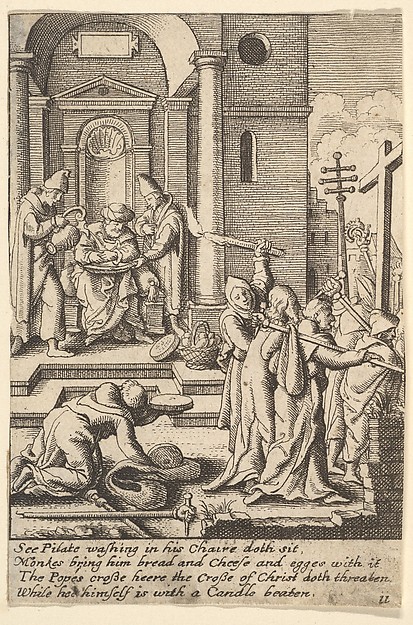
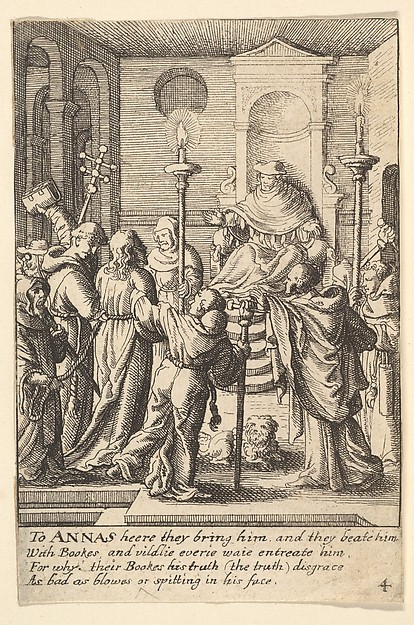
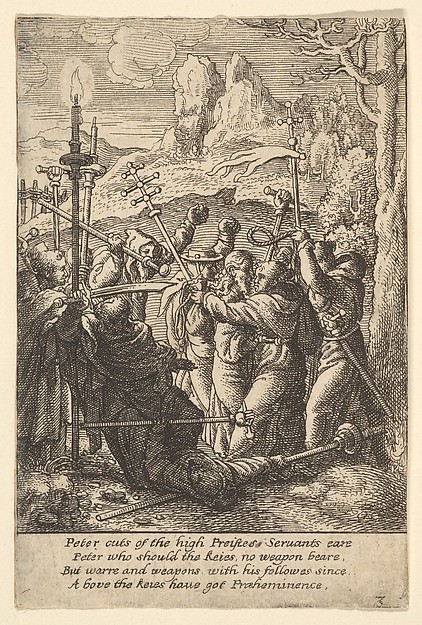
His religious etched output is large and varied. The complete illustrated edition of the Aedes Walpolianae and the Histriomastix included his plates of Christian iconography. The Quarles' Emblems (London, 1635, with later editions) — Francis Quarles's Protestant emblem book — used Hollar's etched plates of the Anima (the Soul) in dialogue with allegorical figures; the volume was the most-reprinted English Protestant devotional emblem book of the seventeenth century. His series of the Apostles, the Saints, the Christ Carrying the Cross, the Crucifixion, and the great Resurrection plates after Italian and Flemish painters circulated through the English print market and shaped Anglican visual devotion in the decades around the Restoration.
He was the supreme topographer of his generation. The Long View of London (1647), engraved during his exile in Antwerp, remains the principal visual record of pre-Great-Fire London. The Theatre of Women, the Costumes of Several Nations, the Views of English Cathedrals (the great series of pre-Restoration views of Lincoln, York, Salisbury, Worcester, and others, several of which were destroyed or altered in the Civil War) — all show his characteristic combination of patient observation, fine etched line, and gentle atmospheric tone.
He produced about 2,700 etchings in his career, on every conceivable subject; the modern catalogue raisonné by Richard Pennington (1982) is the standard reference. He was buried in St. Margaret's churchyard in Westminster, the parish church of the House of Commons.
Notable works in detail
met-360736
Descent from the Cross, etched by Wenceslaus Hollar around 1640 in his middle career, depicts the moment after the Crucifixion in which the body of Christ is being lowered from the cross by Joseph of Arimathea and Nicodemus, with the Virgin and Mary Magdalene gathered at the foot of the cross to receive him. Hollar stages the scene with his characteristic patient observation and finely worked etched line — the body suspended in mid-descent, the white winding sheet draped to catch it, the gathered mourners in postures of restrained sorrow against a darkened landscape with the city of Jerusalem fading into the distant background. The print is one of the early Hollar treatments of a Passion subject in his English exile period and demonstrates the gentle atmospheric tone that characterized his entire religious printmaking output.
met-360830
Crucifixion, etched by Wenceslaus Hollar around 1644 as one of the plates of his great Passion series produced during his Antwerp exile years (when the English Civil War interrupted his London career), depicts the moment of Christ's death on the cross. Hollar stages the scene with characteristic Bohemian-into-English topographical care: the cross at the upper center against a darkening sky; the swooning Virgin in the arms of John on the left; the Magdalene clinging to the foot of the cross; the centurion on horseback in the foreground recognizing the divinity of the dying Christ; the two thieves still alive on their crosses to either side. The Antwerp Passion series circulated widely through both the Catholic Spanish Netherlands and the Protestant English-speaking print market and was reprinted in editions for a century and a half after its first publication.
met-360832
Descent into Hell (The Harrowing of Hell), etched by Wenceslaus Hollar around 1644 as one of the plates of his Antwerp Passion series, illustrates the apocryphal Harrowing of Hell — the tradition that Christ between his death on Friday and his Resurrection on Sunday descended into the underworld to free the souls of the just who had died before his Incarnation. Hollar stages the scene with Bohemian late-Northern-Renaissance density: Christ steps out of the great open mouth of hell at the lower right with his banner of Resurrection raised, while Adam, Eve, and the patriarchs emerge from behind him into the upper light; the rest of the print is filled with the small writhing figures of the still-damned and the demons who guard them. The print circulated through both the Catholic and Protestant publishing networks throughout the seventeenth century.
met-360829
Carrying the Cross, etched by Wenceslaus Hollar around 1644 as one of the plates of his Antwerp Passion series, depicts the moment from the Synoptic Gospels in which Christ, after the scourging and the crowning with thorns, carries his cross through the streets of Jerusalem on the way to Golgotha. Hollar stages the scene with characteristic crowded Northern composition: Christ in the center stumbling under the weight of the cross, Simon of Cyrene reaching to take a portion of the burden from his shoulders, the Roman soldiers driving him forward with whips, the women of Jerusalem watching from the sides with expressions of grief. The print circulated through the Antwerp and London markets in editions for over a century and was widely reproduced in seventeenth and eighteenth-century English Protestant devotional materials.