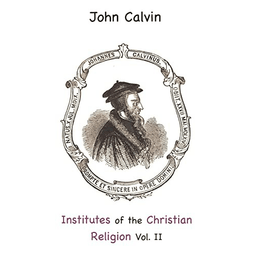
- Starting price
- Free (Beveridge); $70 Battles edition
- Free tier
- Yes
- Platforms
- Print · Kindle · Free PDF · Free online (CCEL)
- Developer
- Westminster John Knox (Battles), Hendrickson, others
- Launched
- 1536 (final 1559)
- Updated
- May 24, 2026
The verdict
The foundational text of Reformed theology and one of the great works of Christian literature - dense, devotional, and unapologetically argumentative. It is also, by modern standards, genuinely hard to read, and Christians from several major traditions sharply disagree with its conclusions.
Try Institutes of the Christian Religion ↗Opens ccel.org
John Calvin’s Institutes of the Christian Religion has quietly become the book that almost no one finishes and almost no serious student of theology can avoid. It is cited in seminary papers, in Sunday sermons, in coffee-shop debates about predestination, and in academic monographs about early modern political theory - often by people who have only read the parts that support their argument. The book is nearly five hundred years old and still in print in multiple translations, which is its own kind of recommendation.
It is not a devotional. It is not a study Bible. It is not an introduction to Christianity. It is a sustained, argumentative, often beautiful work of systematic theology written by a French lawyer who became, almost against his will, the organizing intellect of the Reformed wing of the Reformation. The 1559 Latin edition - the version everyone reads - runs to roughly 1,500 pages in modern English, organized into four books that march from the knowledge of God the Creator down to the practical question of how the church and the state should be structured.
This review tries to do two honest things at once: tell you what is genuinely great about the Institutes (a lot), and tell you what you are signing up for if you actually try to read it (also a lot). It will also note, plainly, that Catholics, Eastern Orthodox, Lutherans, Wesleyans, and Latter-day Saints have substantive disagreements with Calvin on grace, predestination, the sacraments, and the structure of the church. Calvin would have wanted those disagreements to be honest rather than papered over, and so do we.
✓ The good
- The single most influential systematic theology of the Protestant Reformation - foundational reading for Reformed, Presbyterian, Congregational, and most Baptist traditions
- Genuinely devotional in tone - Calvin is constantly pivoting from doctrine into worship, which surprises first-time readers who expect dry scholasticism
- Architecturally elegant - the four-book structure (Creator → Redeemer → Application of Grace → External Means) is one of the cleanest organizational schemes in the history of theology
- Public domain - the Beveridge translation is free in every format imaginable, so cost is never an excuse
- Holds up as literature - Calvin writes with a lawyer’s precision and a preacher’s urgency, and the prose still cuts
- Engages constantly with Scripture and with the church fathers (especially Augustine), so reading it is also a guided tour of patristic theology
- Has shaped Western political thought, education, and economic life far beyond the church - even readers who reject the theology benefit from understanding it
✗ Watch out
- Genuinely difficult - long sentences, dense argument, and a sixteenth-century rhetorical style that asks a lot of modern readers
- Polemical in places - large sections are arguments against Rome, the Anabaptists, and various other opponents, which can feel dated or uncharitable
- Doctrinally divisive - Catholics, Orthodox, Lutherans, Wesleyans, and Latter-day Saints have real disagreements with Calvin’s positions on grace, predestination, sacraments, and ecclesiology
- Length is intimidating - the full Battles edition is about 1,500 pages across two volumes, and most readers significantly underestimate the time commitment
- No modern editor will hold your hand - there are footnotes in the Battles edition, but no chapter-by-chapter walkthrough; you are expected to keep up
- The free Beveridge translation, while serviceable, reads as much more archaic than the Battles - the price gap between free and excellent is real
Best for
- Seminary students and pastors in the Reformed tradition
- Serious lay readers who want to understand where modern evangelical theology came from
- Anyone reading church history or early modern intellectual history
- Readers who already love Augustine and want to see what a Reformer did with him
Avoid if
- You are looking for a first introduction to Christianity
- You want a one-volume systematic theology that respects modern reading habits
- You are unwilling to sit with positions you may strongly disagree with
- You bounce off dense sixteenth-century prose and have no interest in pushing through
What Institutes of the Christian Religion is
The Institutes is a work of systematic theology - a sustained, organized attempt to lay out the whole of Christian doctrine from first principles. Calvin first published it in 1536 as a small Latin catechism intended to defend French Protestants to King Francis I. He revised and expanded it across his entire life, with the definitive 1559 Latin edition coming five years before his death. That final edition is the version reprinted today, organized into four books and eighty chapters.
It is not a commentary on Scripture (Calvin wrote those separately, and they fill many more volumes). It is not a confession of faith, though it shaped many of them. It is closer in genre to Augustine’s City of God or Aquinas’s Summa Theologiae - a comprehensive theological vision, written by one author over many years, intended to teach pastors and informed laypeople how to think about God, salvation, and the church as a coherent whole.
Why serious readers still pick up Calvin
The thing first-time readers almost always notice is that the Institutes is not the dry, predestination-obsessed monolith its reputation suggests. Calvin’s prose is alive. He stops mid-argument to worship. He quotes Augustine the way modern writers quote a favorite novelist. He talks about the universe as a theater of God’s glory and about prayer as the chief exercise of faith. There is a devotional pulse running underneath the systematic structure, and that pulse is what keeps readers coming back centuries later.
The other reason is structural. Whatever you think of Calvin’s conclusions, the architecture of the Institutes is genuinely impressive - the kind of organizational achievement that makes modern theology textbooks look ad-hoc by comparison. Each book builds on the last. The argument has a shape. Even readers who eventually reject Reformed theology often credit the Institutes with teaching them how to think theologically in the first place. It is, in that sense, a master class in how to organize an argument about God.
The four-book structure: Creator, Redeemer, Application, External Means
Book One treats the knowledge of God the Creator - how we come to know God, the role of Scripture, the doctrine of providence, and what it means that the world is created and sustained by God. Book Two moves to the knowledge of God the Redeemer in Christ - the human condition, the law, the person and work of Christ. Book Three covers how we receive the grace of Christ - faith, regeneration, justification, sanctification, prayer, and the famously argued chapters on election. Book Four addresses the external means God uses to invite and keep us in fellowship with Christ - the church, the sacraments, and the civil magistrate.
This Creator → Redeemer → Application → External Means scheme is not just tidy. It is theologically load-bearing. Calvin is arguing that you cannot understand redemption until you understand creation, you cannot understand the application of grace until you understand the redeemer, and you cannot understand the church and sacraments until you understand how grace is applied. The order matters. Reading the Institutes out of order - jumping straight to Book Three, Chapter 21 on predestination, as many readers do - is one of the main reasons Calvin is so often caricatured.
Battles vs. Beveridge: the translation decision
There are two translations any English reader will actually encounter. The Ford Lewis Battles translation, published in 1960 and edited by John T. McNeill for the Library of Christian Classics, is the modern scholarly standard - cleaner English, extensive footnotes, cross-references to Calvin’s sources, and a critical apparatus that helps you see where Calvin is quoting Augustine, Bernard, or Chrysostom. It is the version seminaries assign and the version most contemporary scholars cite.
The Henry Beveridge translation, from 1845, is in the public domain and therefore free everywhere - CCEL, Monergism, Kindle, audio. It is faithful and complete, but the prose is noticeably more Victorian, and there is no critical apparatus. If you are reading the Institutes for the first time and money is no object, get Battles. If you are not sure whether you will finish, start with Beveridge for free, and upgrade to Battles when you know you want to live in the book. The Tony Lane abridgement is a third path - a single shorter volume that gives you the argument without the full length, useful as an on-ramp or a re-read.
Why some readers find it devotional - and why many find it inaccessible
Readers who fall in love with the Institutes usually point to the same passages: the opening on the knowledge of God and of ourselves, the chapters on Christ as Prophet, Priest, and King, the long meditation on prayer in Book Three, the chapter on the Christian life. These sections read like extended devotional reflection wrapped in tight theological argument. Calvin pastored a congregation while he wrote, and it shows. He is not just constructing a system - he is trying to teach Christians how to live before God.
The other readers - and there are many - find the Institutes genuinely inaccessible. The sentences are long. The arguments assume an audience already familiar with Scripture, the church fathers, and sixteenth-century theological disputes. Large stretches are polemic against opponents most modern readers have never heard of. The chapters on predestination, the sacraments, and the relationship of church and state are precisely the chapters where many readers - Catholic, Orthodox, Lutheran, Wesleyan, Latter-day Saint, or just modern - will disagree with Calvin, sometimes sharply. Pretending otherwise does the book no favors. The honest pitch is: this is a great book that asks a lot of you, and you may end up disagreeing with significant portions of its conclusions.
Pricing
Beveridge (online / free PDF)
Free
The 1845 Henry Beveridge translation - public domain, available at CCEL, Monergism, Project Gutenberg, and as a free Kindle download. Older English, but the full text at zero cost.
Battles 2-volume (Westminster John Knox)
Around $70
The 1960 Ford Lewis Battles translation edited by John T. McNeill - the scholarly standard. Extensive footnotes, cross-references, and the cleanest modern English rendering. The version most seminaries assign.
Hendrickson 1-volume
Around $45
A single-volume hardcover printing of the Beveridge translation. Cheaper than Battles and physically easier to handle, but you are still reading nineteenth-century English.
Audible / audiobook
Around $30
Unabridged audio editions exist for the Beveridge translation. Long listen - well over fifty hours - but a real option for readers who prefer their theology read aloud.
Abridged (Tony Lane, ed.)
Around $25
A single-volume abridgement by Tony Lane and Hilary Osborne that cuts roughly two-thirds of the original. The honest entry point for readers who want Calvin’s argument without the full 1,500 pages.
The Institutes is one of the few major works of theology where the free option is genuinely usable. The Beveridge translation has been in the public domain for over a century, which means you can read the entire 1,500-page work on CCEL, Monergism, or a free Kindle download without spending a dollar. If your only goal is to read Calvin, you can do it for free, today.
The Battles 2-volume edition from Westminster John Knox, at around $70, is the version worth paying for. The footnotes alone justify the price - they show you where Calvin is quoting Augustine or Bernard, where he is reworking an argument from an earlier edition, and where modern scholarship has corrected or clarified his sources. For serious study, this is the edition to own.
The Hendrickson single-volume edition at around $45 is a Beveridge reprint in nicer binding - a real option if you want a physical book but do not need the Battles apparatus. The Tony Lane abridgement at around $25 is the realistic entry point for a reader who knows they will not finish the full 1,500 pages but wants to encounter Calvin’s actual argument rather than secondhand summaries. The Audible edition, around $30, is a legitimate option for commuters and walkers, though the listen runs well over fifty hours.
Most readers do not need every edition. The honest setup is: Beveridge online for free reference, Battles in print for serious study, and Lane’s abridgement on the shelf for when someone you know wants to start.
Where Institutes of the Christian Religion falls behind
Accessibility for the first-time reader. Calvin wrote for sixteenth-century pastors and informed laypeople, not for a 2026 small-group attendee. The sentences are long, the references assume a classical and patristic education, and even the Battles translation cannot fully smooth out the rhetorical conventions of Calvin’s era. Modern systematics like Grudem are vastly easier on a first read.
Charitable engagement with theological opponents. Calvin is at his weakest when he is rebutting positions - Roman Catholic sacramental theology, Anabaptist views of the church, Lutheran views of the Lord’s Supper - that he often presents in their least favorable form. Readers from those traditions will frequently find Calvin uncharitable, and modern readers across traditions will sometimes wince at the polemic.
Cultural distance from contemporary questions. Calvin is not writing about pluralism, science, gender, race, secularism, or any of the issues that dominate contemporary theology. He addresses problems his own century was arguing about. Modern readers have to do the work of translating his categories - which is part of the value, but it is real work.
Doctrinal range. The Institutes argues for a specific position - broadly, what we now call Reformed theology - and Catholics, Eastern Orthodox, Lutherans, Wesleyans, Pentecostals, and Latter-day Saints all disagree with significant pieces of it. If you want a textbook that lays out where Christians have historically differed without arguing for one side, the Institutes is not that book, and was never trying to be.
Reading guidance. There is no built-in study plan, no chapter summaries from a modern editor, no companion videos. The Battles edition gives you footnotes, but it does not hold your hand. Most readers do better with a secondary guide - something like Anthony Lane’s Reader’s Guide to Calvin’s Institutes - alongside the primary text.
Calvin’s Institutes vs. Grudem vs. Aquinas’s Summa
These three works are often pulled off the shelf for the same kind of question - what does Christianity actually teach, organized as a whole? - but they answer in very different voices. Different strengths. Calvin is the polemical Reformer, writing in the heat of the sixteenth century to defend a movement and pastor a city. Grudem is the modern Reformed-evangelical professor, writing in clear American English for seminary classrooms and small groups. Aquinas is the medieval Catholic schoolman, writing in tightly structured Latin questions and articles for fellow theologians.
Calvin’s Institutes is better at devotional warmth and rhetorical urgency. Grudem’s Systematic Theology is broader on contemporary issues (charismatic gifts, gender roles, modern apologetics) and much easier to read for a beginner. Aquinas’s Summa is deeper philosophically - if you want to think carefully about the doctrine of God, the metaphysics of creation, or the structure of virtue, nothing in Calvin or Grudem matches it. Each book also has limits its admirers should admit: Calvin is hard, polemical, and reflects Reformed conclusions that other traditions reject. Grudem is much shallower historically and shaped by twentieth-century American evangelicalism. Aquinas is medieval Catholic scholasticism and assumes a worldview many modern readers do not share.
If you are reading one for the first time, Grudem is the easiest on-ramp. If you want to understand the intellectual roots of Reformed Protestantism, Calvin is the source. If you want philosophical depth and to engage the great Catholic theological tradition, Aquinas is the destination. Most serious students of theology end up reading all three, in some order.
The bottom line
Calvin’s Institutes is one of the indispensable books in the history of Christian thought - architecturally elegant, devotionally warm beneath the polemic, and the source code for most of Reformed Protestant theology. It is also long, hard, polemical in places, and arguing for positions that Catholics, Orthodox, Lutherans, Wesleyans, and Latter-day Saints substantively reject. Read it if you want to understand where modern evangelical theology came from, or because you love Augustine and want to see what a Reformer did with him. Start with the Lane abridgement or the free Beveridge online, and upgrade to the Battles edition when you know you want to live in the book.
Alternatives to Institutes of the Christian Religion
 Grudem’s Systematic TheologyThe most-used modern Reformed-evangelical systematic theology. Much easier on a first read, broader on contemporary issues, but shallower historically and philosophically than Calvin.
 Knowing GodJ. I. Packer’s twentieth-century classic. Shares Calvin’s devotional-theological pulse in a fraction of the length and far easier prose. A great pairing or a great substitute.
 Mere ChristianityC. S. Lewis’s defense of the basic Christian faith - not a systematic theology, but the obvious entry point for readers who find Calvin too dense or too partisan.
 ConfessionsAugustine’s spiritual autobiography. Calvin quotes Augustine more than any other source - reading Confessions first makes the Institutes read very differently.
Frequently asked questions
Do I have to be Reformed to get something out of the Institutes?
No. Plenty of Catholic, Lutheran, Wesleyan, and Anglican readers engage with Calvin without converting to Reformed theology - partly to understand the historical roots of Protestantism, partly because the chapters on prayer, the Christian life, and the knowledge of God are valuable on their own terms. You should expect to disagree with significant portions, and that is fine.
Battles or Beveridge - which translation should I actually buy?
If you can spend the money, Battles. The footnotes and modern English are worth the price. If you cannot, the Beveridge is free everywhere and entirely usable - it is just more Victorian in voice. Many readers start with the free Beveridge online and upgrade to Battles once they know they want to keep going.
Is the Institutes really 1,500 pages? Is there a shorter version?
The full 1559 edition is roughly 1,500 pages in the Battles two-volume set. There is a respected one-volume abridgement edited by Tony Lane and Hilary Osborne that cuts about two-thirds of the original, preserves Calvin’s argument, and is the honest on-ramp for most readers.
Where should I start - just open to Book One, Chapter One?
Yes, actually. The opening of Book One - on the knowledge of God and of ourselves - is some of Calvin’s most accessible writing and tells you within twenty pages whether you want to keep going. Avoid the common mistake of jumping straight to the predestination chapters in Book Three; they make much more sense in context.
How does Calvin treat readers from other Christian traditions?
Calvin is polemical - he argues directly and at length against Roman Catholic, Anabaptist, and Lutheran positions he disagrees with. Catholic, Orthodox, Lutheran, Wesleyan, and Latter-day Saint readers will encounter sections that argue against their own tradition’s positions. The honest approach is to read those sections critically and to read the best response from your own tradition alongside.
Should I read a guide alongside it?
For most readers, yes. Anthony Lane’s Reader’s Guide to Calvin’s Institutes is the standard companion. The footnotes in the Battles edition help too. The Institutes was written for an audience already steeped in Scripture and the church fathers, and a modern guide closes some of that distance.
How long will it take to read the whole thing?
Realistically, several months at a steady pace - something like a chapter a day puts you at about three months, and most readers go slower than that. Many seminary courses spread it across a full year. If you only have a few weeks, the Lane abridgement is a far better use of your time than rushing the full edition.
Sources & further reading
More Systematic Theology Books
Systematic Theology by Wayne GrudemThe most-used modern systematic theology in English-speaking evangelicalism, and the one most laypeople actually finish - here’s what that readability costs you, and what it buys. The Cross of ChristJohn Stott’s 1986 masterwork is the book most modern evangelical pastors point to when someone asks what the cross actually accomplished - and four decades later it still earns the recommendation.Reformed DogmaticsA century-old Dutch Reformed masterwork that reads the whole catholic tradition before it argues - magnificent, demanding, and long enough that most readers should start with the one-volume abridgement.Summa TheologicaThe thirteenth-century synthesis that became the backbone of Catholic theology - vast, rigorous, free in the public domain, and almost no one reads it the way it looks like you should.A Body of DivinityThe 1692 Puritan exposition of the Westminster Shorter Catechism - still the warmest, most quotable systematic theology a layperson can actually finish.Concise TheologyJ.I. Packer’s 1993 guide compresses the whole of Christian doctrine into 94 two-to-three-page chapters - a doctrine reference you can actually finish, written by the man behind Knowing God.