Painter of the Bible
Albrecht Altdorfer
Albrecht Altdorfer was the leading painter of the Danube School and one of the great early landscape inventors of the Northern Renaissance.

Their faith
Why Albrecht Altdorfer painted Christ
Albrecht Altdorfer was deeply rooted in his Lutheran faith, which influenced both his life and his art. As a prominent citizen of Regensburg, he held civic responsibilities while also dedicating himself to his artistic pursuits. His commitment to his faith is evident in his major works, particularly the Saint Sebastian Altarpiece, which reflects a profound understanding of scripture and the passion of Christ. Altdorfer's devotion to his craft was intertwined with his spiritual life, as he sought to convey biblical narratives through rich visual storytelling and intricate detail. His engagement with scripture and the themes of redemption and sacrifice shaped his artistic vision, allowing him to create works that resonate with the viewer's faith journey.
Altdorfer's paintings reveal a unique blend of Northern Renaissance aesthetics and deep religious conviction. In the Saint Sebastian Altarpiece, for example, he masterfully depicts the Passion of Christ across eight panels, inviting the viewer into a contemplative experience of suffering and salvation. His use of landscape in works like the Battle of Alexander at Issus demonstrates how he could frame historical narratives within a spiritual context, reminding us of God's presence in all aspects of life. Altdorfer's ability to merge the natural world with divine themes continues to inspire viewers today, inviting them to reflect on their own faith and the beauty of God's creation. His legacy endures, as his devotion to Christ and the artistry of his work reach into the hearts of those who encounter it.
Life & work
Albrecht Altdorfer was the leading painter of the Danube School and one of the great early landscape inventors of the Northern Renaissance. Born around 1480, almost certainly in Regensburg, where he is documented as a citizen from 1505 and where he held civic office (city architect, member of the Outer and then Inner Council) for the rest of his life, he died in Regensburg in 1538. He turned down the city's offer of the mayoralty in 1528 in order to finish a major painting commission.
His central religious works combine the new Northern interest in panoramic landscape with old-style narrative density. The Battle of Alexander at Issus (Alte Pinakothek, Munich, 1529) — though strictly a classical-history painting — frames its battle inside a sky and a panorama that read directly into his Christian compositions. The Saint Sebastian Altarpiece for the abbey of St. Florian near Linz (1509–1518), his largest surviving project, is a folding polyptych whose interior shows the Passion of Christ in eight panels, the Way of Sorrows on the wings, and a Resurrection on the back of the central section: a complete Passion cycle of the highest sixteenth-century Northern accomplishment. The Susanna and the Elders (Munich, 1526) and his Crucifixion miniatures round out his painted output.
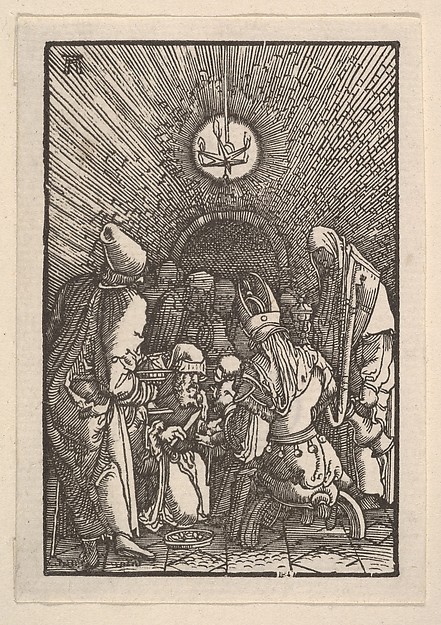
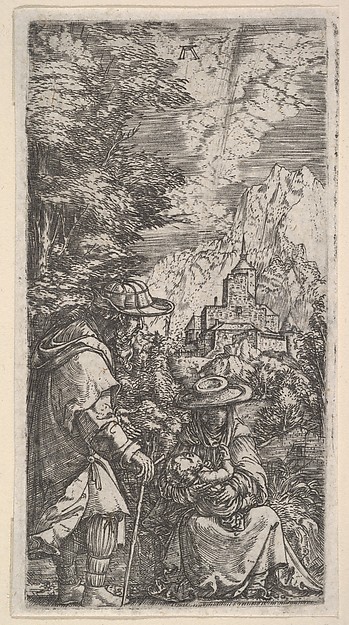
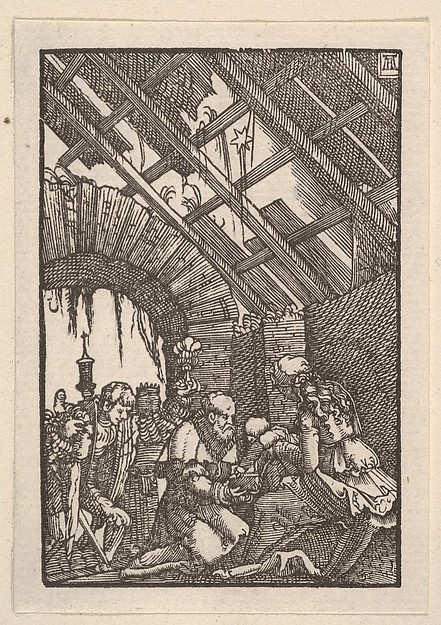
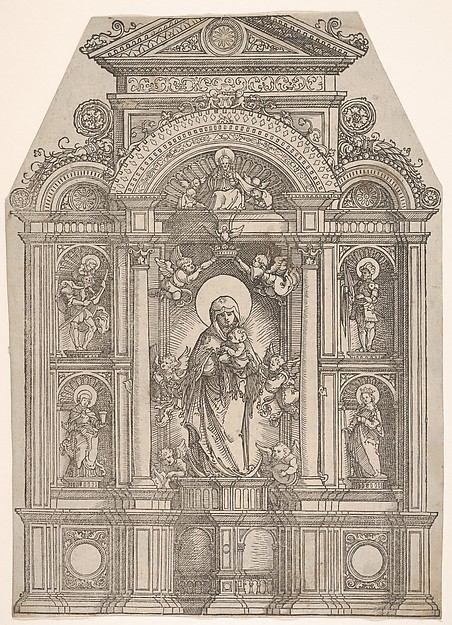
Altdorfer also produced about 120 engravings and woodcuts, mostly on biblical and devotional subjects, including a famous Beautiful Mary of Regensburg (1519–1520) related to a contemporary local pilgrimage cult, and a sequence of small Passion plates that circulated widely. He was an early experimenter in pure landscape — small panels with no human figure at all, painted decades before the Dutch Golden Age made that genre commercial.
His religious work shows the late Gothic German imagination opening into Renaissance perspective without losing its medieval relish for ornament, jewel-color, and narrative crowding. He was Lutheran by the time of his death — Regensburg adopted the Reformation in 1542, four years after his passing — and his late altarpieces already show the move toward the more austere Protestant compositional sense.
Notable works in detail
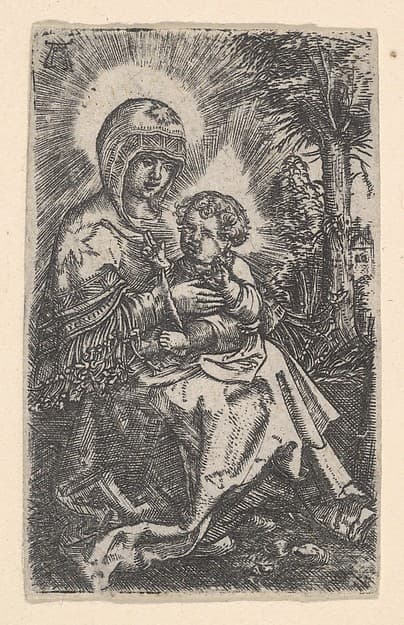
"The Beautiful Virgin of Regensburg" Seated in a Landscape
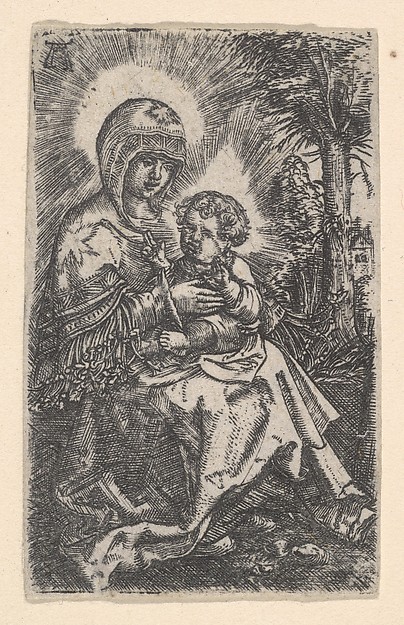
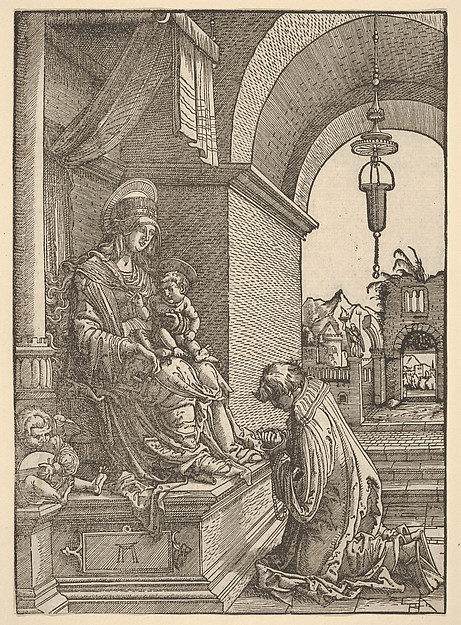
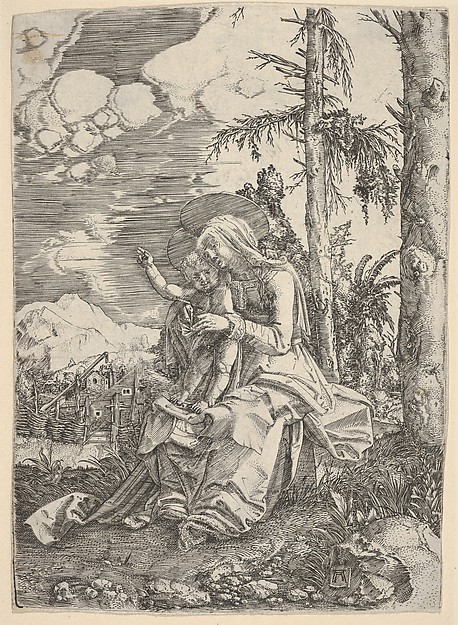
The Beautiful Virgin of Regensburg, designed by Albrecht Altdorfer around 1519–1520 and engraved or woodcut for circulation in the German-speaking Catholic Counter-Reformation print market, depicts the Marian image associated with the great popular pilgrimage to Regensburg that began suddenly in 1519 after the destruction of the city's Jewish quarter and the construction of a chapel on the site dedicated to a miraculous statue of the Virgin. Altdorfer was the city architect of Regensburg at the time, and his print of the Beautiful Virgin (Schöne Maria) circulated widely through the German Catholic devotional market in the years immediately before the Reformation began to displace the Marian-pilgrimage tradition in Lutheran territories. The composition shows the Virgin in three-quarter view holding the Christ Child against her chest, surrounded by a luminous celestial light against a dark architectural niche.
met-395998
Abraham's Sacrifice, designed by Albrecht Altdorfer around 1480 (or, more likely, in the early sixteenth century — the dating of his prints is contested) and engraved by his workshop, illustrates the climactic moment of Genesis 22 in which the angel descends from heaven to stop Abraham from sacrificing his son Isaac on the altar at the top of Mount Moriah. Altdorfer stages the scene with characteristic Danube-school landscape density: the rocky mountain at the upper register, the small altar at the center where Isaac kneels bound, Abraham raising the knife on the right and looking up at the descending angel, the ram caught in the thicket in the lower-left foreground. The composition combines the Northern late-Gothic devotional sensibility with the new Renaissance landscape interest that defined Altdorfer's mature work and the Danube school more broadly.
met-429722
Christ on the Cross (The Small Crucifixion), designed by Albrecht Altdorfer in the early sixteenth century in his Regensburg workshop, is one of the small-format engraved Crucifixions Altdorfer produced for circulation in the German Catholic devotional print market. The composition shows the body of Christ on the cross at the center of the print, with the swooning Virgin in the arms of John on the left, the Magdalene kneeling at the foot of the cross, and a small landscape with the city of Jerusalem fading into the distant background. The chromatic-tonal range achieved by Altdorfer's careful crosshatching, even at the small format characteristic of devotional engraving, demonstrates the technical accomplishment that distinguished his prints from the broader run of late-medieval German engraving.
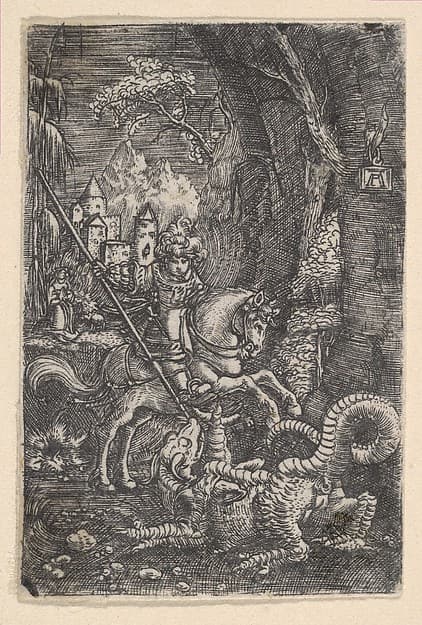
Saint George Killing the Dragon
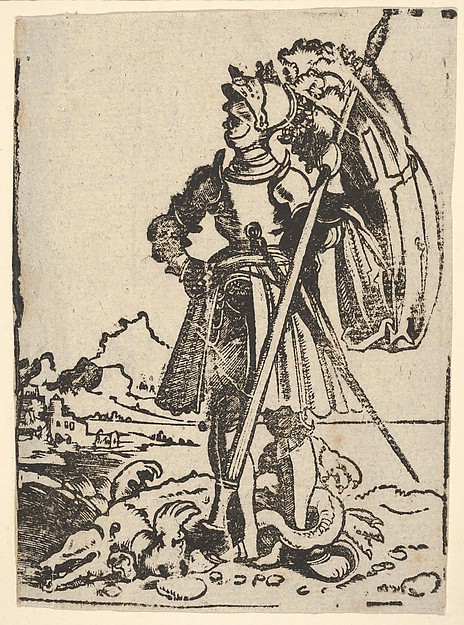
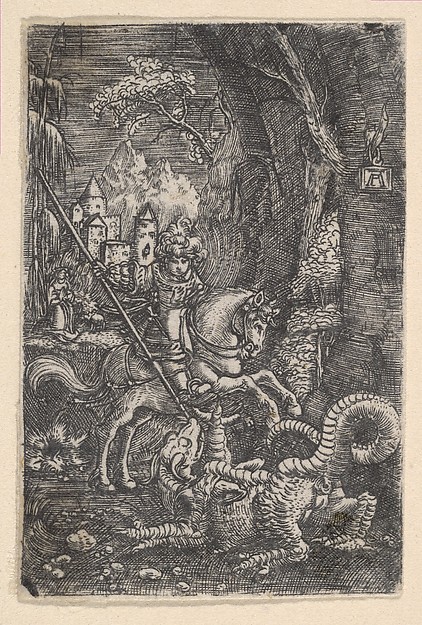
Saint George Killing the Dragon, designed by Albrecht Altdorfer in the early sixteenth century in his Regensburg workshop, depicts the iconographic subject from the late-medieval Golden Legend tradition in which the Christian knight George rescues a princess from a dragon by piercing the creature with his lance. Altdorfer stages the scene in a dense forested German landscape — the mounted George on the left thrusts his lance down through the dragon's open mouth, the princess in the lower-right foreground kneels with her hands folded in prayer, the city in the deep distance fades into atmospheric haze through the trees. The combination of dense Northern forest landscape and dramatic chivalric narrative is the unmistakable Altdorfer signature, and the print is one of the principal small-format Saint George compositions of the early sixteenth century.
Bible scenes Albrecht Altdorfer painted
Luke
1 Kings
Romans
Revelation
Matthew
John
Mark
Acts