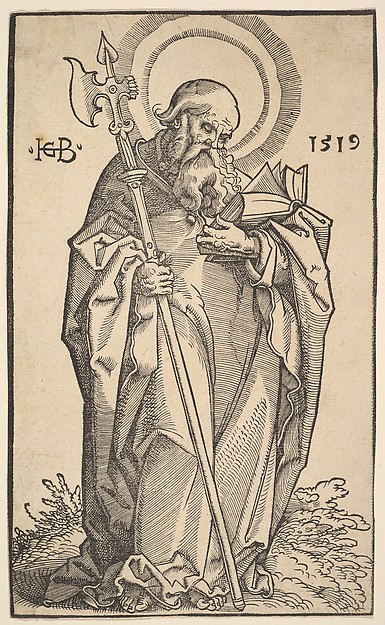
Painter of the Bible
Hans Baldung Grien
Hans Baldung, called Grien from his fondness for the color green, was the most independent of Albrecht Dürer's pupils.

Their faith
Why Hans Baldung Grien painted Christ
Hans Baldung Grien, a prominent figure of the Northern Renaissance, was born into a family with deep roots in both law and the clergy, suggesting a rich intellectual and spiritual upbringing. His training under Albrecht Dürer, one of the most celebrated artists of the time, honed his skills and deepened his appreciation for sacred themes. Baldung's faith is evident in his most significant religious work, the Freiburg Cathedral high altarpiece, which he painted between 1512 and 1516. This ambitious polyptych not only reflects his artistic mastery but also his commitment to exploring and expressing Christian themes through art. His upbringing and the environment of the Reformation in Strasbourg likely influenced his spiritual perspective, leading him to create works that resonate with both the beauty of faith and the complexities of human existence.
Baldung's artwork, particularly the Freiburg Cathedral altarpiece, reveals his profound spiritual vision. The central panel, depicting the Coronation of the Virgin against a celestial backdrop, embodies the reverence and devotion he held for the divine. The altarpiece's wings illustrate pivotal moments from the life of Christ, showcasing his understanding of the sacred narrative and its significance in the Christian faith. In addition to his altarpieces, Baldung's exploration of themes like mortality and the supernatural in works such as the Bewitched Stable Boy and Three Ages of Woman and Death demonstrates a unique blend of devotion and a keen awareness of the human condition. His ability to navigate these contrasting themes speaks to a faith that is both profound and multifaceted, inviting viewers to reflect on their own spiritual journeys. Through his art, Baldung's devotion continues to inspire and uplift those who encounter his work, reminding us of the timeless beauty of faith expressed through creativity.
Life & work
Hans Baldung, called Grien from his fondness for the color green, was the most independent of Albrecht Dürer's pupils. Born in Schwäbisch Gmünd in 1484 or 1485 into a family of jurists and clergy — an unusually learned background for a craftsman — and trained in Strasbourg before joining Dürer's Nuremberg workshop around 1503, he stayed with Dürer for about four years, then moved south to Strasbourg and Freiburg im Breisgau, where he ran his own workshop until his death in Strasbourg in 1545.
His central religious work is the Freiburg Cathedral high altarpiece, a great folding polyptych painted between 1512 and 1516. Its central panel shows the Coronation of the Virgin against a starry sky; the wings hold scenes of the Annunciation, Visitation, Nativity, and Flight into Egypt, with twelve apostles below; the closed exterior shows the Crucifixion. It is one of the most ambitious surviving German altarpieces of its generation and the principal anchor of Baldung's painted reputation. Earlier altarpieces in Halle and Stuttgart, Madonnas now in Nuremberg and Basel, and the late Mass of Saint Gregory (Cleveland, c. 1511) round out his religious output.
Alongside the conventional altarpiece work, Baldung produced an entirely separate body of woodcuts and drawings on subjects rare in his contemporaries: witches' Sabbaths, dances of Death, allegories of the Three Ages, and erotic mythological scenes. His Bewitched Stable Boy (woodcut, 1544) and Three Ages of Woman and Death (Vienna, c. 1510) are landmarks of the Northern Renaissance interest in mortality, sin, and the supernatural; they sit oddly beside, and have nothing in common with, his straight devotional commissions.
He served on Strasbourg's city council in his later years and outlived his teacher Dürer by seventeen years. By the time of his death the city was Lutheran, the new altarpiece market had collapsed, and Baldung's late religious work — relatively few canvases — already shows him moving toward the Protestant compositional preferences (Christ on the Cross, the supper scenes, isolated apostles) that would define German religious painting for the next century.
Notable works in detail

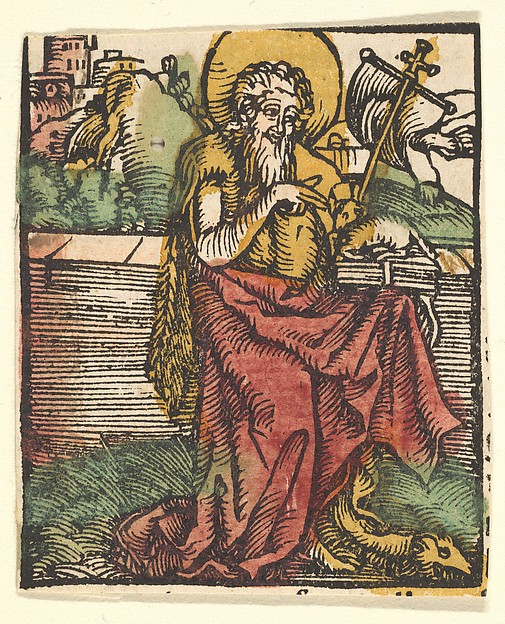
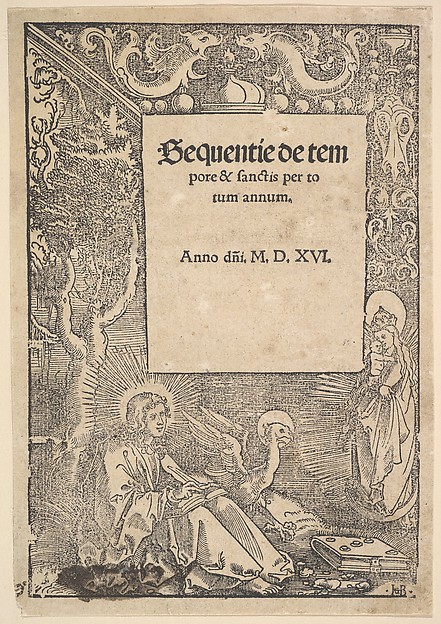
Saint John at Patmos, painted by Hans Baldung Grien around 1511 in oil on panel and now in the Metropolitan Museum of Art in New York, depicts the apostle John seated on the rocky island of Patmos receiving the apocalyptic visions recorded in Revelation. Baldung stages the scene as a small intimate panel: the seated apostle in profile on the right with the open book of Revelation on his knee and his quill in hand, looking up toward the upper-left where the figure of God appears in a small luminous mandorla, with an eagle (the iconographic attribute that distinguishes John from the other evangelists) at his feet. The chromatic palette of warm earth tones, deep crimson, and pale grey against the rocky landscape and a low Mediterranean horizon is characteristic of Baldung's early-mature Strasbourg manner before the great Freiburg Cathedral high altarpiece commission of 1512–1516 that would establish his reputation as one of the leading Northern German painters of his generation.