Painter of the Bible
Lucas Cranach the Elder
Lucas Cranach the Elder was the visual partner of the Protestant Reformation.

Their faith
Why Lucas Cranach the Elder painted Christ
Lucas Cranach the Elder was a pivotal figure in the Protestant Reformation, deeply rooted in his Christian faith as a Lutheran. Born in Kronach, he moved to Wittenberg in 1505, where he became the court painter for Frederick the Wise and established a significant civic presence as a town councilor and mayor. His close friendship with Martin Luther not only influenced his artistic endeavors but also shaped his spiritual life. Cranach served as godfather to one of Luther's children and was instrumental in producing art that visually articulated the Reformation's theological principles. His workshop became a hub for the creation of religious art that emphasized Scripture and the direct relationship between the believer and Christ, free from the mediation of the Church. This devotion is reflected in his meticulous approach to his craft, where he often sought divine inspiration through prayer and reflection on the Word.
Cranach's faith profoundly influenced his artistic output, leading him to create works that encapsulated the essence of Lutheran theology. His Wittenberg Altarpiece is a striking example, depicting the Last Supper with Luther and other reformers seated at the table, emphasizing the centrality of Christ's sacrifice. Another significant work, Law and Gospel, visually contrasts the Old Covenant with the grace of the New Covenant, serving as a teaching tool for Lutheran preaching. Cranach’s portrayal of biblical narratives, such as Christ Blessing the Children and the Crucifixion with the Converted Centurion, reveals his commitment to conveying the message of salvation and grace. Today, Cranach's legacy continues to inspire viewers, reminding us of the transformative power of faith expressed through art, as he invites us to engage with the profound truths of Scripture and the love of Christ.
Life & work
Lucas Cranach the Elder was the visual partner of the Protestant Reformation. Born in Kronach in Upper Franconia, he settled in Wittenberg in 1505 as court painter to Frederick the Wise, Elector of Saxony, and held that post under three successive electors for almost half a century. His workshop was vast and his civic standing in Wittenberg unusual — he served terms as town councilor and mayor — but the work that secured his place in the history of biblical art was his decades of close collaboration with Martin Luther.
Cranach was Luther's neighbor, his close friend, godfather to one of his children, and the painter of nearly every authoritative portrait we have of Luther and his wife Katharina von Bora. He printed broadsides for the Reformation, illustrated the title page of the Luther Bible, and shaped the iconography of the new evangelical churches. His Wittenberg Altarpiece (1547, Stadtkirche St. Marien) places the Last Supper in the predella with Luther and the other Wittenberg reformers seated at the table; the Crucifixion above is flanked on the right wing by Luther himself preaching from the pulpit, pointing his congregation at Christ on the cross. The painted theology of the altarpiece is the painted theology of the Reformation: Word and sacrament, no mediator but Christ, no spectacle but Scripture.
His allegory Law and Gospel — surviving in multiple panel versions across European collections — set out a two-part diagram of Old Covenant judgment and New Covenant grace that became the defining didactic image of Lutheran preaching. His Adam and Eve panels, painted across his career, are the standard Northern depiction of the Fall. Among his independent biblical paintings: Christ Blessing the Children, the Sermon of Saint John the Baptist, the Crucifixion with the Converted Centurion, and a long sequence of devotional Madonnas painted for both Catholic and Lutheran patrons (Cranach worked for both sides of the confessional divide all his life).
He died in Weimar in 1553. His son Lucas Cranach the Younger ran the workshop after him and is responsible for many of the post-1550 panels traditionally attributed to the Cranach name. Father and son together set the visual language of German Protestantism from Wittenberg outward.
Notable works in detail
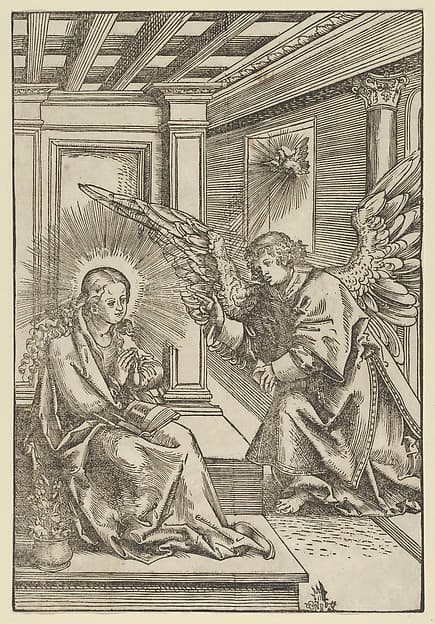
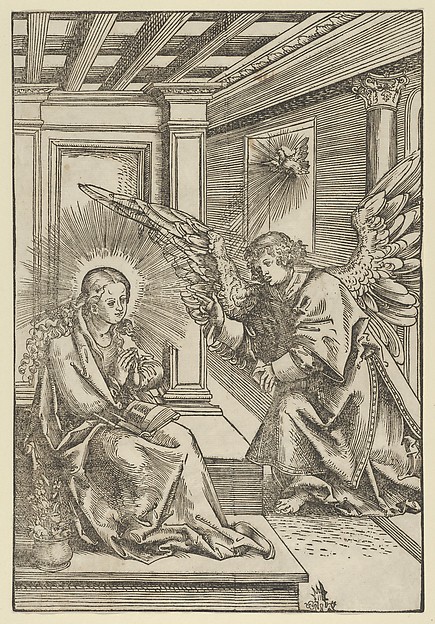
The Annunciation, designed by Lucas Cranach the Elder and produced in his Wittenberg workshop in the early sixteenth century as part of his prolific output of single-leaf religious woodcuts, illustrates the moment from Luke 1 in which the angel Gabriel appears to Mary in her chamber to announce the conception of Christ. Cranach stages the scene in a small Northern European interior with leaded windows opening onto a distant landscape; the Virgin kneels at her prayer-desk on the right, the angel kneels on the left with the lily of purity in one hand and a banner of greeting in the other, and the Holy Spirit descends as a dove on a beam of light from the upper left corner. The woodcut is one of dozens of small devotional prints the Cranach workshop produced in editions for the Wittenberg market; the workshop's prints, alongside its larger panel paintings, supplied the visual catechetical materials of the early Lutheran Reformation.
met-434689
The Lamentation, from the Passion series of woodcuts produced by Lucas Cranach the Elder and his Wittenberg workshop in the early sixteenth century, depicts the moment after the Deposition: the body of Christ has been lowered from the cross and laid across the lap of his mother, with John the Evangelist supporting the head, the Magdalene kneeling at the feet, and Joseph of Arimathea and Nicodemus standing behind. The composition follows the Northern late-Gothic conventions for the subject — a dense pyramidal grouping of figures, careful chiaroscuro modeling in the woodcut line, the city of Jerusalem fading into a soft hilly horizon behind. The Passion series circulated through the German-speaking Reformation lands as one of the standard small-format devotional print cycles of its generation.
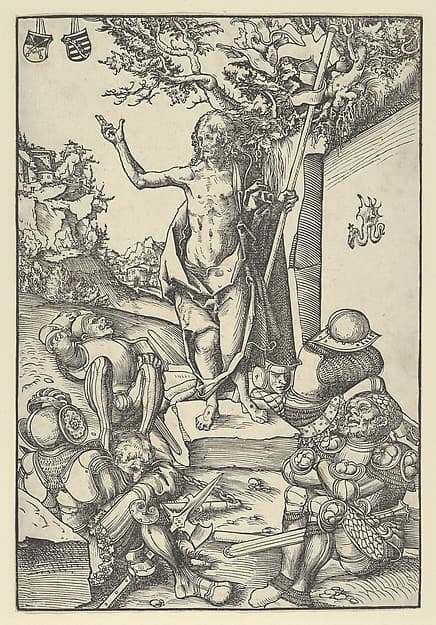
The Resurrection, from "The Passion"
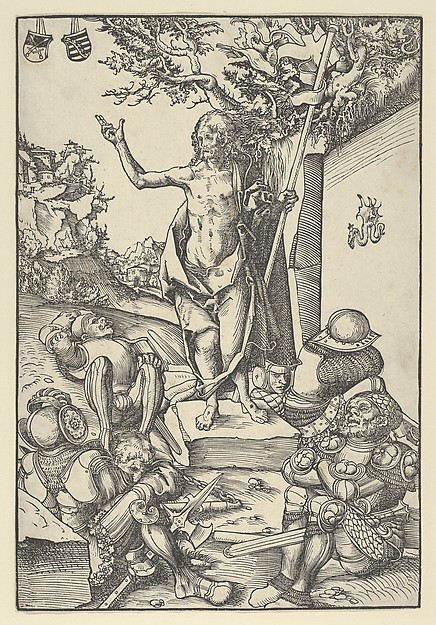
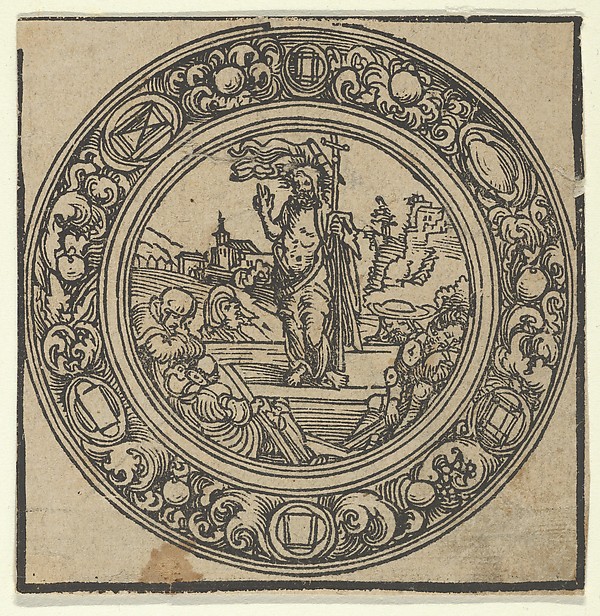
The Resurrection, from the same Passion woodcut series produced by Lucas Cranach the Elder and his Wittenberg workshop in the early sixteenth century, depicts Christ rising from the open tomb in the predawn light. The risen Christ stands fully clothed in white at the upper center of the composition, his right hand raised in benediction, his left holding the banner of the Resurrection; the Roman soldiers in their armor have fallen at the foot of the tomb in postures of unconscious sleep or panicked awakening. The composition follows Northern Renaissance conventions for the subject and shows Cranach's debt to Albrecht Dürer's earlier Apocalypse and Passion woodcuts of 1497–1511; the prints circulated through Wittenberg and the wider German-speaking Reformation publishing networks for several decades after their first appearance.
met-336241
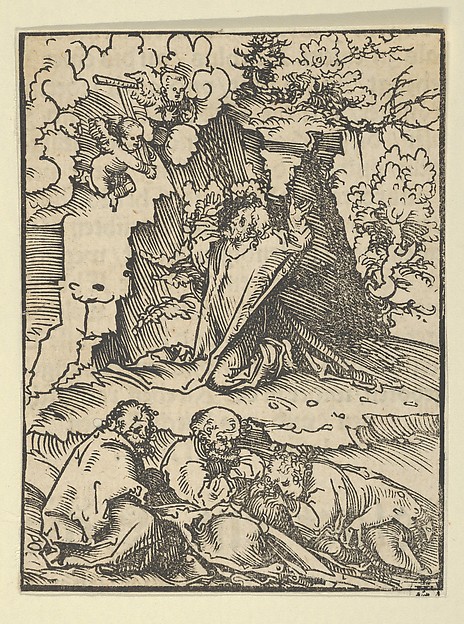
Christ on the Mount of Olives, designed by Lucas Cranach the Elder and produced in his Wittenberg workshop in the early sixteenth century, depicts the Agony in the Garden as recorded in the Synoptic Gospels: Christ kneels in prayer before the angel bearing the cup of the Passion, while the three sleeping disciples — Peter, James, and John — are gathered in the foreground and Judas with the soldiers approach through the gate at the rear. The composition shows the characteristic Cranach combination of careful Northern Renaissance figural drawing with a faintly archaic late-medieval landscape sensibility — the rocky garden, the distant city of Jerusalem, the dark sky above. The print was one of the standard treatments of the Agony subject produced by the Wittenberg workshop and circulated as part of the Cranach Passion sequences through the early Reformation publishing market.
met-625300
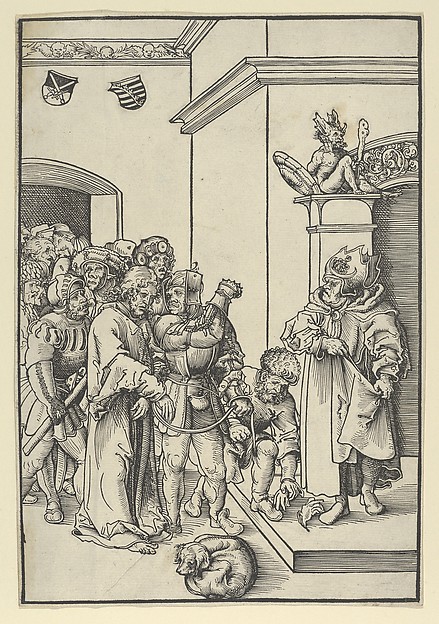
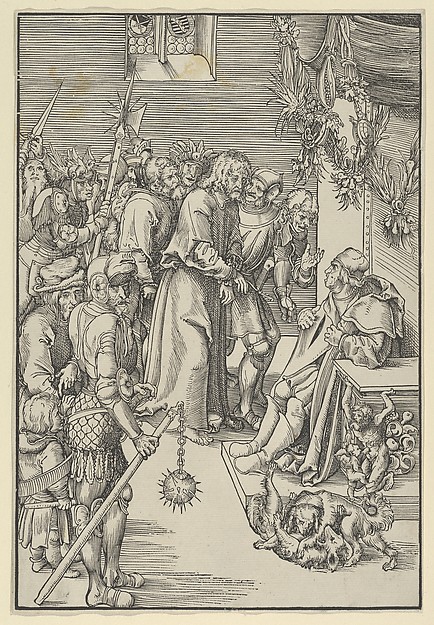
Christ Crowned with Thorns, from the Passion series of woodcuts produced by Lucas Cranach the Elder and his Wittenberg workshop in the early sixteenth century, depicts the moment after the scourging when the Roman soldiers, in cruel mockery of Christ's claim to kingship, press a crown of thorns down onto his head and place a reed in his hand as a mock scepter. Cranach stages the scene in the cramped courtyard of the Praetorium; Christ sits at the center on a low stool, his hands tied, his eyes lowered; two soldiers on either side push the crown down with sticks, while a third kneels in mock obeisance at his feet. The composition is among the most reproduced single sheets from Cranach's Passion series and was directly adapted, as a small inset image, into many of the early Lutheran prayer books and devotional pamphlets the Wittenberg printers turned out in editions of thousands during the 1520s and 1530s.
met-623820
The Beheading of Saint John the Baptist, designed by Lucas Cranach the Elder and produced in his Wittenberg workshop in the early sixteenth century, illustrates the climactic moment from Mark 6 in which the executioner sent by King Herod beheads John the Baptist in his prison cell, and the head is placed on a platter for delivery to Salome at the dance. Cranach stages the scene in a small dungeon: the executioner stands above the kneeling Baptist with raised sword in mid-stroke, while Salome waits at the door with an attendant holding the empty silver platter. The print was reproduced and copied in editions throughout the German-speaking Reformation lands and provided the visual model for many of the smaller printed treatments of the subject in subsequent Northern devotional publishing.
Bible scenes Lucas Cranach the Elder painted
Matthew
Luke
John
Acts
Revelation
Mark
Romans