Painter of the Bible
Adriaen Collaert
Adriaen Collaert was a leading engraver and print publisher of the late sixteenth and early seventeenth centuries in Antwerp — the city that, after the recovery from the religious wars and the consolidation of Spanish-Ca…

Their faith
Why Adriaen Collaert painted Christ
Adriaen Collaert was a devout Catholic engraver whose work played a significant role in the Counter-Reformation's visual culture. Born in Antwerp around 1560, he was immersed in a family of artists, with his father being the engraver Hans Collaert the Elder. His marriage into the Galle family, known for their printmaking, further anchored him in the rich tradition of religious art. Throughout his life, Collaert was dedicated to producing engravings that reflected the Catholic faith, aligning his work with the post-Tridentine visual program that sought to inspire and educate the faithful. His devotion is evident in the sheer volume of religious imagery he created, which served as a vital means of communicating the tenets of Christianity to a populace eager for spiritual nourishment in the wake of the Reformation.
Collaert's engravings, such as the "Vita, Passio et Resurrectio Iesu Christi" and his contributions to the "Evangelicae Historiae Imagines," exemplify his commitment to portraying the life and passion of Christ. These works not only highlight key biblical narratives but also reflect the artist's spiritual vision, aiming to deepen the viewer's understanding of Christ's sacrifice and the stories of the saints. Through his intricate designs, Collaert invited his audience to meditate on the divine, bridging the gap between the sacred and the everyday. His artistry continues to inspire and edify viewers today, reminding us of the beauty and depth of faith that can be captured through the medium of printmaking.
Life & work
Adriaen Collaert was a leading engraver and print publisher of the late sixteenth and early seventeenth centuries in Antwerp — the city that, after the recovery from the religious wars and the consolidation of Spanish-Catholic rule, became the printing capital of Counter-Reformation devotional imagery. Born in Antwerp around 1560 to the engraver Hans Collaert the Elder, trained in his father's workshop and married into the Galle family of printmakers (his wife Catharina was a daughter of Philip Galle), and active in the city for his entire career, he died in Antwerp in 1618.
His religious output was prolific and entirely shaped by the post-Tridentine Catholic visual program. He engraved after designs by Jan van der Straet (Stradanus), Maarten de Vos, Hans Bol, Frans Floris, Crispijn van den Broeck, Ambrosius Francken, Crispin de Passe, and many of the Flemish painters whose religious commissions filled the Antwerp churches and Jesuit schools after the late-1580s reconciliation. His engraved series of the Passion of Christ, the Life of the Virgin, the Lives of the Saints, the Acts of the Apostles, and the Old Testament patriarchs and matriarchs circulated as both single-leaf prints and bound illustrated books from Antwerp through the Hispano-Flemish trading network to Spain, Italy, the German-speaking lands, and the Spanish overseas missions.
His Vita, Passio et Resurrectio Iesu Christi (a great life-of-Christ cycle, 1591) and his contributions to the Jesuit-commissioned Evangelicae Historiae Imagines of Jerónimo Nadal (Antwerp, 1593, on which he worked alongside Hieronymus Wierix and several other engravers) anchor his religious reputation. Beyond strict biblical narrative, his Florilegium of plant studies (1592), his bird-life prints, and his fish series demonstrate the late sixteenth-century interest in natural history that Antwerp printers cultivated for both scientific and devotional purposes — the Christian doctrine of creation made visible in plant-by-plant detail.
His son, Adriaen Collaert the Younger, continued the workshop after his death; his brother-in-law Theodoor Galle and the wider Collaert-Galle family network kept the firm productive into the middle of the seventeenth century.
Notable works in detail
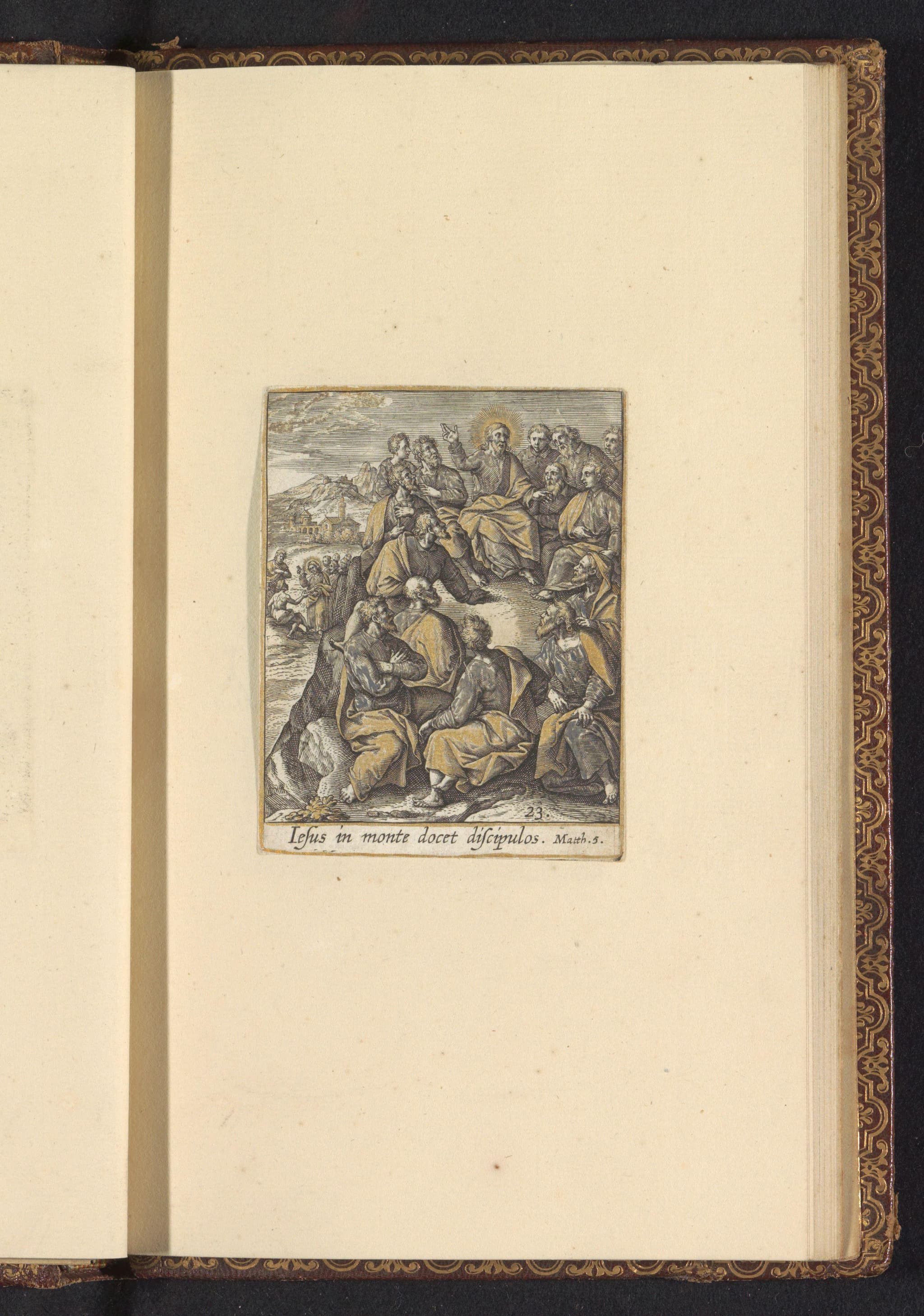
Bergrede (The Sermon on the Mount), engraved by Adriaen Collaert around 1580 in his Antwerp workshop and printed by his stepfather-in-law Philip Galle, depicts the moment in Matthew 5 in which Christ delivers the Sermon on the Mount to the assembled disciples and crowds on a hillside above the Sea of Galilee. Collaert stages the scene as a panoramic outdoor encounter — Christ seated on a low rock at the center of the composition, the assembled listeners gathered around him in a loose semicircle in the foreground, the Mediterranean landscape with distant towns and a soft horizon stretching behind. The engraved line is patiently crosshatched in the standard Antwerp post-Tridentine devotional manner, and the print circulated through the Hispano-Flemish trading network from Antwerp to Spain, the German-speaking lands, and the Spanish overseas missions for over a century.
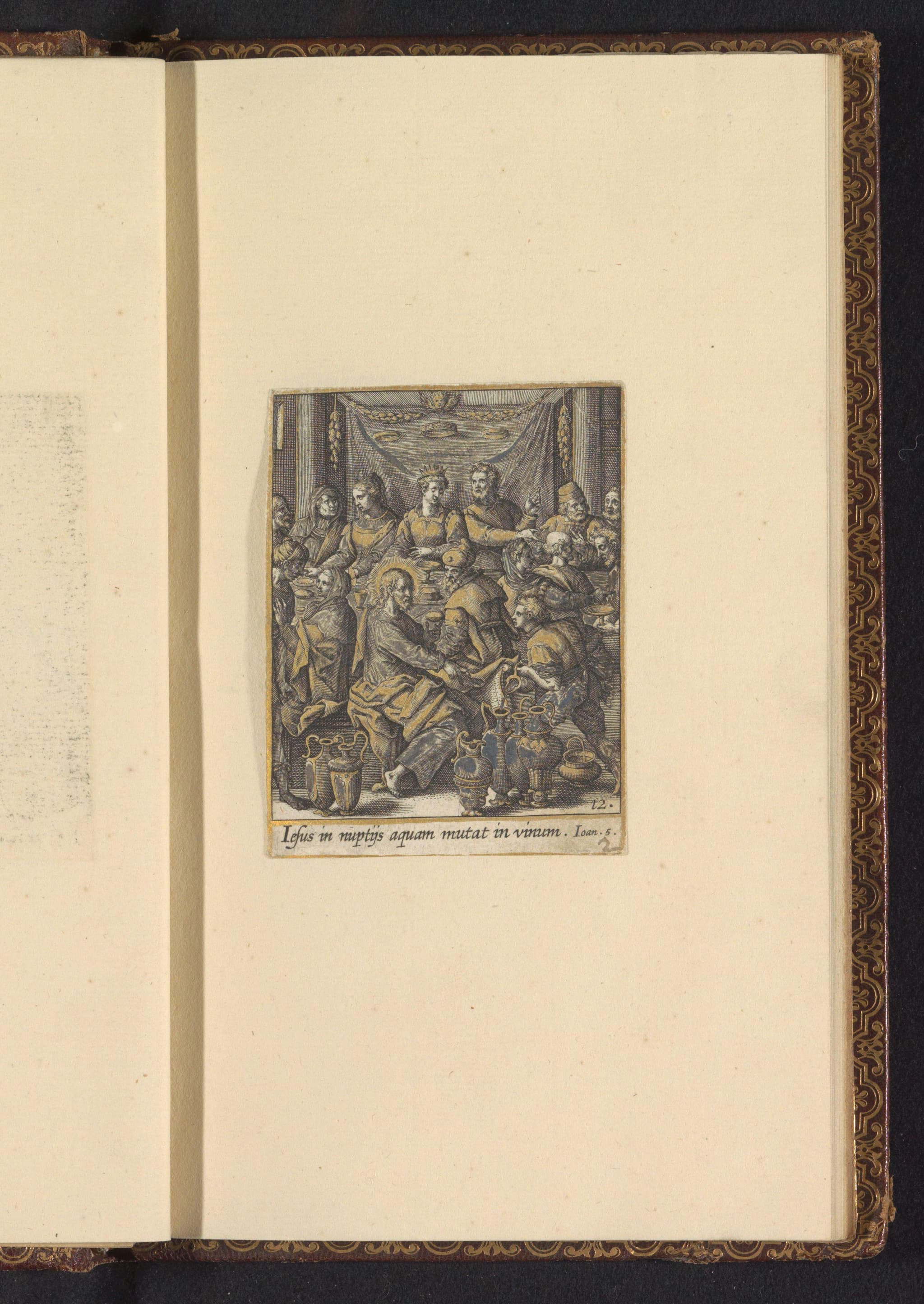
Bruiloft te Kana (The Marriage at Cana), engraved by Adriaen Collaert around 1580 in his Antwerp workshop, illustrates the first public miracle of Christ as recorded in John 2: the conversion of water into wine at the wedding feast in Cana of Galilee. Collaert composes the scene as a long horizontal banquet — the bride and groom seated under a baldachin at the right, Christ and the Virgin and the disciples ranged along the left, the master of the feast tasting from one of the six enormous stone jars in the center, an attendant pouring fresh water into another jar at the moment of the miracle. The print belongs to the great Collaert Life of Christ engraved cycles that supplied the Counter-Reformation Antwerp devotional market for several generations.
adriaen-collaert-opstanding
Opstanding (The Resurrection), engraved by Adriaen Collaert around 1580 in his Antwerp workshop, depicts the moment of the Resurrection: Christ rises from the open tomb in the predawn light, his right arm raised in benediction, his banner of Resurrection in his left hand, while the Roman soldiers below are scattered across the foreground in poses of unconscious sleep or panicked awakening. The engraved line is patiently crosshatched in the characteristic post-Tridentine Antwerp manner; the composition belongs to the long sequence of Life of Christ Easter-cycle engravings that Collaert and his Antwerp workshop produced throughout the late sixteenth and early seventeenth centuries for distribution across the Catholic publishing world.
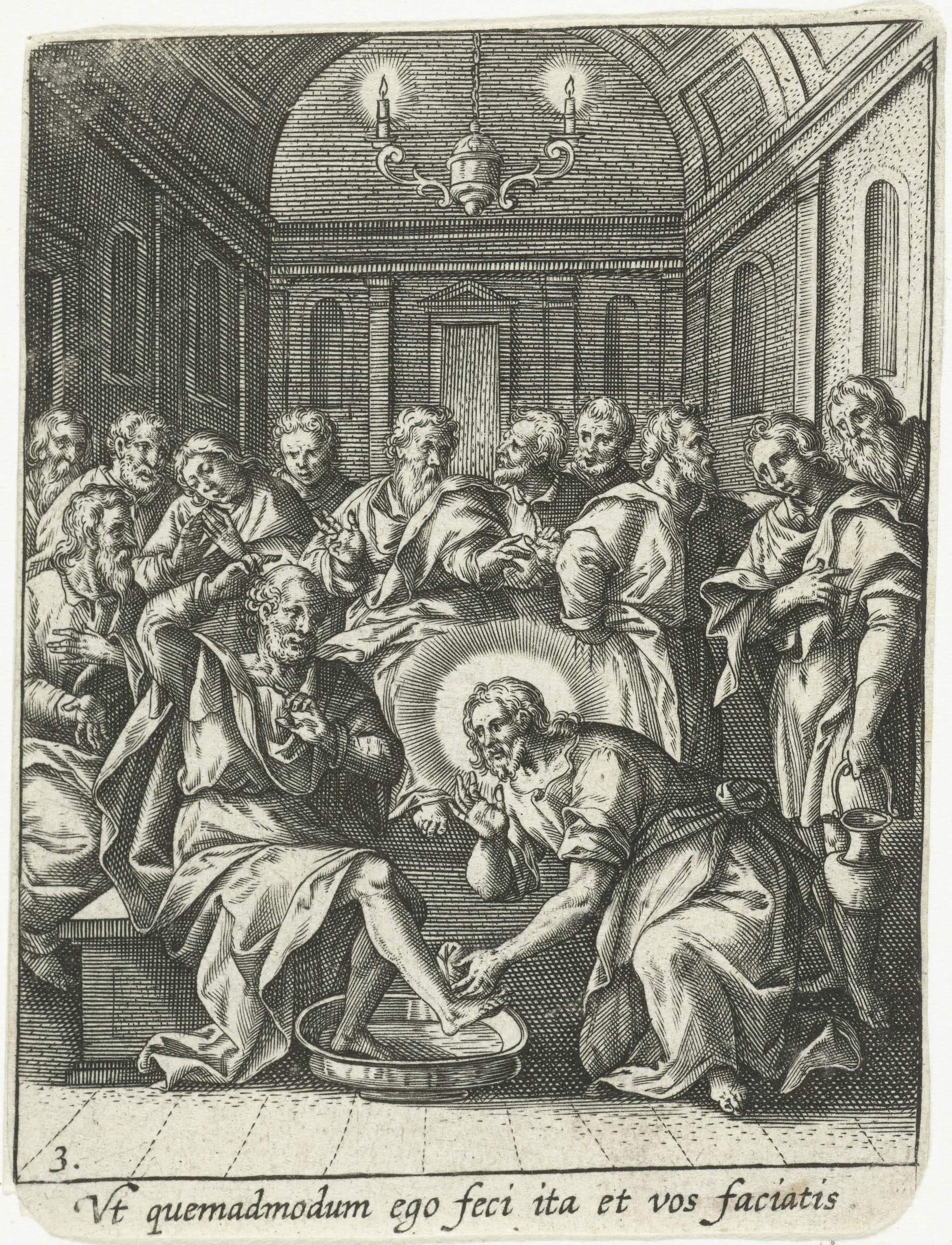
Voetwassing (The Washing of Feet), engraved by Adriaen Collaert around 1570 in his early Antwerp workshop years, illustrates the moment from John 13 at the Last Supper at which Christ washes the feet of the disciples — the symbolic act of humility that institutes the practice of foot-washing in subsequent Christian liturgy. Collaert stages the scene with Antwerp post-Tridentine devotional restraint: Christ kneels in profile before Peter at the center of the composition, washing the apostle's foot in a small basin while Peter gestures in protest; the other apostles are ranged around them in a loose semicircle, untying their sandals or watching in attentive silence. The print belongs to the long sequence of Life of Christ engravings Collaert produced for the Antwerp Counter-Reformation devotional market.