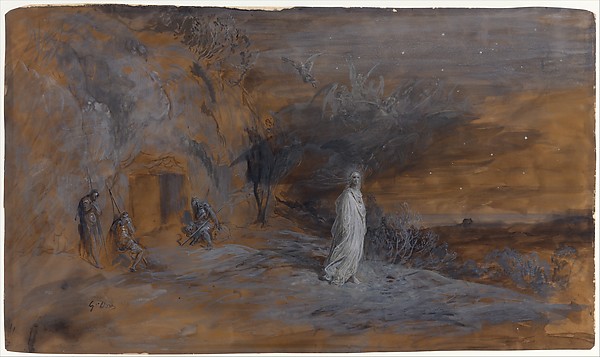
Painter of the Bible
Gustave Doré
Gustave Doré was a French illustrator who, in a career of barely thirty years, produced more than ten thousand published images.

Their faith
Why Gustave Doré painted Christ
Gustave Doré was a deeply devoted artist whose faith was intricately woven into the fabric of his work. Though specific details about his personal beliefs are scarce, his monumental illustrated Bible published in 1866 reveals a profound reverence for Scripture. Doré's illustrations were not merely artistic endeavors; they were acts of devotion that sought to bring the stories of the Bible to life for countless families. His commitment to portraying biblical narratives with dramatic scale and emotional depth reflects a heart attuned to the sacred, as he aimed to inspire faith and reverence in those who encountered his art. The widespread presence of his engravings in Protestant households across the English-speaking world speaks to the impact of his faith on his artistic vision, as he sought to make the Word of God accessible and engaging for all.
Doré's faith found expression in his most notable works, particularly in his stunning illustrations of key biblical events. His depictions of scenes such as the Crossing of the Red Sea and the Crucifixion showcase not only his technical skill but also his ability to evoke awe and reverence. The grandeur of these moments, captured through his Romantic sensibility, invites viewers to reflect on the divine drama unfolding within the pages of Scripture. Doré's work transcends mere illustration; it serves as a visual sermon that continues to resonate with audiences today. Through his art, he invites us to experience the beauty and power of the biblical narrative, reminding us that the stories of faith are timeless and transformative, reaching into our hearts and inspiring our own spiritual journeys.
Life & work
Gustave Doré was a French illustrator who, in a career of barely thirty years, produced more than ten thousand published images. He is the visual conscience of the nineteenth-century Bible. His 1866 illustrated Bible, published in Tours, contained 241 wood engravings covering Genesis through Revelation, and within a generation those engravings had appeared in nearly every Protestant English-speaking household with a Bible in it.
He drew on whitened wood blocks and handed them to a workshop of skilled engravers who cut his lines for the press; the result was a body of work simultaneously theatrical and mass-producible. His sensibility was Romantic: scale, shadow, sublime weather, vast crowds. The Deluge, the Tower of Babel, the Crossing of the Red Sea, the Walls of Jericho, the Brazen Serpent, Jonah and the great fish, the Annunciation, the Massacre of the Innocents, the Crucifixion, and the Last Judgment — these are the images that hung as engravings in late-Victorian parlors and that still come to mind, for many readers, when someone names the scene aloud.
Outside the Bible, Doré illustrated Dante's Inferno (1861), Don Quixote (1863), Paradise Lost (1866), Coleridge's Rime of the Ancient Mariner, and the fairy tales of Perrault. He also painted in oil and worked in sculpture toward the end of his life — the standing Père Lachaise cemetery monument to Alexandre Dumas is by him. Critics in his own time accused him of melodrama; the accusation was true, but it has worn well. Doré's compositions endure because they take the Bible at its own scale: a flood is the size of a continent, a city falling is the size of a city.
He died in Paris in 1883 and is buried in Père Lachaise.
Notable works in detail
dore-crucifixion
The Crucifixion is one of the 230 wood-engraved illustrations Doré produced for La Sainte Bible (Tours, 1866), the great two-volume French Bible that became the most-reproduced illustrated Bible of the nineteenth century. Doré stages the scene from a low oblique angle, with the cross of Christ rising in dramatic foreshortening across the foreground and the city of Jerusalem fading into a darkening sky beyond. The Virgin and Magdalene kneel at the foot of the cross; the centurion looks up from horseback in the moment of recognition; the two thieves on their crosses recede into a stormy distance. Doré's signature combination of theatrical lighting, panoramic landscape, and dense narrative incident is here at its most concentrated. The plate was reprinted in countless editions of the Doré Bible across France, England, the United States, and the Spanish-speaking world for the next century and remains one of the most widely reproduced single religious images of the entire nineteenth century.

The Tower of Babel, from the 1866 Doré Bible, illustrates Genesis 11: the great post-Flood building project on the plain of Shinar that the LORD halts by confusing the language of the builders. Doré frames the unfinished tower as a vast spiraling step-pyramid receding into low cloud cover at the upper right, with hundreds of small workers scattered across its terraces — hauling blocks, mixing mortar, raising scaffolds, gesturing in dispute. In the lower foreground, a princely figure with attendants surveys the project from a flagstone terrace; below them, herders and beasts of burden cross a quay loaded with cut stone. The composition combines the panoramic Romantic landscape sensibility of the early nineteenth century with the architectural fantasy of the eighteenth-century engraver Giovanni Battista Piranesi, and remains the canonical visualization of the Genesis subject in Western Christian art.
dore-cain-slays-abel
Cain Slays Abel, from the 1866 Doré Bible, illustrates the first murder in human history as told in Genesis 4. Doré places the act in a wild and stony landscape; Cain swings down a heavy club in mid-strike from above the fallen Abel, whose body is sprawled across the foreground rocks beside the smouldering remains of the offering whose acceptance has provoked the killing. A single shaft of light from the upper left isolates the figures against a darkening sky; in the deep distance, a small flock of grazing sheep — the original cause of the brothers' competing offerings — continues to feed in unaware contrast. The composition is one of the most reproduced of Doré's Genesis sequence and shaped the visual vocabulary of every subsequent illustrated children's Bible that depicts the subject.

Jacob Wrestles with the Angel, from the 1866 Doré Bible, illustrates the encounter at the ford of the Jabbok in Genesis 32. Doré places the scene at the riverbank in the predawn light, with the figure of Jacob locked in a powerful upright embrace with a fully winged angel — the two figures isolated against a turbulent night sky — while in the deep distance the patriarch's caravan of family and herds can just be made out crossing the ford. The composition leans into the Romantic dramatic-figure tradition descending from Géricault and Delacroix, with strong contrapposto and intense single-source lighting. The plate is one of the most reproduced of Doré's Genesis illustrations and was the principal visual reference for Eugène Delacroix's earlier Saint-Sulpice mural treatment of the same subject in the eyes of the late nineteenth-century French Catholic public.
dore-death-of-absalom
The Death of Absalom, from the 1866 Doré Bible, illustrates the climactic episode of 2 Samuel 18: the death of King David's rebellious son Absalom, his long hair caught in the branches of a great oak as he tries to flee on muleback. Doré frames the moment of the killing — Absalom suspended helpless in the tree while Joab's three soldiers thrust their spears up into him from below — against a dense forest and a roiling stormy sky. The mule, freed of its rider, gallops away into the lower foreground. The composition combines the vertical drama of the suspended figure with the dense Romantic woodland setting that defined Doré's late landscape-illustration manner. The plate became, by repeated reproduction, the single most-recognized image of the Absalom episode in subsequent Christian art and remains the standard visual reference for the subject.
dore-judgment-of-solomon
The Judgment of Solomon, from the 1866 Doré Bible, illustrates the founding case of Hebrew judicial wisdom recorded in 1 Kings 3 — two women claim the same living infant, and Solomon proposes to settle the dispute by having the child cut in half and divided between them. Doré stages the scene in the king's pillared throne room, with Solomon enthroned at the upper left, the soldier with raised sword in the center foreground holding the infant by one foot, and the true mother crying out in horror from the right side of the composition while the false claimant looks on impassively from the left. The architectural setting — heavy Egypto-Mesopotamian columns, deep shadow, and a single overhead light source — was widely imitated in nineteenth and early twentieth-century theatrical and cinematic depictions of the same subject. The plate remains one of the most reproduced single illustrations from the Doré Bible.
Bible scenes Gustave Doré painted
John
Exodus
Acts
Genesis
2 Samuel
Jonah
Revelation
Isaiah
2 Kings
Job
Esther
Jeremiah
Zechariah
Ezra
Luke
Nehemiah
Judges
Mark
Daniel
1 Kings
1 Samuel
2 Maccabees
Ruth
Lamentations
Joshua
Amos
Matthew
1 Maccabees
Ezekiel
Numbers
Tobit
Baruch
Micah